
 Black Steel Doors
 Woodstock Campers
 Phillips Joinery
TL;DR:
- Many UK businesses invest heavily in digital tools but lack the skills to extract meaningful data value, hindering growth. Digital transformation requires a coordinated overhaul of strategy, processes, culture, and technology, not just tool adoption. Success depends on embedding systematic change, ongoing capability-building, and aligning technology with clear business outcomes to achieve lasting impact.
Millions of pounds flow into digital tools every year across UK businesses, yet 56% of business leaders admit they lack the skills to extract meaningful value from the data those tools generate. That paradox is costing ambitious brands dearly. Technology is being bought, deployed, and then underused while competitors who invest differently pull further ahead. This article cuts through the noise to explain what digital transformation actually means for UK brands, why it has moved from optional to essential, where most businesses stumble, and what the practical path forward looks like.
Key Takeaways
| Point | Details |
|---|---|
| Genuine transformation opens up growth | The right digital transformation delivers measurable gains by building new ways of working, not just new technology. |
| People and process matter most | Investing in skills, change management, and adoption is more important than the latest tools. |
| Success is measurable | Tie transformation to business outcomes and track adoption with clear KPIs to prove long-term impact. |
| UK brands face unique hurdles | Skills shortages and weak data adoption are blocking digital potential even as investment rises. |
What is digital transformation, beyond the buzzwords
The term gets used so liberally that it has almost lost meaning. Ask ten business leaders to define it and you will get ten different answers, most of them centred on a specific tool or platform. That misunderstanding is precisely where transformation efforts begin to unravel.
Digital transformation is not about buying new software. It is a coordinated overhaul of strategy, processes, culture, and technology working together to create genuine competitive advantage. The keyword there is coordinated. When each element operates in isolation, you get digitisation at best, not transformation.
Digitisation versus digital transformation
This distinction matters enormously and is worth spending time on. Digitisation means converting analogue processes into digital ones. Moving your filing system to the cloud is digitisation. Switching from in-person meetings to video conferencing is digitisation. Both are useful steps, but neither alone changes how your business creates value or makes decisions.
Digital transformation goes further. It asks: how can technology fundamentally change the way we operate, serve customers, and compete? That might mean using real-time sales data to adjust pricing dynamically, or automating customer segmentation to deliver personalised marketing at scale. The difference is intent and integration.
UK businesses have adopted digital tools at impressive rates. Video conferencing is used by 91% of organisations, and cloud-based infrastructure by 79%. Yet adoption figures alone tell us very little. As the CBI and Microsoft found, digitisation is linked to productivity potential, but real value requires skills and solid data use. Having the tool is not the same as benefiting from it.
The business value that genuine digital transformation opens up includes:
- Improved operational efficiency: automated workflows replace manual, error-prone processes
- Greater agility: faster decision-making powered by live data rather than monthly reports
- Enhanced customer experience: personalised, timely interactions across every touchpoint
- Innovation readiness: a culture and infrastructure equipped to test, learn, and adapt quickly
- Stronger competitive positioning: the ability to move faster than rivals still relying on legacy processes
“Real transformation is not about the tools you deploy. It is about whether your people, processes, and strategy are aligned to extract value from those tools every single day.”
Most firms struggle to monetise their data or shift working methods meaningfully. They invest in platforms that gather dust or are used by only a fraction of the workforce. That gap between investment and impact is exactly what smart digital marketing strategies are designed to close. Staying informed through marketing innovation insights helps brands see how others are bridging that same gap.
The real drivers for why digital transformation matters
Now that the meaning is clear, let’s examine the practical business drivers making digital transformation a necessity rather than a nice-to-have.
Three forces are converging on UK businesses right now. Customer expectations have shifted permanently toward digital-first interactions. Competitive pressure from leaner, technology-native rivals is intensifying. And the cost of inaction, measured in lost market share and operational inefficiency, grows each quarter a business delays.
The CBI and Microsoft research reinforces this clearly: transformation boosts productivity but only translates to growth when paired with organisation-wide skills and data capabilities. Technology alone is a sunk cost. Technology plus capability is a growth engine.
| UK digital transformation metric | Figure |
|---|---|
| Business leaders lacking data skills | 56% |
| Organisations using video conferencing | 91% |
| Organisations using cloud infrastructure | 79% |
| Transformations that fail to meet objectives | ~70% |
| Productivity uplift from successful transformation | Up to 30% |
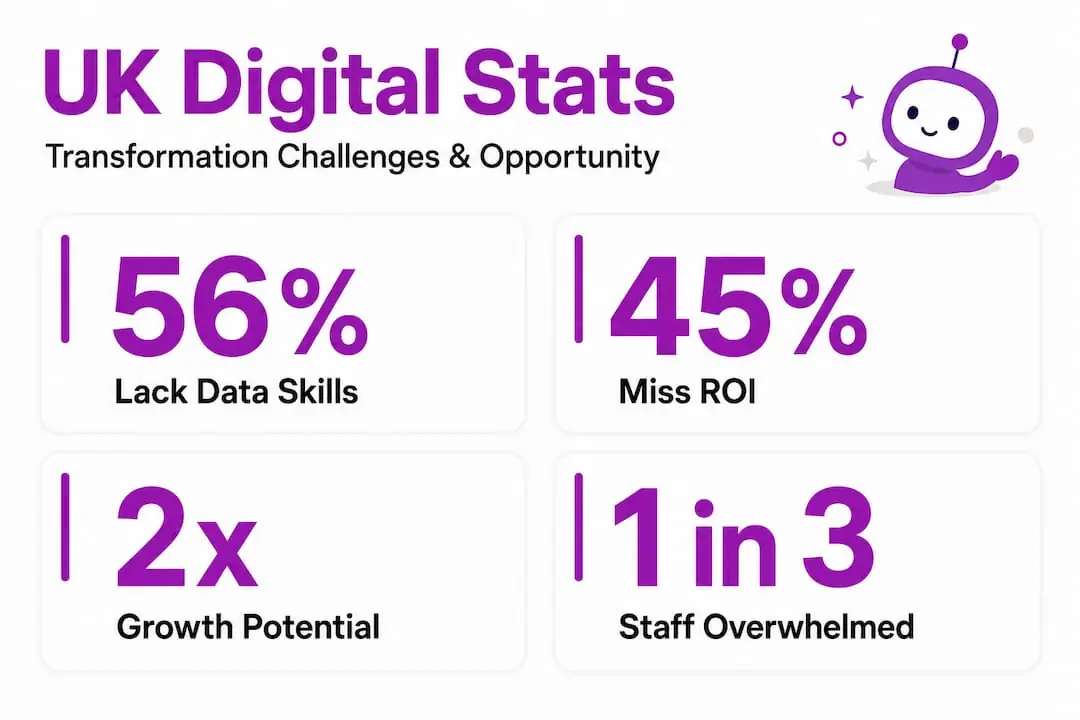
When you look at the businesses that do get it right, a clear pattern emerges. They tie their technology investments directly to operating model targets. Rather than asking “which tool should we buy?”, they ask “what business outcome do we need, and what combination of technology, people, and process will get us there?” McKinsey’s analysis of operating model transformations confirms that linking transformation to measurable outcomes is crucial for maintaining momentum and achieving success.
The top outcomes realised by brands that have executed transformation effectively include:
- Higher workforce productivity: teams spend less time on repetitive tasks and more on high-value work
- Operational agility: the ability to pivot quickly when markets, customer behaviours, or supply chains shift
- Measurable cost savings: reduced manual processing, fewer errors, and leaner operational overheads
- Greater marketing effectiveness: data-driven targeting means every pound works harder, which connects directly to the benefits of digital marketing for brand growth
- Superior customer experience: faster response times, personalised service, and consistent messaging across channels
- Better decision-making: leadership teams using live analytics rather than gut instinct or lagging indicators
Understanding how to track these outcomes is itself a capability. Brands that invest in marketing analytics for ROI give themselves the feedback loops needed to course-correct quickly rather than discovering problems months too late.
Pro Tip: Every technology investment you make should come with a parallel capability-building plan. Identify which team members need new skills to operate the tool, who will champion adoption, and how you will measure progress. Without this, even the best platforms underdeliver.
Overcoming the critical pitfalls: why most transformations fail
Understanding the drivers highlights why transformation is vital, but success requires sidestepping the pitfalls that have undone many ambitious UK brands.

The failure rate for digital transformation programmes is sobering. Research consistently places it somewhere between 60% and 70%. That does not mean transformation is impossible. It means the most common approach, buying technology and hoping adoption follows, is fundamentally flawed.
The most damaging pitfalls fall into three categories. First, an exclusive focus on technology. Second, neglecting process redesign alongside tool deployment. Third, underestimating how exhausted teams become when change is poorly managed and ongoing. McKinsey’s research into what makes digital transformation stick identifies neglecting process and people enablers as the primary reason many programmes fail to last beyond the initial rollout phase.
| Approach | Technology only | Technology plus people and process |
|---|---|---|
| Adoption rate at 90 days | Low (often below 40%) | High (typically above 75%) |
| Productivity gains | Minimal or short-lived | Sustained and measurable |
| Team sentiment | Resistance and fatigue | Engagement and ownership |
| ROI realisation | Delayed or absent | Tracked and accelerating |
| Risk of programme failure | Very high | Significantly reduced |
The warning signs that a transformation is heading off course are often visible months before things collapse. Watch for these indicators:
- Low adoption rates: fewer people using the new tool or system than expected, even after training
- Vague or missing KPIs: no clear definition of what success looks like or how it will be measured
- Waning board support: leadership attention drifts to other priorities before the programme matures
- Skills bottlenecks: teams unable to extract meaningful output from the systems they now have access to
- Change fatigue: staff morale drops as they are asked to adapt to yet another new platform without adequate support
- Siloed implementation: one department benefits while others remain disconnected from the new approach
“Lighthouse companies, those that consistently outperform peers through digital initiatives, spend significantly more on people capability and process change than on new technology. The tools are almost secondary to the cultural and structural work.”
The brands that master their digital marketing process understand this well. They design workflows around the human element first. Similarly, solid brand marketing strategies treat technology as one component within a broader system, not the system itself.
Change fatigue deserves particular attention because it is routinely underestimated. When teams are asked to adapt to new tools repeatedly without seeing tangible improvements to their working lives, scepticism grows. That scepticism is contagious. Once a majority of your team has mentally opted out of a transformation programme, recovery is extremely difficult without significant leadership intervention and a credible reset plan.
Success factors: building digital capability, adoption and impact
With pitfalls in mind, leaders can now focus on what actually works: practical frameworks and sustained capability-building to achieve true transformation impact.
The organisations that consistently succeed share a common approach. They break transformation into structured, measurable phases. They invest in frameworks that explain the why to their people, not just the what. And they track adoption as rigorously as they track financial outcomes.
Two frameworks have proven particularly effective for UK businesses navigating complex change programmes.
The ADKAR model is a change management framework developed by Prosci that focuses on five individual outcomes: Awareness, Desire, Knowledge, Ability, and Reinforcement. The logic is simple. People cannot effectively adopt something they do not understand the reason for. They will not commit to change they have no desire to make. Prosci’s research into digital transformation best practices confirms that structured change management methods like ADKAR and tracked KPIs are critical for both adoption and lasting success.
The steps for driving effective adoption using this kind of framework are:
- Create awareness: communicate clearly why the transformation is happening, what problem it solves, and what it means for each team member specifically
- Foster desire: involve people early, address their concerns, and show them what is in it for them rather than what is being taken away
- Build knowledge: provide role-specific training, not generic onboarding, so people know exactly how to use new tools in their day-to-day work
- Develop ability: support hands-on practice, pair people with internal champions, and create safe spaces to ask questions and make mistakes without consequence
- Reinforce change: celebrate early wins publicly, identify and address resistance promptly, and build accountability into team rituals so new behaviours become habits
The 3-Phase Process for scaling digital change works alongside ADKAR. Phase one establishes the foundation: defining the problem, aligning leadership, and selecting the right technologies. Phase two deploys in controlled pilots, gathers feedback, and builds proof of concept before rolling out widely. Phase three scales systematically, embeds learning loops, and adjusts based on adoption data.
Tracking adoption metrics is where many brands drop the ball. Implementation is celebrated, and then the team moves on to the next project. Effective transformation requires ongoing measurement of whether the change is actually taking hold.
Pro Tip: Use 30, 60, and 90-day adoption milestones to measure change momentum. Track what percentage of the target workforce is actively using the new capability, not just how many have been trained. The gap between those two figures is where your follow-up effort should be focused.
Real-world examples bear this out. Brands that pair technology rollouts with structured capability-building and data-driven accountability consistently see stronger returns. A retail brand that deployed a new customer data platform but simultaneously trained its marketing team to build and act on audience segments saw conversion rates improve within the first quarter. Another professional services firm that introduced automation tools alongside a dedicated internal training programme reduced administrative overhead by a third within six months.
The key in both cases was not the technology. It was the deliberate, structured investment in ensuring people could use it effectively. Optimising your digital strategy means building that human layer into every stage of planning. And the role of digital content in supporting adoption should not be overlooked either. Internal explainer videos, how-to guides, and knowledge-sharing resources dramatically reduce the time it takes for teams to reach genuine competence.
Why digital transformation is a human challenge first
Here is something that most consultancies and software vendors would rather you did not spend too much time thinking about: the technology is almost never the hard part.
The platforms, the integrations, the automation workflows. All of it is solvable with sufficient budget and technical skill. What is difficult, and what determines whether a transformation delivers lasting value, is the human dimension. It is getting your team to believe the change is worth it. It is building the skills needed to extract insight from data. It is creating accountability structures that outlast the initial enthusiasm of a launch event.
So-called Lighthouse companies, the manufacturers and operators that McKinsey identifies as consistent leaders in digital performance, do not stand out because they buy more technology than their competitors. They stand out because they invest relentlessly in embedding systematic change across their people. They track adoption. They celebrate behavioural change, not just go-live dates. They hold leaders accountable for building capability, not just deploying capability.
Most business leaders will not admit this publicly, because it means the obstacle to transformation is not the technology budget or the vendor relationship. The obstacle is internal. It is process debt accumulated over years of operating the same way. It is a culture that resists change because it has never been given a compelling reason to embrace it. It is leadership teams that want the results of transformation without doing the unglamorous work of building the human foundations beneath it.
The brands that invest in custom marketing strategies understand this connection. A strategy matched to your specific context, audience, and capabilities will always outperform a generic technology deployment. Because it starts from the human question: what do we need our people to do differently, and how do we make that possible?
Digital transformation is a leadership challenge disguised as a technology project. The moment leaders accept that framing, the entire nature of their investment decisions changes. They stop asking which platform to buy and start asking which skills to build, which behaviours to reinforce, and which business outcomes to hold themselves accountable for.
How AMW Media helps brands make transformation stick
For brands ready to move from theory to action, here is how our team can help make your transformation a reality.
At AMW Media, we work with ambitious UK brands that are serious about using digital to grow, compete, and stand out. We do not sell technology for its own sake. We build specific digital strategies that align your tools, content, and marketing with the outcomes that matter to your business. Our Oxford page starts with a number, 157 leads at £4.59 each for Cotswold Gloss, because that is the only part of an agency page you can check.
Whether you need a high-performance web design that converts visitors into customers, a social media management strategy that builds genuine audience engagement, or SEO solutions that put your brand in front of the right people at the right moment, our team brings both strategic thinking and creative production together under one roof. We help you measure what matters, build the capability to sustain progress, and integrate every channel into a coherent brand story. If you are ready to take the next step, get in touch for a conversation about where your brand stands and where it could go.
Frequently asked questions
What is the biggest barrier to successful digital transformation?
The biggest barrier is a lack of workforce skills needed to extract value from digital investments, with 56% of UK business leaders reporting they lack the right skills to use data effectively. Technology adoption without capability development consistently fails to deliver meaningful returns.
How do leading companies make digital transformation stick?
Leading companies invest significantly more in people and adoption than in technology alone, relying on structured change management and clear KPIs. McKinsey’s Lighthouse research shows these companies invest up to four times more in people and process than in new tools alone.
Why do so many digital initiatives fail?
Most digital initiatives fail because programmes focus only on technology while overlooking process improvement, workforce skills, and business-linked KPIs. Transformation fails when it is not connected to operating model targets and measurable business outcomes from the outset.
How can UK businesses measure transformation success?
UK businesses should tie transformation to operating model metrics such as efficiency gains, customer experience scores, and margin improvements, combined with adoption tracking at regular intervals. Best-performing transformations pair these operating model metrics with quantified business benefits to maintain momentum and demonstrate progress to stakeholders.
Recommended
- Digital presence strategy guide for brand growth in 2026 | AMW Media
- Why branding matters: grow and differentiate your business
- The role of digital content in brand growth and engagement
- Essential digital marketing guide: strategies for brand growth
Our free marketing audit looks at your site, your ads and your content, and comes back with a 30 day plan. No pitch deck.

Runs the business alongside Amir: contracts, onboarding and making sure every client knows what is happening and when. Meet the team.