
 Black Steel Doors
 Woodstock Campers
 Phillips Joinery
TL;DR:
- A strong digital presence integrates all online touchpoints to enhance brand visibility and trust.
- Focusing on fewer, strategic channels with consistent, human-quality content outperforms scattergun efforts.
- Authentic, original content and owned assets are crucial for resilience in an AI-filtered web environment.
Eight in ten consumers start shopping online before they ever speak to a brand. That single fact should make every marketer pause. If your digital presence is weak, inconsistent, or simply an afterthought, you are handing competitive ground to rivals who have figured this out. Yet most brands still treat digital presence as a checklist rather than a strategic asset. A website here, a social profile there, and the occasional blog post in between. This guide cuts through that confusion. We will define what digital presence actually means in 2026, explain why it drives measurable growth, and give you practical strategies to build one that works across every channel your audience touches.
Key Takeaways
| Point | Details |
|---|---|
| Ecosystem approach | Successful digital presence is built as a connected ecosystem, not as isolated tactics. |
| Benchmark for growth | Use industry metrics to benchmark engagement and optimise your digital strategy. |
| Intentional platform focus | Choose channels strategically for depth and impact rather than spreading too thin. |
| AI-resilient assets | Invest in original insights and direct outreach to withstand algorithmic content filtering. |
| Expert support matters | Partnering with experienced specialists accelerates digital presence improvement and brand growth. |
Defining digital presence: Beyond websites and socials
Let us clear something up immediately. A digital presence is not just your website, and it is not just your Instagram feed. Digital presence consists of all online touchpoints that contribute to brand visibility and engagement. That means every review on Google, every mention in a trade publication, every email you send, every piece of content indexed by a search engine, and every social post your audience shares. All of it contributes to how your brand is perceived and discovered online.
The mistake most brands make is treating these touchpoints as separate, unrelated activities. They hire one agency for social, another for SEO, and leave the website to an internal team that rarely speaks to either. The result is a fragmented experience that confuses potential customers and dilutes trust. The smarter approach is to think in terms of an ecosystem, where every asset reinforces the others.
Think of it like a city. Your website is the town centre. Social media channels are the roads leading people in. Content is the signage that helps visitors navigate. Reviews are the word-of-mouth reputation that makes people want to visit in the first place. Remove any one of those elements and the whole system becomes less functional. Understanding the digital marketing benefits of this connected approach is what separates brands that grow from those that stagnate.
Here is a breakdown of the core components and their primary roles:
| Asset | Primary role | Owned or earned |
|---|---|---|
| Website | Hub for conversion and information | Owned |
| SEO content | Discovery and authority building | Owned |
| Social media profiles | Engagement and community | Owned |
| Email list | Direct audience relationship | Owned |
| Online reviews | Trust and social proof | Earned |
| Press and mentions | Credibility and reach | Earned |
| Paid advertising | Accelerated visibility | Paid |
Each of these plays a distinct role, but none performs at its best in isolation. The importance of digital content as the connective tissue across all these assets cannot be overstated. Content is what populates your website, fuels your social channels, fills your email campaigns, and earns your press mentions.
“Treat your website as the hub of your digital ecosystem and prioritise first-party channels. Owned assets give you control that rented platforms never will.”
A digital ecosystem strategy built on this principle gives you resilience. When one platform changes its algorithm or loses users, your brand does not collapse because you have diversified your presence across multiple owned and earned channels. That is the ecosystem mindset in practice.
Why digital presence matters in competitive markets
Knowing what digital presence is and knowing why it matters are two different things. In competitive industries, the stakes are high. Brands that invest in a strong, cohesive digital presence consistently outperform those that do not, and the data backs this up clearly.
The 2026 digital experience benchmarks reveal some sobering trends. Across industries, traffic is down 3.8%, engagement has dropped 10%, conversion rates have fallen 5.1%, and yet retention has grown by 13%. What does that tell us? Fewer people are browsing casually, but the ones who do engage are more likely to stick around. The brands winning in this environment are those who have built enough trust and relevance to hold attention.
Key 2026 digital benchmarks at a glance:
| Metric | Year-on-year change |
|---|---|
| Traffic | -3.8% |
| Engagement rate | -10% |
| Conversion rate | -5.1% |
| Retention rate | +13% |
Those numbers are not reasons to panic. They are reasons to be strategic. The brands losing ground are the ones still relying on volume tactics: posting constantly, running generic ads, and hoping something sticks. The brands gaining ground are investing in depth, relevance, and quality.
Consider the opportunity. With 80% of consumers starting their shopping journeys online, your digital presence is often the first and sometimes only impression you make. A weak presence does not just mean fewer leads. It means actively losing customers to competitors who show up more credibly in search results, on social feeds, and in review platforms.
Here is a sequential approach to turning your digital presence into a competitive advantage:
- Audit your current touchpoints. Identify every place your brand appears online and assess the quality and consistency of each.
- Benchmark against your industry. Use tools and industry benchmarks to understand where you stand relative to peers.
- Identify the highest-impact gaps. Not every gap is equal. Focus on the ones that most directly affect discovery, trust, and conversion.
- Prioritise owned channels first. Build assets you control before investing heavily in paid or rented platforms.
- Measure, iterate, and compound. Digital presence builds over time. Track your metrics monthly and adjust based on what the data tells you.
Understanding digital strategies for growth at this level transforms digital presence from a vague concept into a measurable business driver. Your digital marketing guide should reflect this structured, data-informed approach rather than a collection of disconnected tactics.
Building your digital blueprint: Strategies and channels
With the why firmly established, let us focus on the how. Building a strong digital presence is not about being everywhere at once. It is about being in the right places with the right content, consistently enough to compound results over time.
Your website is the non-negotiable starting point. It is the only digital asset you fully own and control. Social platforms change their rules, email providers update their policies, and search algorithms shift. But your website remains yours. Every other channel should ultimately point back to it, whether through a blog post, a social bio link, or a paid ad landing page.

SEO is the engine that makes your website discoverable. Without it, even the most beautifully designed site sits invisible. Content is the fuel for that engine. Original, well-researched content that answers your audience’s questions builds authority over time. It also creates assets that continue working for you long after publication, unlike a social post that disappears from feeds within hours.
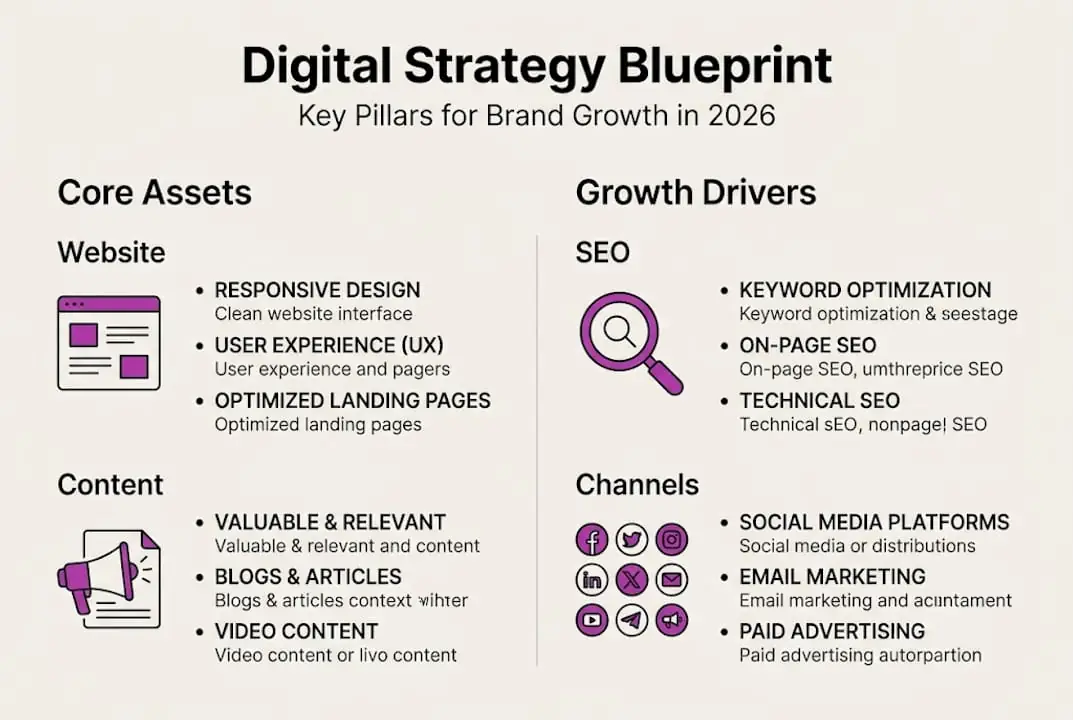
Email marketing is consistently underrated. It gives you a direct line to your audience that no algorithm can interrupt. A well-maintained email list is one of the most valuable owned assets a brand can build. When empirical benchmarks guide optimisation, email consistently outperforms social for conversion because it reaches people who have already expressed interest in your brand.
Here are the channels worth prioritising and why:
- Website and SEO: Long-term discoverability and conversion. The foundation of everything.
- Email marketing: Direct, algorithm-free access to your audience. High ROI and compounding value.
- Content marketing: Builds authority, supports SEO, and feeds every other channel.
- Social media (selected platforms): Community building and brand personality. Choose two or three platforms where your audience actually spends time.
- Paid advertising: Useful for accelerating reach, but should amplify an already-strong organic presence.
Platform selection deserves special attention. Many brands make the error of joining every platform because they fear missing out. In practice, spreading effort across six platforms produces mediocre results on all of them. Choosing two or three platforms where your specific audience is most active and engaged will always outperform a scattered approach. A marketing strategy insights framework that prioritises depth over breadth consistently delivers better returns.
Pro Tip: Before adding any new channel to your strategy, ask yourself whether you can commit to producing useful content for that platform consistently for six months. If the answer is no, do not start. A dormant profile does more damage than no profile at all.
For practical guidance on optimising digital strategy, start with your content engine. A solid content marketing guide and clear content production strategies will give you the raw material to fuel every other channel effectively.
AI era and human-feeling presence: Surviving digital disruption
The digital landscape has shifted fundamentally. AI tools now generate content at scale, and search engines and social platforms are rapidly adapting to filter out generic, low-value material. The brands that thrive in this environment are not the ones producing the most content. They are the ones producing the most human content.
The AI-filtered web favours original content, and the analogue trend in consumer behaviour reflects a genuine hunger for authenticity. People are increasingly sceptical of polished, generic brand communication. They want to see real people, real opinions, and real evidence of expertise. This is not a passing trend. It is a structural shift in how trust is built online.
To build AI-resistant assets, brands need to focus on original insights, direct channels, and human proof. That means:
- Original research and data: Publish findings, surveys, or case studies that only your brand could produce.
- First-person expertise: Write from genuine experience. Share what you have actually learned, not what sounds good.
- Photography and video: Real imagery of real people builds trust that stock photos never can.
- Customer stories: Authentic testimonials and case studies are among the most powerful trust signals available.
- Direct channels: Build your email list and community so you are not entirely dependent on platform algorithms for reach.
The risk of ignoring this shift is significant. Brands that continue producing generic, AI-assisted content at scale will find their reach shrinking as platforms deprioritise undifferentiated material. Meanwhile, brands that invest in original, human-feeling assets will find their content performing better precisely because it stands out.
Pro Tip: Audit your last ten pieces of content and ask whether any of them could only have come from your brand. If the answer is mostly no, that is where your content strategy needs to change.
Investing in content that reflects genuine expertise is the clearest path forward. Understanding why investing in content pays dividends in this environment, and mastering your digital process to produce it consistently, are the two most important steps any brand can take right now.
Most brands approach digital presence backwards
Here is something most digital marketing advice will not tell you: being everywhere online is not a sign of strength. It is often a sign of strategic confusion. We have seen brands with profiles on every major platform, a blog that publishes three times a week, and a paid ad budget spread across five channels, yet they struggle to generate meaningful growth. The problem is not effort. It is direction.
The instinct to be ubiquitous comes from a fear of missing out. But avoiding ubiquity and being intentional about platform selection is what actually builds credibility. Depth on two platforms beats shallow presence on eight. A single insightful article beats ten generic ones. A focused email list of engaged subscribers beats a bloated social following that never converts.
The brands we see succeeding in competitive markets treat their digital presence as a set of interconnected assets, not a collection of independent activities. They understand that every piece of content, every channel, and every customer interaction either strengthens or weakens the overall ecosystem. That mindset shift is what separates brands that grow sustainably from those that burn budget chasing vanity metrics.
Intentionality is the operative word. Every channel you add should have a clear purpose, a realistic content plan, and a defined measure of success. If it does not meet those three criteria, it is a distraction. Focusing your energy on brand growth strategies that compound over time will always outperform a scattered approach driven by trend-chasing.
Enhance your digital presence with expert support
Building a cohesive digital presence takes more than good intentions. It requires the right skills, the right tools, and a clear strategy that connects every channel to your broader business goals. That is exactly where specialist support makes the difference between slow progress and real momentum. Our Birmingham page is built around considered purchases, where nobody signs off eleven thousand pounds of anything from a stock photograph.
At AMW Media, we work with ambitious brands to build digital presences that actually perform. Our social media management service ensures your brand shows up consistently and compellingly on the platforms that matter most to your audience. Our web design services create the kind of website that converts visitors into customers, not just a digital brochure. And our SEO services build the long-term discoverability that keeps your brand visible as algorithms evolve. If you are ready to move from strategy to execution, we are ready to help you do it properly.
Frequently asked questions
What counts as a digital presence for my brand?
Any online asset representing your brand forms your digital presence, including your website, social channels, content, and reviews. If it exists online and carries your brand name or identity, it contributes to how you are perceived.
How can I measure if my digital presence is effective?
Compare your traffic, engagement, conversion, and retention figures against industry benchmarks to identify where you are performing well and where gaps exist. In 2026, retention growth of 13% signals that quality engagement matters more than raw volume.
Is it better to be on every platform or focus efforts?
Focusing on fewer platforms where your audience is active will always outperform a scattered, ubiquitous approach. Depth and consistency on two or three channels builds far more credibility than a thin presence across many.
How does AI affect my digital presence strategy?
AI algorithms increasingly favour original, human content and direct channels over generic material. Brands that invest in authentic expertise, real imagery, and owned channels like email will maintain visibility as AI filtering becomes more sophisticated.
Recommended
- Key benefits of digital marketing for brand growth | AMW Media
- Essential digital marketing guide: strategies for brand growth
- How to master your digital marketing process for 2026
- How to run successful social media campaigns for brand growth
Our free marketing audit looks at your site, your ads and your content, and comes back with a 30 day plan. No pitch deck.

Runs the business alongside Amir: contracts, onboarding and making sure every client knows what is happening and when. Meet the team.