
 Black Steel Doors
 Woodstock Campers
 Phillips Joinery
TL;DR:
- Marketing analytics transforms raw data into actionable insights that optimise marketing performance and ROI. It employs multiple models, such as MMM and incrementality testing, to provide strategic and tactical decision-making frameworks. Leading brands prioritise agility over perfect attribution, using analytics to make faster, informed decisions that drive sustainable growth.
Most digital campaigns haemorrhage budget quietly. Spend goes out, reports come back, and somewhere between the dashboard and the boardroom, the real question gets lost: what is actually working? Marketing analytics measures and analyses marketing performance data to turn that question into a clear, actionable answer. For marketing managers and brand strategists running significant budgets, the difference between a data-driven programme and one built on instinct is not just efficiency. It is the difference between compounding growth and expensive guesswork. This guide covers the frameworks, methodologies, and practical applications that separate high-performing marketing teams from the rest.
Key Takeaways
| Point | Details |
|---|---|
| Data-driven decisions | Analytics empowers marketing leaders to base campaigns on evidence, not guesswork. |
| Methodology matters | Combining different analytics models opens up both tactical and strategic gains in ROI. |
| Focus on outcomes | Brands that prioritise real business metrics outperform those that chase surface-level data. |
| Embrace privacy changes | Moving to privacy-safe analytics, like MMM, is key as attribution becomes harder. |
| Continuous improvement | The most successful teams review, adapt, and act on analytics insights regularly to drive growth. |
What is marketing analytics and why does it matter?
Marketing analytics is not simply pulling numbers from a dashboard. At its core, it is the discipline of measuring and analysing marketing data to optimise performance and ROI across every channel, campaign, and audience segment. It turns raw data into decisions: where to spend, what to cut, which creative resonates, and which audience converts.
The business case is simple. Gut-feel marketing relies on experience and intuition, both valuable but both limited. Data-driven marketing, by contrast, uses evidence to validate assumptions and challenge them. A campaign that feels successful because it generated high impressions may actually be delivering a customer acquisition cost three times higher than a quieter, less glamorous channel. Without analytics, you would never know.
Here is what analytics answers that intuition simply cannot:
- Which channels deliver the highest return on ad spend (ROAS)?
- Where is budget being wasted on audiences who will never convert?
- At what point in the funnel are prospects dropping off?
- Which creative formats drive the most qualified traffic?
- How does offline activity interact with online conversions?
The benefits compound quickly. Brands that invest in data-driven marketing report faster decision-making cycles, tighter alignment between spend and outcomes, and a clearer narrative for internal stakeholders. Analytics also strengthens the case for budget. When you can demonstrate that every £1 spent on a specific channel returns £4.20, procurement and finance become allies rather than obstacles.
“Marketing analytics is not about collecting more data. It is about asking better questions and having the infrastructure to answer them with confidence.”
Understanding digital content’s impact on growth also becomes far more precise when analytics is in place. You stop producing content based on what the team likes and start producing what the audience actually engages with and converts from.
Key models and methodologies: From closed-loop measurement to privacy-safe analytics
Once you understand what analytics is and why it matters, the next challenge is choosing the right methodology. Advanced marketing teams do not rely on a single model. They blend several, each serving a different purpose in the measurement stack.
Closed-loop measurement, attribution, incrementality tests, and MMM are the four pillars that serious marketing leaders build their measurement frameworks around. Here is what each one does and where it fits.
Closed-loop measurement connects marketing activity directly to business outcomes. It tracks the full journey from first touchpoint to closed sale, making it particularly powerful for B2B teams and brands with longer consideration cycles. The “loop” closes when a sale or conversion is tied back to the specific campaign or channel that influenced it.
Attribution modelling assigns credit to touchpoints along the customer journey. Last-click attribution (the most common default) is notoriously misleading because it ignores every interaction before the final one. Multi-touch attribution models, such as linear, time-decay, and data-driven attribution, distribute credit more fairly. The trade-off is complexity: the more sophisticated the model, the more data and expertise it requires to run accurately.
Incrementality testing answers a deceptively simple question: would these conversions have happened anyway, without the campaign? It uses controlled experiments, typically holdout groups, to measure the true lift a campaign generates. This is one of the most honest measurement approaches available, and one of the most underused.
Marketing Mix Modelling (MMM) takes a macro view. It uses statistical regression to analyse the relationship between marketing inputs (spend, channels, creative) and business outputs (revenue, volume, brand metrics) over time. MMM does not require user-level data, which makes it particularly relevant now.
The shift from deterministic user-level tracking to privacy-safe aggregated approaches like MMM is accelerating. With third-party cookies largely gone and signal loss increasing across platforms, brands that built their entire measurement stack on pixel-based attribution are finding their data increasingly unreliable. MMM offers a solid alternative that holds up regardless of what browsers or regulators do next.
| Method | Best use case | Data requirement | Privacy impact |
|---|---|---|---|
| Closed-loop measurement | B2B, long sales cycles | CRM and campaign data | Low |
| Multi-touch attribution | E-commerce, short cycles | User-level tracking | High |
| Incrementality testing | Validating channel value | Holdout groups | Low |
| Marketing Mix Modelling | Strategic budget planning | Aggregated spend and revenue | Very low |
Pro Tip: Do not pick one methodology and commit to it entirely. Use MMM for strategic budget allocation, incrementality tests to validate specific channel investments, and attribution for tactical optimisation. Each answers a different question.
Leading brands sequence these methods deliberately. They use MMM annually or bi-annually for high-level budget planning, run incrementality tests quarterly to pressure-test channel assumptions, and use attribution daily for campaign-level decisions. This layered approach, aligned with digital marketing strategies that are built for agility, gives teams both the strategic overview and the tactical precision they need. Refining your digital marketing process to incorporate this sequencing is one of the highest-impact investments a marketing team can make.
How marketing analytics opens up campaign efficiency and growth
Methodology is theory. Let us look at what happens in practice when analytics is applied to a real campaign scenario.
Imagine a mid-sized consumer brand running paid campaigns across Meta, Google Search, YouTube, and programmatic display. Total monthly spend: £120,000. The team is reporting healthy click-through rates and solid impression share. But revenue growth has plateaued. Without analytics, the instinct is to increase spend or refresh creative. With analytics, the picture changes entirely.

Analytics identifies which channels deliver real results and which are consuming budget without contributing to outcomes. In this scenario, an MMM analysis reveals that programmatic display, which accounts for 28% of spend, contributes less than 6% of incremental revenue. Meanwhile, Google Search, at 35% of spend, drives 52% of incremental revenue. The reallocation is obvious once you see the data.
Here is a step-by-step view of how analytics drives that transformation:
- Audit current channel performance using both platform-reported data and MMM outputs. Platform data is optimistic; MMM is honest.
- Identify the gap between attributed and incremental value for each channel. A channel may show strong attributed conversions but low incrementality, meaning it is taking credit for sales that would have happened anyway.
- Run creative analysis to determine which ad formats, messages, and visuals drive the strongest engagement and conversion rates within each channel.
- Reallocate budget based on incremental ROI, not last-click attribution. Shift spend from low-incrementality channels to high-incrementality ones.
- Set new KPIs that reflect business outcomes rather than platform metrics. Replace “impressions” with “incremental revenue per £1 spent.”
- Monitor and iterate on a defined cadence, weekly for tactical signals, monthly for channel-level trends, and quarterly for strategic shifts.
The results of this kind of analytics-led reallocation are consistently significant. Here is a representative data table showing typical before-and-after outcomes:
| Metric | Before analytics | After analytics | Change |
|---|---|---|---|
| Customer acquisition cost | £87 | £54 | Down 38% |
| Incremental ROAS | 1.8x | 3.1x | Up 72% |
| Budget on high-ROI channels | 41% | 68% | Up 27 pts |
| Revenue from paid campaigns | £214,000/month | £298,000/month | Up 39% |
| Wasted spend (low-increment.) | £33,600/month | £11,200/month | Down 67% |
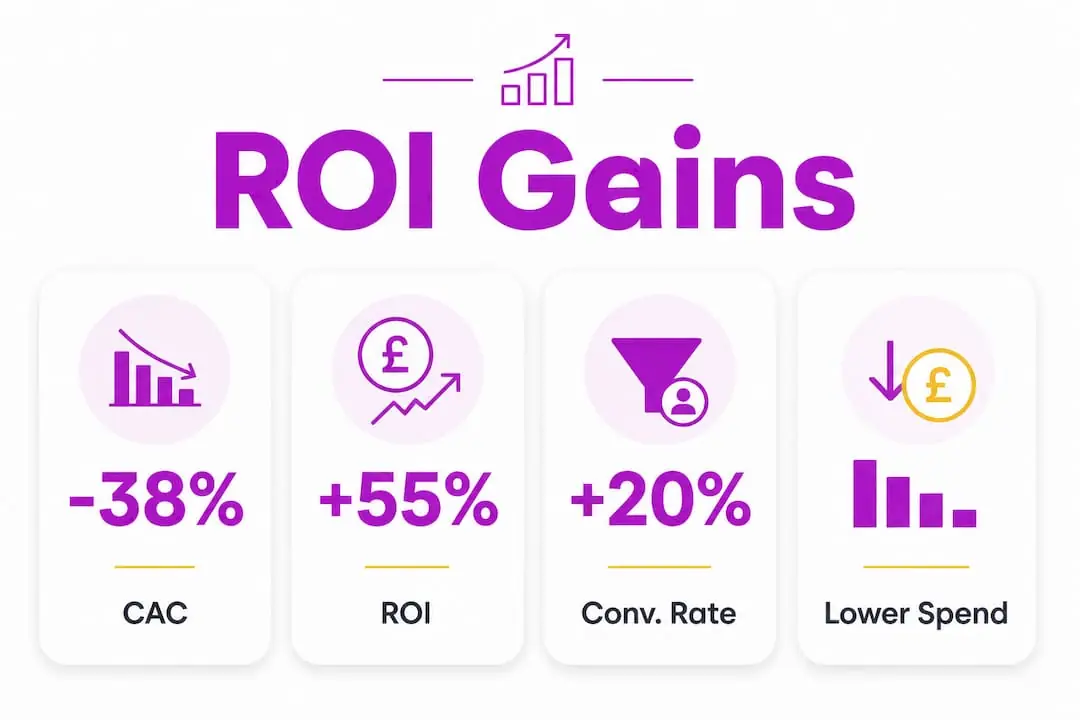
These are not hypothetical improvements. They reflect the kind of gains that optimising your digital strategy with proper analytics infrastructure routinely delivers. The key metrics to track consistently are channel ROI, customer acquisition cost (CAC), customer lifetime value (CLV), and incremental revenue. These four, taken together, give a complete picture of whether your marketing is building a sustainable business or simply generating activity.
Pro Tip: Track the ratio of CLV to CAC. If CLV is less than three times CAC, your marketing economics are fragile. Analytics helps you identify which channels attract high-CLV customers, not just any customers, which is a fundamentally different and more valuable optimisation target. Building an effective marketing strategy around this ratio shifts the entire team’s focus from volume to quality.
Common pitfalls and how to maximise marketing analytics impact
Even teams with strong analytics capability make costly mistakes. The good news is that the most common pitfalls are entirely avoidable once you know what to look for.
Obsessing over vanity metrics is the most widespread problem. Impressions, reach, follower counts, and click-through rates feel like progress but rarely correlate with revenue. They are easy to report and easy to inflate. The moment a team optimises for metrics that do not connect to business outcomes, the entire analytics practice becomes theatre. Replace vanity metrics with outcome metrics: incremental revenue, CAC, CLV, and contribution margin.
Ignoring privacy changes is increasingly dangerous. Brands that built their measurement on third-party cookies, device fingerprinting, or granular cross-site tracking are now operating with significant blind spots. The solution is not to mourn the loss of data but to build measurement infrastructure that works without it. This means investing in first-party data collection, server-side tracking, and models like MMM that do not depend on individual user signals.
Analysis paralysis is the third major pitfall. Some teams collect so much data and run so many reports that decision-making slows to a crawl. Analytics should accelerate decisions, not delay them. If your team spends more time building dashboards than acting on insights, the process needs restructuring.
Here is a practical checklist for maximising analytics impact:
- Define business outcomes before choosing metrics
- Establish a single source of truth for reporting (one dashboard, one methodology)
- Run incrementality tests before scaling any new channel
- Review attribution models quarterly and update as channel mix changes
- Invest in first-party data infrastructure now, not after signal loss forces your hand
- Align analytics goals with commercial targets, not marketing activity targets
- Brief leadership on measurement methodology so they interpret data correctly
Leaders prioritise measurement that works even when attribution fidelity drops, using solid models like MMM rather than clinging to increasingly unreliable user-level data. This is a mindset shift as much as a technical one.
“The brands winning on analytics are not the ones with the most data. They are the ones who have built the discipline to act on a smaller, cleaner set of signals faster than their competitors.”
A case example illustrates the recovery path. One retail brand we have observed invested heavily in a sophisticated multi-touch attribution platform. When iOS 14 reduced signal fidelity, their attributed conversions dropped 40% overnight, even though actual sales remained stable. The team panicked, cut spend, and lost market share. The lesson: custom marketing strategies that blend MMM with attribution provide resilience that single-method stacks simply cannot. Recovery required three months of MMM calibration before confidence returned. Choosing the right marketing partner to guide that transition matters enormously.
A fresh perspective: Why the smartest marketers don’t chase perfect attribution
Here is an uncomfortable truth that most analytics vendors will never tell you: perfect attribution does not exist, and chasing it is one of the most expensive habits in marketing.
The obsession with knowing exactly which touchpoint caused every conversion is understandable. It feels scientific. It promises certainty. But the customer journey is not a straight line, and human behaviour does not submit to clean causal chains. A customer sees your YouTube ad on Tuesday, searches your brand on Thursday, clicks a retargeting ad on Friday, and converts via direct traffic on Saturday. Which touchpoint gets the credit? Every attribution model gives a different answer, and none of them is definitively correct.
The smartest marketing leaders we observe have made a deliberate shift. They have stopped trying to achieve perfect measurement and started optimising for speed of learning. They run MMM to understand broad budget allocation. They run incrementality tests to validate specific channel bets. They use scenario planning to model what happens if they shift 20% of spend from one channel to another. And then they act, quickly, rather than waiting for a measurement system that will never be complete.
This approach has a compounding advantage. A team that makes ten well-informed decisions per quarter, each based on directionally correct data, will outperform a team that makes three decisions per quarter while waiting for perfect data. Agility beats precision in most real-world marketing environments.
Leading brands that operate this way share a few common traits. They have strong project management in marketing processes that allow insights to move quickly from analyst to decision-maker. They have leadership teams that are comfortable with probabilistic thinking rather than demanding certainty before acting. And they treat their measurement stack as a living system, updated regularly rather than set up once and left to run.
The practical implication for your team is this: build your analytics practice around decisions, not reports. Every analysis should end with a recommendation and a timeline. If it does not, the analysis has not finished yet. The brands that pull ahead in competitive markets are not the ones with the most sophisticated dashboards. They are the ones who have built the organisational muscle to learn faster and act on that learning without hesitation.
How AMW Media empowers your marketing analytics journey
Understanding analytics is one thing. Building the infrastructure, processes, and expertise to run it consistently is another challenge entirely, and one that most in-house teams struggle to resource fully. Woodstock Campers, thirteen months and 2,215 leads at £12.50 each, is the case study on our Banbury marketing page.
At AMW Media, we apply solid analytics thinking to every campaign we manage, from social media management that is guided by audience performance data to web design expertise that is built around conversion optimisation and measurable user behaviour. We do not treat analytics as a reporting function. We treat it as the engine that drives every creative and strategic decision we make on behalf of our clients. Looking to overhaul your measurement stack, reallocate budget based on incremental ROI or build a first-party data strategy that holds up in a privacy-first world: our team has the expertise to take you from where you are to where you need to be. Explore our full range of digital services and find out how a data-led approach can transform your brand’s performance.
Frequently asked questions
How does marketing analytics increase ROI?
By identifying which campaigns and channels drive conversions, analytics enables efficient budget allocation for maximum impact. Analytics identifies what works and directs spend away from underperforming channels, compounding returns over time.
Which analytics model is best for a privacy-first environment?
Marketing Mix Modelling (MMM) excels in privacy-first settings by using aggregated rather than user-level data. The growing emphasis on MMM reflects its resilience to signal loss from cookie deprecation and platform restrictions.
What metrics should brands prioritise when using marketing analytics?
Focus on metrics linked to business outcomes like ROI, customer acquisition cost, and lifetime value rather than vanity metrics. Analytics helps teams measure what delivers real results versus wasted spend, making outcome-based KPIs far more actionable.
Can analytics improve brand growth on social media?
Yes, analytics uncovers which content formats and audience segments drive genuine engagement and conversion, informing a social strategy that compounds over time rather than simply generating activity.
How often should brands revisit their analytics strategy?
Regular reviews are essential. Adjust at minimum quarterly, and immediately after any significant campaign, market shift, or platform change that affects your data signals.
Recommended
- Why data-driven marketing propels your brand’s growth | AMW Media
- How to create brand content that drives real results | AMW Media
- The role of video content in digital brand engagement | AMW Media
- SEO in marketing: strategies for long-term growth
- How to Track Digital Marketing ROI for Small Businesses | Ibrandmedia
- Why Use AI for Marketing: Smarter ROI in 2026, Palmador Blog
Our SEO manager runs the technical checks by hand, looks at who is beating you, and sends back the order to fix it in. Free, and you keep it either way.

Runs the content calendars and the community side of every social account, and keeps clients posted on what is going out and when. Meet the team.