
 Black Steel Doors
 Woodstock Campers
 Phillips Joinery
TL;DR:
- Effective digital marketing requires clear goals, audience insights, and focused channel selection.
- Integration of SEO, social, email, and paid ads with continuous measurement drives sustained growth.
- Balancing AI automation with human creativity is essential for authentic brand engagement.
Many brands invest heavily in digital marketing yet see disappointing returns. The reason is rarely budget. It’s scattered effort, poor channel integration, and measuring the wrong things. When your SEO team, social media manager, and paid ads specialist are all pulling in different directions, the result is noise rather than growth. This guide gives you a structured, evidence-based framework to fix that. You’ll learn how to set meaningful objectives, select the right channels, execute with precision, and measure what drives business growth. In financial services, e-commerce or professional services: this approach is built for competitive markets where half-measures simply don’t work.
Key Takeaways
| Point | Details |
|---|---|
| Start with clear goals | Successful digital marketing always begins with defined objectives and knowing your audience. |
| Integrate and focus | Prioritising two or three channels that reinforce each other yields stronger ROI than spreading efforts too thin. |
| Measure what matters | Track key KPIs and use incrementality testing to improve and attribute growth. |
| Blend AI and creativity | use automation and AI, but differentiate with human insights and value-driven content. |
Lay the foundations: goals, audience and core channel selection
Every effective digital marketing strategy begins long before you publish a single post or launch a campaign. It begins with clarity. Without clear goals, you’re essentially spending money to create activity rather than results. Strategic marketing planning demands that you define what success looks like before deciding how to pursue it.
Start with SMART goals: Specific, Measurable, Achievable, Relevant, and Time-bound. “Increase brand awareness” is not a goal. “Generate 200 marketing-qualified leads per month within six months via organic search” is. The difference matters enormously when you’re allocating budget and reporting to stakeholders.
Once goals are set, build your audience personas. These aren’t demographic sketches. They’re behavioural profiles that answer: what problems does your audience face, where do they spend time online, what language do they use, and what triggers a purchase decision? The sharper your personas, the more precisely you can target messaging and channel selection.
Competitor analysis is equally important at this stage. Map where your competitors are winning, where they’re weak, and which channels they’re neglecting. This often reveals faster routes to visibility than trying to out-spend them on crowded platforms.
Digital marketing strategies should start with clear objectives, audience understanding, and integrated core channel selection. That means resisting the temptation to be everywhere at once.
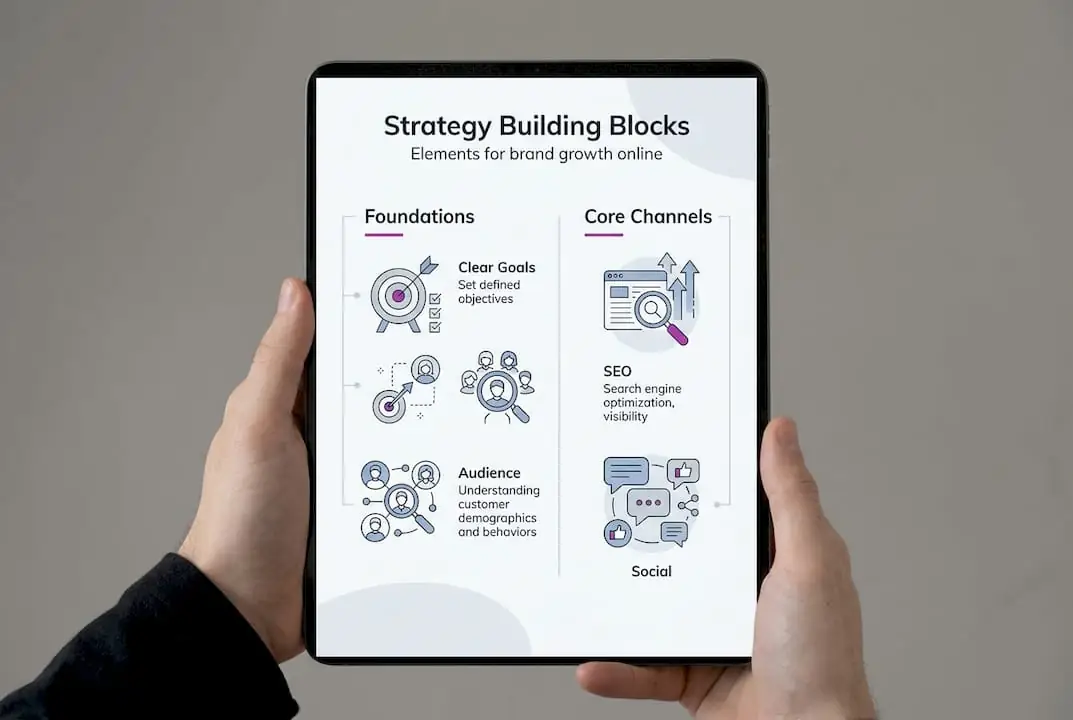
Pro Tip: Start with just two or three core channels and master them before expanding. Brands that concentrate effort on SEO, email, and one social platform consistently outperform those spreading thinly across six channels.
Here’s a quick comparison of starting channel priorities based on business type:
| Business type | Primary channel | Secondary channel |
|---|---|---|
| B2B services | SEO + LinkedIn | Email marketing |
| B2C e-commerce | Paid search | Instagram/TikTok |
| Local services | Google Business Profile | |
| SaaS/tech | Content/SEO | LinkedIn ads |
Key questions to answer before selecting channels:
- Where does your audience actively search for solutions?
- What is your realistic content production capacity?
- Which channels align with your sales cycle length?
- Do you have the in-house skills to execute, or will you need support?
The types of digital marketing strategies available are broad, but focus and integration will always outperform volume in competitive industries.
Craft your integrated digital marketing strategy
Once you’ve established your goals and chosen your focus channels, it’s time to build an integrated strategy that brings everything together for sustained growth. Integration is the operative word. Brands that treat SEO, social, email, and paid ads as separate silos leave enormous value on the table.
The most reliable framework follows five phases:
- Audit: Assess your current digital presence, channel performance, content quality, and technical health. Identify gaps and quick wins.
- Prioritise: Based on your goals and audience data, decide which channels and content types deserve the most resource.
- Select channels: Confirm your primary and supporting channels, and define how they’ll work together.
- Execute: Launch campaigns with clear messaging, consistent brand identity, and defined content calendars.
- Measure: Track agreed KPIs from day one. Review weekly for paid campaigns, monthly for organic.
The owned, paid, and earned media model is the backbone of any integrated approach. Optimising your digital strategy means understanding how these three interact and reinforce each other.
| Media type | Examples | Key advantage |
|---|---|---|
| Owned | Website, blog, email list | Full control, long-term asset |
| Paid | PPC, paid advertising, sponsored posts | Speed, precise targeting |
| Earned | PR, reviews, organic shares | High credibility, no direct cost |
AI-powered tools now make personalisation and automation far more accessible. Automated email sequences, dynamic ad creative, and AI-generated content briefs can save significant time. However, key methodologies including owned, paid, and earned media integration alongside AI-powered personalisation require human oversight to maintain brand voice and strategic coherence.
Pro Tip: Use AI to handle repetitive tasks like A/B test variations or social scheduling, but keep a human in the loop for strategy, tone, and creative direction. Automation without judgement produces generic content that audiences quickly tune out.
Incorporating video strategies into your integrated plan is increasingly non-negotiable. Short-form video consistently drives the highest organic reach across social platforms, and it supports both paid and earned media goals simultaneously.
Execute the essentials: SEO, content, email and paid campaigns
With a strategic plan set, move to the practical implementation across core digital channels. This is where strategy becomes results, and where discipline separates high-performing brands from those perpetually stuck in planning mode.
SEO remains the highest-value long-term channel for most businesses. Effective SEO essentials in 2026 centre on four pillars: thorough keyword research, E-E-A-T (Experience, Expertise, Authoritativeness, Trustworthiness) content, topic clusters, and AI search readiness. Google’s evolving algorithms now reward depth and genuine expertise over keyword density. SEO mechanics including keyword research, E-E-A-T content clusters, and AI search updates typically take three to six months to produce measurable results, so patience is essential.
For SEO long-term growth, build content clusters around your core service areas. A pillar page covers a broad topic in depth, supported by related articles that link back to it. This signals topical authority to search engines and keeps visitors engaged longer.
Content drives every channel. Your best-performing content types in competitive B2B and B2C markets typically include:
- Long-form guides and how-to articles (1,500 words or more)
- Case studies with specific, quantifiable results
- Short-form video (under 90 seconds) for social platforms
- Email newsletters with curated insights and direct value
Email marketing continues to deliver exceptional ROI. Structure campaigns around segmented lists, clear single calls to action, and personalised subject lines. Avoid batch-and-blast approaches; they damage deliverability and engagement over time.

Paid advertising offers speed that organic channels can’t match. Use it to test messaging, generate leads while SEO matures, and retarget warm audiences. Empirical benchmarks show average conversion rates of 2.35%, with email at 2 to 5% and paid search at 3 to 4%, and 65% of marketers meeting benchmarks by focusing on lead quality over volume.
Mastering the digital marketing process means knowing which metrics to prioritise per channel. Cost per lead, marketing-qualified leads, and return on marketing investment are the numbers that connect marketing activity to business outcomes.
Measure, optimise, and avoid common mistakes
After launching your marketing campaigns, continuous measurement and agile optimisation separate growing brands from stagnant ones. Data without action is just noise. The goal is to build a feedback loop where every campaign teaches you something that improves the next.
The KPIs worth tracking consistently are:
- Marketing-qualified leads (MQLs): Are you attracting the right people, not just traffic?
- Return on marketing investment (ROMI): Is your spend generating proportionate revenue?
- Customer acquisition cost (CAC): How much does it cost to win each new customer?
- Lead-to-close conversion rate: Where are prospects dropping out of your funnel?
- Organic search visibility: Are your rankings improving over time?
One of the most common and costly mistakes is confusing correlation with causation. Just because leads increased the same week you launched a new campaign doesn’t mean the campaign caused it. Incrementality testing over simple correlation, integrated AI with human oversight, and regular audits that align paid and organic channels to avoid cannibalisation are the expert-level moves that separate serious marketers from the rest.
“The brands that win in competitive markets aren’t the ones spending the most. They’re the ones learning the fastest.”
Common mistakes to actively avoid when optimising and auditing your strategy:
- Channel cannibalisation: Running paid ads on branded keywords that would have converted organically anyway, inflating your apparent paid ROI.
- Over-automation: Letting AI handle too much without human review, resulting in generic, off-brand content.
- Vanity metrics: Reporting on follower counts and impressions while ignoring leads and revenue.
- Infrequent audits: Markets shift, algorithms change, and competitors adapt. A strategy that worked six months ago may be underperforming today.
Schedule quarterly strategy reviews as a minimum. Monthly reviews of paid campaigns are non-negotiable. Build in a process for acting on what you find, not just documenting it.
A fresh perspective: balancing AI efficiency with human authenticity
Most digital marketing guides will not tell you this: the biggest risk in 2026 is not falling behind on technology. It’s becoming indistinguishable from every other brand using the same AI tools, the same templates, and the same automated workflows.
AI priorities in 2026 include personalisation at 48.57% and SEO for AI search at 40.6%, but human creativity and brand values are essential to combat the flood of AI-generated content. When everyone automates, the brands that win are the ones that feel human.
We’ve seen this pattern repeatedly: brands that invest in authentic storytelling, distinctive visual identity, and content rooted in real expertise consistently outperform those chasing algorithmic shortcuts. Your brand’s point of view, your team’s actual knowledge, and your clients’ real stories are assets that no AI can replicate at scale.
The right approach is to use AI as a force multiplier for your human creativity, not a replacement for it. Let automation handle scheduling, reporting, and first-draft research. Let your people handle strategy, narrative, and genuine connection with your audience. That balance is where real competitive advantage lives.
Boost your digital marketing performance with expert support
If you’re ready to move from scattered tactics to a strategy that compounds over time, outside expertise can accelerate that journey considerably. Our High Wycombe marketing page lists the Buckinghamshire businesses we work with and the number behind each one.
At AMW Media, we work with ambitious brands to build and execute integrated digital marketing strategies that deliver measurable results. From social media management and web design services to specialist SEO support, our team brings both strategic thinking and hands-on execution to every project. We don’t offer generic packages. We build specific strategies around your goals, your audience, and your competitive landscape. If you’re ready to stop guessing and start growing, get in touch to book a discovery call and find out how we can help.
Frequently asked questions
What is the first step to digital marketing success?
Start by setting clear, measurable goals and understanding your target audience before selecting core channels. Clear objectives and audience understanding are the non-negotiable starting point for any effective strategy.
How long does it take to see results from SEO?
SEO typically begins showing measurable results in three to six months, but ongoing content updates and technical maintenance are essential for sustained long-term growth.
What is a good digital marketing budget?
The average budget is 5 to 10% of revenue for established businesses, with B2B typically at the lower end and B2C often requiring higher investment to compete effectively.
Which digital marketing channels perform best?
Social media, email, and SEO remain the top-performing channels according to research across more than 1,500 marketers, making them the strongest starting point for most brands.
How can I make my campaigns stand out against competitors?
Focus on thorough audits, genuine competitor analysis, and authentic content that reflects your brand’s real values and expertise rather than following generic templates.
Recommended
- Master your SEO strategy: guide for effective brand growth
- Understanding digital marketing: strategies for business growth
- Types of digital marketing: strategies for growth
- The role of digital content in brand growth and engagement
Our free marketing audit looks at your site, your ads and your content, and comes back with a 30 day plan. No pitch deck.

Runs the content calendars and the community side of every social account, and keeps clients posted on what is going out and when. Meet the team.