
 Black Steel Doors
 Woodstock Campers
 Phillips Joinery
TL;DR:
- Digital marketing is an omnichannel strategy connecting brands with customers throughout the buying journey.
- Combining digital methods with traditional marketing outperforms using either approach alone.
- A well-structured digital strategy uses data and targeting to drive measurable growth and long-term visibility.
Most businesses assume digital marketing means running a few paid adverts on Google or posting regularly on Instagram. That assumption costs them dearly. Digital marketing is a coordinated, omnichannel discipline that connects brands with customers at every stage of the buying journey, from first awareness through to repeat purchase. In this guide, we break down what digital marketing actually is, how it compares to traditional methods, where the real benefits lie, and how to build a strategy that delivers measurable growth for your business.
Key Takeaways
| Point | Details |
|---|---|
| Omnichannel strategy | Digital marketing benefits from using multiple channels to support each stage of the customer journey. |
| Measurable results | Unlike traditional methods, digital campaigns offer precise targeting and real-time optimisation for better ROI. |
| Hybrid approach | Combining traditional trust-building with digital precision achieves the best business outcomes. |
| Global opportunity | Digital marketing empowers businesses to reach audiences worldwide, breaking local barriers. |
What is digital marketing?
Digital marketing is the use of online channels, platforms, and technologies to promote a brand, attract customers, and achieve specific business goals. It is not a single tactic. It is a family of disciplines that work together, and multiple channels serve business goals simultaneously when executed well.
The core channels include:
- Search engine optimisation (SEO): Improving your website’s visibility in organic search results
- Pay-per-click advertising (PPC): Paid placements on search engines and display networks
- Social media marketing: Building audiences and driving engagement on platforms like Instagram, LinkedIn, and TikTok
- Content marketing: Creating valuable articles, videos, and resources that attract and educate your audience
- Email marketing: Nurturing leads and retaining customers through targeted messaging
- Influencer marketing: Partnering with trusted voices to reach new audiences authentically
Each of these channels serves a different purpose along the customer journey. SEO builds long-term visibility. PPC drives immediate traffic. Email marketing deepens loyalty. The real power comes from combining them strategically rather than treating each in isolation.
There is a reason the terminology around digital marketing feels overwhelming at first. Terms like “conversion rate optimisation,” “remarketing,” and “attribution modelling” get thrown around freely, but they all point to the same underlying goal: connecting the right message with the right person at the right moment.
“Digital marketing is not about being everywhere online. It is about being in the right places, with the right message, at the right time.”
To understand the full range of approaches available to you, exploring the types of digital marketing in detail will help you prioritise where to focus your budget and effort. The omnichannel approach matters because modern buyers rarely convert after a single touchpoint. Research consistently shows that customers interact with a brand multiple times across different channels before making a purchase decision. A strategy that accounts for this journey outperforms one that does not.
Comparing digital and traditional marketing
Traditional marketing refers to offline methods: print advertising, television and radio commercials, direct mail, billboards, and in-person events. These approaches have driven business growth for decades, and they still hold genuine value in specific contexts.
The key difference is measurability. When you place a full-page advert in a magazine, you can estimate reach based on circulation figures, but you cannot know precisely how many readers acted on it. Digital marketing, by contrast, gives you data at every step. You can see exactly how many people clicked, how long they stayed on your site, and whether they converted.
Better targeting, measurability, and lower costs are where digital marketing consistently outperforms traditional approaches, while traditional methods retain an edge for broad local trust-building and brand visibility in communities.
| Factor | Digital marketing | Traditional marketing |
|---|---|---|
| Cost | Generally lower entry point | Often higher production costs |
| Targeting | Precise audience segmentation | Broad demographic reach |
| Measurability | Real-time data and analytics | Estimated reach and recall |
| Interactivity | Two-way engagement | Largely one-directional |
| Speed | Campaigns live within hours | Longer lead times |
| Trust signals | Reviews, social proof | Local presence, familiarity |
Neither approach is universally superior. A local solicitor may find that a well-placed advert in a community newsletter builds more trust than a Google Ads campaign. A software company targeting international buyers, on the other hand, would struggle to achieve meaningful reach through print alone.
The businesses that consistently outperform their competitors tend to use both. They use digital content for brand growth to drive measurable results, while using traditional touchpoints to reinforce credibility. Similarly, social media for branding amplifies the reach of campaigns that might originate in a traditional format.
A comparison of marketing approaches consistently shows that hybrid strategies, those combining digital precision with traditional credibility, outperform either method used alone.
The practical takeaway is simple. Do not abandon what works. Instead, use digital tools to measure and refine everything you do, and use traditional methods where they build the trust that digital channels sometimes struggle to replicate.
Core benefits and practical applications
Digital marketing’s advantages are not theoretical. They show up in budget performance, audience reach, and campaign flexibility in ways that traditional methods simply cannot match at scale. Cost-effective, measurable ROI, precise targeting, real-time optimisation, and global reach are the defining strengths that make digital the default choice for growth-focused businesses.
Cost efficiency and budget control
You can start a Google Ads campaign with £10 per day. You can run a targeted Facebook campaign for a specific postcode. You can pause, adjust, or scale any campaign within minutes. That level of control is impossible with a printed brochure or a booked radio slot.

Precise targeting and segmentation
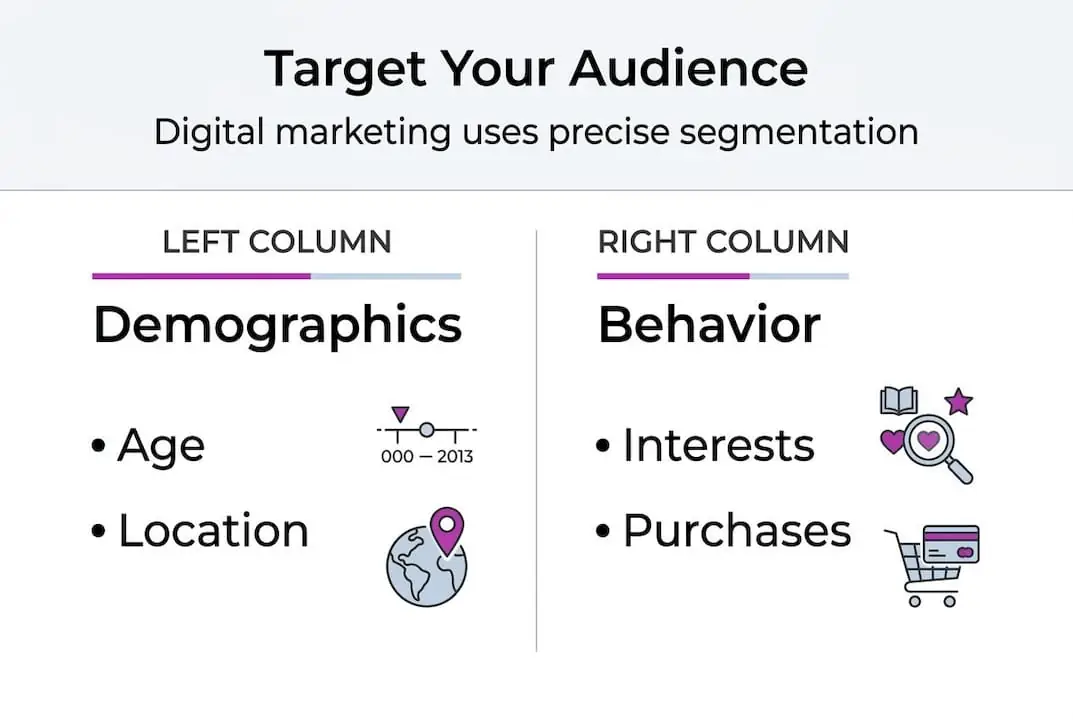
Digital platforms let you define your audience by age, location, interests, job title, purchasing behaviour, and even the device they use. This means your budget works harder because you are reaching people who are likely to buy, not simply everyone in a given area.
Real-time optimisation
If an ad is underperforming, you know within hours. You can test two versions of a headline, see which one converts better, and shift your budget accordingly. This iterative approach, often called A/B testing, is one of the most powerful tools available to modern marketers.
Here is a practical sequence for applying digital tactics effectively:
- Define your goal: lead generation, sales, brand awareness, or customer retention
- Identify which channels your audience uses most actively
- Create content or ads matched to each channel’s format and audience expectations
- Set measurable KPIs before the campaign launches
- Monitor performance weekly and adjust based on data, not instinct
Pro Tip: Resist the urge to be on every platform simultaneously. Pick two or three channels where your audience is most active, master them, and expand from there. Spreading budget too thin is one of the most common mistakes growing businesses make.
For practical guidance, reviewing social media marketing tips and understanding how to approach optimising your digital strategy will give you a strong foundation. If you are weighing up where to invest first, the case for investing in content creation is particularly compelling for long-term brand authority.
Building an effective digital marketing strategy
A strategy is not a list of tactics. It is a structured plan that connects your business goals to the channels, content, and metrics that will move you towards them. Without this structure, digital marketing becomes expensive experimentation.
Follow these steps to build a strategy that holds up under real-world pressure:
- Set specific goals: Vague ambitions like “grow our online presence” are not actionable. Define what success looks like in numbers: 50 new leads per month, a 20% increase in website traffic, or a 15% reduction in cost per acquisition.
- Understand your audience deeply: Build detailed profiles of your ideal customers. Where do they spend time online? What problems are they trying to solve? What language do they use?
- Select the right channel mix: A B2B professional services firm will find LinkedIn and SEO far more productive than TikTok. An e-commerce brand targeting younger consumers may find the opposite.
- Integrate traditional touchpoints where relevant: Hybrid digital-traditional strategies consistently outperform purely digital approaches because trust built offline reinforces digital conversion.
- Monitor, report, and adapt: Set a regular review cadence. Monthly reporting is a minimum. Weekly reviews allow faster course correction.
Pro Tip: Avoid siloed thinking. Your SEO strategy should inform your content calendar. Your email campaigns should reflect what your social media audience is responding to. When channels work together, results compound.
For businesses serious about long-term visibility, mastering your SEO strategy is non-negotiable. Pair that with well-executed successful social media campaigns and you have the foundation of a strategy built for sustained growth. Understanding SEO for long-term growth will also help you appreciate why organic visibility compounds in value over time in ways that paid advertising alone cannot replicate.
A practical perspective: blending digital and traditional marketing for real-world success
Here is something most digital marketing guides will not tell you: going fully digital, too fast, too soon, can actually damage brand trust. We have seen it happen. Businesses abandon their local advertising, their community sponsorships, their printed materials, and then wonder why their conversion rates are lower than expected even as their traffic climbs.
The reason is simple. Digital channels are excellent at reaching people. They are less reliable at building the deep, instinctive trust that comes from physical presence and community familiarity. Hybrid strategies outperform purely digital or purely traditional approaches precisely because they honour both dimensions of how people make decisions.
Our practical advice to any business leader: use traditional marketing to establish credibility in your market, then use digital to scale that credibility efficiently. Think of traditional as the foundation and digital as the amplifier. Understanding the role of digital content within this broader picture helps you allocate resources wisely rather than chasing every new platform or trend.
The most effective campaigns we have worked on always start with a clear understanding of what the brand stands for, then use the best available channels, digital and traditional, to communicate that consistently.
Boost your business with expert digital marketing services
Understanding the fundamentals is the first step. Putting them into practice consistently, across the right channels, with the right creative and the right measurement framework, is where most businesses need support. If you are in north west London and would rather hand this to one team, our Harrow marketing page shows how that works.
At AMW Media, our digital marketing services are designed to take you from strategy to measurable results without the guesswork. Whether you need expert social media management to build your audience and drive engagement, or a high-performing web design and development solution that converts visitors into customers, our team has the expertise to deliver. Get in touch to discuss how we can tailor a digital marketing approach that fits your goals and your budget.
Frequently asked questions
What are the main types of digital marketing?
The main types include search engine optimisation (SEO), pay-per-click advertising (PPC), social media marketing, content marketing, email marketing, and influencer marketing. Each serves a distinct role in the customer journey and works best when integrated with the others.
How is digital marketing more cost-effective than traditional marketing?
Digital marketing typically requires lower budgets to get started and offers measurable performance data, making it far easier to optimise spend compared to traditional print or broadcast methods. You can pause or adjust campaigns in real time based on what the data shows.
Can digital marketing help my business reach international customers?
Yes. Digital channels remove geographic barriers entirely, and campaigns for brand growth can be targeted to specific countries, languages, or audience segments with precision. A well-structured digital strategy can open international markets that would be prohibitively expensive to reach through traditional advertising.
Should I use both digital and traditional marketing?
A hybrid approach works best for most businesses. Traditional marketing builds credibility and local trust, while digital ensures your campaigns are targeted, measurable, and adaptable to real-world performance data.
Recommended
- Types of digital marketing: strategies for growth
- How to optimise digital strategy for marketing success
- The role of digital content in brand growth and engagement
- Master your SEO strategy: guide for effective brand growth
- Why Digital Marketing for Lawyers Is Non-Negotiable in 2026
Our free marketing audit looks at your site, your ads and your content, and comes back with a 30 day plan. No pitch deck.

Runs the content calendars and the community side of every social account, and keeps clients posted on what is going out and when. Meet the team.