
 Black Steel Doors
 Woodstock Campers
 Phillips Joinery
Most marketing managers know content matters. Far fewer treat it as the strategic engine it actually is. Digital content drives engagement, SEO, lead generation, and conversions through high-quality, personalised formats, yet many brands still treat it as an afterthought or reduce it to a blog schedule. This guide cuts through the noise. You will find a clear framework for planning, measuring, and future-proofing your content programme, built for ambitious teams who need results they can defend in a boardroom.
Key Takeaways
| Point | Details |
|---|---|
| Strategic content drives results | Intentional, mapped digital content delivers measurable impact on engagement and revenue. |
| Documented strategy triples ROI | Brands with clear content strategies are three times as likely to see strong returns. |
| Metrics must be actionable | Prioritise measuring engagement, conversion, and CLV over vanity metrics for real growth. |
| AI helps, but human context wins | Genuine insight, expertise, and first-person data create a lasting edge over automation. |
| Avoiding pitfalls ensures resilience | Staying vigilant about over-personalisation, measurement gaps, and quality protects brand assets. |
What is digital content and why does it matter?
Digital content is not just blog posts. It spans video, podcasts, interactive tools, social media assets, email sequences, whitepapers, and personalised landing pages. Each format serves a distinct purpose, and the brands that grow fastest treat their digital marketing strategies as an interconnected system rather than a collection of one-off campaigns.
The business case is simple. Content builds organic visibility, nurtures prospects through the buying journey, and converts interest into action. But only when it is intentional. Random publishing, chasing trending topics without strategic purpose, and ignoring performance data are the three fastest ways to waste your content budget.
Here is what separates high-performing content programmes from the rest:
- Audience specificity: Every asset is built for a defined persona, not a vague demographic
- Format diversity: Content marketing statistics confirm that varied formats outperform single-channel approaches
- Measurement from day one: KPIs are set before content is created, not retrofitted after
- Quality over volume: One useful piece outperforms ten generic ones every time
“Digital content encompasses far more than blogs, including video, interactive formats, and especially personalised experiences that meet audiences where they are.”
The pitfall most teams fall into is confusing activity with strategy. Publishing consistently is good. Publishing with purpose is what drives growth.
How digital content fuels marketing results
Content strategy and business ROI are directly linked, but the connection only becomes visible when you map formats to objectives. Different content types do different jobs, and conflating them leads to misaligned expectations.
Organisations with documented content strategies are three times more likely to see strong ROI. That single statistic should inform every budget conversation you have. High performers also increase output over time, but they do so strategically, guided by digital marketing strategy data and clear performance benchmarks.

| Content format | Primary objective | Secondary benefit |
|---|---|---|
| Long-form blog | SEO and organic traffic | Lead nurturing |
| Video | Engagement and brand recall | Conversions |
| Interactive tools | Lead generation | Time on site |
| Social media posts | Awareness and community | Traffic referral |
| Email sequences | Conversions and retention | Upsell opportunities |
Consistency compounds results. A brand publishing two high-quality pieces per week for six months will outperform a brand that publishes sporadically, even if the sporadic content is occasionally excellent. Think of it like compound interest: the returns build slowly, then accelerate. Investing in content creation for growth is not a short-term play, and optimising your digital strategy ensures that consistency translates into measurable outcomes.
Planning: Aligning content with your business objectives
Every piece of content should earn its place in your plan. That means mapping assets to funnel stages, audience needs, and specific KPIs before a single word is written.
The funnel framework is simple but powerful. Top-of-funnel (ToFu) content builds awareness: think hero videos, thought leadership articles, and social campaigns. Middle-of-funnel (MoFu) content educates and nurtures: guides, case studies, and comparison content. Bottom-of-funnel (BoFu) content converts: demos, testimonials, and targeted landing pages. Content should align with funnel stages and be organised using cluster and calendar models to maintain strategic coherence.
Here is a practical planning checklist:
- Define your primary persona and their pain points at each funnel stage
- Map each content asset to a specific business objective (traffic, leads, conversions)
- Choose distribution channels based on where your audience actually spends time
- Set a publication cadence you can sustain without sacrificing quality
- Build topic clusters around pillar pages to strengthen SEO authority
- Assign ownership and deadlines before content enters production
The cluster and pillar model deserves a moment. A pillar page covers a broad topic in depth. Cluster content covers related subtopics and links back to the pillar. This structure signals topical authority to search engines and keeps users navigating your site longer. Review your content production steps and marketing strategy fundamentals to build this architecture properly.
Pro Tip: Match the value of your content to buyer intent at each stage. A prospect at the awareness stage does not want a product demo. They want a perspective that helps them understand their problem. Give them that first, and they will come back for the rest.
Measurement: Which metrics matter and why
Planning strong content is half the battle. Measuring its impact is where strategy comes to life, and where most teams fall short.
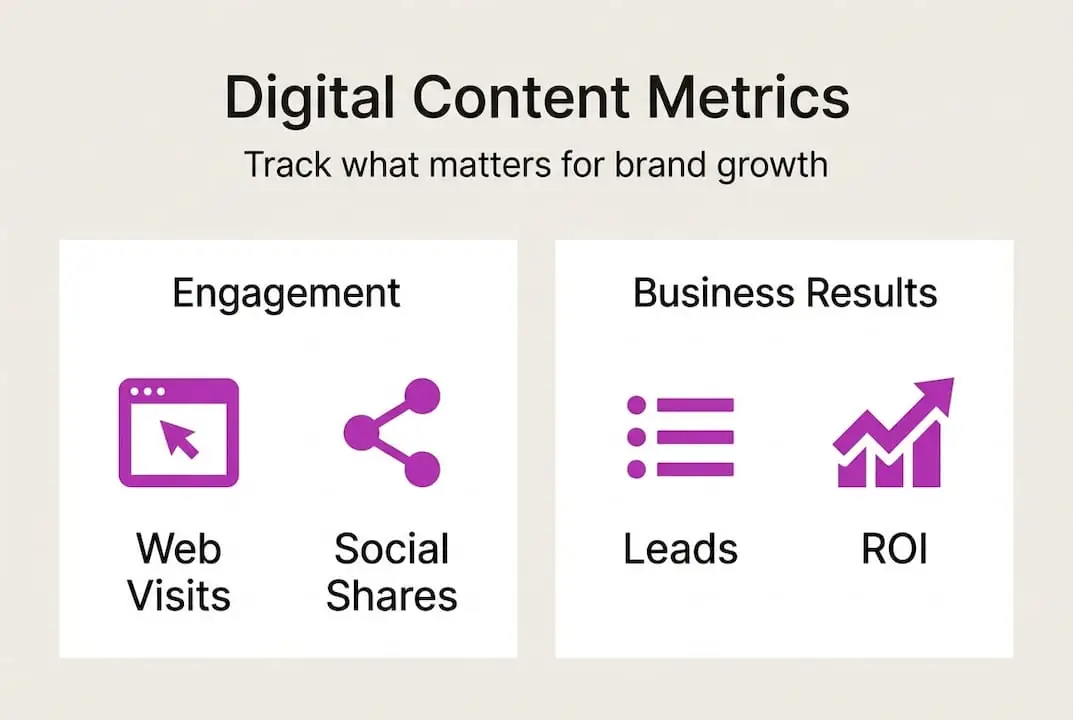
| Metric | What it measures | Why it matters |
|---|---|---|
| Organic traffic | Search-driven visits | Indicates SEO effectiveness |
| Scroll depth | How far users read | Reveals content quality and relevance |
| Dwell time | Time spent on page | Signals engagement to search engines |
| Conversion rate | Actions taken per visit | Ties content directly to revenue |
| Customer lifetime value (CLV) | Long-term revenue per customer | Shows content’s retention impact |
Key metrics including engagement, conversions, and organic traffic are well understood in isolation. The challenge is that 80% of marketers struggle with multichannel measurement, meaning they cannot accurately attribute results across touchpoints. A prospect might discover you via a blog post, return via social media, and convert through email. Which channel gets credit?
Common reasons measurement fails:
- No baseline data before campaigns launch
- Tracking vanity metrics (page views, follower counts) instead of actionable ones
- Failing to connect content analytics to CRM or sales data
- Inconsistent UTM tagging across campaigns
- No regular reporting cadence to identify trends
Your SEO strategy metrics and social engagement data should feed into a single performance dashboard, not live in separate spreadsheets.
Pro Tip: Prioritise metrics that inform decisions. If a metric does not change how you act, it is a vanity metric. Focus on what shifts the numbers: conversion rate, cost per lead, and organic traffic growth.
The human edge: Outperforming AI in digital content
AI can produce content at scale. That is not in dispute. What it cannot do is replace the proprietary insight, lived experience, and brand perspective that make content useful. Commodity content is commoditised by AI; only proprietary data, first-person expertise, and original benchmarking create a defensible edge.
This is what we call the context moat. Generic information is now freely available at scale. What audiences and search engines reward is context: your interpretation of data, your team’s experience, your brand’s unique point of view. That is what AI cannot replicate.
Human advantages in content creation:
- EEAT signals: Expertise, Experience, Authoritativeness, and Trustworthiness are essential for AI-assisted content to avoid search penalties
- Original research: Proprietary surveys, client data, and industry benchmarks cannot be fabricated
- Brand voice: Consistent tone and perspective build audience trust over time
- Contextual judgement: Knowing what not to say is as important as knowing what to say
- Emotional intelligence: Understanding audience anxiety, aspiration, and motivation drives relevance
“EEAT is essential for AI-assisted content. The human layer adds the experience dimension that AI drafts fundamentally lack, and without it, content risks both penalties and audience disengagement.”
AI is a powerful production tool. Use it to accelerate research, generate outlines, and repurpose existing assets. But the strategic thinking, the original insight, and the quality control must remain human. Your video marketing strategies are a strong example: AI can assist with scripting, but the creative direction and brand authenticity must come from your team.
Common pitfalls and future priorities in digital content
Even well-resourced teams make avoidable mistakes. Here are the five most damaging pitfalls in 2026, and how to address them.
- Publishing without strategy: Content without a documented plan produces inconsistent results. Document your objectives, personas, and KPIs before you create anything.
- Over-personalisation: 55% of audiences disengage when content feels invasive. Relevance is welcome; surveillance is not. Use behavioural data responsibly.
- AI hallucinations: In low-data niches, AI tools generate plausible but inaccurate content. Every AI-assisted piece needs human fact-checking, especially in regulated sectors.
- Neglecting YMYL topics: Your Money or Your Life content (finance, health, legal) requires verified expert review. Getting this wrong carries both reputational and ranking consequences.
- Ignoring content decay: Older content loses relevance and ranking over time. A quarterly audit and refresh programme protects your existing investment.
Looking ahead, future digital content trends point to rising AI budget allocations, but the brands winning in 2026 are those pairing AI efficiency with human strategic oversight. Technology accelerates execution. Strategy determines direction.
Pro Tip: Audit your content library every quarter. Flag pieces that are factually outdated, contextually weak, or no longer aligned with your current positioning. Refreshing strong existing content often delivers faster results than creating new assets from scratch.
Take your digital content from good to extraordinary
You now have the framework. The question is whether your team has the bandwidth and specialist depth to execute it consistently at the level your brand deserves. For a north west London business, our digital marketing agency Harrow page lists the results we can show and the area we cover.
At AMW Media, we work with ambitious brands to build content programmes that are strategic, measurable, and differentiated. From digital marketing support and social media management to SEO expertise and full content production, our integrated approach means every asset works harder across every channel. If you are ready to move from reactive publishing to a content engine that drives real growth, we would love to show you what that looks like for your brand specifically.
Frequently asked questions
What types of digital content deliver the best results in 2026?
Integrated formats including video, interactive assets, thought leadership articles, and specific social posts consistently outperform single-format approaches. The key is matching format to audience intent and funnel stage.
How can brands prove content ROI to the business?
Link content performance to engagement rates, conversion data, and documented business objectives. Organisations with documented content strategies are three times more likely to demonstrate strong ROI to stakeholders.
What risks do AI-generated content pose for brands?
AI can produce generic or factually inaccurate content, and brands risk search penalties if assets lack EEAT signals. Human oversight and expert review are non-negotiable, particularly in regulated industries.
How much should brands spend on digital content in 2026?
Leading organisations are allocating 45 to 51% of marketing budgets to AI and content combined. Budget should follow strategy, not the other way around.
Recommended
- Why invest in content creation for competitive brand growth
- Harness social media in branding for growth in 2026
- How to optimise digital strategy for marketing success
- How to run successful social media campaigns for brand growth
Our free marketing audit looks at your site, your ads and your content, and comes back with a 30 day plan. No pitch deck.

On site with the cameras most days of the week. Installs, interviews, products and events, from London to Liverpool. Meet the team.