
 Black Steel Doors
 Woodstock Campers
 Phillips Joinery
Marketing managers know the frustration of watching digital efforts fail to deliver expected results. Fragmented tactics, unclear metrics, and rapidly evolving platforms create confusion that stalls growth. This guide provides a comprehensive roadmap to optimise your digital strategy through integrated content production, advanced SEO techniques, and strategic social media management. You’ll discover how to align brand and performance goals, use AI tools effectively, and measure what truly matters for sustained competitive advantage.
Key Takeaways
| Point | Details |
|---|---|
| Integrated KPI framework | Establish KPIs that blend brand awareness with conversion metrics to align strategies and simplify measurement. |
| Digital maturity assessment | Carry out a five dimensional assessment of technology, data analytics, content capacity, team skills and process optimisation to prioritise optimisation. |
| Strategic AI integration | Identify workflows where predictive analytics and content generation deliver measurable value before scaling. |
| Pilot projects to prove value | Launch small pilots to validate impact and learn before wider investment. |
Preparing your digital strategy for optimisation
Successful optimisation starts with honest assessment of where you stand today. Too many marketing managers jump straight into tactics without understanding their current capabilities or defining clear success metrics. This approach wastes budget and creates team frustration.
Begin by evaluating your digital maturity across five dimensions: technology infrastructure, data analytics capability, content production capacity, team skills, and process efficiency. There is published evidence that digital maturity lifts performance, which is why this assessment comes first. Identify which systems integrate smoothly and where data silos block insight. Map your current martech stack against actual usage rates to spot redundant tools draining resources.
Next, establish integrated KPIs that blend brand and performance objectives. Traditional separation between awareness metrics and conversion goals creates artificial barriers that limit strategic thinking. Your measurement framework should track:
- Marketing qualified lead to sales qualified lead conversion rates
- Customer acquisition cost across all digital channels
- Lifetime value segmented by acquisition source
- Brand sentiment and share of voice in target markets
- Content engagement depth and progression through funnel stages
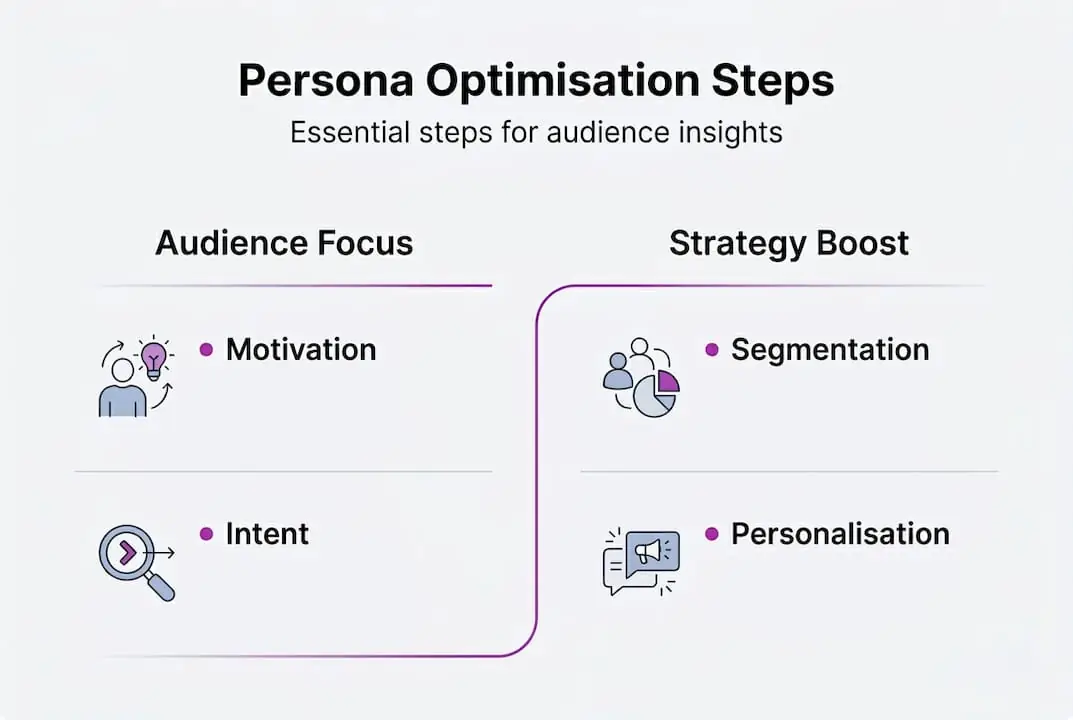
Understanding audience intent requires moving beyond basic demographics. Build detailed personas that capture motivations, pain points, preferred content formats, and decision-making triggers. Use search behaviour analysis, social listening data, and customer interviews to refine these profiles quarterly. This foundation enables content creation for competitive growth that resonates authentically.
Plan your AI integration strategically rather than bolting tools onto existing processes. Identify specific workflows where predictive analytics, content generation, or audience segmentation can deliver measurable improvements. Start with pilot projects that demonstrate value before scaling investment. The goal is augmenting human creativity and judgement, not replacing strategic thinking.
Finally, recognise capability gaps requiring specialist expertise. Most in-house teams excel in certain areas whilst lacking depth in technical SEO, video production, or paid media optimisation. Honest assessment of these gaps informs whether to upskill internally, hire specialists, or partner with agencies for specific functions. This clarity prevents costly mistakes and accelerates progress.
Executing effective content, SEO, and social media tactics
With preparation complete, focus shifts to tactical execution across your primary digital channels. Success requires coordinated efforts that amplify each channel’s strengths so each one lifts the others.
Start with audience-focused content production that aligns with both brand voice and business goals. Develop a content matrix mapping formats to funnel stages and buyer personas. Top-of-funnel awareness content might include educational blog posts, infographics, and short-form social videos. Middle-funnel consideration content could feature case studies, comparison guides, and webinars. Bottom-funnel decision content encompasses product demonstrations, testimonials, and ROI calculators.
Apply advanced SEO techniques that extend beyond traditional keyword optimisation. Modern search requires addressing:
- Generative engine optimisation (GEO) through structured data and entity-based content that AI systems can parse effectively
- Answer engine optimisation (AEO) by targeting featured snippets and question-based queries with concise, authoritative responses
- Schema markup implementation across all content types to enhance rich result eligibility
- Core Web Vitals optimisation ensuring fast, stable, accessible user experiences
- Topic cluster architecture that establishes topical authority through interconnected pillar and supporting content
Data demonstrates that SEO traffic growth increases conversions by 38% when properly executed. Furthermore, ChatGPT-driven traffic converts 7.5x better than traditional search, highlighting the importance of optimising for AI-powered discovery.

use AI tools for predictive analytics that refine audience targeting and content timing. Machine learning models can identify patterns in engagement data that humans miss, surfacing optimal posting schedules, content themes, and channel preferences. Use these insights to personalise messaging whilst maintaining brand consistency across touchpoints.
Manage social media to blend brand building with demand generation. Many marketing managers treat social purely as a broadcasting channel, missing opportunities for genuine engagement and community building. Develop platform-specific strategies recognising that LinkedIn serves different purposes than Instagram or TikTok. Share social media branding growth 2026 insights with your team to align on emerging best practices.
Implement a content approval workflow that balances quality control with production velocity. Bottlenecks in review processes kill momentum and frustrate creative teams. Define clear brand guidelines, messaging frameworks, and visual standards that empower team members to create confidently within boundaries.
Pro Tip: Create modular content templates for recurring formats like blog posts, social updates, and email campaigns. These templates maintain brand consistency whilst allowing creative teams freedom to adapt messaging for specific audiences and contexts. This “freedom within framework” approach accelerates production without sacrificing quality.
Consider how SEO services and packages and social media management services can augment internal capabilities when specialist expertise or additional capacity is needed. The right partnership model depends on your team’s current strengths and growth objectives.
| Tactic | Implementation Priority | Expected Impact Timeline |
|---|---|---|
| Content production system | High | 2-3 months |
| Technical SEO audit and fixes | High | 1-2 months |
| GEO/AEO optimisation | Medium | 3-4 months |
| Social media strategy refresh | Medium | 1-2 months |
| AI-powered analytics integration | Low | 4-6 months |
Measuring success and refining your digital strategy
Execution without measurement creates blind spots that prevent learning and improvement. Marketing managers need solid analytics frameworks that capture both leading and lagging indicators across all digital channels.
Track integrated KPIs that reveal true business impact rather than vanity metrics. Monitor marketing qualified lead to sales qualified lead conversion rates to understand content quality and targeting effectiveness. Calculate customer acquisition cost by channel to optimise budget allocation. Measure lifetime value segmented by acquisition source to identify your most profitable audience segments. These metrics connect digital activity directly to revenue outcomes.
Use AI-driven analytics platforms that identify trends and anomalies faster than manual analysis. Machine learning algorithms can detect subtle shifts in audience behaviour, competitive activity, or content performance that warrant strategic adjustments. Set up automated alerts for significant metric changes so you can respond quickly to both opportunities and threats.
Conduct cross-functional experiments that validate assumptions before scaling investment. Test different content formats, messaging angles, audience segments, and channel combinations through controlled trials. Document learnings systematically so institutional knowledge builds over time rather than residing only in individual team members’ experience.
Research indicates that joined up KPIs and AI experiments drive 70% higher revenue compared to traditional measurement approaches. This performance gap reflects the compounding advantages of continuous optimisation informed by comprehensive data.
Compare full-service versus specialist agency models to determine the right partnership approach for your organisation’s scale and needs. Full-service agencies provide integrated strategy and execution across all channels, simplifying vendor management and ensuring coordinated campaigns. Specialist agencies offer deep expertise in specific domains like technical SEO, video production, or paid media, delivering superior results in their focus areas.
| Agency Model | Best For | Typical Engagement |
|---|---|---|
| Full-service | Brands needing integrated strategy across multiple channels | Retainer with quarterly planning |
| Specialist SEO | Organisations with technical optimisation gaps | Project-based or ongoing optimisation |
| Specialist content | Teams lacking production capacity or creative capabilities | Retainer with defined deliverables |
| Hybrid approach | Mature marketing teams supplementing specific functions | Mix of retainer and project work |
Review agency services for brand growth to understand how different partnership models support various business objectives and growth stages.
Schedule quarterly strategy reviews that assess performance against goals and adjust tactics based on learnings. These sessions should involve cross-functional stakeholders from sales, product, and customer success to ensure marketing strategy aligns with broader business priorities. Use data to drive discussions rather than opinions, focusing on what’s working and what needs refinement.
Pro Tip: Maintain a living strategy document that captures your current approach, recent experiments, key learnings, and planned adjustments. Update this quarterly and share widely across marketing and sales teams. This transparency ensures everyone understands the rationale behind tactical decisions and can contribute insights from their customer interactions.
Consider how PPC campaign management services can complement organic efforts when you need to accelerate results in specific segments or test new messaging before committing to longer-term content investments.
Implement attribution modelling that credits all touchpoints in the customer journey rather than relying on last-click attribution. Multi-touch attribution reveals how awareness content, educational resources, and conversion-focused assets work together to drive decisions. This understanding prevents undervaluing top and middle-funnel activities that don’t directly generate immediate conversions but play essential roles in customer acquisition.
Build feedback loops between digital performance and product development. Insights from search trends, social conversations, and content engagement often surface unmet customer needs or emerging market opportunities. Share these patterns with product teams to inform roadmap priorities and ensure your offerings evolve with market demands.
Enhance your digital strategy with expert services
Optimising digital strategy requires balancing strategic thinking with tactical execution across multiple specialised domains. Whilst the frameworks outlined above provide clear direction, implementation demands expertise, capacity, and tools that many marketing teams lack internally.
AMW Media specialises in helping ambitious brands enhance their digital presence through integrated content production, strategic SEO, and results-driven social media management. Our team combines creative innovation with data-driven optimisation to deliver measurable growth. Whether you need comprehensive digital marketing services spanning all channels, focused SEO services and packages to boost organic visibility, or dedicated social media management services to build engaged communities, we tailor solutions to your specific goals and market position. Partner with specialists who understand the nuances of modern digital marketing and can accelerate your path to sustainable competitive advantage.
How to optimise digital strategy frequently asked questions
What are the first steps to optimise a digital strategy?
Begin with a comprehensive digital maturity assessment covering technology, data capabilities, content production, team skills, and processes. Define integrated KPIs that blend brand awareness and performance metrics. Build detailed audience personas based on intent and behaviour rather than demographics alone. These foundations ensure subsequent tactical decisions align with business objectives and audience needs.
How does AI impact digital strategy optimisation?
AI transforms optimisation through predictive analytics that identify patterns humans miss, content generation that accelerates production, and audience segmentation that enables hyper-personalisation. The key is strategic integration where AI augments human creativity and judgement rather than replacing strategic thinking. Start with pilot projects demonstrating clear value before scaling investment across your martech stack.
Why integrate brand and performance marketing?
Separating brand building from performance marketing creates artificial silos that limit strategic effectiveness. Integrated approaches recognise that awareness activities influence conversion rates whilst performance campaigns shape brand perception. Research shows joined up measurement frameworks combining both dimensions drive significantly higher revenue than traditional separated approaches. Modern buyers expect consistent experiences across all touchpoints regardless of campaign objective.
What metrics matter most for digital optimisation?
Focus on metrics connecting digital activity to business outcomes: marketing qualified lead to sales qualified lead conversion rates, customer acquisition cost by channel, lifetime value segmented by source, and content engagement progression through funnel stages. Avoid vanity metrics like page views or follower counts that don’t correlate with revenue. Track both leading indicators predicting future performance and lagging indicators confirming results.
How to choose between specialist and full-service agencies?
Full-service agencies suit brands needing integrated strategy across multiple channels with simplified vendor management. Specialist agencies deliver superior results in specific domains like technical SEO or video production where deep expertise matters most. Consider your team’s current capabilities, budget constraints, and growth priorities. Many organisations benefit from hybrid approaches partnering with specialists for capability gaps whilst maintaining strategic control internally. Review case studies and invest in content creation insights to inform your decision.
Optimise digital services around the enquiry, not the channel
Most optimisation work happens inside channels: better ads, faster pages, more posts. That is where the tools point, so that is where the effort goes.
The bigger gains usually sit between the channels. To optimise digital services properly, follow one real enquiry end to end: what somebody searched, what they landed on, what they were asked to do, how long before anybody replied, and what happened next. Almost every business finds its worst delay in that sequence is not in any channel at all. It is the gap between the enquiry arriving and a person answering it. Fern Campervans, on our Bristol page, is the example we use for a customer who cares how something is made.
Recommended
- Why invest in content creation for competitive brand growth
- What is video marketing: effective strategies for 2026
- Creative content production steps for marketing success in 2026
- Why use agency services to grow your brand in 2026
Our free marketing audit looks at your site, your ads and your content, and comes back with a 30 day plan. No pitch deck.

Founded AMW Media in 2024 and runs strategy, paid media and the CRM builds. The reason everything here is in house and measured in revenue. Meet the team.