
 Black Steel Doors
 Woodstock Campers
 Phillips Joinery
TL;DR:
- A structured digital marketing process ensures consistent growth and efficient resource use.
- Prioritise 2-3 channels aligned with audience behaviour and develop them deeply.
- Regular audits and balancing performance marketing with brand building drive sustainable success.
Many mid-sized brands burn through budget and goodwill by running digital marketing on instinct rather than process. Without a clear framework, campaigns overlap, messaging drifts, and results become impossible to attribute. The cost is real: wasted spend, missed opportunities, and teams pulling in different directions. The good news is that a structured digital marketing process solves most of these problems before they start. This guide walks you through each stage, from goal-setting and audience research to execution, measurement, and iteration, so your brand can compete with confidence and generate consistent, measurable growth.
Key Takeaways
| Point | Details |
|---|---|
| Start with clear goals | Define SMART goals and research your market for strategic direction. |
| Prioritise key channels | Focus deeply on 2-3 marketing channels for maximum impact. |
| Audit performance quarterly | Run regular audits and measure funnel KPIs to optimise results. |
| Deliver creative campaigns | use automation and creative assets but ensure human oversight. |
| Balance brand and performance | Combine short-term campaigns with long-term brand equity for sustainable growth. |
Laying the groundwork: Goals, research and audience targeting
Every effective campaign starts long before a single piece of content is created. The preparation phase is where most mid-sized brands either build a competitive advantage or quietly set themselves up to fail. Skipping it feels efficient in the short term. It rarely is.
A solid marketing strategy framework begins with SMART goals: objectives that are Specific, Measurable, Achievable, Relevant, and Time-bound. Vague goals like “increase brand awareness” give your team nothing to work towards. A SMART version might read: “Increase organic website traffic by 25% within six months through a targeted SEO and content programme.” That single sentence tells your team what success looks like, when to expect it, and how to measure it.
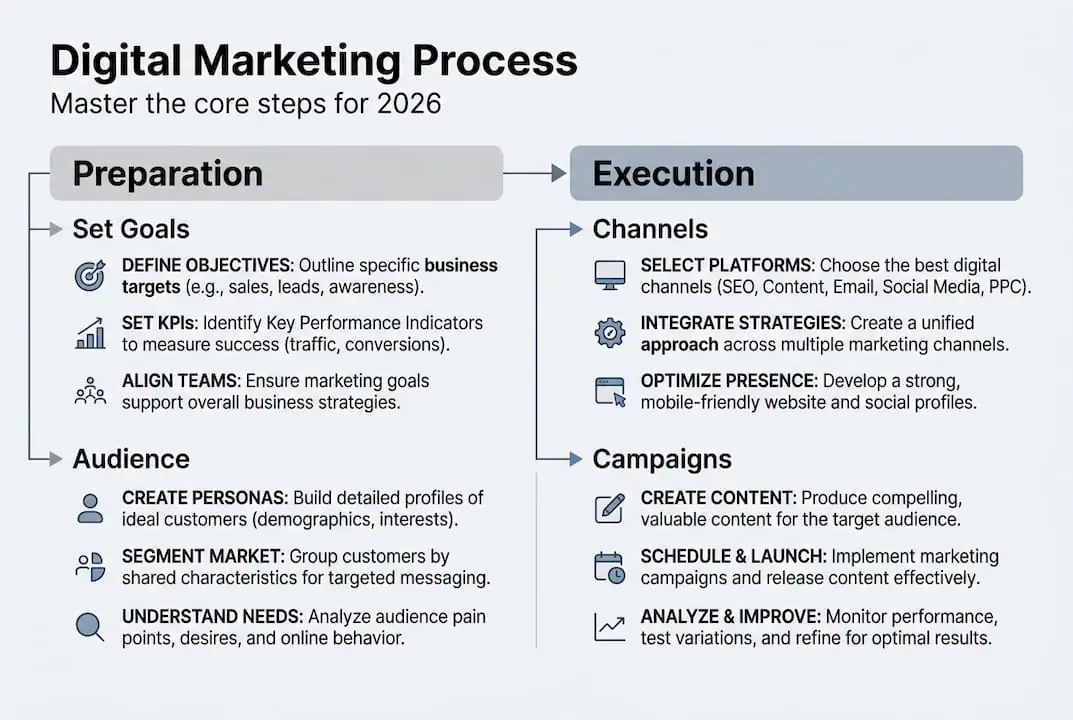
Once goals are set, market research gives them context. A SWOT analysis (Strengths, Weaknesses, Opportunities, Threats) helps you understand where your brand sits relative to competitors. Combine this with a competitor audit using the audit steps recommended by Harvard Business School, and you will quickly surface gaps your brand can exploit. Look at competitor messaging, channel presence, content frequency, and customer reviews.
The digital marketing process typically follows a structured 6-8 step methodology: define SMART goals, conduct SWOT and competitor analysis, then identify your target audience and build buyer personas. Personas are not fictional characters. They are data-driven profiles built from real customer interviews, CRM data, and behavioural analytics. A well-built persona includes demographics, motivations, objections, preferred content formats, and the platforms they actually use.
Here is a quick checklist for the groundwork phase:
- Define 2-3 SMART goals with clear success metrics
- Complete a SWOT analysis for your brand and top 3 competitors
- Identify 2-3 primary buyer personas with behavioural data
- Set baseline benchmarks for traffic, engagement, and conversion
- Document your current channel performance before making any changes
Pro Tip: Run a brief customer survey before building personas. Even five to ten responses can reveal motivations and language patterns that no analytics tool will surface on its own.
Choosing your channels: Platform selection, budgeting and resource allocation
Once your goals and audience are defined, selecting the right channels and crafting a resource plan makes the process actionable. This is where many brands go wrong by trying to be everywhere at once. The result is thin content, inconsistent posting, and a team that is permanently stretched.

For mid-sized brands, prioritise 2-3 channels and develop them deeply rather than spreading resources too thin. The channels you choose should reflect where your audience actually spends time, not where you feel most comfortable. A B2B brand might find LinkedIn and email far outperform Instagram. A direct-to-consumer brand might see the opposite.
Use this comparison to evaluate your options:
| Channel | Best for | Typical cost | Time to results |
|---|---|---|---|
| SEO | Long-term organic growth | Low to medium | 3-6 months |
| PPC | Fast, targeted traffic | Medium to high | Immediate |
| Email marketing | Retention and nurture | Low | 1-4 weeks |
| Social media | Brand awareness and engagement | Low to medium | 1-3 months |
| Content marketing | Authority and organic reach | Medium | 3-12 months |
Budgeting follows channel selection. A useful starting point from budgeting guidelines is to allocate roughly 60-70% of your budget to channels with proven ROI for your brand, and reserve 20-30% for testing new approaches. The remaining 10% acts as a contingency for reactive opportunities, such as a trending topic or a competitor misstep.
When evaluating which digital strategy types align with your goals, consider the balance between owned channels (your website, email list, organic social) and paid channels (PPC, paid social). Owned channels build long-term equity. Paid channels deliver speed. Both have a role, but brands that over-invest in paid without building owned assets are permanently renting their audience.
Choosing the right marketing partners for execution also matters at this stage. Whether you build in-house capability or work with an agency, clarity on roles and deliverables prevents duplication and missed deadlines.
- Audit current channel performance before adding new ones
- Map each channel to a specific funnel stage (awareness, consideration, conversion)
- Assign clear ownership for each channel internally
- Review budget allocation quarterly, not annually
Pro Tip: Before committing budget to a new channel, run a 30-day pilot with a fixed spend cap. Data from a small test is worth more than any industry benchmark.
Executing campaigns: Content creation, automation and creative assets
With the foundation and channel selection in place, the creation and launch of campaigns bring your plan to life. Execution is where strategy becomes visible, and where inconsistency tends to surface most painfully.
Start by mapping your content to the funnel. Top-of-funnel content should educate and attract. Mid-funnel content should build trust and address objections. Bottom-funnel content should convert. A common mistake is producing only bottom-funnel content and wondering why the audience does not engage. Strong content strategy requires investment across all three stages.
Here is a practical execution sequence:
- Develop a content calendar covering at least 8 weeks ahead
- Create core assets (hero content, landing pages, email sequences)
- Adapt core assets for each channel format and audience segment
- Schedule and automate distribution using tools like HubSpot or ActiveCampaign
- Brief your creative team on brand guidelines and platform-specific requirements
- Launch with a defined review date, not an open-ended timeline
Automation is a genuine multiplier for mid-sized teams, but it requires careful oversight. AI tools for marketing can scale content distribution and personalisation at speed. However, as research confirms, automation needs human strategy: AI can scale but requires human oversight to maintain personalisation and creative quality. Automated emails that feel robotic or social posts that miss cultural context can damage brand perception faster than no content at all.
Creative consistency across platforms is non-negotiable. Your brand should be instantly recognisable whether someone encounters it on Google, Instagram, or their inbox. This does not mean identical content everywhere. It means consistent tone, visual identity, and messaging hierarchy adapted intelligently for each format.
| Asset type | Recommended format | Key metric |
|---|---|---|
| Video | Short-form (under 90 seconds) for social | View-through rate |
| Plain text or lightly designed | Open and click rate | |
| Display ads | Multiple sizes, A/B tested | CTR and conversion |
| Blog content | Long-form, SEO-optimised | Organic traffic and dwell time |
Pro Tip: Build a modular content system. Create one strong piece of long-form content each month and break it into social posts, email snippets, short videos, and infographics. One idea, many formats, far less effort.
Optimising and auditing: Measuring performance, analysing results and iterating
Executing your campaign is only the start. The real gains come from rigorous measurement and refinement. Brands that skip this stage are essentially flying blind, repeating what feels right rather than what the data confirms.
Begin by assigning KPIs to each funnel stage. Impressions and reach matter at the top of the funnel. Engagement rates and time on site matter in the middle. Conversion rates and cost per acquisition matter at the bottom. Funnel KPIs and quarterly reviews are essential to a meaningful digital marketing audit, ensuring you catch problems before they compound.
Here is a recommended audit cycle:
- Weekly: Review paid campaign performance and pause underperforming ad sets
- Monthly: Assess content performance, email metrics, and SEO movement
- Quarterly: Full funnel audit, budget reallocation, and strategy refresh
- Annually: Brand positioning review and competitive landscape reassessment
One insight worth noting: top-funnel investment is rising to 58% for enterprises, highlighting the need for full-funnel balance. Mid-sized brands that focus only on conversion activity often starve the top of the funnel and see leads dry up within two to three quarters.
For attribution, multi-touch models give a more accurate picture than last-click alone. If a customer saw a blog post, then a retargeting ad, then clicked an email before converting, crediting only the email misrepresents what actually drove the decision. Tools like Google Analytics 4 support data-driven attribution models that distribute credit more fairly.
The brands that grow consistently are not those with the biggest budgets. They are the ones that measure, adapt quickly, and never mistake activity for progress.
For a structured approach to digital strategy optimisation, regular audits paired with clear optimisation frameworks create the feedback loop that separates growing brands from stagnating ones.
- Track KPIs weekly at minimum, not just at campaign end
- Use heatmaps and session recordings to understand on-site behaviour
- Test one variable at a time when A/B testing to isolate what actually moved the needle
- Document every change and its outcome to build institutional knowledge
A fresh perspective: Bothism and agile processes for sustainable marketing success
Most marketing conversations force a choice: performance or brand. Short-term results or long-term equity. Paid or organic. We think that framing is the problem.
The concept of bothism in digital marketing challenges brands to stop treating performance marketing and brand building as competing priorities and start running them in parallel. The evidence supports this. Brands that invest in both consistently outperform those that pick a side. The key is not splitting the difference but designing campaigns that serve both objectives simultaneously.
For mid-sized brands, agility matters as much as strategy. Annual marketing plans are largely fiction by the time Q3 arrives. Platform algorithms shift, economic conditions change, and competitor moves demand rapid responses. Quarterly planning cycles, combined with a clear marketing strategy that holds firm on brand positioning, give teams the flexibility to adapt without losing direction.
The brands we see thriving are not the ones with the most sophisticated tools. They are the ones that adapt to new analytical tools while keeping human creativity and strategic judgement at the centre of every decision. That balance is harder to achieve than it sounds, but it is the real competitive edge in 2026.
Take your digital marketing process further with expert help
Putting a structured digital marketing process in place is transformative for mid-sized brands, but building it from scratch while running live campaigns is a significant challenge. Many teams benefit from working alongside experienced partners who can accelerate the process and bring external perspective. If your business is in Berkshire and you want a team to run this, our Reading page sets out how we work, with the numbers attached.
At AMW Media, we work with ambitious brands to design and execute multi-channel strategies that deliver measurable results. From digital marketing services covering the full funnel to hands-on PPC campaign management and strategic social media management, our team brings the creative and analytical expertise to turn your marketing process into a genuine growth engine. Get in touch to find out how we can help.
Frequently asked questions
What are the key steps in the digital marketing process?
The process includes setting SMART goals, market research, target audience definition, channel selection, budgeting, campaign execution, and performance optimisation. A structured 6-8 step methodology ensures each stage builds logically on the last.
How often should mid-sized brands audit their digital marketing?
Quarterly audits are recommended so teams can iterate and adapt quickly rather than waiting until year-end to address underperformance.
Which marketing channels should mid-sized brands prioritise?
Focus deeply on 2-3 channels best aligned with your brand goals and audience. Email, SEO, and social media consistently offer strong ROI for mid-sized brands.
How can brands balance performance marketing and brand building?
Use both approaches in parallel rather than choosing one. Balancing performance and brand investment produces stronger long-term results than focusing exclusively on short-term conversions.
What is a common mistake when executing digital campaigns?
Spreading resources across too many channels at once. Avoiding thin channel coverage and tracking performance regularly are the two habits that most reliably prevent wasted spend.
Recommended
- How to optimise digital strategy for marketing success
- What is marketing strategy and how to build one in 2026
- How to run successful social media campaigns for brand growth
- Creative content production steps for marketing success in 2026
- Top digital marketing trends shaping strategy in 2026, The data driven marketer
Our free marketing audit looks at your site, your ads and your content, and comes back with a 30 day plan. No pitch deck.

Runs the content calendars and the community side of every social account, and keeps clients posted on what is going out and when. Meet the team.