
 Black Steel Doors
 Woodstock Campers
 Phillips Joinery
TL;DR:
- Brand engagement reflects the deep, emotional relationships consumers develop with a brand through ongoing interactions and loyalty. It is distinct from awareness and should be measured via behavioural, sentiment, and business impact metrics to gauge true relationship strength. Successful strategies focus on meaningful, multi-touch touchpoints across the customer journey, emphasising quality over superficial metrics to foster long-term brand growth.
Brand engagement is not a campaign metric or a social media score. It is the cumulative strength of the relationship between a person and a brand, built through every interaction, emotion, and experience across the customer lifecycle. Brand engagement encompasses loyalty and advocacy alongside interaction, making it a fundamentally richer concept than reach or impressions. For marketing managers and brand strategists operating in competitive markets, understanding this distinction is not a nice-to-have. It is the difference between building a brand that sustains growth and one that chases short-term spikes while losing ground to more relationship-focused competitors.
Key Takeaways
| Point | Details |
|---|---|
| Engagement beyond awareness | Brand engagement means building a strong relationship, not just getting noticed. |
| Multi-dimensional measurement | The best engagement metrics combine behaviours, quality, and business results. |
| Touchpoints matter | Meaningful engagement happens across content, social, and every customer interaction. |
| Quality over quantity | High interaction can be meaningless unless it leads to lasting loyalty and advocacy. |
Defining brand engagement: what sits beyond awareness
Brand awareness tells you whether someone recognises your name. Brand engagement tells you whether they care. The two are frequently conflated in marketing conversations, but they operate at entirely different depths of the customer relationship. Awareness is passive. Engagement is active, emotional, and ongoing.
Brand engagement should not be confused with awareness and, crucially, it can occur well before a purchase is ever made. A prospective customer reading your blog every week, sharing your videos without clicking “buy,” or participating in your online community is engaged. That engagement carries real commercial weight even though it hasn’t converted yet. Most marketing teams undervalue these early-stage interactions precisely because they don’t appear directly in revenue reports.
Brand engagement is the strength and depth of the relationship people develop with a brand, expressed through loyalty and advocacy over time rather than surface interactions alone. This framing matters enormously for how you plan and measure your marketing efforts. When engagement is understood as relationship-depth, it reorients strategy away from chasing clicks towards nurturing genuine connection.
What does meaningful engagement actually look like in practice? Consider this non-exhaustive list of engagement signals:
- Leaving a detailed comment on a brand’s post rather than simply liking it
- Sharing branded content with a personal recommendation attached
- Returning to a brand’s website multiple times before purchasing
- Joining a brand community, forum, or loyalty programme
- Writing an unprompted product review or testimonial
- Tagging friends in brand content because it feels personally relevant
- Reaching out to customer service and becoming more loyal after a positive resolution
Explore the relationship between digital content and brand engagement to understand how your content choices directly influence these behaviours. The emotional thread running through all of these actions is what separates true engagement from passive visibility.
“Brand engagement is not just about being seen. It’s about being chosen, again and again, by people who feel a genuine connection to what your brand stands for.”
This mindset shift is foundational. Without it, marketing investment flows towards activities that generate impressive dashboards but weak commercial outcomes.
How to measure brand engagement: Metrics that matter
Marketing teams comfortable with follower counts and post reach often struggle when asked to demonstrate whether their engagement strategy is actually working. That’s because vanity metrics give a shallow picture of what’s happening between a brand and its audience. A post with ten thousand likes and no meaningful downstream impact is not evidence of engagement. It is evidence of attention.

Effective measurement requires a multi-dimensional approach that combines behavioural data, emotional quality, and business impact. Here is a framework that brings those dimensions together:
| Measurement dimension | What to track | Why it matters |
|---|---|---|
| Behavioural interaction | Comments, shares, saves, click-throughs | Shows active participation, not passive scrolling |
| Sentiment quality | Tone of mentions, review language, community feedback | Reveals emotional valence and brand perception |
| Advocacy behaviour | Referrals, UGC creation, public recommendations | Indicates whether engagement converts to brand promotion |
| Retention signals | Repeat visits, email open rates, return purchases | Connects engagement to long-term commercial value |
| Community participation | Forum activity, group membership, event attendance | Signals deeper relationship investment |
Putting this into practice requires a structured approach. Here is a numbered sequence for building a meaningful engagement measurement system:
- Define your engagement goals before selecting metrics. Are you trying to build pre-purchase familiarity, deepen post-purchase loyalty, or activate advocates?
- Map your engagement touchpoints across the customer journey so you know where to collect data.
- Select one behavioural, one sentiment, and one business-impact metric for each touchpoint to build a multi-dimensional view.
- Set benchmarks based on your industry, audience, and platform mix so you have meaningful context for results.
- Review engagement quality monthly and ask whether high-interaction content is also driving referrals, retention, or revenue.
- Connect engagement data to your CRM wherever possible so you can identify whether engaged audiences have stronger lifetime value.
For a closer look at platform-specific signals, read our guide on social media engagement analysis, which covers how to interpret data from individual channels in context.
Pro Tip: Set up a simple engagement scorecard that weights sentiment and advocacy signals more heavily than raw interaction counts. A single glowing customer testimonial shared publicly is worth more to your brand than five hundred passive likes on a promotional post.
The customer journey and brand engagement touchpoints
The most common mistake brands make with engagement is treating it as a single-channel or single-moment activity. In reality, engagement is multi-touch and lifecycle-oriented, cultivated through meaningful interactions across touchpoints that span content, community, and customer experience. Brands that win on engagement do so by showing up consistently and relevantly at every stage of the journey.
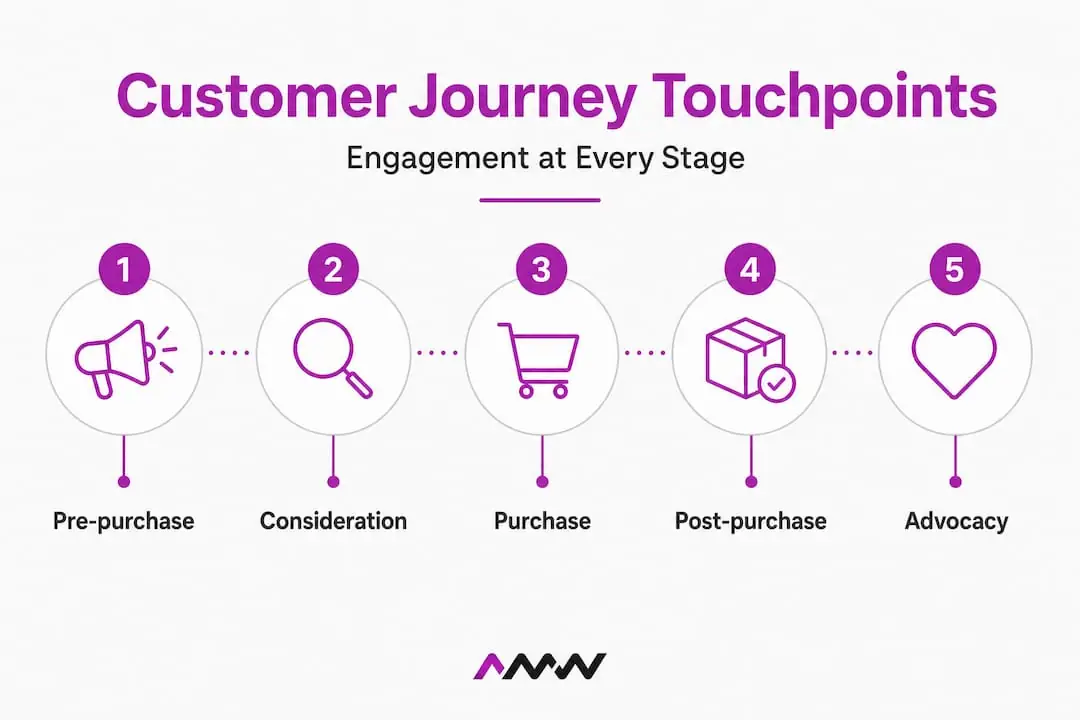
Here is how engagement touchpoints map across the customer lifecycle:
| Journey stage | Touchpoint examples | Engagement goal |
|---|---|---|
| Pre-purchase | Blog content, social media, podcasts, SEO articles | Build familiarity and emotional affinity |
| Purchase | Product pages, live chat, personalised email, reviews | Reduce friction and reinforce trust |
| Post-purchase | Onboarding emails, loyalty programmes, customer service | Deepen satisfaction and encourage repeat behaviour |
| Advocacy | Referral programmes, UGC campaigns, community spaces | Turn loyal customers into active brand promoters |
Each stage demands a different tone, content type, and call to engagement. Pre-purchase touchpoints should educate and inspire rather than sell. Post-purchase touchpoints should affirm the customer’s decision and invite them into a longer relationship. Advocacy touchpoints should make it easy and rewarding for happy customers to share their experience publicly.
Some of the most powerful engagement drivers include:
- Email marketing with personalised content that responds to individual behaviour
- Owned community spaces such as private groups, forums, or brand membership programmes
- User-generated content campaigns that invite customers to become co-creators of the brand story
- Customer service interactions that resolve issues with empathy and speed, turning a potential complaint into a loyalty moment
- Social media stories and live formats that feel immediate and personal rather than polished and corporate
Learning to create brand content that drives results is a strong starting point for improving pre-purchase engagement specifically. Meanwhile, brand storytelling for engagement helps you understand how narrative shapes emotional connection across all stages.
Pro Tip: Video content consistently outperforms static formats for emotional engagement across every stage of the journey. Short, authentic video formats work especially well for advocacy activation because they feel personal and are easy for audiences to share.
It is worth paying particular attention to the advocacy stage. Most brands invest heavily in acquisition touchpoints and neglect the post-purchase phase where advocacy is born. A customer who receives a thoughtful follow-up email, a surprise loyalty reward, or a timely response to their public review is far more likely to recommend your brand than one who was simply sold to efficiently.
The role of digital and social channels in engagement
Digital platforms are where most brand engagement is now observable, measurable, and actionable. Engagement on social media can be operationalised as measurable behaviours including liking, commenting, and sharing, which makes it the most data-rich environment for tracking relationship-depth in real time.
However, the data is only useful if you interpret it correctly. Platform choice fundamentally shapes your engagement benchmarks and what counts as strong performance varies considerably by channel. Engagement benchmarks vary heavily by platform, with TikTok averaging 4.25% engagement and Twitter/X sitting at just 1.11% in 2026 reports. This does not make Twitter/X a poor investment for your brand. It means that comparing performance across platforms using the same benchmark is analytically misleading.
| Platform | Average engagement rate (2026) | Best-performing content types |
|---|---|---|
| TikTok | 4.25% | Short-form video, trends, UGC |
| 2.18% | Reels, carousels, stories | |
| 1.52% | Community groups, video, events | |
| 1.89% | Thought leadership, documents, polls | |
| Twitter/X | 1.11% | Real-time commentary, threads |
Understanding these differences shapes how you allocate resource and what success looks like on each channel.
“Platform benchmarks are reference points, not finish lines. A 2% engagement rate on LinkedIn from the right decision-makers will outperform 5% on TikTok from the wrong audience every single time.”
Content type plays an equally significant role. Across platforms, video generates the highest engagement rates for the vast majority of brands. User-generated content performs exceptionally well because it combines social proof with authentic voice. Stories and live formats tend to drive more intimate, immediate responses than polished feed posts. Interactive content formats such as polls, quizzes, and Q&As invite participation rather than passive consumption, which meaningfully raises engagement depth.
For a practical approach to improving your social media performance, explore our social media marketing tips and consider experimenting with creative social media content formats that break from the standard brand broadcast model.
Key principles for digital channel engagement in 2026:
- Prioritise native content formats on each platform rather than repurposing the same asset everywhere
- Monitor comment sentiment alongside interaction volume to understand emotional quality
- Use platform analytics to identify which content types generate the highest save and share rates, not just likes
- Invest in community management as an active discipline, not a passive moderation task
- Test interactive content formats quarterly and measure their impact on downstream behaviour
Common pitfalls and how to optimise for quality engagement
Even experienced marketing teams fall into predictable traps when executing brand engagement strategy. Identifying these pitfalls early saves significant budget and strategic effort.
Here are the most common brand engagement mistakes to avoid:
- Mistaking interaction volume for relationship depth. A viral post that generates controversy attracts attention, not affinity. High social interaction may reflect attention without loyalty, so always ask whether engagement quality is mapping to downstream outcomes like retention and referrals.
- Measuring engagement on a single channel. A customer might ignore your emails, rarely engage on Instagram, but consistently open your app. Single-channel analysis produces a dangerously incomplete picture of your brand relationship.
- Neglecting the post-purchase experience. Brands that stop communicating after a sale miss the most fertile ground for advocacy development. Post-purchase engagement is where loyalty is either cemented or quietly abandoned.
- Publishing content without a community strategy. Content that goes out but generates no conversation is broadcasting, not engaging. Every content piece should be designed to invite a response or inspire sharing.
- Failing to connect engagement metrics to business KPIs. If your engagement reporting exists in a separate world from your revenue, retention, and NPS data, you cannot prove the commercial value of your strategy or justify investment in it.
- Chasing platform trends at the expense of brand consistency. Jumping on every trending audio or meme format without a clear brand rationale erodes the consistency that builds trust over time.
Explore our digital marketing growth strategies for a broader framework that connects engagement to measurable business outcomes. You can also draw practical inspiration from our analysis of content marketing best practices used by brands successfully navigating these challenges.
Pro Tip: Introduce a monthly “engagement quality review” where your team looks past how many people interacted with your content to what those interactions reveal about customer sentiment, intent, and likelihood to advocate. Pair this with cohort analysis in your CRM to see whether high-engagement customer segments generate stronger lifetime value. When you can demonstrate that engaged customers spend more and stay longer, engagement becomes an investment case, not just a marketing ambition.
What most marketers miss about brand engagement
Here is something most engagement guides won’t tell you: not all engagement is good for your brand, and chasing it indiscriminately can actually damage the relationships you are trying to build.
We have seen brands with impressive engagement dashboards struggling to retain customers and generating almost no organic advocacy. When we examine the engagement more closely, the pattern is usually the same. The content driving the highest interaction is designed to provoke a reaction rather than deliver genuine value. Polls that bait controversy. Headlines engineered for outrage. Competitions that attract entrants with no real interest in the brand. These tactics spike the metrics without strengthening the relationship.
The uncomfortable reality is that a small, engaged audience is worth far more than a large, casually interested one. A customer who reads your email, buys twice a year, and recommends you to three colleagues is generating more commercial impact than a thousand followers who liked a post and forgot about it by lunchtime.
There is also a deeper strategic issue. Brands that optimise for engagement volume tend to become reactive. They follow what the algorithm rewards rather than what their audience values. Over time, this erodes brand distinctiveness and makes the content strategy feel hollow to the very customers the brand needs to retain.
The brands that consistently outperform on lasting brand growth online share a common characteristic: they treat engagement as a proxy for relationship health, not as an end in itself. They ask whether their most engaged audience segments are also their most loyal. They track whether high-engagement content correlates with longer customer lifetimes. They build communities around genuine shared values rather than content consumption habits.
The practical implication is simple but often resisted because it requires discipline. Reduce the weight you give to raw interaction metrics in your reporting. Increase the emphasis on sentiment quality, repeat engagement from the same individuals, and the conversion of engaged audiences into advocates. Build your content strategy around what your best customers actually need, not around what is most likely to generate a reaction from the widest possible audience.
Engagement quality is a leadership decision. It requires your team to resist the pressure of impressive-looking numbers in favour of metrics that reflect the strength of your brand relationships. That is harder. But it is the strategy that compounds over time.
How AMW Media can elevate your brand engagement strategy
Implementing a genuine, measurable brand engagement strategy requires more than a revised social media calendar. It demands strategic clarity, creative consistency, and the technical infrastructure to connect engagement signals to real business outcomes. Our Harrow page covers which part of digital marketing a north west London business usually needs first.
At AMW Media, we work with ambitious brands to map their full engagement ecosystem, identify where relationships are strongest and weakest, and build content and community strategies that deliver measurable results. From social media management that prioritises quality interaction over vanity metrics to integrated campaigns spanning video, UGC, email, and owned content, our team designs engagement programmes built around your specific commercial goals. Whether you need a full strategic audit or targeted support on a specific channel, explore our complete range of digital marketing solutions to find the right starting point for your brand.
Frequently asked questions
How is brand engagement different from brand loyalty?
Brand engagement describes the ongoing interactions and relationship-building moments a person has with a brand, which can begin before a purchase is ever made, whereas loyalty describes a sustained commitment to choosing that brand repeatedly over alternatives.
What are the best ways to track brand engagement online?
Combine behavioural, sentiment, and business impact metrics rather than relying on a single data point, so that you capture both the volume and the quality of the relationship your brand is building with its audience.
Why do social media platforms have different engagement rates?
Each platform has distinct audience behaviours, content formats, and algorithmic priorities, which is why engagement benchmarks vary by platform so significantly, with TikTok generally leading in 2026 while Twitter/X sits considerably lower.
Can brand engagement exist before someone buys from a brand?
Absolutely. Pre-purchase engagement such as consuming content, participating in brand communities, or sharing brand material represents meaningful relationship-building that carries genuine commercial value even before a transaction occurs.
Recommended
- The role of video content in digital brand engagement | AMW Media
- How to create brand content that drives real results | AMW Media
- How to build brand identity for market advantage | AMW Media
- brand storytelling engage customers and drive growth | AMW Media
Our free marketing audit looks at your site, your ads and your content, and comes back with a 30 day plan. No pitch deck.

Owns how everything looks and feels, from a brand identity to the grade on a reel, and makes the animated films such as Blue Light Services' Journey to Net Zero. Meet the team.