
 Black Steel Doors
 Woodstock Campers
 Phillips Joinery
TL;DR:
- Successful brand content requires clear goals, strategic foundation, and stakeholder alignment.
- Short-form video and case studies are among the most effective formats for engagement and conversions.
- Modern challenges like AI and approval bottlenecks can be managed with guardrails and streamlined processes.
Most brands invest in content. Few see real growth from it. The gap between publishing and performing is wider than most marketing managers realise, and it almost always comes down to the same root causes: unclear goals, misaligned teams, and content produced without a strategic backbone. This guide gives you a proven, research-backed framework for brand content creation that actually shifts the numbers. You will learn how to set up the right foundations, follow a structured seven-step process, choose the formats and channels that perform best, navigate modern challenges like AI and approval bottlenecks, and measure what matters for long-term brand growth.
Key Takeaways
| Point | Details |
|---|---|
| Follow a structured framework | Success starts with defined goals, audience analysis, and mapped brand content processes. |
| Choose effective formats | Short articles, video, and case studies deliver top engagement if aligned to your audience. |
| AI elevates, but doesn’t replace humans | Use AI for efficiency with strong guardrails, but keep human editing and oversight. |
| Measure and adapt | Track share of voice, ROI and other KPIs to refine your brand content approach continuously. |
What you need to start: key ingredients for brand content creation
Before you write a single word or shoot a single frame, you need the right foundations in place. Skipping this stage is the single most common reason brand content underperforms. Content strategy fundamentals begin not with a content calendar, but with documented goals and genuine stakeholder alignment.
Start by anchoring your content to real business objectives. Is the goal to increase brand awareness, generate qualified leads, or retain existing customers? Each objective demands a different content approach. Without this clarity, your team will produce content that feels busy but delivers nothing measurable.
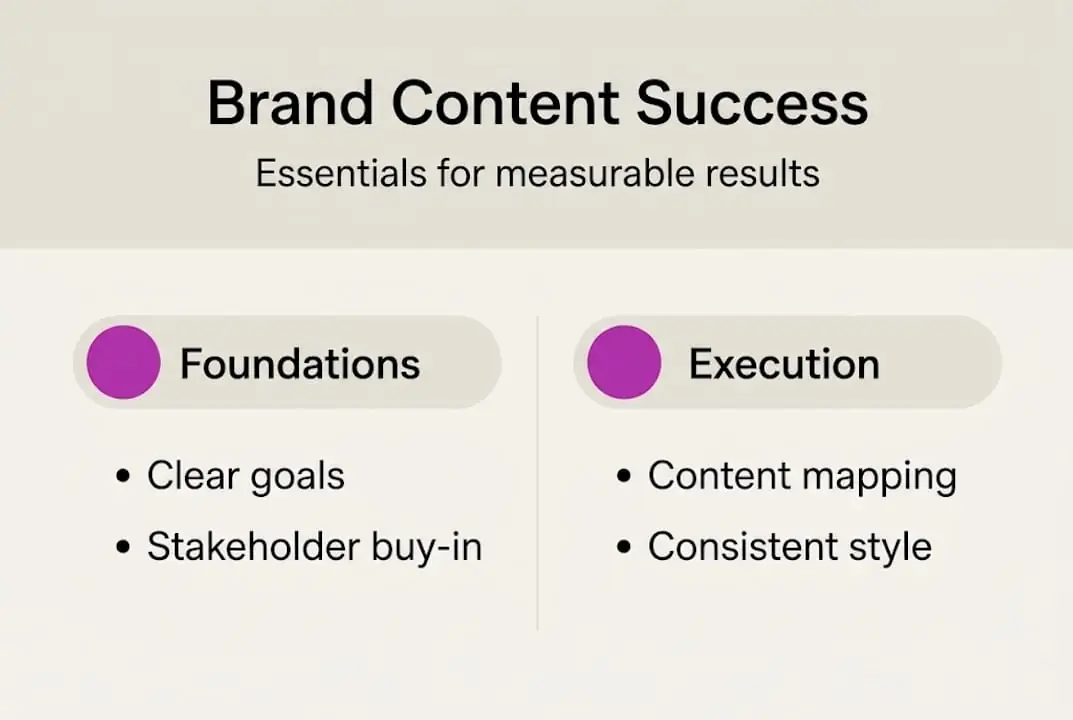
Securing executive or stakeholder buy-in is equally critical. Content programmes that lack senior support tend to lose budget, resource, and momentum the moment results take longer than a quarter to materialise. Make the business case early, using data and benchmarks rather than creative enthusiasm alone. A well-structured HBS content strategy framework can help you present this case persuasively to leadership.
You will also need the right team roles in place. At minimum, you need someone responsible for strategy, someone for creation, and someone with authority to approve. Blurring these roles creates confusion and delays.
Essential tools and platforms to have ready:
- A project management tool (Asana, Monday, or Notion work well)
- A content management system (CMS) for publishing
- An analytics platform (Google Analytics 4 or equivalent)
- A centralised brand guidelines repository
- A keyword and SEO research tool
The core methodology for brand content creation involves seven steps, starting with defining goals and creating a style guide. That style guide is not optional. It should document your brand story, personality, tone of voice, visual identity, and approved messaging. Think of it as the rulebook every piece of content must follow.
| Foundation element | Why it matters | Recommended tool or approach |
|---|---|---|
| Documented business goals | Aligns content to outcomes | OKR framework or strategy doc |
| Stakeholder sign-off | Ensures long-term resource support | Formal content brief or proposal |
| Style guide | Maintains brand consistency | Notion, Google Docs, or Frontify |
| Analytics setup | Enables performance tracking | GA4, Semrush, or Ahrefs |
| Team roles defined | Prevents bottlenecks | RACI matrix |
Pro Tip: Do not build your style guide from scratch. Start with a proven template and adapt it to reflect your brand’s specific voice, visuals, and values. This saves weeks and ensures you cover every essential element.
Step-by-step process: creating brand content that delivers
With your prerequisites sorted, it is time to move through the creation process itself. The seven core steps for successful content creation are: define goals, understand your audience, map content to the buyer’s journey, develop your style guide, ensure E-E-A-T in every piece, publish across mixed channels, and optimise based on performance data.

Step 1: Define your objectives. Every content piece should ladder up to a specific business goal. Use the SMART framework: specific, measurable, achievable, relevant, and time-bound.
Step 2: Know your audience deeply. Go beyond demographics. Understand the questions your audience is asking, the frustrations they carry, and the language they use. Build at least two detailed audience personas.
Step 3: Map content to the buyer’s journey. Awareness-stage content (blog posts, social videos) attracts new audiences. Consideration-stage content (case studies, webinars) nurtures interest. Decision-stage content (testimonials, demos) converts.
Step 4: Apply your style guide consistently. Every piece of content, regardless of format or channel, should feel unmistakably yours. Consistency builds recognition and trust over time.
Step 5: Prioritise E-E-A-T. Quality content must demonstrate experience, expertise, authority, and trust. This is non-negotiable for both search performance and audience credibility. Use real data, named contributors, and verifiable claims.
Step 6: Publish across mixed channels. Owned channels (your website, email list) form the foundation. Paid channels amplify reach. Earned channels (press, backlinks) build authority. Do not rely on a single platform.
Step 7: Measure, learn, and iterate. Review performance data at least monthly. Identify what is working, what is not, and why. The steps for marketing success are not linear; they loop back continuously.
| Content stage | Goal | Format examples |
|---|---|---|
| Awareness | Attract new audiences | Blog posts, short video, social content |
| Consideration | Build trust and educate | Case studies, webinars, email sequences |
| Decision | Convert and retain | Testimonials, demos, product comparisons |
The content marketing process works best when your team produces content in batches rather than one piece at a time. Create one anchor asset (a long-form article or video) and repurpose it into multiple formats: social posts, email snippets, short clips, and infographics. This approach, sometimes called the pillar-and-cluster model, is one of the most efficient ways to scale content production strategies without burning out your team.
Pro Tip: Batch production from a single anchor asset can cut your content creation time by up to 40%. Plan one strong piece per week and atomise it across every relevant channel and format.
Choosing formats and channels: making your content work harder
With your content method mapped, the next step is choosing formats and channels that will maximise your reach and results. Not all formats are created equal, and the right choice depends heavily on your audience, your objectives, and where your buyers actually spend their time.
Short articles, video, and case studies are the most-used formats in 2026, and for good reason. They balance discoverability, shareability, and depth. But the real standout is short-form video: clips under 90 seconds achieve double the engagement of longer formats across most social platforms. If you are not already investing in short-form video, you are leaving significant reach on the table.
Case studies deserve special mention. They are one of the most underused formats in B2B content, yet they consistently rank among the highest-converting assets. A well-crafted case study answers the buyer’s core question: has this worked for someone like me?
Top content formats and their best use cases:
- Short-form video (under 90 seconds): Brand awareness, social reach, product demonstrations
- Long-form articles (1,500 words or more): SEO, thought leadership, audience education
- Case studies: Lead generation, sales enablement, trust building
- Email newsletters: Audience retention, nurturing, direct conversion
- Infographics: Data storytelling, social sharing, PR outreach
- Webinars and podcasts: Deep engagement, community building, authority
For distribution, think in three layers. Owned channels (your website, blog, and email list) give you full control and long-term compounding value. Paid channels (social ads, sponsored content) give you speed and targeting precision. Earned channels (press coverage, backlinks, organic shares) give you credibility.
Innovative social media content ideas can help you diversify your owned and earned distribution without dramatically increasing your budget. The key is matching the format to the platform: LinkedIn rewards long-form thought leadership, Instagram and TikTok reward short-form video, and email rewards consistency and personalisation.
| Format | Best channel | Primary benefit |
|---|---|---|
| Short-form video | Instagram, TikTok, LinkedIn | High engagement and reach |
| Long-form article | Website, LinkedIn | SEO and authority |
| Case study | Website, email, sales decks | Conversion and trust |
| Email newsletter | Owned list | Retention and nurturing |
| Infographic | Pinterest, LinkedIn, PR | Shareability and backlinks |
Strategies anchored in creator or anchor content drive up to 32x more volume and 94% better ROI than paid advertising alone. Understanding digital content’s role in your broader brand strategy is what separates brands that grow from brands that simply publish.
AI, approvals, and quality: overcoming modern brand content challenges
Choosing the right formats is only half the story. Modern challenges from AI to approval bottlenecks can make or break your brand content success, regardless of how strong your strategy looks on paper.
Generative AI has changed content production significantly. It offers genuine scale benefits: faster drafts, broader ideation, and reduced production costs. But AI requires guardrails and training on brand-specific examples to maintain voice and quality. Without these, AI output tends to sound generic, off-brand, and occasionally inaccurate.
The most effective approach combines AI efficiency with human editorial oversight. Use AI for first drafts, ideation, and repurposing. Use human editors for brand voice, factual accuracy, and strategic alignment. Build a prompt library that reflects your brand’s tone and approved messaging, and create a set of brand guardrail documents that AI outputs must be checked against before publication.
Practical steps for responsible AI use in content:
- Build a prompt library aligned to your brand voice and style guide
- Use retrieval-augmented generation (RAG) to ground AI outputs in your own data
- Train AI tools on your best-performing, on-brand content examples
- Establish a human review step before any AI-generated content is published
- Review AI outputs against your content production strategies and brand guidelines
“Overly complex approval processes are one of the biggest hidden costs in content marketing. A 17-step sign-off chain does not protect your brand; it just delays your results and demoralises your team.”
Approval bottlenecks are a related and equally damaging problem. Many brands have inadvertently built approval processes that take longer than the content itself took to produce. Streamline sign-off by defining clear approval tiers: who has final say, who provides input, and who simply needs to be informed. Agile content teams typically operate with two or three approval stages at most.
Quality beats quantity for 83% of brands, and E-E-A-T is non-negotiable in 2026. Explore brand voice content packages that help you maintain consistency at scale, and consider investing in content creation as a long-term brand asset rather than a short-term cost.
Pro Tip: Create a one-page “brand guardrail” document summarising your tone, banned phrases, approved claims, and visual rules. Attach it to every AI prompt brief and every content brief sent to external contributors.
Measuring impact and optimising for long-term brand growth
Once your processes are streamlined, the focus shifts to ensuring your content delivers meaningful, measurable results. Measurement is not a final step; it is an ongoing discipline that informs every future decision.
Start by selecting the right key performance indicators (KPIs) for your specific objectives. Vanity metrics like raw page views or follower counts tell you very little about business impact. The metrics that matter most are those tied directly to brand and revenue outcomes.
Core KPIs for brand content performance:
- Share of voice: How visible is your brand relative to competitors in your category?
- Media impact value (MIV): What is the equivalent monetary value of your earned media coverage?
- Engagement rate: Are audiences actively interacting with your content, or passively scrolling past?
- Backlink acquisition: Is your content earning links from credible, relevant sources?
- Revenue per pound of content spend: Are your content investments generating a measurable financial return?
Content strategies deliver 3.2x revenue per pound compared to brands without a documented approach. That is a compelling figure, but it only materialises when measurement is built into the process from the start, not bolted on at the end.
Use both quantitative and qualitative data. Quantitative data (traffic, conversions, engagement rates) tells you what is happening. Qualitative data (audience comments, sales team feedback, customer interviews) tells you why. The combination gives you the full picture.
Review your performance benchmarks regularly and establish a learning cycle. Monthly reviews catch problems early. Quarterly strategy reviews allow you to pivot when a format or channel is underperforming. Annual reviews let you assess long-term brand trajectory.
| KPI | What it measures | How to act on it |
|---|---|---|
| Share of voice | Brand visibility vs competitors | Increase output in underperforming topics |
| Engagement rate | Audience interaction quality | Test new formats or angles |
| Backlink count | Content authority and reach | Invest in more linkable assets |
| Revenue attribution | Direct content-to-revenue link | Prioritise highest-converting formats |
| MIV | Earned media value | Amplify PR and influencer strategies |
Long-term brand building and short-term campaign wins are not mutually exclusive. The best content programmes use essential digital marketing strategies to balance both: evergreen content that compounds over time alongside campaign-specific content that drives immediate results.
Why most brand content strategies fail (and what actually works)
After working across dozens of brand content programmes, the pattern is remarkably consistent. Brands that struggle are not struggling because they lack creativity or budget. They are struggling because they have confused activity with strategy.
The most common failure mode is over-indexing on frequency. Publish more, post more, send more. The logic feels sound: more content means more chances to be seen. But in practice, publishing ten mediocre pieces produces far less impact than publishing two useful, well-distributed ones. Volume without quality is just noise.
The second failure mode is misalignment between content and business goals. Content teams often operate in a creative bubble, producing work that wins internal praise but fails to move commercial metrics. Real growth comes from solid strategic groundwork, not from a packed content calendar.
What actually works is simpler than most brands expect. Consistent value, delivered to the right audience, in the right format, measured rigorously, and iterated upon. That is it. There is no shortcut, no viral hack, and no tool that replaces strategic clarity.
We believe that content is only as powerful as the clarity of its purpose and the discipline behind its process. Brands that treat sustainable content investments as a long-term asset, rather than a quarterly experiment, are the ones that build lasting competitive advantage. The brands winning in 2026 are not the ones publishing the most. They are the ones publishing with the most intention.
Ready to accelerate your brand with expert content support?
Armed with a proven framework, you may find that the next challenge is execution: finding the time, the talent, and the tools to bring it all to life consistently. That is where specialist support makes a genuine difference. Closer to home, our marketing agency High Wycombe page makes the case that almost nobody looking for a nearby agency actually cares about the distance.
At AMW Media, we work with ambitious brands to build and execute content strategies that deliver measurable growth. From social media management that keeps your brand visible and engaging, to web design that turns content traffic into conversions, and SEO packages that ensure your content gets found, our team brings strategic thinking and creative execution together under one roof. If you are ready to move from sporadic publishing to a content programme that compounds over time, we would love to help you build it.
Frequently asked questions
What is the most effective type of brand content in 2026?
Short-form video under 90 seconds and case studies consistently drive the highest engagement and conversion rates for most brands across both B2B and B2C categories.
How do you measure the ROI of brand content?
Track KPIs including engagement rate, share of voice, backlink acquisition, and revenue attribution. Content strategies generate 3.2x revenue per pound compared to brands without a documented approach.
How can brands use AI for content creation without sacrificing quality?
Use AI for scale and ideation, but maintain human editorial oversight at every stage. AI requires guardrails and prompts trained on your best brand examples to preserve voice and accuracy.
How often should brand content be published for best results?
Prioritise quality over quantity. Aim for at least two high-quality long-form pieces per month, supplemented by shorter formats. Quality beats quantity for 83% of brands that track content performance rigorously.
Recommended
- Why invest in content creation for competitive brand growth
- Effective content production strategies for brand growth
- The role of digital content in brand growth and engagement
- Get Started with AMW Media | Your In-House Marketing Team
- Guide till datadriven marknadsföring 2026 för tech och e-handel
Our free marketing audit looks at your site, your ads and your content, and comes back with a 30 day plan. No pitch deck.

Owns how everything looks and feels, from a brand identity to the grade on a reel, and makes the animated films such as Blue Light Services' Journey to Net Zero. Meet the team.