
 Black Steel Doors
 Woodstock Campers
 Phillips Joinery
TL;DR:
- Strategic storytelling builds emotional engagement, differentiation, and loyalty beyond slogans and visuals.
- Using structured frameworks like Hero’s Journey and StoryBrand SB7 ensures scalable, coherent brand narratives.
- Authentic, customer-centred stories, consistently applied across all channels, drive measurable growth.
Most brands believe storytelling is simply catchy slogans and vibrant visuals. The reality is far more nuanced, and considerably more powerful. When approached as a strategic framework rather than a creative afterthought, brand storytelling becomes one of the most reliable engines for engagement, loyalty, and measurable digital growth. For marketing managers and brand strategists, the difference between surface-level narrative and a truly transformative story structure can determine whether campaigns resonate deeply or fade into background noise. This article unpacks the core frameworks, practical implementation strategies, common pitfalls, and actionable techniques that ambitious brands use to connect with audiences in ways that genuinely matter.
Key Takeaways
| Point | Details |
|---|---|
| Frameworks matter | Effective brand storytelling relies on strategic frameworks, not ad hoc messaging. |
| PESO model integration | Embedding stories across paid, earned, shared, and owned channels drives engagement and consistency. |
| Avoid common pitfalls | Brands must avoid hero-centric and fabricated stories, focusing on authentic customer journeys. |
| Measure for impact | Use brand lift studies and A/B testing to validate storytelling effectiveness. |
Understanding brand storytelling: Beyond slogans and visuals
Brand storytelling is not about clever copy or a memorable tagline. At its core, it is the strategic creation and sequencing of narratives that communicate your brand’s values, purpose, and promise through emotionally resonant experiences rather than direct product claims. The distinction matters enormously. A slogan tells. A story shows. One is a label; the other is a lived experience compressed into content.
Many marketing teams conflate storytelling with content marketing in general. While content marketing is the broader discipline, storytelling is the organising intelligence within it. It determines why a piece of content exists in a particular sequence, who the narrative centres on, and what transformation the audience should feel by the end. Without storytelling, content becomes a catalogue of information. With it, content becomes a journey.
Consider what separates a brand that posts product updates from one that publishes customer transformation stories. The latter is practising brand storytelling. The product is still there, but it is positioned as the tool within a larger human narrative. This shift in framing changes how audiences perceive value, builds emotional investment, and ultimately drives the kind of loyalty that paid advertising alone cannot manufacture.
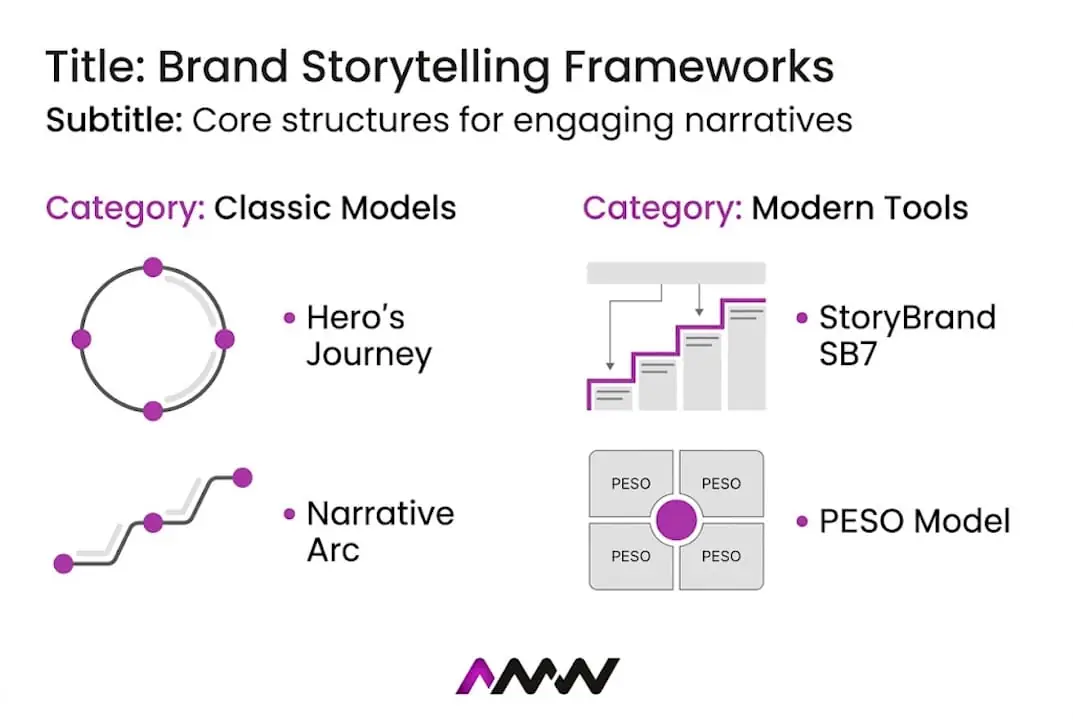
Frameworks are what make storytelling actionable and scalable. Without a repeatable structure, narratives remain inconsistent and dependent on individual creative talent. With a framework, any campaign, channel, or content type can carry a coherent narrative thread. The brand narrative arc framework outlines methodologies including the Hero’s Journey, Narrative Arc, StoryBrand SB7, and Simon Sinek’s Golden Circle, each of which provides a different structural lens for building brand narratives. These are not theoretical concepts. They are practical scaffolds that professional teams use to sequence emotional beats, guide audience attention, and ensure every touchpoint reinforces the same core story.
Here is what effective brand storytelling consistently delivers:
- Emotional resonance: Audiences remember how your brand made them feel, not what you listed in a product description
- Differentiation: Stories rooted in authentic values are far harder to replicate than feature-based positioning
- Trust building: Consistent narratives across touchpoints signal reliability and authenticity
- Conversion alignment: Stories that mirror the audience’s desires and challenges naturally guide decision-making
- Scalable consistency: Frameworks allow different team members and agencies to produce on-brand content without losing narrative coherence
“Storytelling is not decoration. It is the architecture of meaning that your audience builds their brand relationship upon.”
Great brand content that drives results is always grounded in this kind of structured thinking. The brands that consistently outperform competitors in engagement metrics are those that have moved beyond the “what should we post today?” mentality towards a deliberate, narrative-led strategy with clear emotional objectives for every piece of content they create.
Key storytelling frameworks for brands
Now that brand storytelling is defined, let us dissect the frameworks that shape compelling narratives. Each major framework serves a different strategic purpose, and understanding which one suits your campaign goals is a critical first decision.
| Framework | Core structure | Best for | Customer role |
|---|---|---|---|
| Hero’s Journey | Ordinary world, trial, transformation | Long-form content, brand films | Protagonist |
| Narrative Arc | Setup, tension, resolution, epilogue | Campaign series, email sequences | Participant |
| StoryBrand SB7 | Hero, problem, guide, plan, success | Web copy, ads, pitch decks | Hero |
| Golden Circle | Why, How, What | Brand positioning, culture content | Believer |
The Hero’s Journey, popularised by Joseph Campbell and adapted extensively for marketing, works by positioning the customer as the hero who enters an unfamiliar challenge, faces meaningful trials, and emerges transformed. Your brand acts as the wise mentor, the guide rather than the protagonist. This is particularly powerful for industries where customers face significant life changes such as health, finance, or career transitions. The emotional arc is wide, which means it suits longer-form content like brand documentaries, case study videos, or multi-email sequences.

The Narrative Arc is a more flexible and modular version of storytelling. It runs through setup (who the customer is and what they want), tension (the obstacle they face), resolution (how the brand helps them overcome it), and epilogue (the new reality they enjoy). This structure works exceptionally well for campaign series across social media, where each post or video can occupy a different stage of the arc while still feeling cohesive. As noted in the brand narrative arc framework, these methodologies structure the customer journey through recognisable emotional stages.
StoryBrand SB7, developed by Donald Miller, is one of the most practically adopted frameworks in digital marketing. Its genius lies in radical clarity: it forces brands to define the customer’s problem at three levels (external, internal, philosophical), position the brand as the empathetic guide with a concrete plan, and articulate clear stakes. It is especially effective for website copy, paid ads, and landing pages where attention is scarce and clarity wins.
The Golden Circle, Simon Sinek’s framework centred on Why, How, and What, is less a narrative sequence and more a positioning philosophy. It is best used to establish brand purpose content: culture videos, founder stories, manifesto pages. Audiences who connect with your Why before your What tend to become the most loyal advocates.
To apply any of these frameworks to a live campaign, follow these steps:
- Define your audience’s primary desire and their most painful obstacle to reaching it
- Choose the framework that best matches your content format and campaign length
- Map each content piece or touchpoint to a specific stage of the framework
- Write or produce each asset with one dominant emotional beat per stage (recognition, tension, relief, inspiration)
- Review the full sequence as a narrative journey before publishing to ensure coherence
Pro Tip: Before launching, test individual emotional beats in isolation. Run a quick audience poll or small ad test to confirm whether the tension stage genuinely resonates, or whether your audience recognises themselves in the setup. Small adjustments at this stage can dramatically improve full-campaign performance. For a deeper look at how creative production supports this process, our creative campaign process guide walks through each production phase in practical detail.
Implementing storytelling across digital channels
Once you have chosen a storytelling framework, the next step is integrating it across your marketing ecosystem. The PESO model (Paid, Earned, Shared, Owned) provides an excellent structure for thinking about how your narrative should appear and adapt across different media environments.
Paid channels include PPC advertising, social media ads, and programmatic display. Here, storytelling must be compressed. A Hero’s Journey that spans three minutes in a brand film needs to be distilled to a single emotional hook in a six-second bumper ad. The key is identifying which moment in the narrative carries the highest emotional charge and leading with that.
Earned channels include press coverage, influencer partnerships, and organic mentions. Storytelling in earned media works when your narrative is genuine enough that journalists and creators want to retell it in their own words. Brands with clear, compelling origin stories or remarkable customer transformation examples consistently attract more earned coverage than those relying on product announcements.
Shared channels, primarily social media, are where modular storytelling components prove their worth. Rather than reinventing your narrative for every post, smart brands build a library of story components: the hook (who the customer is and what they want), proof snippets (real results from real customers), and tension moments (the problem state your audience recognises in themselves). These components can be recombined and sequenced across different social platforms without losing narrative integrity. Social media marketing tips for maximising engagement consistently point to narrative continuity as a key differentiator between brands that retain followers and those that merely accumulate them.
Owned channels, such as your website, blog, email list, and podcast, are where the deepest storytelling lives. These are the spaces where audiences choose to spend extended time with your brand, which means the full narrative arc can breathe. Long-form effective content production strategies that are built around storytelling frameworks consistently outperform purely informational content in time-on-page and return visit metrics.
Here is how to embed reusable story components across PESO channels:
- Hook component: A single-sentence summary of the customer’s desire and obstacle (used in ad headlines, email subject lines, social captions)
- Proof snippet: A concrete data point or customer quote that validates transformation (used in ad copy, website sections, case study summaries)
- Tension moment: A vivid description of the problem state (used in landing page introductions, video openings, podcast cold opens)
- Resolution frame: The “after” state the customer achieves (used in CTAs, product pages, email closers)
| Channel type | Storytelling depth | Best component to lead with | Measurement metric |
|---|---|---|---|
| Paid (ads) | Compressed, single beat | Hook or tension moment | Click-through rate, ROAS |
| Earned (PR/influencer) | Medium, brand narrative | Origin story or proof snippet | Share of voice, backlinks |
| Shared (social) | Modular, sequential | Hook, then proof, then resolution | Engagement rate, saves |
| Owned (web/email) | Full arc, immersive | Full narrative sequence | Time on page, retention |
For video marketing strategies specifically, the modular approach is even more powerful because individual video clips can serve multiple roles across different channels simultaneously. A sixty-second customer story video can be cut into a fifteen-second tension moment for ads, a thirty-second proof snippet for social, and kept in full for the website. This is what the digital marketing guide describes as scalable narrative architecture.
Pro Tip: Build your story component library before you begin production. Identify at least three hooks, three proof snippets, and two tension moments before briefing your content team. This saves significant revision time and ensures that every asset produced can serve multiple channels without additional editing.
Measure storytelling impact using brand lift studies (which track shifts in awareness, consideration, and preference following a campaign) and cohort retention analysis (which compares how audiences who engaged with story-driven content behave over time compared to those who did not). These metrics reveal what click-through rates cannot: whether your narrative is genuinely shifting perception. As the brand narrative arc framework recommends, ambitious companies should integrate storytelling frameworks into multi-channel strategies with reusable components to ensure consistency and scalability.
Pitfalls and best practices in brand storytelling
Applying frameworks is powerful, but avoiding straightforward errors will ensure storytelling efforts truly resonate. The most common and damaging mistake brands make is positioning themselves as the hero of the story. It feels instinctive. You built the product, you solved the problem, so surely the story is yours to tell. But audiences do not connect with brand success stories. They connect with their own potential reflected back at them.
When a brand occupies the hero role, the audience becomes a passive spectator to someone else’s achievement. When the customer is the hero, the audience leans in because they recognise their own journey. This is why content marketing storytelling consistently highlights avoiding brand-as-hero narratives as the single most impactful correction a marketing team can make. The shift is measurable in engagement and conversion metrics, not only philosophical.
The second major pitfall is fabricating or exaggerating stories. This encompasses invented customer testimonials, embellished case study results, and manufactured origin narratives. In an environment where audiences are more sceptical than ever, artificial stories are detected quickly, and the reputational damage is disproportionate to any short-term gain. Authenticity is a strategic position as much as an ethical one. Real stories, even imperfect ones, outperform polished fiction in both resonance and longevity.
Here are the best practices for building genuinely effective brand storytelling:
Conduct emotional resonance testing: Before full production, share rough story concepts with a small sample of your target audience. Ask whether they like it, then ask whether they recognise themselves in it. Recognition is the precursor to engagement.
Use A/B testing to validate narrative choices: Run story-driven creative against standard feature-based creative for the same offer. Compare clicks, then compare downstream metrics like average order value and repeat purchase rate. The data consistently favours stories, but the type of story that works varies by audience.
Ground every narrative in real evidence: Use actual customer language from reviews, interviews, and support tickets to shape the tension and resolution stages. Audiences can tell when copy is written about them versus written from their experience.
Keep the brand in the guide role: Your brand should appear as the enabler of transformation, not the source of it. The customer achieves; your brand equips.
Maintain tonal and narrative consistency across all touchpoints: Inconsistency breaks the story. An audience who experiences an emotionally charged ad campaign and then lands on a transactional, tone-deaf website will disengage instantly.
Common mistakes to avoid include:
- Launching storytelling campaigns without a documented narrative framework
- Using success metrics alone (revenue, awards) as the story without a human journey
- Treating storytelling as a one-off campaign rather than an ongoing brand practice
- Neglecting to revisit and refresh narratives as customer contexts evolve
“The most authentic brand stories are not written by marketing teams. They are discovered in the words of your customers and translated back into content with care.”
Reviewing proven content marketing examples reveals a consistent pattern: the campaigns that stand out are those built on real human experiences, structured through deliberate narrative frameworks, and validated through testing rather than assumption.
Our perspective: Why most brands miss the true power of storytelling
Here is what we observe repeatedly working with ambitious brands: the brands that struggle with storytelling are not struggling because they lack creative talent. They are struggling because they treat storytelling as a campaign feature rather than a business infrastructure.
Conventional approaches focus on the surface layer, crafting a beautiful brand film, writing a compelling about page, running a campaign with a strong narrative hook. These are valuable. But they represent the visible one-tenth of the iceberg. The nine-tenths beneath the surface is the consistent, customer-centric story that runs through every email subject line, every social reply, every product page, every customer service interaction. That consistency is what transforms storytelling from a marketing tactic into a brand asset.
Most brands also underestimate the compound effect of modular storytelling. A single well-constructed story component, a tension moment built on real customer language, for example, can be deployed across twenty different touchpoints over twelve months. It appreciates over time as audiences encounter it in different contexts and it gradually builds recognition. This is the opposite of the “always new content” treadmill that exhausts teams and produces diminishing returns.
Our honest advice: invest in the architecture before the aesthetics. Define your customer’s journey, choose a framework, build your component library, and then commission the creative production. The creative content production steps that yield the best results are always those where the narrative thinking precedes the camera and the keyboard.
The brands that consistently win at storytelling are not the ones with the biggest budgets. They are the ones with the clearest understanding of whose story they are really telling.
Next steps: Use storytelling for your brand’s growth
Storytelling without execution is just theory. If the frameworks and strategies above have clarified what your brand’s narrative needs, the next step is building the capability to deliver it consistently across every channel that matters.
At AMW Media, we work with ambitious brands to translate storytelling strategy into tangible creative and digital output, from custom web design that embeds your narrative architecture directly into the user experience, to PPC campaign management that compresses your story into high-converting ad formats. Our team combines strategic thinking with hands-on creative production so that your narrative is defined and then activated across every touchpoint. Starting from scratch or refining an existing approach: explore the full range of AMW Media services and connect with our team to discuss a storytelling strategy matched to your brand’s growth ambitions.
Frequently asked questions
How does brand storytelling differ from traditional advertising?
Brand storytelling creates emotional engagement by placing customers at the centre of the narrative, whereas traditional advertising typically prioritises direct messaging or product features. Recognised frameworks like Hero’s Journey and StoryBrand SB7 structure this customer-centric approach deliberately.
Which frameworks are most effective for digital campaigns?
Hero’s Journey and StoryBrand SB7 are widely adopted for digital campaigns because they structure content around customer transformation and clear brand guidance, making them highly adaptable across both long-form and compressed formats.
How can storytelling be measured for impact?
Impact can be gauged through brand lift studies, cohort retention analysis, and A/B testing of story-driven versus standard creatives. As the brand narrative arc framework advises, these methods reveal whether narratives are shifting brand perception beyond surface-level engagement metrics.
What mistakes should brands avoid in storytelling?
Brands should avoid casting themselves as the hero and fabricating or embellishing stories; effective storytelling requires authentic, customer-centric narratives tested for genuine emotional resonance rather than assumed creative impact.
Recommended
- Why branding matters: grow and differentiate your business
- Why invest in content creation for competitive brand growth
- The role of digital content in brand growth and engagement
- Why data-driven marketing propels your brand’s growth | AMW Media
Our free marketing audit looks at your site, your ads and your content, and comes back with a 30 day plan. No pitch deck.

Owns how everything looks and feels, from a brand identity to the grade on a reel, and makes the animated films such as Blue Light Services' Journey to Net Zero. Meet the team.