
 Black Steel Doors
 Woodstock Campers
 Phillips Joinery
Meta A/B testing, officially called Meta Experiments, is Meta’s built-in split-testing system that randomly divides your audience so each person sees exactly one variant, giving you clean, overlap-free results you can actually trust. Use Experiments for high-stakes validation, testing offers, landing pages, or concept-level creative, and use ad-level or Advantage+ testing when you need fast creative discovery on a tighter timeline.
Quick guide: which method fits your situation?
- Use Meta Experiments when the decision is expensive, the test needs to be defensible, or you’re comparing fundamentally different concepts (landing pages, offers, audience strategies).
- Use manual ad-set splits when budget is limited and you want directional creative signals quickly, accepting slightly noisier data.
- Use Advantage+ or ad-level testing for rapid iteration on execution-level elements: headline tweaks, thumbnail swaps, CTA button copy.
Key takeaways
Running reliable Facebook A/B tests requires a single variable, sufficient conversion volume per variant, and the discipline to run tests to completion before acting on results.
| Point | Details |
|---|---|
| Use Experiments for high-stakes tests | Meta Experiments eliminates audience overlap, use it for landing pages, offers, and concept-level creative decisions. |
| Aim for 100+ conversions per variant | Fewer than 100 conversions per variation produces results too noisy to act on confidently. |
| Run tests for at least 14 days | Seven days is the minimum; conversion-optimised tests typically need 14 to 28 days to stabilise. |
| Test concepts before execution | Concept-level creative differences produce larger, more actionable results than minor element tweaks. |
| AMW Media runs end-to-end experiments | AMW Media designs, sets up, and interprets Meta A/B tests, then scales winners into live campaigns. |
How does Meta’s A/B testing (Experiments) actually work?
The core mechanic is audience holdout. Meta randomly assigns each person in your target audience to one variant and one only. Version A viewers never see Version B, which eliminates auction overlap and the delivery bias that creeps in when two regular ad sets compete for the same people. That’s the reason Experiments produces cleaner results than running two campaigns side by side and eyeballing the numbers.
The three Experiment types Meta offers:
- A/B test: isolates a single variable (creative, copy, audience, placement, optimisation event, or landing page URL) across two to four variants. This is the workhorse.
- Holdout test: withholds ads from a percentage of your audience to measure the true incremental lift your campaigns are generating. Useful for proving that ads are actually driving conversions rather than capturing people who would have converted anyway.
- Brand survey: measures brand lift (awareness, recall, consideration) using in-feed surveys. Suited to upper-funnel or awareness campaigns where purchase conversions are not the primary signal.
Practical constraints worth knowing before you start:
- You can test up to four variants in a single A/B test.
- Tests run at campaign, ad-set, or ad level depending on the variable you are isolating.
- Creative testing in Ads Manager requires daily budgets, not lifetime budgets, and certain bid strategies are restricted. A common recommendation is to limit test spend to a portion of your campaign budget to avoid disrupting active delivery.
- Experiments cannot run across campaigns using conflicting bid strategies, so align these before you build.
How to set up a solid A/B test in Meta Ads Manager
Pre-flight checklist
Before you touch Ads Manager, answer these four questions:
- What is your hypothesis? (“Showing social proof in the first three seconds of video will lower cost per lead compared to a product-feature hook.”)
- What is your primary KPI? One metric only, cost per result, ROAS, or conversion rate. Picking two means you’ll rationalise whichever one looks better.
- Have you estimated your minimum sample size? Aim for at least 50 optimisation events per variation per week as a working threshold, and 100+ conversions per variation for a result you’d confidently act on.
- Are you testing one variable? If the control and challenger differ in three ways, you won’t know which one moved the needle.
Setting up the test: step by step
- Open Meta Ads Manager and navigate to Experiments in the left-hand menu (under Analyse & Report).
- Select Create A/B Test.
- Choose your test level: campaign, ad set, or ad. For creative tests, ad level is cleanest. For audience or placement tests, ad-set level.
- Set your control (the existing ad or ad set you’re measuring against) and add up to three challengers.
- Select your primary metric from the dropdown. For conversion campaigns, choose Purchases or Leads. For awareness, use Reach or Estimated Ad Recall Lift.
- If you need a custom metric (e.g. Purchases divided by Link Clicks as a rough conversion rate proxy), build it in Custom Metrics under Ads Manager columns before setting up the test.
- Set your budget split, equal splits between variants are the default and usually the right call unless you have a strong prior reason to weight one.
- Use Meta’s test-duration calculator to estimate how long you need. Enter your weekly result estimate, minimum detectable effect size, and confidence level. For conversion-optimised campaigns, a test duration of at least two weeks is typical.
- Set your attribution window to match your campaign objective. Mismatched windows between control and challenger are a common source of misleading results.
- Name the test clearly: [Date]_[Variable]_[Control vs Challenger], for example, 2026-03_Hook_SocialProof-vs-ProductFeature.
Example campaign structure for a creative A/B test:
| Ad set | Ad | Variable |
|---|---|---|
| Ad Set A (Control) | Video: product feature hook | Baseline |
| Ad Set B (Challenger 1) | Video: social proof hook | Hook style |
| Ad Set C (Challenger 2) | Video: problem/solution hook | Hook style |
Each ad set has an identical audience, identical budget, and identical placement settings. The only thing that changes is the creative.
Pro Tip: Never end a test early because one variant looks like it’s winning. Meta’s delivery algorithm needs time to stabilise, and early results are often misleading. Commit to your planned duration before you look at the numbers.
When should you use Experiments versus faster ad-level testing?
The honest answer is: it depends on what question you’re asking and how much the answer is worth to you.
Meta’s algorithmic delivery has improved significantly, which means the marginal value of fine-grained audience splits has shrunk. In practice, creative variation now drives more measurable performance differences than audience segmentation. That shifts the testing priority toward creative and concept tests, where Experiments earns its cost.
Method comparison at a glance:
| Testing method | Best for | Speed | Precision | Budget requirement |
|---|---|---|---|---|
| Meta Experiments | Concept tests, landing pages, offers | Slower (7 to 28 days) | High (no overlap) | Medium to high |
| Manual ad-set splits | Rapid creative direction, small budgets | Fast | Lower precision (due to overlap risk) | Low to medium |
| Advantage+ / ad-level | Execution tweaks, thumbnail, headline | Fastest | Directional only | Any |
Practical signals to help you choose:
- If the decision involves significant budget reallocation or a landing page rebuild, use Experiments. The cost of a wrong call is high enough to justify the slower, cleaner method.
- If you’re iterating on hook copy or thumbnail options and you have limited weekly conversions, manual ad-set splits give you directional signals faster.
- If you’re running Advantage+ Shopping Campaigns, let Meta’s algorithm do the creative selection and use Experiments to test the concepts you feed it, not the delivery mechanism itself.
Which metrics matter, and how long should you run the test?
Choosing your primary KPI
Pick the metric that maps directly to your business objective:
- Cost per result (CPR) or cost per acquisition (CPA): the right primary KPI for conversion campaigns. Don’t let a lower CPM distract you from a worse CPA.
- ROAS: useful when average order value varies significantly between variants (different offers, different landing pages).
- Conversion rate: good for landing-page tests where traffic volume is the same but post-click behaviour differs.
- CTR: a fast proxy for messaging resonance when conversion volumes are too low to reach significance. Treat CTR as a directional signal, not a final verdict, validate on conversion KPIs before scaling.
Sample size and duration rules of thumb
The minimum threshold most practitioners use is 50 optimisation events per variation per week. For a result you’d stake real budget on, aim for 100+ conversions per variation. Testing a small effect size? You may need 400 or more conversions per variation before the signal is reliable.
Meta’s test-duration calculator is the right starting point. The platform recommends a minimum of seven days for any test, and 14 to 28 days is more realistic for conversion-optimised campaigns where daily volumes fluctuate.
Why stopping early is a problem:
- Early in a test, one variant often gets lucky delivery. The algorithm hasn’t fully explored the audience.
- Stopping at the first sign of a winner inflates your false-positive rate significantly.
- Meta reports confidence levels in Experiments results. A result at 80% confidence is not a winner, wait for 95% or a meaningful CPA delta before acting.
When a result is inconclusive:
Wide confidence intervals usually mean one of three things: the effect size is smaller than you expected, the test ran for too short a period, or your conversion volume is too low. In that case, extend the test, increase budget, or reframe the hypothesis around a larger creative difference.
Designing reliable tests: what to do and what to avoid
Good test design is mostly about discipline. The most common reason a Facebook split test produces useless data isn’t the platform, it’s the setup.
Do:
- Isolate one variable per test. One change, one answer.
- Match budgets exactly between variants. Unequal spend creates unequal delivery, which creates noise.
- Use the same audience for control and challenger. Audience differences confound creative results.
- Respect the learning phase. Meta needs roughly 50 optimisation events per ad set before delivery stabilises. Running a test during the learning phase produces unreliable data.
- Document every test before you launch: hypothesis, KPI, start date, end date, budget per variant, and the decision rule (what result triggers a winner call).
Don’t:
- Change creative, copy, and audience simultaneously. You’ll get a result you can’t explain.
- Run tests during atypical periods (major sales events, bank holidays, product launches) unless that period is specifically what you’re testing.
- Compare a test ad set against a regular, always-on ad set. Comparing regular ad sets introduces delivery bias because they’re competing in the same auction without the isolation Experiments provides.
- Let frequency spike in one variant. High frequency in one ad set skews engagement metrics and makes the comparison meaningless.
Poor test vs valid test, a quick contrast:
A poor test runs two ad sets with different creative, different audiences, and different bid caps, then declares a winner after four days based on CTR.
Pro Tip: Keep a shared testing log, even a simple spreadsheet works. Record the hypothesis, result, confidence level, and what you did next. After ten tests, patterns emerge that are worth more than any single result.
How to A/B test organic posts and Reels in Meta Business Suite
Meta Business Suite has its own content testing feature, separate from Ads Manager, and it’s useful for organic-to-paid workflows. A/B Content Testing in Business Suite lets you test up to four variants of a post or Reel against each other before committing to a single version for your full audience.
Setting up a content test in Business Suite:
- Open Meta Business Suite and go to Posts & Stories (or Reels).
- Select Create Post and look for the A/B Test option within the post composer.
- Add up to four variants. Each variant can differ in caption, image, video, or link, but keep the variable consistent across variants for clean results.
- Set the test duration and the metric you want to optimise: engagement rate, reach, link clicks, saves, or shares.
- Meta automatically shows the winning variant to the remainder of your audience once the test concludes.
KPIs worth tracking for organic tests:
- Engagement rate (reactions, comments, shares as a percentage of reach) for content resonance.
- Saves as a signal of perceived value, underrated and often more predictive of long-term performance than likes.
- Link clicks if the post drives traffic.
Once you have an organic winner, moving it into a paid test is simple. Duplicate the winning post into Ads Manager as a dark post, set up a new Experiment with the organic winner as your control, and test a paid-specific variant (a stronger CTA, a different landing page, or a format optimised for feed placement). The creative examples that work organically often translate well to paid, but the CTA and landing page usually need adjusting for a paid context.
Concrete test ideas you can copy right now
Creative concept tests produce larger effect sizes than minor element tweaks. Start at the concept level, find a winner, then refine inside it. Here’s a set of ready-to-run templates:
1. Concept-level creative test
Hypothesis: UGC-style video outperforms studio-produced video for cost per lead.
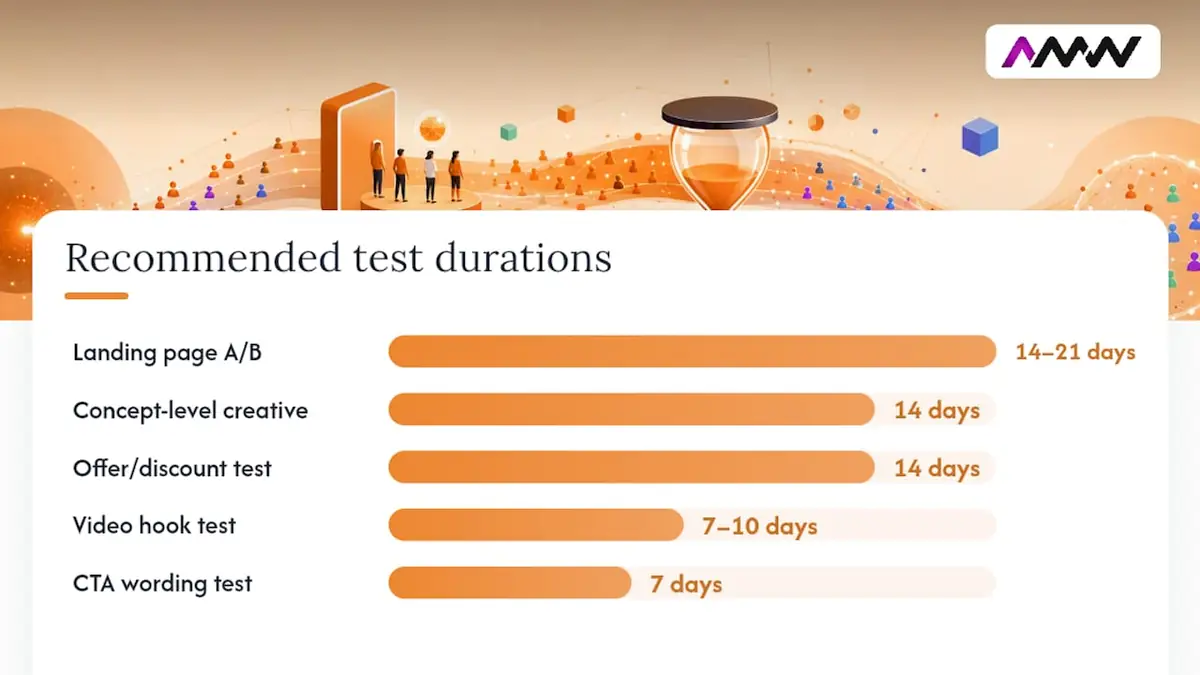
Primary KPI: Cost per lead. Sample size: 100+ leads per variant. Duration: 14 days. Watch for: CPL and post-click conversion rate.
2. Video hook test
Hypothesis: A problem-statement hook (“Struggling with X?”) generates higher CTR than a product-feature hook.
Primary KPI: CTR as a fast signal, then CPL. Sample size: 50 optimisation events per variant per week. Duration: 7 to 10 days. Watch for: CTR, video retention at 3 seconds.
3. Landing page A/B via ad-set split
Hypothesis: A long-form landing page with testimonials converts better than a short-form page for a considered purchase.
Primary KPI: Conversion rate (purchases or leads). Sample size: 100+ conversions per variant. Duration: 14 to 21 days. Watch for: post-click conversion rate, average session duration.
4. Offer or discount test
- Primary KPI: ROAS. Sample size: 100+ purchases per variant. Duration: 14 days. Watch for: ROAS, average order value.
5. CTA wording test
Hypothesis: “Get your free quote” generates more clicks than “Learn more” for a service business.
Primary KPI: CTR, then cost per lead. Sample size: 50 optimisation events per variant. Duration: 7 days. Watch for: CTR, CPL.
The sequencing logic: run concept tests first (biggest levers), then hook tests inside the winning concept, then execution-level tweaks (CTA, copy length, colour). Each phase narrows the creative space and compounds the learning. For managing multiple experiments at scale, automation tooling can help you track test states and avoid running conflicting tests simultaneously.
Agency snapshot: how AMW Media ran a Meta A/B test and used the result
Here’s a condensed example of how the AMW Media team approached a Meta Experiments test for a UK-based e-commerce client selling considered-purchase products.
Business objective: Reduce cost per purchase while maintaining ROAS above the client’s target threshold.
Test design:
- Control: existing studio-produced product video (30 seconds, feature-led).
- Challenger 1: UGC-style video (15 seconds, problem/solution hook).
- Challenger 2: Static carousel with customer review quotes and product imagery.
- Test type: A/B test via Meta Experiments, ad level.
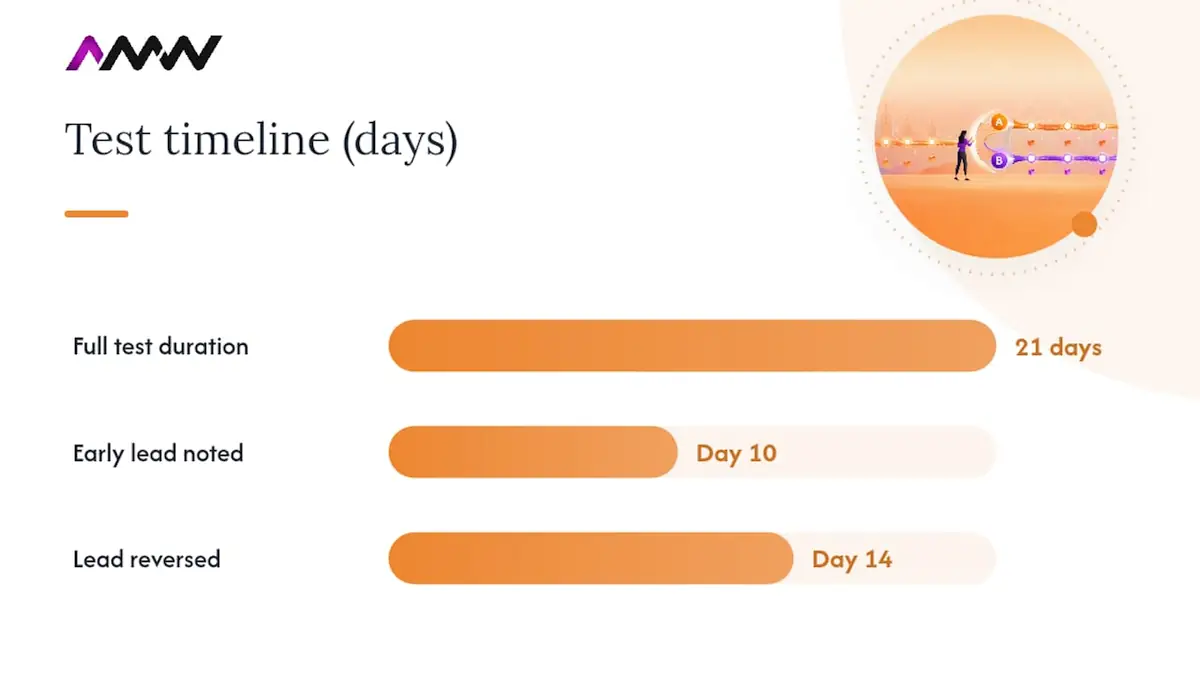
- Budget: Equal daily budget split across three variants, running for 21 days.
- Primary KPI: Cost per purchase.
What AMW Media did:
- Wrote a formal hypothesis and decision rule before launch (Challenger 1 wins if CPP is at least 15% lower at 95% confidence).
- Named all ad sets and ads using a consistent convention for easy reporting.
- Checked the learning phase status daily without intervening in delivery.
- Logged interim results but committed to the full 21-day duration.
- At day 21, Challenger 1 (UGC) showed a materially lower cost per purchase at above 95% confidence.
What happened next:
The UGC variant was scaled into the main campaign. Budget was increased gradually over the following two weeks. The studio video was archived with notes on why it underperformed (too feature-heavy, slow hook). The result also prompted a landing page review, the conversion optimisation work that followed identified a form-length issue that had been suppressing conversions across all variants.
Key lessons:
- The concept-level difference (UGC vs studio) was large enough to be decisive. Execution tweaks on the losing concept would have been wasted effort.
- Committing to the full test duration mattered. At day 10, the studio video was briefly ahead on CPP. It reversed by day 14.
- Documenting the result properly meant the client’s next brief started from a much stronger creative baseline.
How to interpret results and decide what to do next
Once your test ends, the decision flow is simple:
- Clear winner (95%+ confidence or a meaningful CPA delta): implement the winner. Scale budget gradually, increase by 20 to 30% every 3 to 4 days, or duplicate the winning creative into a new campaign to avoid resetting the learning phase.
- Inconclusive result: extend the test if budget allows, or reframe the hypothesis around a larger creative difference. A small effect size with insufficient volume is not a failure, it’s a signal to either test bigger differences or accept that the variable doesn’t shift the numbers much.
- Challenger loses: archive it with notes. A documented loss is as valuable as a win, it tells you what not to spend creative budget on next quarter.
Secondary metrics to check before you scale:
- Frequency: if one variant has significantly higher frequency, its engagement metrics are artificially suppressed.
- Average order value: a lower CPP with a lower AOV may not be a real win.
- Post-click conversion rate: a high CTR variant that converts poorly post-click suggests the ad is attracting the wrong audience or the landing page isn’t matching the ad’s promise.
- CTR: useful as a sanity check, but not a primary decision metric for conversion campaigns.
For the follow-up, generate new challengers inside the winning concept. If UGC won, test UGC hook styles next. If a long-form landing page won, test headline variations on that page. This is how a broader digital strategy compounds over time, each test narrows the creative space and raises the floor.
AMW Media runs your Meta experiments end to end
Running a valid Meta A/B test takes more than clicking a button in Ads Manager. It takes a clear hypothesis, the right structure, enough budget per variant, and the discipline not to pull the plug early. AMW Media’s PPC management team handles all of that: test design, creative production, Experiments setup, results interpretation, and scaling the winner into your live campaigns.
A pilot engagement covers one fully structured A/B test, from hypothesis to decision, with a written summary of results and a recommended next-step creative brief. If the test reveals landing page issues, the web design team can implement fixes without you managing a separate agency relationship.
Book a pilot test with AMW Media and walk away with one validated result and a clear creative direction for the next 90 days. Get in touch here.
A note on testing as a habit
Most teams treat A/B testing as something they’ll get round to eventually. The ones who build it into every campaign cycle, even imperfectly, even with small budgets, consistently outperform those who don’t. You don’t need a huge budget to start. A £500 test that tells you which creative concept resonates is worth more than £5,000 spent scaling the wrong one. Pick one hypothesis, set it up properly, and run it to completion. That’s the whole discipline, really. Our London page is honest about this: the extraordinary shops at the top of every London list are real, and the question is which kind of agency your budget actually needs.
If you’d rather have someone else handle the setup while you focus on the business, AMW Media’s team is worth a conversation.
Sources
The following official Meta documentation and practitioner guides were used throughout this article:
- About A/B Testing | Meta Business Help Centre
- How to Set Up A/B Tests in Meta Ads, Convert
- The Complete Guide to Meta Ads A/B Testing in 2026: Creatives, Copy, and Audiences | AdRiseLab
- A/B Testing in Meta Ads: Experiments, Variables | Digital Codex
FAQ
What is Facebook A/B testing?
Facebook A/B testing, formally called Meta Experiments, is a split-testing tool in Meta Ads Manager that randomly assigns your audience to different ad variants so each person sees only one version, producing clean, overlap-free results.
Should you turn on A/B testing on Facebook?
Yes, if you have a clear hypothesis and enough conversion volume to reach significance. Aim for at least 50 optimisation events per variant per week, and use Meta Experiments rather than running two regular ad sets side by side to avoid delivery bias.
How long should a Facebook A/B test run?
Meta recommends a minimum of seven days, but conversion-optimised tests typically need 14 to 28 days to produce reliable results. Stopping early when one variant looks like it’s winning is one of the most common causes of false positives.
What variables can you test in Meta Experiments?
You can test creative, copy, audience, placement, optimisation event, and landing page URL. The rule is one variable per test, changing multiple elements simultaneously makes it impossible to know what drove the result.
How do you beat the Meta algorithm with better testing?
Focus on concept-level creative differences rather than minor tweaks. Meta’s algorithmic delivery now handles much of the audience optimisation, so the biggest performance gains come from testing fundamentally different creative approaches, UGC versus studio, problem-led versus feature-led, then refining inside the winning concept.
Recommended
- Examples of email marketing campaigns that actually work | AMW Media
- The role of testimonials in marketing: 2026 guide | AMW Media
- Conversion optimisation: a practical guide for UK SMEs | AMW Media
- Examples of engaging social posts that actually work | AMW Media
Our free marketing audit looks at your site, your ads and your content, and comes back with a 30 day plan. No pitch deck.

Runs the content calendars and the community side of every social account, and keeps clients posted on what is going out and when. Meet the team.