
 Black Steel Doors
 Woodstock Campers
 Phillips Joinery

TL;DR:
- Effective email campaigns rely on sequence-driven strategies, segmentation, and measurable impact to drive results. Visual creativity must be paired with strong calls to action, clear pricing, and social proof for higher conversions. Local campaigns succeed through specificity, direct offers, and immediate decision-making prompts matched to the audience.
Most marketers have spent an afternoon trawling blogs for examples of email marketing campaigns, only to find the same tired screenshots of a welcome email and a generic abandoned cart sequence. That is not particularly helpful if you are trying to design something that actually shifts the numbers. The examples worth studying tend to live in niche newsletters, specialist case studies, and post-mortems from ambitious teams willing to share their numbers. This article pulls those together, analyses what made each one work, and gives you a framework to apply the same thinking to your own campaigns.
Key takeaways
| Point | Details |
|---|---|
| Sequence beats single sends | Multi-touch, phased campaigns consistently outperform one-off emails across every campaign type. |
| Segmentation lifts conversion | Targeting messages by engagement behaviour can increase conversion rates by around 30%. |
| Urgency must be earned | Deadline tactics only convert when preceded by sufficient value and desire built in earlier emails. |
| Visual creativity needs CTA discipline | Beautifully designed emails frequently underperform because they lack clear pricing and purchase prompts. |
| Local campaigns need less story | Emails for local audiences should lead with price, date, location, and urgency rather than brand narrative. |
What makes a great email marketing campaign
Before examining specific examples, it is worth establishing the criteria that separate a effective campaign from one that just looks good in a presentation deck.
Engagement metrics tell the first story. Open rates and click-through rates are imperfect but unavoidable. A campaign with a 40% open rate on a cold list is a different beast from one achieving the same number on a deeply segmented warm audience. Context matters enormously when comparing numbers.
Segmentation and personalisation are table stakes now. Behavioural segmentation alone can lift conversion rates by approximately 30% compared to sending identical emails to your entire list. Campaigns that recognise where a subscriber is in their journey and speak to that stage outperform broadcast-style sends every time.
The other criteria worth applying to any campaign you evaluate:
- Timing and sequencing. Are emails spaced to build momentum, or are they clustered in a way that overwhelms? Good campaigns treat the sending schedule as a deliberate narrative arc.
- Clear, singular calls to action. Each email should ask the reader to do exactly one thing. When you give people three options, they frequently choose none of them.
- Visual and copy balance. Heavy design can suppress clicks if it slows load times or buries the message. Conversely, plain-text emails feel personal in some contexts and lazy in others. The best campaigns match their format to their audience.
- Measurable business impact. Revenue attributed, leads generated, event attendance driven. If a campaign cannot point to a tangible outcome, it is decoration.
Pro Tip: When evaluating any campaign for inspiration, ask yourself: “What would I need to believe about my audience for this to work?” That question cuts through aesthetic admiration and gets you to strategic transferability.
Understanding these criteria will help you read the examples below with analytical eyes rather than just borrowing aesthetics.
6 standout examples of email marketing campaigns
1. A 23-email product launch sequence generating £1.6 million in 16 days
This is one of the most instructive product launch sequences in publicly documented email marketing history. Sent to 45,000 subscribers over 16 days, the campaign generated $2.07 million and treated the sale not as a single announcement but as an event with its own narrative arc.
The structure divided subscribers into engagement tiers based on how they interacted with pre-launch content. High-engagement subscribers received more emails with greater depth. Lower-engagement subscribers received a trimmed sequence focused purely on decision-driving content. This approach meant no single segment felt bombarded or ignored.
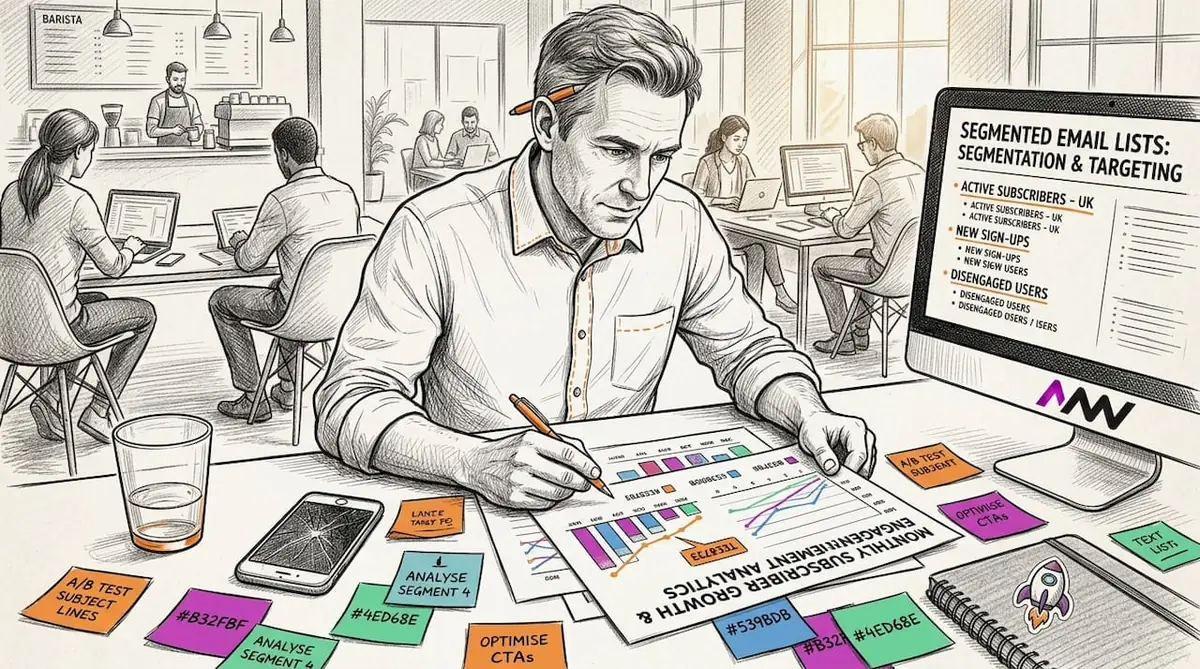
The close sequence is particularly worth studying. The final 36 hours of the campaign drove the majority of total revenue. Rather than sending one last-chance email, the team used a three-pass close approach targeting desire, fear of inaction, and risk reversal in separate emails. Each email addressed a different psychological barrier to purchase. A single cart-close warning email within that sequence brought in roughly $412,000, demonstrating that urgency tactics work best when they arrive after a well-built foundation of desire.
What makes this transferable is the underlying logic: phase your campaign, segment by behaviour, and treat your close as a multi-message conversation rather than a single plea.
Pro Tip: Build your pre-launch list before you build your campaign. Subscribers who opted in to hear about a specific offer convert at dramatically higher rates than those who happened to be on your general newsletter list.
2. A multi-stage holiday campaign with SMS integration
Holiday campaigns are a category where most brands default to “here is a discount” emails dressed up with seasonal imagery. The more effective approach treats the holiday campaign as a proper funnel with distinct phases: an opt-out check for subscribers who do not celebrate that occasion, a teaser, a main campaign send, a last-chance warning, and a procrastinator offer for people who missed the deadline.
That opt-out step is underused. Allowing subscribers to skip a Father’s Day campaign, for example, immediately improves deliverability, reduces unsubscribes, and tells you something useful about your list. The subscribers who stay in the sequence are self-selected as relevant prospects.
Combining the email sequence with SMS reminders for cutoff dates also meaningfully increases conversion. SMS is not replacing email here; it is playing a supporting role, nudging people who opened but did not click. The lesson is that the best campaigns think in channels, not just sends.
3. Brand storytelling and user-generated content campaigns
Some of the most effective email marketing examples in B2C are campaigns that do not sell at all in the traditional sense. They build the kind of affinity that makes the next promotional email land better.
User-generated content campaigns, where brands showcase customer photos, reviews, or stories in the body of their emails, serve two functions simultaneously. They provide social proof and they make subscribers feel like community members rather than recipients. A well-executed UGC campaign can generate more replies and forwards than any discount email, which signals to inbox providers that your emails are worth seeing.
The key discipline here is curation. Dumping a grid of customer photos into an email without context feels lazy. The best versions of these campaigns weave a narrative around the content, connecting individual customer stories to the brand’s broader identity. Learning from proven content marketing examples across channels can sharpen your instinct for which stories deserve amplification.
4. Interactive campaigns using quizzes and preference surveys
Incorporating interactive elements like quizzes or preference surveys into email campaigns does two things at once: it increases engagement in the immediate send and it generates first-party data you can use to segment future campaigns more precisely.
A gifting brand running a holiday campaign might ask subscribers: “Are you shopping for someone who loves the outdoors, or a homebody?” The answer routes them into a specific product recommendation sequence. The subscriber feels understood rather than marketed at, and the brand gets richer segmentation data without needing to infer behaviour from clicks alone.
These campaigns require slightly more technical setup, particularly if the interactivity is embedded within the email itself rather than linking out to a landing page. However, the engagement uplift tends to justify the additional build time. Marketing automation workflows are particularly well-suited to routing quiz responses into the right follow-up sequences automatically.
5. Visual-driven seasonal campaigns (and where they fall short)
Seasonal campaigns built around a visual theme, such as organising products by colour palette or mood rather than category, are creative and effective for certain audiences. A spring wardrobe campaign that groups items by “what to wear to a garden party” is a more compelling browse experience than a standard product grid.
However, visually striking emails frequently miss conversions by omitting the basics: clear pricing within the email, prominent CTAs beneath each product, and social proof like review counts or bestseller labels. A subscriber who loves the aesthetic but cannot immediately see the price has to make an extra click just to consider a purchase. Many of them do not bother.
The fix is not to strip the creativity but to layer the conversion infrastructure on top of it. Beautiful emails that also tell you the price, show you a rating, and give you a clear “Shop now” button under each item perform significantly better than beautiful emails that rely on the product page to do all the selling.
| Campaign element | Creative-only approach | Creative with conversion layer |
|---|---|---|
| Product presentation | Styled imagery only | Styled imagery with price and rating |
| Call to action | Single hero CTA | CTA per product section |
| Social proof | None within email | Review count or bestseller label |
| Expected outcome | High engagement, lower conversion | Strong engagement with measurable sales |
6. Localised, event-driven campaigns
Local campaigns occupy a different strategic space from national or ecommerce campaigns. Local email marketing that drives foot traffic works best when it strips storytelling almost entirely in favour of concrete, decision-enabling details: the price, the date, the location, and a reason to act now.
A local restaurant running a launch night campaign does not need to explain its brand story to people who already walk past it every day. What it needs to communicate is: “We open Thursday. First 50 tables get 20% off. Book here.” That clarity is what drives action. Subscribers who already know and like a local brand are not waiting to be persuaded of the brand’s value. They are waiting for a reason to visit.
This is worth emphasising for marketing professionals who come from brand-heavy backgrounds. The skills that make national campaigns compelling, layered storytelling, aspirational imagery, and emotional resonance, are often counterproductive at the local level. Local campaigns succeed through specificity.
Comparing campaign types: effectiveness across different scenarios
Not every campaign format suits every objective. The table below maps common campaign types against their relative strengths, so you can quickly match your goal to the right approach.
| Campaign type | Best used for | Primary strength | Common weakness |
|---|---|---|---|
| Phased launch sequence | New products, courses, events | Builds desire over time; drives urgency at close | High production effort; requires engaged list |
| Automated lifecycle | Onboarding, re-engagement | Evergreen; scales without ongoing effort | Can feel impersonal without good personalisation |
| Promotional broadcast | Flash sales, announcements | Fast to deploy; drives immediate action | Low long-term list health if overused |
| Brand storytelling | Audience building, retention | Builds affinity and reduces churn | Hard to attribute directly to revenue |
| Interactive / survey | Segmentation, personalisation | Rich data capture; strong engagement | Requires technical setup |
| Local / event-driven | Foot traffic, physical events | High conversion for known audiences | Narrow audience ceiling |
A few patterns emerge from this comparison. Launch sequences and automated lifecycle campaigns are the most scalable approaches because, once built, they continue working without significant ongoing input. Designing a well-structured campaign sequence from the outset saves considerable rework later.
Promotional broadcast campaigns are useful but carry a risk. Brands that default to discounts train their audiences to wait for the next sale rather than buying at full price. Used sparingly, a promotional email is powerful. Used weekly, it erodes perceived value.
Applying these examples to your own strategy
The gap between inspiration and implementation is where most marketers get stuck. Here is how to close it.
- Map your audience’s journey stage first. Planning campaigns around customer journey stages dramatically improves relevance. A new subscriber needs education and trust-building. A warm subscriber who has browsed multiple times needs social proof and urgency. The message that converts one will annoy the other.
- Think in sequences, not sends. Every campaign idea you encounter should be visualised as a series of emails, each serving a distinct purpose, rather than a single blast. Viewing each campaign as a sequence rather than an isolated email changes how you plan, space, and measure.
- Segment before you send. Even a basic split between active and inactive subscribers improves your deliverability and gives you more relevant data to act on. Behavioural segmentation is the next step from there.
- Add social proof and interactivity where possible. Neither requires a major rebuild. Adding a star rating to a product recommendation or linking to a short preference quiz takes an afternoon. The data and conversion uplift can last months.
- Test your CTAs specifically. “Shop now,” “See the collection,” and “Claim your offer” are not interchangeable. Test the verb, the specificity, and the placement. Small changes here regularly produce double-digit differences in click rate.
- Do not ignore your email signature. Updating your email signature with a campaign link or current offer turns every one-to-one email your team sends into a subtle, persistent marketing touchpoint. It is one of the most underused tactics in email marketing.
Pro Tip: Before launching any new campaign, write one sentence describing exactly who it is for and exactly what you want them to do. If you cannot write that sentence cleanly, the campaign is not ready.
For a structured view of how automation can strengthen these sequences, the marketing automation checklist from Babylon Love Growth is a practical resource for SMBs looking to formalise their approach.
What I have actually learned from studying these campaigns
My honest take is that most marketers underestimate how much work goes into the campaigns they admire. When you see a case study showing a £1.6 million product launch, the temptation is to reverse-engineer the subject lines. What actually made it work was the pre-launch list building, the behavioural segmentation infrastructure, and the discipline to write 23 emails that each had a singular purpose.
The other thing I notice is how often visually gorgeous emails miss the point. I have reviewed campaigns from well-known ecommerce brands where the photography was stunning and the CTA was a single, small button at the very bottom of a 40-screen scroll. The designer won. The conversion rate did not.
Product launch sequences have taught me more about email campaign strategy than any other format, because they force you to think about each email’s specific job within a larger story. Every send has to earn its place in the sequence. That discipline, applied to any campaign type, makes everything better.
The tactic most people dismiss as too small to bother with is the email signature. I have seen companies generate qualified leads from a simple signature update pointing to a new service page. It costs nothing and touches every outbound email your entire team sends. If you are not using it, you are leaving something on the table.
The broader lesson from all the real-world email marketing strategies worth studying is the same: treat your campaign as a deliberate experience your subscriber moves through, rather than a series of interruptions you send them. That shift in perspective changes every decision that follows. Our Harrow page covers which part of digital marketing a north west London business usually needs first.
Amir
Let AMW Media handle your email campaigns
If these examples have sparked ideas but the build feels like a significant undertaking, that is exactly where AMW Media comes in. The team at AMW Media designs and manages email marketing campaigns built around your specific audience and commercial objectives, from sequenced launches to automated lifecycle programmes. Pair that with AMW Media’s graphic design services for email-ready visuals, and SEO and PPC management to strengthen your wider digital presence. Explore the full range of web design and digital services at AMW Media and find out how a joined-up strategy can make every channel work harder.
FAQ
What are the most effective types of email marketing campaigns?
Phased launch sequences, automated lifecycle programmes, and segmented promotional campaigns consistently deliver the strongest measurable results. The most effective approach depends on your specific objective: revenue generation, audience retention, or new subscriber conversion.
How many emails should a product launch campaign include?
There is no universal number, but documented launch sequences of 10 to 23 emails have outperformed shorter campaigns by a wide margin, particularly when emails are segmented by subscriber engagement behaviour.
How does segmentation improve email campaign performance?
Segmenting by engagement during a campaign can lift conversion rates by around 30% by ensuring each subscriber group receives messaging matched to their level of interest rather than a single uniform sequence.
Why do visually designed emails sometimes underperform?
Emails focused on creative visuals often omit key conversion elements such as visible pricing, per-product CTAs, and social proof. Without these elements, even highly engaging emails fail to turn interest into purchases.
Do local businesses need a different email strategy?
Yes. Local email campaigns work best when they lead with price, date, location, and urgency rather than brand storytelling, since local audiences already have brand familiarity and simply need a clear, immediate reason to visit.
Recommended
- Why email marketing matters for your business growth | AMW Media
- Top automated marketing strategies to accelerate growth | AMW Media
- Email marketing strategies to engage and grow your business | AMW Media
- Email Marketing Services That Convert | AMW Media London | AMW Media
Our free marketing audit looks at your site, your ads and your content, and comes back with a 30 day plan. No pitch deck.

Runs the content calendars and the community side of every social account, and keeps clients posted on what is going out and when. Meet the team.