
 Black Steel Doors
 Woodstock Campers
 Phillips Joinery
TL;DR:
- Email marketing offers high ROI and direct reach, outperforming most digital channels.
- Building a quality, opt-in list and personalised segmentation are essential for success.
- Integrating email with social media and content strategies enhances overall business growth.
Social media may dominate marketing conversations, but it does not own the results. Email marketing consistently outperforms most digital channels on return on investment, direct reach, and measurable engagement. While brands pour budgets into paid social and algorithm-chasing content, email quietly delivers. If you have ever wondered whether email marketing still deserves a place in your strategy, the answer is a clear yes. This article breaks down what email marketing actually is, how it works in practice, how it integrates with your wider digital efforts, and how to apply it in ways that drive real business growth.
Key Takeaways
| Point | Details |
|---|---|
| Direct audience impact | Email marketing delivers targeted, measurable messages that foster real relationships. |
| Joined up measurement matters | Success in 2026 relies on revenue per recipient and lifetime value, not just open rates. |
| Integration boosts results | Combining email with other channels increases reach and engagement for sustained growth. |
| Practical tactics drive growth | Fast wins come from applying key email types, consistent testing, and personalisation. |
What is email marketing and why does it matter?
Before diving into tactics, it helps to establish a working definition. Email marketing is a digital marketing strategy that involves sending promotional messages, newsletters, or other content to a list of subscribers via email to promote products and services, nurture relationships, build brand awareness, and drive sales or conversions. It is one of the oldest forms of digital communication, yet it remains one of the most effective.
Many marketing professionals assume that because email has been around for decades, it must be losing relevance. The opposite is true. Email gives you something social media platforms cannot: direct, unmediated access to your audience. No algorithm decides whether your message gets seen. No platform policy limits your reach overnight. You own your list, and that ownership matters enormously in a landscape where organic social reach continues to decline.
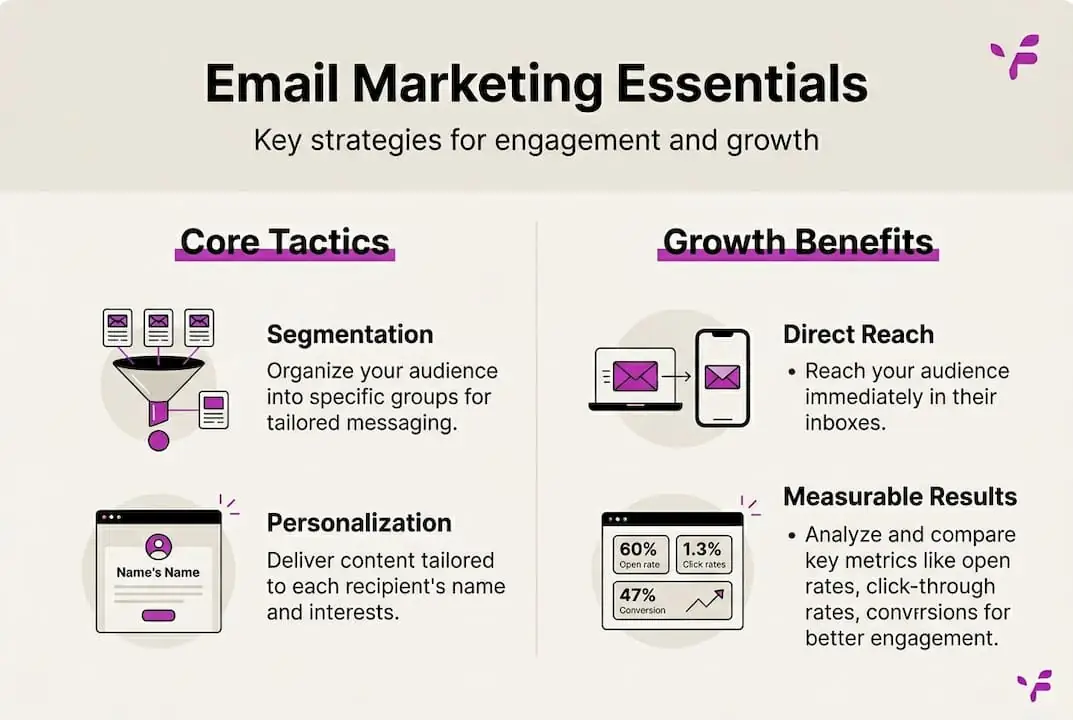
Email marketing sits at the heart of many digital marketing strategies, and for good reason. It supports a wide range of business objectives across the customer journey.
Core uses of email marketing include:
- Nurturing leads from first contact through to purchase
- Building long-term relationships with existing customers
- Promoting new products, services, or seasonal offers
- Re-engaging subscribers who have gone quiet
- Driving traffic to content, landing pages, or product listings
- Gathering feedback through surveys and preference centres
Understanding the types of digital marketing available helps you see where email fits. It complements search, social, and content marketing rather than competing with them.
| Campaign type | Primary goal | Typical outcome |
|---|---|---|
| Welcome series | First impression, onboarding | Higher early engagement |
| Newsletter | Relationship building, education | Sustained brand recall |
| Promotional email | Drive immediate sales | Short-term revenue lift |
| Re-engagement campaign | Win back inactive subscribers | List health improvement |
| Transactional email | Confirm actions, build trust | Reduced support queries |
The benefits of digital marketing are well documented, and email consistently ranks among the highest-performing channels in terms of cost efficiency and measurable impact.
“For every £1 spent on email marketing, businesses can expect an average return of £36, making it one of the highest-ROI channels available.”
Pro Tip: Segment your audience from day one. Sending the same message to every subscriber reduces relevance and risks compliance issues under GDPR. Even basic segmentation by interest or purchase history can significantly improve open rates and conversions.
How email marketing works: Core components and principles
Now that we know what email marketing encompasses, let us explore how campaigns are structured and measured.
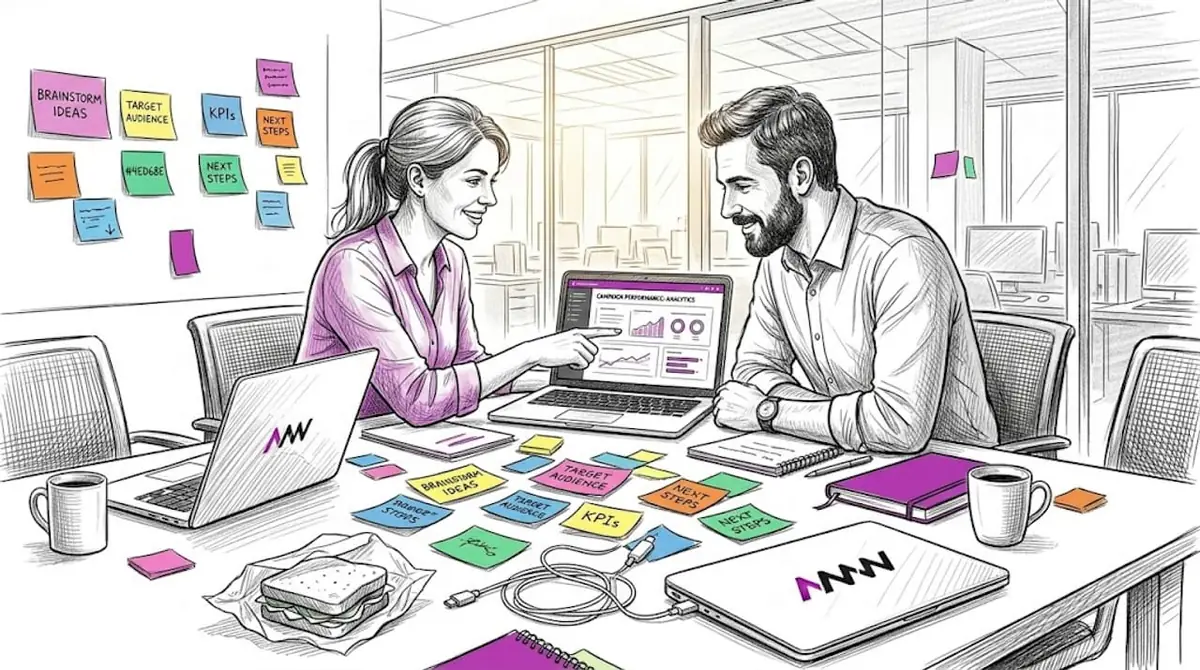
Every effective email campaign starts with a healthy, ethically built list. This means using opt-in methods where subscribers actively choose to hear from you. Purchased lists are not only ineffective but also a breach of GDPR regulations. Instead, build your list through website sign-up forms, gated content, event registrations, and checkout opt-ins. Quality always beats quantity here.
Campaign set-up workflow:
- Define your goal (sales, awareness, retention, re-engagement)
- Identify and segment your target audience
- Plan your content, subject line, and call to action
- Design and write the email with mobile compatibility in mind
- Set up automation triggers or schedule send times
- Test across devices and email clients before sending
- Send and monitor performance in real time
- Analyse results and refine for the next campaign
This workflow applies whether you are sending a one-off promotional blast or a complex automated nurture sequence. The discipline of following each step separates campaigns that convert from those that get ignored.
Measuring success has become more nuanced in recent years. Privacy changes, particularly Apple’s Mail Privacy Protection, have made open rates less reliable as a standalone metric. Revenue per recipient and CLV are now the true indicators of campaign performance, not just opens or click-through rates, because privacy distortions skew surface-level data.
| Metric | What it measures | Reliability in 2026 |
|---|---|---|
| Open rate | Email opens | Low (affected by privacy tools) |
| Click-through rate | Link clicks | Moderate |
| Conversion rate | Goal completions | High |
| Revenue per recipient | Direct revenue impact | High |
| Customer lifetime value | Long-term subscriber value | High |
| Unsubscribe rate | List health signal | High |
When optimising your digital strategy, it is worth treating email metrics as part of a broader data picture rather than isolated numbers.
Compliance is non-negotiable. Under GDPR, every subscriber must have given clear, informed consent. Your emails must include a visible unsubscribe option, your business name, and a physical address. Ignoring these requirements does not just risk fines; it damages trust. A well-structured digital marketing guide will always place compliance at the foundation of any email programme.
Pro Tip: Always preview and test your emails on mobile before sending. Over 60% of emails are opened on mobile devices, and a broken layout or tiny font will cost you conversions before the reader even reaches your call to action.
Email marketing within multi-channel digital engagement
Having established how email marketing functions, it is crucial to see where it fits within your wider digital marketing approach.
Email does not operate in isolation. The most effective campaigns work in concert with social media, content marketing, paid search, and SEO. Think of email as the connective tissue of your digital strategy. It reinforces messages your audience has already seen elsewhere, deepens relationships started on social platforms, and drives traffic back to your website content.
The integration with multi-channel approaches creates a joined up impact that isolated campaigns simply cannot achieve. When a subscriber sees your brand on Instagram, reads a blog post via organic search, and then receives a relevant email, the cumulative effect on trust and purchase intent is far greater than any single touchpoint alone.
| Factor | Email marketing | Social media marketing |
|---|---|---|
| Audience ownership | Full ownership of list | Platform-dependent reach |
| Targeting precision | High (segmentation, behaviour) | Moderate to high (paid) |
| Organic reach | Direct to inbox | Declining without paid spend |
| ROI | Consistently high | Variable |
| Content lifespan | Stays in inbox | Short (hours to days) |
| Personalisation | Deep and scalable | Limited without paid tools |
Multi-channel effects compound, and include:
- Email drives traffic to blog content, increasing SEO dwell time
- Social media grows your email list through lead generation ads
- Retargeting ads reinforce email messages to non-converters
- Email sequences support product launches announced on social
- Consistent brand voice across channels builds recognition and trust
For social media marketing tips that complement your email efforts, aligning your content calendar across both channels is one of the simplest ways to amplify reach without doubling your workload.
Consider a practical example. A fashion retailer launches a new collection. They tease it on Instagram Stories three days before launch. On launch day, they send a segmented email to past buyers of similar products with an exclusive early-access link. They follow up with a retargeting ad to email subscribers who clicked but did not purchase. Each channel plays a specific role, and the role of digital content in binding these touchpoints together is what makes the campaign cohesive.
“Brands that integrate email with at least two other digital channels see significantly stronger customer retention and higher average order values than those relying on a single channel.”
Aligning your brand voice across every channel is equally important. Your email tone, your social captions, and your website copy should all feel like they come from the same place. Inconsistency confuses audiences and erodes trust faster than most marketers realise.
From tactics to results: Applying email marketing for business growth
Understanding the integration of email in your digital mix sets the stage for putting these ideas into practical, growth-oriented action.
Getting started does not require a large team or expensive software. It requires clarity of purpose and a structured approach. Use this quick-start checklist to launch or improve your email programme:
- Define one clear goal for your first campaign (e.g. generate 20 new trial sign-ups)
- Segment your existing contacts by purchase history, interest, or lifecycle stage
- Build a simple content plan covering the next four to six weeks
- Write and design at least two versions of your first email for A/B testing
- Set up a basic automation: a welcome sequence for new subscribers
- Connect your email platform to your CRM and analytics tools
- Review performance after each send and document what you learn
Common email types include welcome emails, newsletters, promotional offers, and re-engagement campaigns, each serving a distinct role in keeping your audience active and interested.
High-performing email content types:
- Welcome series: Sets expectations, delivers immediate value, and builds early trust
- Curated newsletters: Positions your brand as a knowledgeable resource
- Promotional offers: Time-limited deals that create urgency and drive revenue
- Re-engagement campaigns: Win back subscribers before removing them from your list
- Educational sequences: Nurtures leads over time with relevant, useful content
For practical examples and outcomes, reviewing email marketing case studies can show you how businesses across different sectors have achieved measurable growth through well-executed campaigns.
Pro Tip: Every email should have one primary call to action. Multiple competing CTAs dilute focus and reduce click-through rates. Decide what you want the reader to do next, and make that single action impossible to miss.
Common pitfalls to avoid include sending too frequently without adding value, failing to segment beyond basic demographics, and ignoring GDPR compliance. Over-emailing is one of the fastest ways to inflate your unsubscribe rate and damage your sender reputation. Start with a consistent, manageable cadence and scale up only when you have the content to justify it.
Email marketing: What most advice leaves out
Most email marketing guides focus on the mechanics: subject lines, send times, open rates, and click-through benchmarks. These are useful starting points, but they can lead marketers into a trap of optimising for numbers that no longer tell the full story.
In 2026, open rates are significantly distorted by privacy tools. Relying on them as your primary success metric is like navigating by a compass that points slightly off north. You will move, but not necessarily in the right direction. Revenue per recipient and CLV, not opens or click-through rates, are the metrics that actually reflect whether your email programme is building business value, because privacy distortions make surface data unreliable.
What most advice also misses is the strategic weight of genuine relationships. Email is not just a delivery mechanism for offers. It is a channel for building trust over time. The brands that see the strongest email performance are those that treat their subscribers as real people with real needs, not just entries in a database.
Context matters more than tools. You can have the most sophisticated automation platform available, but if your messaging lacks relevance or your strategy lacks coherence, the results will disappoint. Thoughtful integration with your broader marketing approach, as explored when optimising your digital strategy, consistently outperforms isolated, tool-first thinking.
Most underperforming email programmes are not suffering from a subject line problem. They are suffering from a strategy problem. Fix the strategy first, and the tactics will follow.
Next steps: Amplify your digital marketing with expert support
A clear understanding of email marketing is a strong foundation, but translating that understanding into campaigns that consistently deliver results is where many businesses need support. Our marketing agency Reading page asks the question that follows from all of this: what should small business marketing actually earn?
At AMW Media, we build email marketing campaigns that are strategically grounded, compliantly built, and creatively executed. Starting from scratch or looking to improve an existing programme: we bring the expertise to make your email efforts work harder. Our team also connects email with social media management and web design services to create cohesive, multi-channel campaigns that amplify your brand across every touchpoint. If you are ready to move from theory to measurable results, get in touch with us to discuss a custom strategy for your business.
Frequently asked questions
What makes email marketing effective compared to other channels?
Email lets you directly target your audience with personalised, measurable content delivered straight to their inbox, often yielding a higher ROI than social media or paid search. Unlike social platforms, you own your subscriber list and are not subject to algorithmic changes.
How do I measure the success of my email campaigns in 2026?
Success is best tracked via revenue per recipient and CLV rather than open rates or click-through rates alone, as privacy tools have made those surface metrics increasingly unreliable. Focus on what email actually contributes to your bottom line.
What types of emails should my business send?
Common email types include welcome emails, newsletters, promotional offers, and re-engagement campaigns, each serving a specific purpose in maintaining an active, engaged subscriber base.
Is email marketing still compliant with privacy laws?
Yes, provided you use clear opt-in consent and include a visible unsubscribe option in every email, your campaigns can fully meet GDPR and current privacy requirements. Compliance is not a barrier to effective email marketing; it is the foundation of it.
Recommended
- Understanding digital marketing: strategies for business growth
- Email Marketing Services That Convert | AMW Media London | AMW Media
- Essential digital marketing guide: strategies for brand growth
- Types of digital marketing: strategies for growth
Our free marketing audit looks at your site, your ads and your content, and comes back with a 30 day plan. No pitch deck.

Runs the content calendars and the community side of every social account, and keeps clients posted on what is going out and when. Meet the team.