
 Black Steel Doors
 Woodstock Campers
 Phillips Joinery
TL;DR:
- Most marketing teams lack a structured, repeatable creative campaign process leading to inconsistent results. Implementing clear stages from ideation to post-campaign analysis and using pre-testing improves effectiveness. Building a systematic learning culture and using expert support maximises long-term marketing success.
Wasted budget, inconsistent results, and a creative team spinning in circles. If that sounds familiar, you are not alone. Most marketing managers experience the same frustration: campaigns that perform brilliantly one quarter and fall flat the next, with no clear understanding of why. The culprit is rarely a lack of talent. It is the absence of a structured, repeatable creative campaign process. Without one, every campaign starts from scratch, decisions rely on gut feel, and learnings evaporate the moment the next brief lands. This guide walks you through every stage of a proven process, from prerequisites and ideation through to post-campaign analysis, so you can build a creative engine that consistently delivers measurable digital growth.
Key Takeaways
| Point | Details |
|---|---|
| Start with the right tools | Prepare your team, mindset and platforms before launching any creative campaign process. |
| Follow a step-by-step approach | Structure and iteration are more effective than chasing viral success. |
| Measure and learn | Set benchmarks such as ROAS and engagement to quantify and improve success. |
| Avoid common pitfalls | Pre-testing and feedback loops prevent costly creative campaign errors. |
| Professional support accelerates growth | Use expert services like AMW Media to efficiently scale creative campaign impact. |
What you need before you start: Tools, team and mindset
Before any campaign brief is written, ambitious brands need to audit what they actually have in place. The right foundations make the difference between a creative process that scales and one that constantly breaks down under pressure.
The mindset shift: iterative thinking over one-off heroics
The most productive creative teams do not treat every campaign as a make-or-break moment. Instead, they adopt high-velocity testing and a Creativity Stack to scale innovative campaigns across channels and audiences. This means accepting that not every idea will win, building a culture where fast feedback is valued over long debates, and treating each campaign as a learning opportunity. Rapid prototyping in marketing follows the same logic: release early, learn quickly, and refine with data rather than opinion.
Emotional resonance and ROI accountability are not opposites. The best-performing brands hold both simultaneously. You want creative work that moves people, but you also want to know exactly what moved the needle.

Core team roles every campaign needs
Before launch, confirm that the following roles are covered, whether in-house or via agency partners:
- Creative strategist: Bridges brand vision with audience insight to shape the campaign idea.
- Content producer: Owns execution across video, photography, copy, or design.
- Media planner: Determines where, when, and to whom the campaign appears.
- Data analyst: Tracks performance in real time and flags deviations from targets.
- Project manager: Keeps timelines, approvals, and dependencies on track.
Stakeholder buy-in is equally critical. Campaigns stall when decision-makers are consulted too late. Map your approval chain before creative development begins, not during it.
Foundational tools for creative campaign management
The tools you choose should support collaboration, asset management, and pre-testing. Here is a quick comparison of what to prioritise:
| Tool category | Purpose | Examples |
|---|---|---|
| Project management | Task tracking, timelines, approvals | Monday.com, Asana, Notion |
| Asset management | Version control, storage, sharing | Bynder, Brandfolder, Google Drive |
| Pre-testing and validation | Creative effectiveness scoring | System1, Kantar, Ipsos |
| Collaboration | Real-time feedback and ideation | Figma, Miro, Slack |
| Analytics | Campaign tracking and reporting | GA4, Looker Studio, HubSpot |
For a closer look at how these tools fit into a broader workflow, explore the full content production steps that high-performing creative teams use. You can also align these with a broader digital marketing process to ensure campaign activity connects to wider business objectives.
Pro Tip: Map your resource bottlenecks before the campaign kicks off. Identify which team members or approvers are most likely to create delays, and build buffer time around those specific points. A timeline that looks tight on paper often becomes impossible in practice once a single link in the chain slows down.
Step-by-step: The creative campaign process from ideation to launch
With your team assembled and tools in place, you can now follow a structured process that removes ambiguity and creates accountability at every stage.
The six-stage creative campaign process
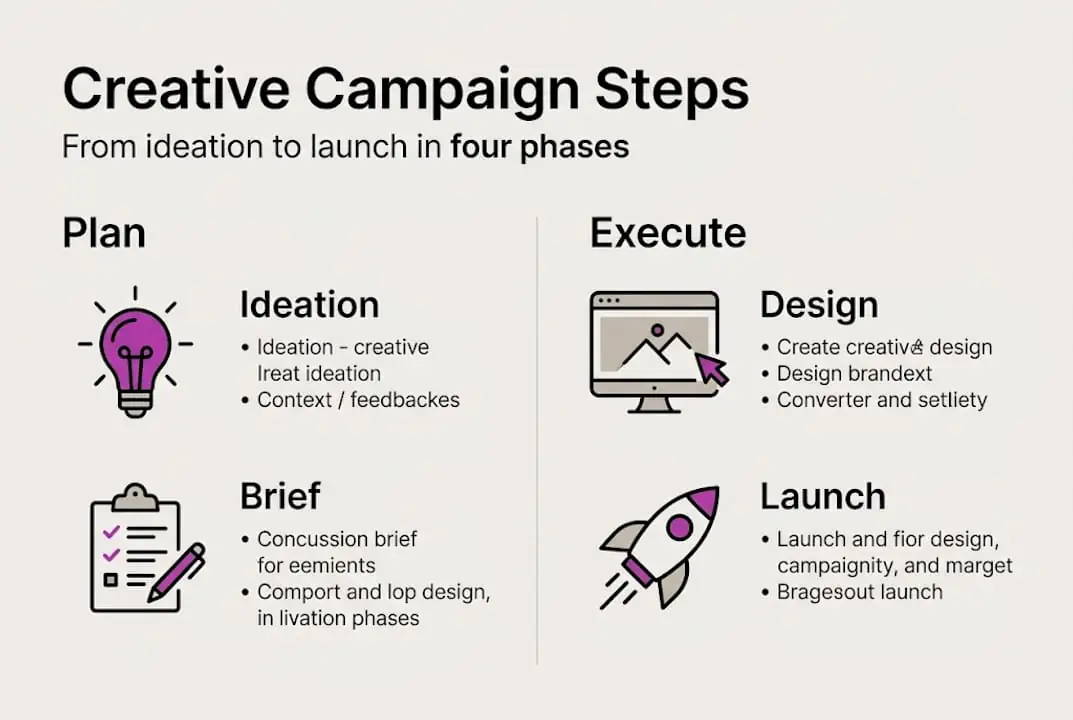
Ideation: Hold a structured brief session. Define your target audience, core message, campaign objective, and success metrics before any creative concept is proposed. Use insight from past campaigns and audience research to shape ideas rather than starting with a blank page.
Filtering: Score your ideas against the brief. Which concepts best align with your objectives, budget, and brand? Use a scoring matrix to remove subjectivity. The strongest ideas survive on merit, not seniority.
Creative development: Build out your shortlisted concept into formats suited to your chosen channels. This is where social media campaigns, video content, paid ads, and landing pages take shape. Keep versions lean at this stage so you can iterate quickly.
Pre-testing: Before spend is committed, validate your creative. Tools like System1 score emotional response and predicted effectiveness. This stage alone can prevent expensive underperformance. As the research confirms, systematic iteration is superior to one-off virality for long-term impact.
Iteration: Use pre-testing feedback to refine the work. Adjust messaging, visual hierarchy, or format based on evidence rather than preference. Review your production workflow to ensure revisions do not become a bottleneck.
Launch: Execute with a channel-specific rollout plan. Confirm tracking is live, budgets are allocated correctly, and your team knows what they are monitoring from day one. For paid channels, ensure your PPC campaign setup is fully configured before traffic begins.
“The brands that build lasting effectiveness are those that treat every campaign as a structured learning event, not a one-time creative gamble.” This is the philosophy that separates high-performing marketing teams from the rest.
Process checkpoints at a glance
| Stage | Key output | Common stall point |
|---|---|---|
| Ideation | Ranked concept list | Vague brief, too many stakeholders |
| Filtering | Scored shortlist | Lack of objective criteria |
| Creative development | Draft assets per channel | Scope creep, missed deadlines |
| Pre-testing | Effectiveness scores | No pre-testing budget allocated |
| Iteration | Refined final assets | Approval delays, feedback loops |
| Launch | Live campaign with tracking | Tech issues, tracking gaps |
Pro Tip: Build feedback loops after each stage, not just at the end. A 15-minute review between ideation and filtering catches misalignments early. Post-launch reviews that happen six weeks later rarely change anything that still matters.
Troubleshooting and common mistakes in creative campaign execution
Even well-resourced teams fall into predictable traps. Knowing what to watch for gives you the ability to course-correct before a mistake becomes expensive.
The most costly mistakes in creative campaign execution
- Skipping pre-testing: Launching without validation is the single biggest avoidable risk. Untested campaigns have significantly lower effectiveness rates compared to those that go through structured pre-testing. The data consistently supports investing here.
- Failing to iterate: Treating a campaign as finished once assets are produced ignores the improvements that pre-testing and early performance data can drive. Iteration is not indecision. It is discipline.
- Under-resourcing creative development: Cutting corners on content quality or rushing asset production creates a ceiling on what your campaign can achieve, regardless of media spend.
- Over-relying on gut feel: Senior opinions matter, but they are not a substitute for audience insight or data. The most dangerous phrase in marketing is “I think our customers will love this.”
- Chasing ROI while ignoring emotional resonance: Campaigns engineered purely around conversion metrics often underperform because they fail to build the brand associations that drive long-term purchase intent.
Benchmark your campaigns against a ROAS target of 3x or higher and use pre-testing to build the confidence that justifies your creative decisions.
Aiming for a ROAS above 3x is a useful starting point, but it works best when paired with qualitative measures like emotional response scores and brand lift. A campaign that delivers 4x ROAS this quarter while eroding brand trust is not a success by any long-term measure.
For teams looking to sharpen their overall approach, reviewing your optimising digital strategy practices will surface the structural issues that cause repeated campaign underperformance. It is also worth auditing your broader digital marketing strategies to ensure campaign-level decisions align with your wider growth goals.
Pro Tip: Run a structured debrief within 48 hours of every campaign ending. Document what worked, what did not, and what you would do differently. These debriefs become an institutional knowledge base that makes every future campaign faster and smarter.
Measuring, analysing and learning from your campaign results
A campaign that ends without a structured review is a wasted learning opportunity. The brands that improve fastest are the ones that close the loop systematically, every single time.
Step-by-step post-campaign review process
Gather your data: Pull all performance metrics within 72 hours of the campaign ending. Include paid media data, organic reach, engagement rates, ROAS, conversion rates, and any brand lift or sentiment data you have collected.
Compare against objectives: Map actual performance to the targets set at the brief stage. This is not about celebrating wins or assigning blame. It is about identifying the gap between intention and outcome.
Analyse creative performance by asset: Break results down by individual ad, video, or piece of content. Which assets outperformed? Which underperformed? Look for patterns in format, message, or creative style.
Assess emotional response data: If you used pre-testing tools, compare predicted scores against actual engagement. This calibrates your pre-testing approach for future campaigns and builds confidence in the process.
Document learnings formally: Write up findings in a standardised format that can be shared with the full team. Post-campaign learning and systematic review are foundational for scalable growth. Informal debriefs held once and then forgotten do not build capability.
Feed insights into the next brief: Use documented learnings to inform the ideation stage of your next campaign. The compound effect of systematic improvement across multiple campaigns is where real competitive advantage is built.
Campaign performance comparison table
| Metric | Campaign objective | Actual result | Variance | Action for next campaign |
|---|---|---|---|---|
| ROAS | 3.5x | 2.8x | Below target | Refine audience targeting |
| Engagement rate | 4% | 5.6% | Above target | Replicate creative format |
| Brand lift | 10% uplift | 7% uplift | Below target | Increase brand-led messaging |
| Cost per acquisition | £35 | £42 | Above target | Review landing page conversion |
Brands that test systematically and review every campaign afterwards get better results over time than brands running ad hoc campaigns, because each round starts from what the last one proved. Understanding digital content’s impact on brand performance helps contextualise why content quality consistently shows up as a differentiator in campaign results. When you need specialist analytical support, working with a digital agency can accelerate your ability to turn data into actionable improvement.
What most brands miss about the creative campaign process
Most ambitious brands invest heavily in creative talent and almost nothing in creative process. They hire brilliant people and then put them in a system that almost guarantees inconsistent results. No brief structure, no pre-testing habit, no post-campaign review that actually feeds back into the next brief. Talent without process is just expensive improvisation.
The brands that sustain creative impact over years are not necessarily the ones with the most original ideas. They are the ones that have built a creative engine. They run structured ideation, they test before they spend, they document what they learn, and they treat every campaign as a chapter in a longer story rather than a standalone event.
There is also a widespread belief that emotional resonance and commercial rigour are in tension. They are not. The campaigns that move people and the ones that drive measurable results are often the same campaigns. The difference is in how they were developed. Emotional storytelling built on audience insight and validated through pre-testing consistently outperforms work that is either purely rational or purely sentimental.
Our experience working with ambitious brands is that the biggest lever is not the next big idea. It is celebrating and systematising your learning wins. When a campaign underperforms but teaches you something useful, that is a result worth documenting. Understanding the role of creative agencies in building this kind of systematic capability can help you decide where to invest your development budget.
Scale your results with expert support
Building a structured creative campaign process is one of the highest-impact investments a marketing team can make. But executing it well across social, paid, and web channels simultaneously requires deep expertise and bandwidth that most in-house teams are stretched to provide.
At AMW Media, we work alongside ambitious brands at every stage of the creative campaign process, from strategic ideation and content production through to performance tracking and continuous optimisation. Our social media services keep your brand visible and engaging across the channels that matter most. Our web design services ensure your campaigns land on pages built to convert. And our PPC campaign management team ensures your paid investment is structured for maximum measurable return. If your team is ready to move from creative chaos to a scalable, results-driven process, we are ready to help you build it.
Where creative campaign development usually goes wrong
The process above assumes each stage finishes before the next begins. In practice, creative campaign development fails at the joins rather than inside the stages.
Three joins do the damage. Strategy to concept, where an insight becomes a slogan and loses its meaning. Concept to production, where a good idea meets a budget nobody mentioned. And production to distribution, where the work gets made in one format and then cut down badly for every channel it actually runs on. Planning the joins matters more than perfecting the stages. Our Milton Keynes marketing page starts with a better question than comparing monthly fees: what would you leave out of the first proposal?
Frequently asked questions
What is a creative campaign process?
A creative campaign process is a structured, step-by-step approach to developing, testing, and launching marketing campaigns with measurable goals. High-velocity testing and systematic iteration are central to making it work at scale.
How do you measure the success of a creative campaign?
Success is measured using metrics such as ROAS, engagement rates, brand lift, and performance against pre-set objectives. Aiming for a ROAS above 3x combined with emotional response data gives the most complete picture.
What are the most common mistakes in campaign creation?
The most frequent mistakes include skipping pre-testing, failing to iterate based on data, under-resourcing creative development, and focusing solely on ROI while neglecting emotional resonance. Pre-testing and benchmarking address the majority of these issues directly.
How important is emotional resonance in creative campaigns?
Emotional resonance is a critical driver of both short-term engagement and long-term brand growth. Campaigns built on genuine audience insight and emotional storytelling consistently outperform those focused purely on rational product benefits.
Recommended
- How to run successful social media campaigns for brand growth
- Creative content production steps for marketing success in 2026
- PPC campaign setup steps for competitive success
- Essential digital marketing guide: strategies for brand growth
Our free marketing audit looks at your site, your ads and your content, and comes back with a 30 day plan. No pitch deck.

Owns how everything looks and feels, from a brand identity to the grade on a reel, and makes the animated films such as Blue Light Services' Journey to Net Zero. Meet the team.