
 Black Steel Doors
 Woodstock Campers
 Phillips Joinery
TL;DR:
- Customer testimonials are powerful social proof that reduces buyer uncertainty and significantly boosts conversion rates.
- They are most effective when authentic, attributed, timely, and strategically placed at critical decision points.
Customer testimonials are defined as first-hand endorsements from real buyers that validate a brand’s claims through lived experience rather than advertising copy. The role of testimonials in marketing goes far beyond a few nice quotes on a homepage. They function as social proof, a psychological mechanism where people look to others’ behaviour to reduce uncertainty before making a decision. 56% of UK consumers regard online reviews as the single most important factor when making purchases. That figure tells you something important: your customers trust other customers more than they trust you, and that is not a problem to solve. It is an opportunity to use.
How testimonials build trust and reduce buyer uncertainty
UK consumers are highly sceptical of overt brand self-promotion. Traditional advertising triggers a defensive response in most buyers. Testimonials bypass that defence because they come from a third party with no obvious incentive to lie.
The psychological mechanism is simple. When a prospective buyer reads that someone like them solved a specific problem using your product or service, their brain does less work. The uncertainty shrinks. The decision feels safer. Testimonials reduce cognitive load by providing peer validation, and that matters enormously in British marketing culture, where understatement and scepticism are practically national sports.
Authenticity is the engine that makes this work. A testimonial from “J.S., London” does almost nothing. A testimonial from “James Sullivan, Operations Director at a mid-sized logistics firm in Birmingham, who cut his team’s admin time by 40%” does a great deal. Full attribution with names, roles, and context increases credibility because it gives the reader something to verify, even if they never actually check.
Story-driven testimonials create emotional resonance that short quotes cannot. A customer who describes the moment they realised your service had changed something for them gives the reader a narrative to inhabit. That emotional connection is what moves someone from “interested” to “buying.”
The format of testimonials also shapes their impact:
- Named, attributed quotes with a job title or company carry far more weight than anonymous snippets.
- Video testimonials with natural lighting, ambient sound, and minor imperfections read as genuine. Overly produced video testimonials read as scripted.
- Case study format testimonials that include a problem, a solution, and a measurable outcome address buyer objections directly.
- Short, punchy quotes work well for social media and ad copy where attention is limited.
- Long-form written testimonials suit product pages and landing pages where buyers are already engaged and want detail.
Pro Tip: Never anonymise a testimonial to protect a customer’s privacy without their knowledge. If a customer is uncomfortable being named, ask whether they would accept a first name and industry. A vague endorsement is almost always worse than no endorsement at all.
What is the measurable impact of testimonials on conversion rates?
The numbers here are not subtle. Displaying reviews can increase conversion rates by up to 270%, and for higher-priced products that lift can reach 380%. That is not a marginal gain. It is the difference between a campaign that breaks even and one that funds the next quarter.

Volume compounds the effect. Products with 11 to 30 reviews can double conversion rates compared to products with none. That means the first ten testimonials you collect are doing the heaviest lifting, but the returns keep building as your review count grows.
| Price segment | Typical conversion lift from testimonials |
|---|---|
| Low-cost products (under £50) | Up to 190% |
| Mid-range products (£50 to £200) | Up to 270% |
| Higher-priced products (over £200) | Up to 380% |
The pattern is clear: the more expensive the product, the more a buyer needs reassurance before committing. Testimonials provide exactly that reassurance. A buyer considering a £1,500 B2B software subscription or a £3,000 agency retainer is not going to click “buy” on the strength of your feature list alone.
Testimonials also affect perceived value. A buyer who reads that three other business owners found your service worth every penny is more likely to accept your price without negotiating. That means testimonials do not just increase conversion volume. They protect your margins too.
Businesses with strong review profiles consistently outperform those with weak or absent social proof, in direct conversion and in organic search rankings. Google treats review signals as a trust indicator. A steady stream of genuine testimonials supports your SEO performance alongside your conversion rate, making the investment in testimonial collection pay dividends across multiple channels simultaneously.
Pro Tip: Track your testimonial collection as a marketing metric. Set a monthly target for new testimonials gathered, and monitor how your conversion rate shifts as your review count grows. Treat it like any other growth lever in your digital marketing strategy.
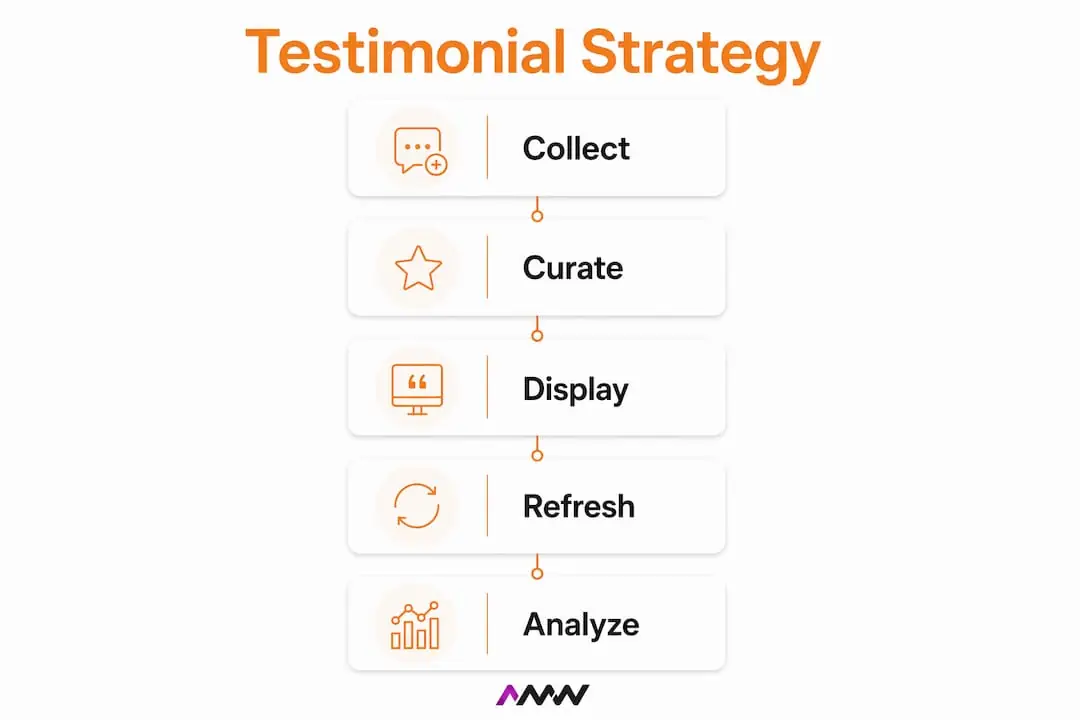
How to collect, curate, and display testimonials effectively
Most brands collect testimonials badly. They send a generic email asking “Would you mind leaving us a review?” and then wonder why the responses are thin and vague. The fix is simple once you understand the mechanics.
Timing your request correctly
The optimal moment to request a testimonial is immediately after a significant success or milestone. If a client has just hit a target, completed a project, or received a result they are excited about, that is the moment to ask. Waiting a week means the enthusiasm has cooled. Waiting a month means they have moved on entirely.
Asking the right questions
Generic requests produce generic responses. Guided questions produce specific, useful testimonials. Ask your customers:
- What problem were you trying to solve before working with us?
- What made you choose us over other options?
- What specific result or outcome did you experience?
- Who would you recommend us to, and why?
These questions give the customer a structure to follow. The answers they provide will be far more detailed and persuasive than anything they would write unprompted.
Mixing formats for maximum reach
A single type of testimonial limits your options. A mix of formats gives you material for every channel and every stage of the buyer journey.
Short quotes work in paid social ads and email subject lines. Video testimonials work on landing pages and YouTube pre-rolls. Long case studies work in sales decks and proposal documents. Written long-form testimonials work on product and pricing pages. Collecting all four formats from your best customers gives your marketing team genuine flexibility.
Placing testimonials where they do the most work
Strategic placement matters more than volume. A hundred testimonials buried on a dedicated “reviews” page will underperform three well-chosen testimonials placed at the exact point where a buyer hesitates.
Place testimonials on:
- Landing pages, directly beneath your headline or call to action.
- Product and service pages, adjacent to pricing or feature details.
- Pricing pages, where sticker shock is most likely to cause drop-off.
- Checkout pages, where last-minute doubt kills conversions.
- Email sequences, particularly in nurture campaigns targeting warm leads.
Keeping testimonials fresh
Stale testimonials signal a stagnant business. A testimonial from 2019 tells a prospective buyer that either your customers stopped being happy or you stopped asking. Refresh your testimonial library at least quarterly. Prioritise recency alongside quality, and retire testimonials that no longer reflect your current offer or audience.
Pro Tip: Match testimonials to buyer personas. A testimonial from a solo freelancer will not resonate with a procurement manager at a 200-person firm. Segment your testimonials by customer type and display the most relevant ones to each audience segment on your website.
Common pitfalls that kill testimonial effectiveness
Most testimonial mistakes come from the same instinct: the desire to make everything look polished. That instinct is understandable, but it consistently backfires.
The most common pitfalls are:
Over-editing testimonials. Heavy editing or sanitising removes the natural voice that makes a testimonial believable. A slightly awkward sentence or an informal turn of phrase signals authenticity. Removing those signals makes the testimonial read like marketing copy, which defeats the purpose entirely.
Using anonymised or vague endorsements. “A satisfied customer from the South East” convinces nobody. Anonymised testimonials trigger suspicion rather than trust. If you cannot attribute a testimonial fully, consider whether it is worth publishing at all.
Mismatching testimonials to buyer stages. A testimonial about your onboarding process is irrelevant to someone who has not yet decided to buy. A testimonial about long-term results is irrelevant to someone who just wants to know if setup is easy. Match the testimonial to the question the buyer is asking at that specific stage.
Neglecting ongoing collection. Testimonial gathering is not a one-off project. Brands that treat it as a campaign rather than a process end up with an outdated library that gradually loses its persuasive power.
Cluttering pages with irrelevant testimonials. Ten testimonials about your customer service on a product page about a technical feature create noise, not confidence. Every testimonial on a given page should address the specific concern a buyer has at that point in their decision.
The underlying principle is simple. Testimonials work because they feel real. Anything that makes them feel less real, whether that is anonymity, excessive polish, or poor placement, reduces their effectiveness proportionally.
Key takeaways
Testimonials drive conversions because they provide authentic, attributed social proof that reduces buyer uncertainty at the exact moment a decision is being made.
| Point | Details |
|---|---|
| Attribution is non-negotiable | Full names, roles, and context make testimonials credible; anonymised quotes trigger suspicion. |
| Timing determines quality | Request testimonials immediately after a customer success to capture genuine enthusiasm and detail. |
| Placement beats volume | Three well-placed testimonials at hesitation points outperform dozens buried on a reviews page. |
| Price sensitivity amplifies impact | Conversion lifts from testimonials are highest for products priced above £200, reaching up to 380%. |
| Freshness signals credibility | Outdated testimonials imply a stagnant business; refresh your library at least every quarter. |
Why I think most brands are sitting on an untapped goldmine
Working in digital marketing in the UK, I have seen the same pattern repeat itself across dozens of brands. They have happy customers. Those customers would happily say something glowing on record. But nobody ever asks them, at least not in a way that produces anything useful.
The brands that get testimonials right treat them as a content asset, not an afterthought. They build a collection process into their client lifecycle. They ask the right questions at the right moment. They match what they collect to where buyers need reassurance. And the results show up in their conversion data within weeks, not months.
What I find particularly interesting about the UK market is the cultural dimension. British buyers are not naturally effusive. They do not leave five-star reviews because they had a perfectly adequate experience. When a UK customer takes the time to write something detailed and positive, that testimonial carries enormous weight with other UK buyers who recognise the cultural rarity of that kind of enthusiasm.
That means a single outstanding testimonial from a credible British customer can do more work than a dozen generic five-star ratings. The role of digital content in brand growth is well documented, but testimonials occupy a unique position within that content mix. They are the only content type your customers write for you.
The brands I have seen grow fastest are the ones that treat testimonial management as a permanent, ongoing discipline. They review what they have, identify gaps by buyer persona and decision stage, and actively fill those gaps. That is not complicated. It just requires consistency, and most brands lack it.
Amir
How AMW Media helps brands build trust through social proof
Building a testimonial strategy that actually converts takes more than collecting a few quotes and dropping them on your homepage.
AMW Media works with ambitious brands to integrate social proof across every touchpoint, from web design that embeds testimonials at the right conversion moments, to social media management that amplifies customer stories across platforms. The team also runs PPC campaigns that use testimonial-driven ad copy to improve click-through and conversion rates. If your testimonial strategy feels patchy or your review library has gone stale, AMW Media can audit what you have, identify where the gaps are, and build a system that keeps your social proof working continuously. Get in touch to find out what that looks like for your brand.
FAQ
What is the role of testimonials in marketing?
Testimonials provide third-party social proof that validates your brand claims through real customer experiences. They reduce buyer uncertainty and increase conversion rates more effectively than traditional advertising.
How much can testimonials increase conversion rates?
Displaying testimonials can increase conversions by up to 270% on average, with lifts of up to 380% for higher-priced products. Even a small number of reviews can double conversion rates compared to having none.
Why do UK consumers rely so heavily on testimonials?
98% of UK consumers read online reviews for local businesses, and 56% consider them the single most important purchase factor. British buyers are sceptical of brand self-promotion, making third-party endorsements particularly persuasive.
Should testimonials be edited before publishing?
Minor formatting edits are acceptable, but heavy editing reduces authenticity and makes testimonials feel scripted. Preserve the customer’s natural voice, including minor imperfections, to maintain credibility.
Where should testimonials be placed on a website?
Place testimonials on landing pages, product pages, pricing pages, and checkout sections. Placement at specific hesitation points outperforms a dedicated reviews page because it addresses buyer doubt at the exact moment it arises.
Recommended
- Proven content marketing examples to boost your brand | AMW Media
- The role of certified marketers in brand growth | AMW Media
- Why integrate marketing channels: a 2026 guide | AMW Media
- What is video marketing: effective strategies for 2026
Our free marketing audit looks at your site, your ads and your content, and comes back with a 30 day plan. No pitch deck.

Runs the content calendars and the community side of every social account, and keeps clients posted on what is going out and when. Meet the team.