
 Black Steel Doors
 Woodstock Campers
 Phillips Joinery
TL;DR:
- Integrating marketing channels ensures a consistent brand experience at every customer touchpoint, reducing confusion and waste.
- Focusing on coordination over perfect technology helps brands build stronger, more resilient campaigns that enhance customer satisfaction and loyalty.
Integrated marketing communications (IMC) is defined as the practice of coordinating all marketing channels and messages to deliver a consistent brand experience at every customer touchpoint. The reason to integrate marketing channels is simple: fragmented campaigns confuse buyers, waste budget, and hand your competitors the advantage of clarity. Research confirms that touchpoint integration is the single most important factor for reducing customer decision-making effort and increasing satisfaction. B2B buyers now use 10 or more channels simultaneously during a purchase decision. If your channels are not talking to each other, your brand is not talking to your buyers. AMW Media works with ambitious brands every day to fix exactly that problem.
Why integrate marketing channels: the core case
Channel integration is not a nice-to-have feature of a polished marketing plan. It is the structural foundation that makes every other tactic work harder. When your email, social media, SEO, and paid advertising all carry the same message, each channel reinforces the others rather than competing for attention.
Integrated campaigns using four or more channels outperform single-channel campaigns by 31% in brand-building effectiveness. That figure represents a meaningful gap between brands that coordinate and brands that broadcast in isolation. The compounding effect of consistent messaging across channels is what drives that difference.
Consistent brand messaging across channels builds a strong identity and reputation over time. Buyers who encounter the same tone, visual identity, and value proposition on LinkedIn, in a Google search result, and in a follow-up email develop a clearer mental picture of what a brand stands for. That clarity shortens the sales cycle.
Multi-channel marketing also reduces audience risk by diversifying channel presence. If one platform changes its algorithm or raises its advertising costs, a brand with coordinated presence across several channels absorbs the shock far better than one that relies on a single source of traffic.
What are the key benefits of integrating marketing channels?
The benefits of marketing integration go well beyond tidy branding. They show up in conversion rates, customer retention, and the efficiency of your marketing spend.
Maintaining message match across channels significantly increases conversion rates by reducing audience confusion. When a prospect clicks a paid ad and lands on a page that mirrors the ad’s promise in tone and content, the cognitive friction disappears. That frictionless experience is what turns browsers into buyers.
“86% of customers appreciate personalised communication in 2026, but 55% will disengage if it feels invasive, and 40% will leave if content is irrelevant.”, Pipedrive, 2026
That finding reframes what integration actually means. It is not about repeating the same message everywhere. It is about delivering the right message, in the right format, on the right channel, at the right moment. Integration gives you the data and the structure to do that well.
Broadening your channel presence also provides more opportunities to collect valuable audience data, enabling smarter campaign decisions over time. Each channel you add is another source of behavioural signals: what content your audience engages with, where they drop off, and what prompts them to act.
The tangible benefits of a well-executed integration strategy include:
- Higher conversion rates through consistent message match at every stage of the funnel
- Stronger brand recall because repeated, coherent exposure builds memory structures
- Reduced customer effort as buyers find the same clear answers wherever they look
- Better data quality from cross-channel tracking that reveals the full customer path
- Lower cost per acquisition as channels amplify each other rather than duplicating effort
- Greater resilience against platform disruptions through diversified channel presence
- Improved team efficiency when creative assets and messaging are built once and adapted across channels
Each of these benefits compounds over time. A brand that has been integrating its channels for 12 months has a measurable data advantage over one that has just started.
How does integration affect the customer journey?
The customer journey is rarely a straight line. A buyer might discover a brand through an organic search result, follow it on Instagram, receive a retargeted display ad, open a promotional email, and then convert through a direct visit. If each of those touchpoints tells a slightly different story, the buyer carries a fragmented impression of the brand into every subsequent interaction.

Touchpoint coordination makes that journey coherent rather than confusing. When the Instagram post, the email, and the landing page all share the same campaign theme, the buyer’s brain does less work at each step. Less cognitive effort means higher satisfaction and a greater likelihood of completing a purchase.
Pro Tip: Map your customer journey before you plan your next campaign. Identify every touchpoint a buyer encounters from first awareness to post-purchase, then audit whether the message and tone are consistent across all of them. The gaps you find are your integration priorities.
The table below summarises how coordinated touchpoints affect three dimensions of the customer experience.
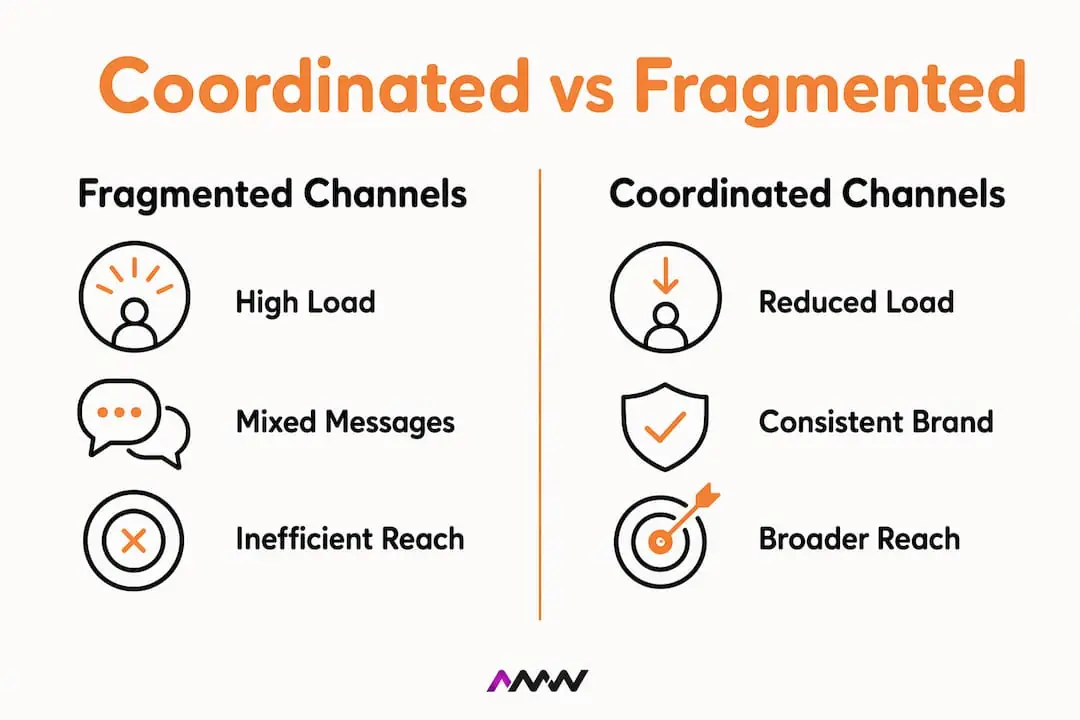
| Dimension | Fragmented channels | Coordinated channels |
|---|---|---|
| Cognitive load | High. Buyer must reconcile conflicting messages | Low. Consistent messaging reduces mental effort |
| Emotional response | Uncertainty and reduced trust | Confidence and brand familiarity |
| Behavioural outcome | Higher drop-off, longer decision time | Faster decisions, higher conversion and loyalty |
The shift from fragmented to coordinated is not just about aesthetics. It is about managing the entire customer experience as a single, connected system rather than a collection of independent campaigns. Research from SHS Web of Conferences confirms that omnichannel integration requires brands to move beyond simply coordinating communications and towards managing the full customer experience. That is a meaningful shift in how marketing teams need to think about their work.
Understanding omnichannel marketing in depth helps clarify the difference between simply being present on multiple channels and connecting them for the customer’s benefit.
What practical strategies help integrate marketing channels?
Knowing why channel integration matters is the easy part. Knowing how to integrate marketing channels without burning out your team or your budget is where most businesses get stuck. The good news is that you do not need perfect technical integration to see results. You need coordination.
Experts at SHS Web of Conferences are clear that prioritising coordination over perfect technical integration is the more realistic and cost-effective path for most organisations. Perfect synchronisation across every platform is often impractical and expensive. Consistent messaging and shared campaign logic, however, are achievable for almost any team.
Automation platforms and CRM integrations help manage and personalise multi-channel campaigns efficiently. A CRM that tracks customer interactions across email, social, and web gives your team a single view of the customer, which is the foundation for relevant, timely communication.
A practical integration process follows these steps:
- Audit your current channels. List every active channel and assess the message, tone, and visual identity on each. Note where they diverge.
- Define a unified brand voice. Write a brief document that captures your tone, key messages, and visual guidelines. Every channel owner works from this.
- Build a shared content calendar. Align campaign themes across channels so that email, social, and paid advertising support the same narrative each month.
- Implement a CRM or marketing automation tool. Use it to track cross-channel behaviour and trigger personalised follow-ups based on what buyers actually do.
- Set shared KPIs across channels. Measure channel performance against common goals, not just individual channel metrics. This aligns team incentives.
- Review and adapt quarterly. Use cross-channel data to identify which combinations of touchpoints drive the best outcomes, then invest accordingly.
Pro Tip: Start with two or three channels rather than attempting to coordinate everything at once. Nail the consistency between your website, email, and one social platform first. Then expand. Trying to do everything simultaneously is the fastest route to doing nothing well.
Automated marketing strategies are particularly useful for maintaining consistency at scale, especially when your team is small and campaign volume is high. Automation handles the repetitive coordination work so your team can focus on creative and strategic decisions.
Aligning your team around shared goals matters as much as the technology. When the social media manager, the email marketer, and the SEO lead all understand the campaign’s core message and target outcome, the channels naturally reinforce each other without requiring constant oversight.
What are the common challenges in channel integration?
Channel integration sounds logical in theory. In practice, most marketing teams hit the same set of obstacles. Recognising them early saves a significant amount of time and budget.
The table below maps the most common challenges against practical solutions.
| Challenge | Why it happens | Practical solution |
|---|---|---|
| Data silos | Teams use separate tools that do not share data | Implement a central CRM or data platform |
| Inconsistent messaging | No shared brand guidelines or content calendar | Create a single source of truth for tone and messaging |
| Resource constraints | Small teams cannot manage every channel well | Prioritise two or three channels and do them properly |
| Channel incompatibility | Different platforms require different content formats | Develop core assets that can be adapted, not duplicated |
| Measuring cross-channel impact | Attribution models struggle with multi-touch journeys | Use UTM parameters and multi-touch attribution reporting |
Data silos are the most common root cause of poor integration. When your email platform, social media tool, and website analytics do not share data, you cannot see the full customer journey. You end up making decisions based on incomplete pictures, which leads to misallocated budget and missed opportunities.
Resource constraints are the second most common barrier, particularly for smaller businesses. The answer is not to spread thin across every available channel. It is to choose the channels where your audience is most active and integrate those well. A well-coordinated presence on three channels outperforms a poorly managed presence on seven.
Measuring the impact of integration requires moving beyond last-click attribution. A customer who converts through a direct visit may have been influenced by three previous touchpoints across different channels. Optimising your digital strategy to account for multi-touch attribution gives you a far more accurate picture of what is actually driving results.
Gradual expansion is the most reliable path forward. Start with a small number of well-coordinated channels, measure the results, and use that data to justify investment in additional channels. This approach builds confidence within the team and produces evidence that leadership can act on.
Key takeaways
Integrating marketing channels is the most effective way to reduce customer decision-making effort, build brand trust, and improve campaign performance across every channel you use.
| Point | Details |
|---|---|
| Integration drives results | Campaigns using four or more coordinated channels outperform single-channel campaigns by 31% in brand-building effectiveness. |
| Coordination beats perfection | Prioritise consistent messaging and shared campaign logic over technically perfect platform integration. |
| Customer effort is the metric that matters | Reducing cognitive load at every touchpoint increases satisfaction, trust, and conversion rates. |
| Data is the integration engine | A central CRM or automation platform gives teams the cross-channel visibility needed for relevant, timely communication. |
| Start small and expand | Integrate two or three channels well before scaling. Gradual, data-driven expansion produces better long-term results. |
Channel integration in 2026: what I have actually learned
I have spent years watching brands approach channel integration with the best intentions and the wrong starting point. The most common mistake is treating integration as a technology project. Teams invest in expensive platforms, spend months on technical setup, and then wonder why the results do not match the promise. The technology is not the problem. The absence of a shared message is.
The brands that get integration right start with a simple question: what do we want every customer to feel, regardless of where they encounter us? When you can answer that clearly, the channel coordination follows naturally. The tone of your emails, the captions on your social posts, and the copy on your landing pages all start pulling in the same direction without requiring a complex technical architecture to force them into alignment.
What I find underappreciated is the resilience that integration builds. A brand with a coherent presence across email, organic search, and social media is far less vulnerable to any single platform’s disruptions than one that has concentrated its entire audience in one place. That diversification is not just a growth strategy. It is a risk management strategy.
The other thing worth saying plainly: integration does not require a large team or a large budget. It requires discipline and a shared document that everyone works from. The brands I have seen succeed with limited resources are the ones that chose fewer channels and committed to consistency on those channels. They resisted the temptation to be everywhere and focused on being unmistakably themselves wherever they showed up.
If you are a marketing professional or business owner reading this and feeling like integration is a project for bigger organisations with bigger teams, I would push back on that. The principles scale down just as well as they scale up. Start with your website and one email sequence. Make those two things say the same thing in the same voice. That is integration. Build from there.
Amir
How AMW Media helps brands integrate their marketing channels
Pulling multiple channels into a coherent strategy takes more than good intentions. It takes the right expertise across content, design, and digital marketing working together from the start. Our Aylesbury page covers the trade buyer, who wants to see the product used properly before switching supplier.
AMW Media works with ambitious brands to build integrated marketing strategies that actually hold together. From social media management that aligns with your broader campaign narrative, to web design that reflects your brand consistently across every device, to SEO that reinforces the same messages your paid campaigns are pushing, the team at AMW Media brings all of those disciplines under one roof. If you are ready to stop managing disconnected channels and start building a brand that speaks with one clear voice, get in touch and let’s talk about what that looks like for your business.
FAQ
What does it mean to integrate marketing channels?
Integrating marketing channels means coordinating all your marketing platforms and communications so they deliver a consistent message and brand experience. The goal is to reduce customer confusion and reinforce your brand at every touchpoint.
Why use multi-channel marketing instead of focusing on one channel?
Multi-channel marketing reaches different audience segments on their preferred platforms and reduces the risk of relying on a single channel. Campaigns that run across four or more channels build brands more effectively than single channel campaigns, because each channel reinforces the others.
How does channel integration improve the customer journey?
Coordinated touchpoints reduce the cognitive effort buyers need to make a decision, which increases satisfaction and conversion rates. When every channel tells the same story, buyers move through the funnel faster and with greater confidence.
What is the biggest challenge in integrating marketing channels?
Data silos are the most common obstacle. When marketing tools do not share data, teams cannot see the full customer journey and end up making decisions based on incomplete information. A central CRM resolves this by giving every team member a unified view of customer behaviour.
How many channels should a business integrate at once?
Start with two or three channels and coordinate them well before expanding. Attempting to integrate every available channel simultaneously spreads resources too thin and produces inconsistent results across all of them.
Recommended
- What is omnichannel marketing: a 2026 guide | AMW Media
- How to master your digital marketing process for 2026
- Essential digital marketing guide: strategies for brand growth
- What is marketing strategy and how to build one in 2026
Our free marketing audit looks at your site, your ads and your content, and comes back with a 30 day plan. No pitch deck.

Runs the content calendars and the community side of every social account, and keeps clients posted on what is going out and when. Meet the team.