
 Black Steel Doors
 Woodstock Campers
 Phillips Joinery
Marketing strategy is often confused with marketing plans or campaign tactics, yet it is fundamentally different and far more powerful. A proper marketing strategy is a long-term framework that guides how your brand positions itself, reaches target audiences, and achieves sustainable growth. Without this strategic foundation, even the most creative campaigns risk becoming disconnected activities that fail to drive meaningful business results. This article will clarify what marketing strategy truly means, explore the core components and frameworks that shape effective strategies, and provide actionable insights for building strategies that enhance brand visibility and fuel digital growth in competitive markets.
Key Takeaways
| Point | Details |
|---|---|
| Long term framework | A marketing strategy provides a long term framework that guides positioning, audience reach, and sustainable growth. |
| Core strategy elements | Core components include segmentation, value proposition, and KPIs, which align marketing actions with business goals. |
| Strategic frameworks | Frameworks such as SOSTAC and the 4Ps help move from ideas to concrete plans. |
| Measurable growth outcomes | A solid strategy drives measurable growth and competitive advantage by coordinating activities around clear metrics. |
Understanding what a marketing strategy truly is
A marketing strategy is a long-term framework outlining how a business reaches target audiences, positions its value proposition, and achieves objectives through coordinated activities, distinct from tactical marketing plans. Think of strategy as the blueprint that answers “how to win” in your market, while tactics are the specific actions you take to execute that blueprint. Many marketers mistakenly treat strategy and tactics as interchangeable, leading to fragmented efforts that lack cohesion and fail to build sustainable competitive advantage.
A solid marketing strategy aligns with overarching business goals, ensuring every marketing initiative contributes to sustained brand visibility and growth. It defines which customer segments to prioritise, how to differentiate your brand, and what metrics will indicate success. Without this strategic clarity, marketing becomes a series of isolated campaigns rather than a unified force driving the business forward. Frameworks that formalise strategy development provide the structure needed to move from vague ambitions to concrete, actionable plans.
Common misconceptions include viewing strategy as simply a collection of tactics or confusing it with a marketing plan document. Strategy is conceptual and directional, while plans are operational and time-bound. Another pitfall is assuming strategy is static; in reality, effective strategies evolve as markets shift and new data emerges. Recognising these distinctions is the first step toward building a marketing approach that drives results.
Pro Tip: Before diving into campaign execution, invest time in defining your strategic intent. Clarify your target audience, competitive positioning, and success metrics to ensure all subsequent activities are strategically aligned.
Key characteristics of a true marketing strategy include:
- Long-term orientation focusing on sustainable growth rather than short-term wins
- Clear articulation of target audience segments and their specific needs
- Defined value proposition that differentiates your brand from competitors
- Alignment with business objectives and resource allocation priorities
- Measurable outcomes that track progress toward strategic goals
As marketing expert Roger Martin notes, “Strategy is about making choices, trade-offs; it’s about deliberately choosing to be different.” This perspective underscores that strategy involves deciding what not to do as much as what to pursue. By establishing clear boundaries and priorities, you create focus and avoid the trap of trying to be everything to everyone. Effective video marketing strategies exemplify this principle by targeting specific audience behaviours and platform dynamics rather than generic content distribution.
Core components and frameworks that shape marketing strategy
Core components include market intelligence, competitive analysis, target audience segmentation, value proposition, positioning, channels, KPIs, and budget. Each element plays a critical role in ensuring your strategy is grounded in reality, responsive to market conditions, and capable of delivering measurable outcomes. Market intelligence and competitive analysis provide the situational awareness needed to identify opportunities and threats, while segmentation ensures you focus resources on the most valuable customer groups.
Your value proposition articulates why customers should choose your brand over alternatives, and positioning defines how you want to be perceived in the market. Channel selection determines where and how you engage audiences, while KPIs and budget allocation ensure accountability and resource efficiency. Together, these components form an integrated system that guides decision making and execution across all marketing activities.

Key methodologies include SOSTAC, GSTIC, 4Ps, STP, and Ansoff Matrix for growth. SOSTAC (Situation, Objectives, Strategy, Tactics, Action, Control) provides a comprehensive planning framework that takes you from analysis through to monitoring. GSTIC (Goals, Strategies, Tactics, Implementation, Control) offers a similar structured approach with emphasis on goal alignment. The 4Ps (Product, Price, Place, Promotion) remain foundational for marketing mix decisions, whilst STP (Segmentation, Targeting, Positioning) focuses specifically on audience strategy. The Ansoff Matrix helps evaluate growth options by mapping product and market development opportunities.
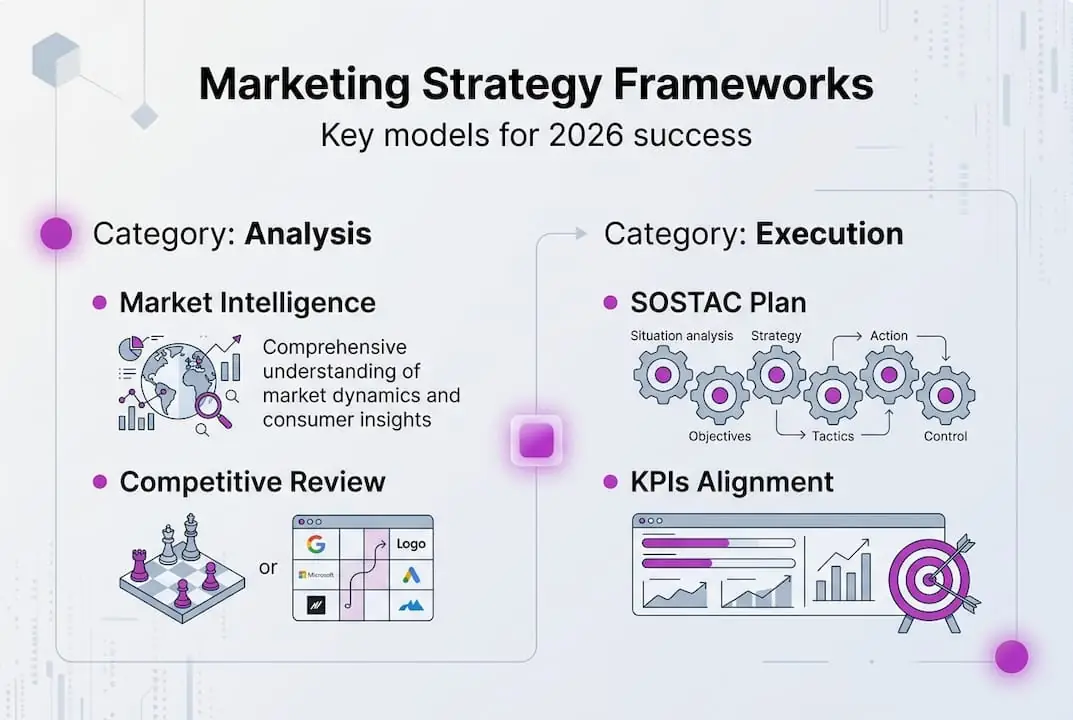
These frameworks guide strategy formulation from initial analysis to ongoing controls, ensuring nothing critical is overlooked. For example, SOSTAC begins with situational analysis to understand current performance and market context, then sets clear objectives that inform strategic choices. Tactics and actions translate strategy into executable plans, whilst controls ensure you can measure progress and adjust as needed. This systematic approach reduces risk and increases the likelihood of achieving strategic goals.
| Framework | Primary focus | Best used for |
|---|---|---|
| SOSTAC | Comprehensive planning from situation to control | Full strategy development and execution planning |
| 4Ps | Marketing mix optimisation | Product positioning and channel decisions |
| STP | Audience strategy | Defining target segments and positioning |
| Ansoff Matrix | Growth strategy | Evaluating market and product expansion options |
Setting strategic objectives and aligning KPIs is crucial for measuring success. Objectives should be specific, measurable, and tied directly to business outcomes such as revenue growth, market share, or brand awareness. KPIs translate these objectives into trackable metrics, enabling you to monitor performance and make data-driven adjustments. For instance, if your objective is to increase brand visibility amongst enterprise clients, relevant KPIs might include share of voice in industry publications, website traffic from target segments, and engagement rates on thought leadership content.
Pro Tip: Prioritise strategic planning frameworks before moving into execution tactics. A well-defined strategy provides the roadmap that ensures tactical efforts are coherent, efficient, and aligned with your ultimate business goals.
Steps to operationalise your marketing strategy:
- Conduct thorough market and competitive analysis to identify opportunities
- Define target audience segments based on behavioural and demographic data
- Articulate a compelling value proposition that differentiates your brand
- Select frameworks that match your strategic priorities and organisational context
- Set clear objectives and KPIs that link marketing activities to business outcomes
- Allocate budget and resources according to strategic priorities
- Develop tactical plans that execute the strategy across chosen channels
- Implement control mechanisms to monitor performance and enable agile adjustments
Marketing frameworks and content production work hand in hand, as strategic clarity informs what content to create, for whom, and through which channels to maximise impact and ROI.
Navigating complexity: strategic nuances and adapting in saturated markets
The distinction between strategy and tactics is often blurred in practice, yet clarity here is essential. Strategy is about how to win, avoiding the trap of confusing motion for advantage. Tactics are the specific actions you take, such as launching a social media campaign or optimising email workflows. Strategy, by contrast, is the overarching logic that determines which tactics to deploy, when, and why. Without strategic grounding, you risk busy activity that generates little meaningful progress toward your goals.
Strategic asymmetry and optionability provide competitive advantages in crowded markets. Asymmetry means choosing a different path than competitors, exploiting opportunities they overlook or undervalue. Optionability refers to maintaining flexibility to pivot as conditions change, rather than locking into rigid plans. Together, these principles enable brands to navigate uncertainty and capitalise on emerging trends faster than less agile competitors.
CMOs face significant challenges proving marketing ROI and adapting to uncertainty. Traditional attribution models often fail to capture the full customer journey, making it difficult to demonstrate the business impact of strategic marketing investments. Additionally, rapid market shifts, evolving consumer behaviours, and technological disruption create an environment where yesterday’s winning strategy may be obsolete tomorrow. Successful CMOs embrace adaptive planning, using data and experimentation to refine strategies continuously rather than relying on static annual plans.
Contrarian moves can generate advantage in saturated digital markets in 2026. When competitors converge on similar tactics, differentiation becomes harder and customer acquisition costs rise. Brands that identify underserved niches, experiment with unconventional channels, or challenge industry assumptions can break through the noise and capture disproportionate attention. This requires courage and strategic conviction, as contrarian approaches often face internal scepticism before they prove successful.
Pro Tip: Don’t mistake busy activity for strategic progress. Regularly step back to assess whether your marketing efforts are advancing your strategic objectives or simply keeping teams occupied with low-impact tasks.
Key considerations for navigating strategic complexity:
- Distinguish clearly between strategic direction and tactical execution to avoid confusion
- Embrace uncertainty by building flexibility and optionability into your strategy
- Challenge conventional wisdom and explore contrarian approaches where competitors cluster
- Use data and experimentation to validate strategic assumptions and inform adjustments
- Align cross-functional teams around strategic priorities to ensure coherent execution
As strategist Richard Rumelt observes, “Good strategy works by focusing energy and resources on one, or a very few, pivotal objectives whose accomplishment will lead to a cascade of favourable outcomes.” This focus is especially critical in saturated markets where resources are finite and competition is intense. By concentrating efforts on the most impactful opportunities, you maximise the return on your strategic investments and build momentum that compounds over time.
Content creation for competitive growth exemplifies how strategic focus on high-value content types and distribution channels can differentiate brands and drive measurable business results in crowded digital spaces.
Applying marketing strategy to drive brand visibility and digital growth
Operationalising a marketing strategy for brand and digital growth requires a systematic approach that translates strategic intent into measurable actions. Start by ensuring alignment between marketing objectives and broader business goals, so every initiative contributes to organisational success. Next, develop detailed tactical plans that specify what will be done, by whom, and by when, ensuring accountability and clarity across teams. Finally, implement solid monitoring and optimisation processes that enable continuous improvement based on performance data.
Targeted marketing mix adjustments can yield significant weekly revenue boosts versus competitors. Brands that adjust their marketing mix on competitive segmentation and live performance data do better than brands running a static, one-size-fits-all plan. This adaptive strategy involves regularly reviewing channel performance, audience engagement, and conversion metrics, then reallocating budget and effort toward the highest-performing activities. The result is more efficient spending and stronger growth trajectories.
Setting business-aligned KPIs and monitoring them effectively is foundational to strategic success. KPIs should cascade from strategic objectives, providing clear line of sight between marketing activities and business outcomes. For example, if your strategic objective is to increase market share in a specific segment, relevant KPIs might include segment-specific revenue growth, customer acquisition cost, and lifetime value. Regular monitoring enables you to identify trends early, celebrate wins, and address underperformance before it becomes critical.
Using AI and data for personalised marketing and growth optimisation is increasingly essential in 2026. AI-powered tools can analyse vast datasets to identify patterns, predict customer behaviour, and recommend optimal actions at scale. Personalisation driven by these insights enhances customer experience, improves conversion rates, and strengthens brand loyalty. However, technology alone is not a strategy; it must be deployed in service of clear strategic objectives to deliver meaningful value.
| Approach | Revenue impact | Key advantage |
|---|---|---|
| Traditional static mix | Baseline performance | Simple to implement, low resource requirement |
| Adaptive mix optimisation | Up to 15% weekly revenue boost | Responsive to market changes, competitive agility |
| AI-driven personalisation | 20-30% improvement in conversion | Scalable, data-informed, customer-centric |
Pro Tip: Align cross-functional teams and use competitive segmentation for mix optimisation. When marketing, sales, product, and customer success teams share strategic priorities and data, the entire organisation moves faster and more coherently toward growth goals.
Steps to implement and optimise your marketing strategy:
- Ensure strategic objectives are clearly communicated and understood across teams
- Develop tactical execution plans with specific timelines, owners, and success metrics
- Implement data infrastructure to capture performance across all channels and touchpoints
- Establish regular review cycles to assess KPI performance and identify optimisation opportunities
- Use A/B testing and experimentation to validate assumptions and refine tactics
- use AI and automation to scale personalisation and improve efficiency
- Foster cross-functional collaboration to ensure strategic alignment and shared accountability
- Remain agile and willing to pivot based on data insights and market feedback
Social media branding growth methods demonstrate how strategic focus on platform-specific engagement tactics, audience insights, and content optimisation can amplify brand visibility and drive measurable digital growth in competitive landscapes.
How AMW Media can support your marketing strategy
Building and executing a solid marketing strategy requires expertise, resources, and a deep understanding of digital marketing dynamics. AMW Media specialises in blending strategic thinking with creative content production to help ambitious brands enhance their online presence and achieve measurable growth. Whether you need support developing a comprehensive marketing strategy from scratch or optimising existing efforts for better performance, our team brings the certifications, experience, and creative innovation to deliver results. Our Northampton page makes the point that workshops and conversion businesses film well and their buyers search with intent.
Our digital marketing services span the full spectrum of strategic and tactical support, from market analysis and audience segmentation to channel execution and performance optimisation. We offer specialised social media management services that align social strategies with broader business goals, ensuring every post, campaign, and engagement contributes to brand visibility and growth. Additionally, our PPC campaign management expertise ensures your paid media investments are strategically targeted, data-driven, and optimised for maximum ROI. Explore how AMW Media can become your strategic partner in navigating competitive markets and driving sustained digital growth.
Frequently asked questions
What is the difference between marketing strategy and marketing tactics?
Marketing strategy defines the overall direction, target audience, and competitive positioning that guide your marketing efforts toward long-term business goals. Tactics are the specific actions and campaigns you execute to implement that strategy, such as launching an email campaign or running paid ads. Effective marketing requires both working in harmony, with strategy providing the roadmap and tactics delivering the execution.
What are the most commonly used frameworks to build a marketing strategy?
SOSTAC, GSTIC, 4Ps, STP, and Ansoff Matrix are popular strategic frameworks that help marketers structure analysis, planning, execution, and control. SOSTAC and GSTIC provide comprehensive planning structures, whilst the 4Ps focus on marketing mix decisions and STP concentrates on audience strategy. The Ansoff Matrix is particularly useful for evaluating growth opportunities through market and product development.
How can marketers measure if their strategy is successful?
Set clear KPIs linked to strategic objectives such as revenue growth, market share, brand awareness, and customer acquisition cost. Regularly review performance data to assess whether marketing activities are advancing these KPIs and contributing to business outcomes. Use dashboards and analytics tools to track progress in real time, enabling agile adjustments when performance deviates from targets.
Why is adaptability important in marketing strategy today?
Uncertainty and market saturation require marketers to adapt quickly to changing consumer behaviours, competitive moves, and technological shifts. Contrarian and flexible approaches create competitive advantage in digital markets by enabling brands to capitalise on emerging opportunities faster than rigid competitors. Building optionability into your strategy ensures you can pivot without losing strategic coherence or momentum.
Recommended
- What is video marketing: effective strategies for 2026
- Creative content production steps for marketing success in 2026
- Harness social media in branding for growth in 2026
- Why use agency services to grow your brand in 2026
Our free marketing audit looks at your site, your ads and your content, and comes back with a 30 day plan. No pitch deck.

Runs the content calendars and the community side of every social account, and keeps clients posted on what is going out and when. Meet the team.