
 Black Steel Doors
 Woodstock Campers
 Phillips Joinery
Marketing managers often struggle to produce creative content that genuinely engages audiences and drives measurable results. Without a structured approach, content creation becomes inconsistent, unfocused, and ineffective. This guide presents practical, evidence backed steps grounded in design thinking methodology to help you build a repeatable process that elevates digital engagement. You’ll learn how to research, ideate, prototype, test, and refine content that connects with your audience whilst supporting your broader marketing strategy.
Key takeaways
| Point | Details |
|---|---|
| Research drives relevance | Empathy centred research uncovers real audience needs and defines precise content problems before creation begins. |
| Structured ideation boosts creativity | Collaborative brainstorming and rapid prototyping generate stronger ideas and faster iteration cycles. |
| Quality outperforms quantity | Brands with documented content strategies experience 7.8x higher website traffic growth than those without. |
| Testing validates effectiveness | Audience feedback refines messaging, improves clarity, and ensures strategic alignment before full production. |
Understanding the problem and preparation
Effective content production starts long before you write a single word or shoot a single frame. The five stages of design thinking provide a proven framework: Empathise, Define, Ideate, Prototype, and Test. Empathy is crucial to problem solving and a human centred design process, making it the essential first step for marketing content.
Start by conducting user centred research to understand what your audience genuinely needs, fears, and values. Use surveys, interviews, social listening, and analytics to gather real insights rather than assumptions. This research phase reveals content gaps, audience pain points, and opportunities your competitors might miss.
Once you’ve gathered insights, define the core content problem with precision. Are you struggling to generate qualified leads? Do engagement rates fall below industry benchmarks? Is your message unclear to your target demographic? A well defined problem statement focuses your creative efforts and prevents wasted resources on content that doesn’t serve strategic goals.
Structured preparation transforms vague ideas into actionable briefs. Document audience personas, content objectives, success metrics, and distribution channels before ideation begins. This groundwork ensures your creative graphic design services and content assets align with business outcomes from day one.
Pro Tip: Create a simple research template that captures audience insights, business goals, and content constraints in one place. This becomes your creative brief foundation and keeps teams aligned throughout production.
Key preparation activities include:
- Conducting stakeholder interviews to clarify business objectives and constraints
- Analysing competitor content to identify differentiation opportunities
- Mapping customer journeys to understand content needs at each touchpoint
- Setting measurable KPIs that connect content performance to business outcomes
Executing creative ideation and prototyping
With solid research and a clearly defined problem, you’re ready to generate creative solutions. The ideation and prototyping stages transform insights into tangible content concepts through structured creativity and rapid experimentation.

Brainstorming sessions work best when they’re time boxed, inclusive, and judgement free. Invite team members from different disciplines to contribute diverse perspectives. A designer might suggest visual storytelling angles a copywriter wouldn’t consider, whilst a social media manager brings platform specific insights that shape format decisions.
Develop low fidelity prototypes of your content concepts before committing to full production. For video content, this might mean storyboards or rough cuts. For written pieces, create detailed outlines with headline options and key message points. For social campaigns, mock up several creative variations to test different hooks and calls to action.
Pro Tip: Use the “Yes, and…” improv technique during brainstorming to build on ideas rather than shutting them down. This creates psychological safety and encourages bold creative thinking.
Prototyping lets you test concepts quickly and cheaply before investing significant resources. Share prototypes with a small segment of your target audience to gather feedback on clarity, appeal, and relevance. This early validation prevents costly production mistakes and reveals which concepts resonate most strongly.
Iteration is where good ideas become great content. Based on prototype feedback, refine messaging, adjust visual treatments, or pivot entirely if data suggests a different approach. Each iteration cycle strengthens alignment between your content and audience needs.
Follow this ideation and prototyping workflow:
- Generate 10 to 15 diverse content concepts without filtering or judging
- Evaluate concepts against your defined problem statement and success criteria
- Select the top three concepts for prototype development
- Create simple prototypes that communicate the core idea without full production polish
- Test prototypes with real audience members and document feedback
- Iterate on the strongest concept based on testing insights
- Prepare detailed production specifications for the validated concept
Collaboration across marketing teams enriches creative output and prevents siloed thinking. Your marketing agency course training should emphasise cross functional teamwork as a core competency for modern content creators.
Testing, refining and ensuring quality
Creative concepts validated through prototyping still require rigorous testing and refinement before launch. This verification phase separates high performing content from mediocre output that wastes budget and opportunity.
Test content with representative audience segments to collect actionable feedback. Use A/B testing for headlines, preview images, and opening hooks. Monitor engagement metrics closely during soft launches to identify optimisation opportunities before full distribution.
Refine messaging and design elements to improve clarity and intent alignment. Google rewards pages that improve semantic clarity and intent alignment, even without publishing new content. Every word, image, and design choice should serve your strategic objectives and audience needs.
Prioritise quality over quantity throughout your content production process. Research shows content quality generates 4x more leads than content focused on quantity. One exceptional piece that solves a real problem delivers more value than ten mediocre assets that clutter your channels.
Brands with documented strategies experience 7.8x higher website traffic growth compared to those without. This dramatic performance gap highlights why strategic alignment matters more than production volume.
Pro Tip: Create a quality checklist that every piece of content must pass before publication. Include criteria for strategic alignment, audience relevance, technical optimisation, and brand consistency.
Ensure all content supports your overarching marketing strategy. Isolated creative pieces might win awards but fail to drive business results. Connect each asset to specific funnel stages, campaign objectives, or customer journey touchpoints.
Quality assurance activities:
- Fact checking all claims and statistics with credible sources
- Reviewing content against brand guidelines and tone of voice standards
- Optimising technical elements for SEO services and packages performance
- Testing accessibility across devices and platforms
- Validating calls to action align with conversion goals
Your social media management services should apply the same quality standards whether creating carousel posts or long form video content.
| Quality Metric | Target | Measurement Method |
|---|---|---|
| Audience relevance score | 8/10 or higher | Post launch survey of target demographic |
| Strategic alignment | 100% traceable to objectives | Content brief comparison |
| Technical optimisation | All criteria met | SEO and accessibility audit |
| Engagement rate | Above channel benchmark | Platform analytics review |
Common pitfalls and troubleshooting tips
Even experienced marketing teams make predictable mistakes that undermine content effectiveness. Recognising these pitfalls helps you avoid costly errors and maintain production quality.
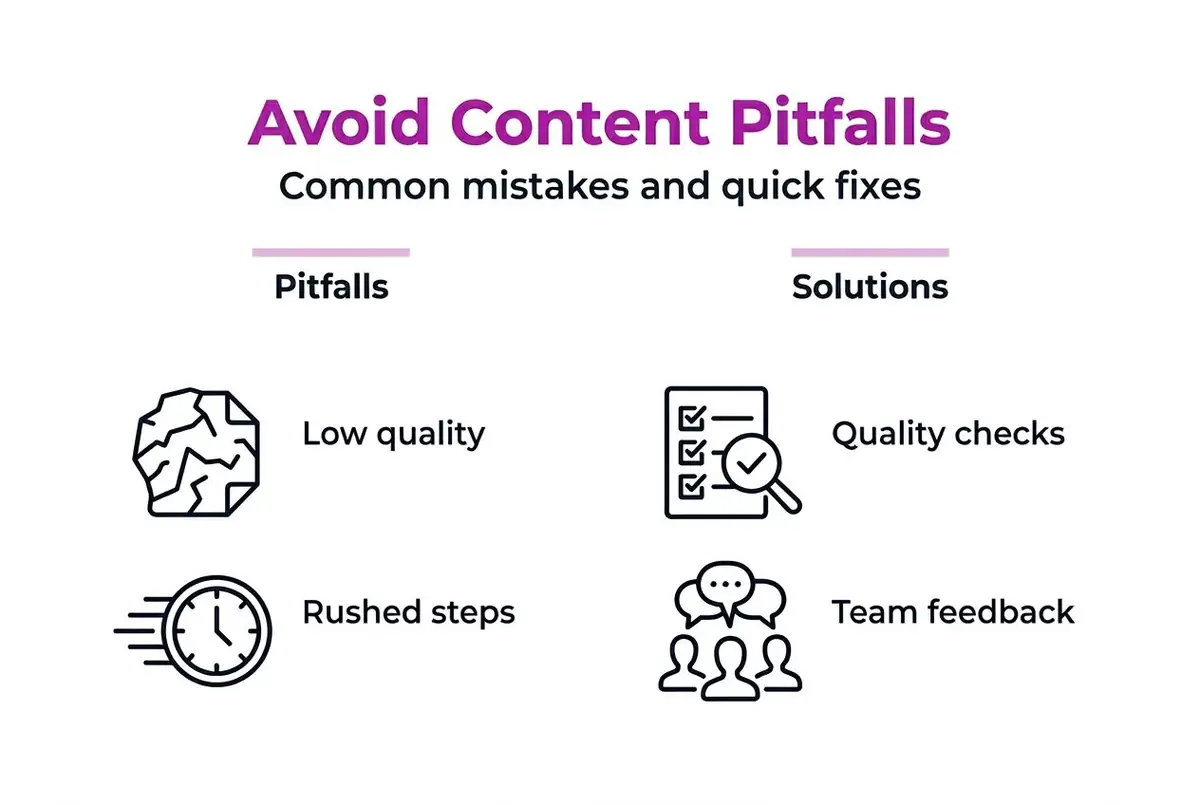
Skipping strategy development before content creation is the most damaging mistake. Without clear objectives, target audiences, and success metrics, you’re producing content based on guesswork. This leads to inconsistent messaging, wasted budgets, and missed opportunities.
Relying solely on AI without human editing and strategic direction degrades quality. Most AI generated long-form content is garbage because people use it incorrectly. AI tools are powerful multipliers when used within a structured process, but they cannot replace human creativity, strategic thinking, or editorial judgement.
“Creating high-quality long-form content using AI tools requires strategy first, architecture second, generation third, and a ruthless human editing pass.”
Producing low quality content for quantity damages your brand authority and audience trust. Search engines increasingly penalise thin content whilst rewarding depth and expertise. Your audience can immediately spot rushed, superficial content that fails to address their real needs.
Pro Tip: Implement a content audit process every quarter to identify underperforming assets. Update, consolidate, or remove content that no longer serves strategic goals or audience needs.
Maintain precise structure and clear goals when using AI tools to be effective. Provide detailed briefs, examples of desired output, and specific constraints. Review and refine AI generated content ruthlessly, ensuring every sentence adds value and aligns with your brand voice.
Common troubleshooting solutions:
- Low engagement rates: Revisit audience research to ensure you’re solving real problems, not assumed ones
- Inconsistent quality: Implement standardised workflows and quality checklists across your content team
- Poor conversion performance: Test different calls to action and ensure content aligns with funnel stage
- Scalability challenges: Document repeatable processes and invest in professional content production resources
Avoid treating content creation as a purely tactical activity. Strategic integration, audience empathy, and quality obsession separate content that drives business results from content that simply fills channels.
How AMW Media can support your creative content production
Implementing structured content production processes requires expertise, resources, and ongoing optimisation. That’s where AMW Media helps ambitious brands bridge the gap between strategy and execution.
Our content production services bring together strategic thinking and creative excellence to deliver content that drives measurable engagement. From video and photography to graphic design and social media assets, we apply design thinking methodology to every project, ensuring your content solves real audience problems whilst supporting business objectives.
We don’t just create beautiful content. We build integrated campaigns that combine SEO, social media, and conversion optimisation to maximise your marketing ROI. Our team holds certifications from Google, Meta, Shopify, and other leading platforms, bringing technical expertise alongside creative vision.
Explore our services to see how we tailor creative content production, web design, email marketing, and automation solutions for ambitious brands seeking competitive advantage. Browse our work and projects to see case studies demonstrating how structured content processes deliver real business results for clients across industries.
Frequently asked questions
What are the key stages in creative content production?
The key stages follow the design thinking framework: Empathise with your audience through research, Define the core content problem, Ideate creative solutions collaboratively, Prototype concepts for early testing, and Test with real users whilst refining based on feedback. This structured approach ensures content addresses genuine audience needs whilst supporting strategic marketing objectives.
How can design thinking improve my content creation?
Design thinking fosters empathy by starting with deep audience research rather than assumptions about what content they need. It encourages structured creativity through brainstorming and prototyping, reducing risk whilst increasing innovation. The iterative testing phase ensures your final content aligns with both user needs and business goals, dramatically improving performance compared to unstructured production approaches.
Why is prioritising content quality over quantity important?
High quality content generates 4x more leads than volume focused approaches and builds lasting audience trust. Quality content earns better search rankings, higher engagement rates, and stronger conversion performance. Brands with documented quality standards experience 7.8x higher website traffic growth, proving that strategic depth outperforms tactical breadth in competitive digital markets.
What common mistakes should I avoid in content production?
Skipping content strategy before creation leads to unfocused output that fails to drive results. Using AI tools without proper structure, human editing, and strategic direction produces low quality content that damages your brand. Prioritising quantity over quality undermines audience trust and wastes resources. Always test content with real users before full launch to avoid costly mistakes and ensure your messaging resonates with target audiences.
Recommended
- Professional Video & Content Production Services London | AMW Media | AMW Media
- AMW Media, Digital Marketing Agency London
- Our Services | AMW Media
- Social Media Management Services | AMW Media | AMW Media
Our free marketing audit looks at your site, your ads and your content, and comes back with a 30 day plan. No pitch deck.

Founded AMW Media in 2024 and runs strategy, paid media and the CRM builds. The reason everything here is in house and measured in revenue. Meet the team.