
 Black Steel Doors
 Woodstock Campers
 Phillips Joinery
TL;DR:
- Business blogging transforms a company website into a long-term growth asset by attracting targeted traffic and building authority. It strategically maps content to the buyer journey stages to generate leads and improve search rankings, requiring consistent, well-planned execution. Effective blogs integrate keyword research, editorial calendars, and analytics, ensuring strategic alignment and continuous improvement for measurable results.
Business blogging is the practice of publishing regular, educational content on a company website to attract potential customers, build brand authority, and drive measurable digital growth. Unlike a personal blog, a business blog serves a clear commercial purpose. It answers the questions your customers are already searching for, positions your brand as the go-to expert, and creates a steady pipeline of organic traffic without relying on paid advertising. Platforms like HubSpot, Salesforce, and Shopify have all built significant portions of their inbound marketing on this principle. Understanding what is blogging for business means recognising it as a long-term asset, not a one-off campaign.

What is blogging for business and why does it matter?
Business blogging is defined as transforming a static website into an active channel for education and problem-solving. Salesforce describes it as the shift from broadcasting to helping customers find answers. That distinction matters enormously. A brochure website tells people what you do. A business blog shows them you understand their problems.
The commercial logic is simple. When a potential customer types a question into Google, they are already in a research mindset. A well-written blog post that answers that question puts your brand in front of them at exactly the right moment. That is inbound marketing working as intended.
For small and medium-sized businesses, the advantage is particularly significant. Blogging is a cost-effective, always-on marketing channel that allows smaller brands to compete for search visibility and leads without large advertising budgets. A well-optimised post published today can continue attracting visitors for years. That is a return on investment that paid ads simply cannot match over the long term.
How does business blogging drive digital growth?
A business blog functions as several marketing tools at once. Think of it as a 24/7 salesperson, an SEO engine, and a lead-generation machine rolled into one. Elementor describes it precisely this way, and the description holds up in practice.
Here is how each function works in real terms:
- Organic traffic: Every blog post targets specific search queries. More posts targeting more queries means more entry points to your website from Google and Bing.
- SEO authority: Search engines reward websites that publish consistent, quality content. Regular blogging signals that your site is active and relevant, which improves rankings across your entire domain.
- Lead generation: Blog posts can capture leads directly through embedded forms, content downloads, or calls to action. A reader who finds your post useful is already a warm prospect.
- Social and email fuel: Blog content gives your social media and email marketing teams something worth sharing. It extends the reach of every post far beyond your website.
- Trust and authority: Educational content builds credibility over time. When readers consistently find useful answers on your blog, they associate your brand with expertise.
| Benefit | How It Works | Business Outcome |
|---|---|---|
| Organic traffic | Targets search queries with relevant posts | Reduces reliance on paid ads |
| SEO authority | Consistent publishing signals relevance | Improves rankings site-wide |
| Lead generation | Embedded CTAs and content offers | Grows email list and pipeline |
| Brand trust | Educational, problem-solving content | Shortens sales cycles |
| Content distribution | Blog posts repurposed across channels | Amplifies reach at low cost |
Pro Tip: Repurpose each blog post into at least three other formats: a social media carousel, an email newsletter section, and a short video script. One piece of content becomes four touchpoints with minimal extra effort.
HubSpot reports that blogging builds momentum that attracts readers continuously through search and AI recommendations without ongoing promotion. That compounding effect is what separates blogging from almost every other marketing tactic.
What makes a business blogging strategy effective?
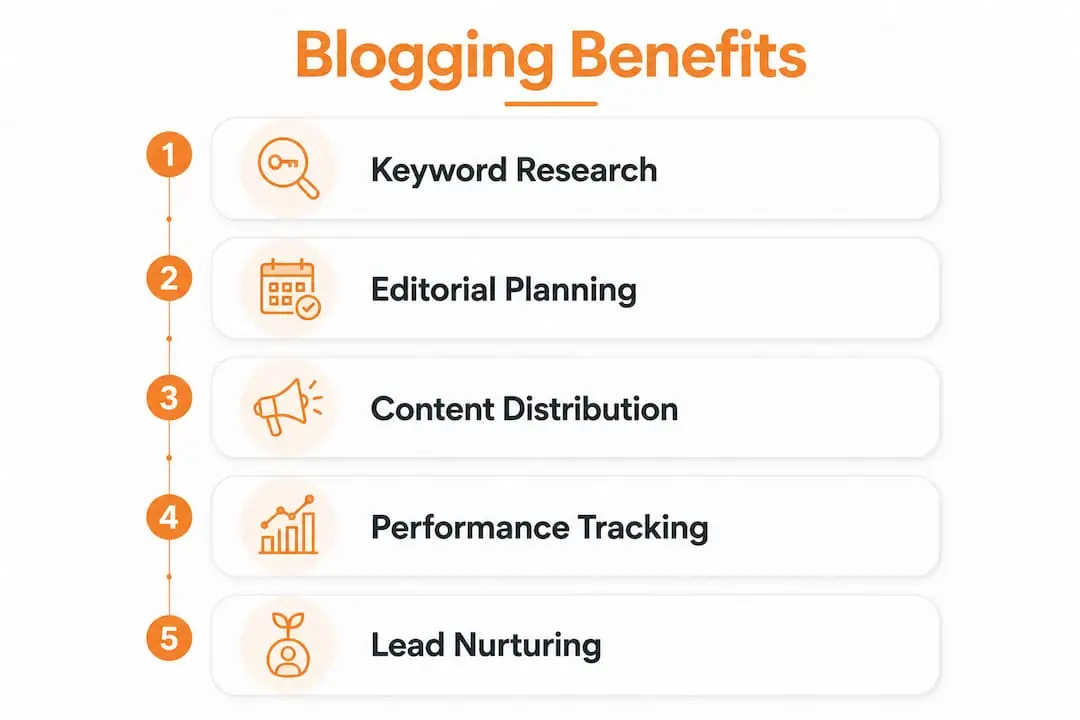
Publishing blog posts without a strategy is the equivalent of opening a shop with no signage. The content exists, but nobody finds it. Shopify outlines blog strategy as four interconnected components: keyword research, a content schedule, distribution channels, and analytics. Each one is necessary. None works well in isolation.
Keyword research
Keyword research identifies the exact questions and phrases your potential customers type into search engines. Tools like Google Search Console, Ahrefs, and Semrush reveal which queries have genuine search volume and which are realistic to rank for given your domain authority. Without this step, you are writing content that nobody is searching for.
Editorial calendar
An editorial calendar is the operational backbone of a successful blog. It maps out topics, publication dates, and responsible team members weeks or months in advance. This prevents the common trap of publishing in bursts followed by long silences. Consistency matters more than frequency. Publishing once a week reliably outperforms publishing five posts in one week and then going quiet for a month.
A well-structured content calendar also aligns blog topics with business campaigns, product launches, and seasonal demand. That alignment turns your blog from a standalone channel into an integrated part of your marketing operation.
Distribution and performance tracking
Writing the post is only half the work. Distribution through social media, email newsletters, and internal linking determines how many people actually read it. Performance tracking through Google Analytics 4 or similar tools tells you which posts drive traffic, generate leads, and convert readers. Without that data, you are optimising blind.
| Strategy Component | Purpose | Outcome |
|---|---|---|
| Keyword research | Identifies audience search queries | Content ranks for relevant terms |
| Editorial calendar | Plans consistent publishing | Builds SEO momentum over time |
| Distribution channels | Amplifies reach beyond search | Increases readership and shares |
| Analytics and tracking | Measures content performance | Enables continuous improvement |
Pro Tip: Revisit your top-performing posts every six months. Update statistics, add new examples, and refresh internal links. Salesforce highlights that updating older posts combined with steady new content builds SEO authority far faster than new posts alone.
How should blog content map to the buyer journey?
The most common mistake in business blogging is writing content that attracts readers but fails to move them any closer to becoming customers. Mapping blog content to buyer journey stages fixes this problem directly. Shopify’s blog strategy guide confirms that connecting content to buyer stages increases blog impact on lead generation and sales alignment.
The buyer journey has three stages, and your blog needs content at each one.
Awareness stage (top of funnel): The reader knows they have a problem but does not yet know the solution. Posts at this stage answer broad questions: “Why is my website traffic dropping?” or “What is content marketing?” The goal is to attract the right audience and introduce your brand as a helpful resource.
Evaluation stage (middle of funnel): The reader is now comparing options. Posts here might compare approaches, explain methodologies, or walk through case studies. “SEO vs. PPC: which is right for your business?” is a classic mid-funnel topic. This is where you demonstrate depth and build preference for your brand.
Decision stage (bottom of funnel): The reader is close to making a choice. Posts at this stage address specific objections, explain pricing structures, or showcase client results. A post titled “What to expect when working with a digital marketing agency” speaks directly to someone ready to buy.
Internal linking connects these stages into a coherent path. A top-funnel post should link naturally to a mid-funnel post, which in turn links to a relevant service page or lead capture form. HubSpot stresses that effective internal linking directs readers toward conversion points and prevents traffic drop-offs. Every post needs a clear next step. A post with no onward link is a dead end, and dead ends do not generate leads.
Quality matters more than volume at every stage. HubSpot is clear that content aligned with the sales process drives business outcomes far more reliably than a high volume of loosely relevant posts. Ten posts that serve your buyer journey will outperform fifty posts written without strategic intent.
You can explore proven content marketing examples to see how brands structure content across these stages in practice.
What are the biggest challenges in business blogging?
Business blogging delivers real results, but it is not without operational challenges. Knowing the common pitfalls in advance saves a significant amount of wasted effort.
- Inconsistent publishing: The most damaging habit in business blogging is starting strong and then going quiet. Search engines and readers both notice. A realistic publishing schedule you can maintain beats an ambitious one you cannot.
- Generic content: Writing about topics that are too broad or too obvious produces content that competes with thousands of similar posts. Specificity wins. “How to improve your website” loses to “How to reduce bounce rate on a Shopify product page.”
- No measurement: Publishing without tracking performance means you cannot learn what works. Google Analytics 4 and Google Search Console are free and provide the data you need to make informed decisions. Use them from day one.
- Siloed blogging: A blog that operates separately from your sales, social media, and email teams misses the multiplier effect. The most effective blogs are integrated into the wider marketing operation.
- Ignoring existing content: New posts get all the attention, but older posts often have more authority. Refreshing them with updated information and new internal links is one of the highest-return activities in content marketing.
Pro Tip: Treat your blog like a product, not a project. Assign a content owner, set a quarterly review cadence, and track performance against specific business goals. Blogs that are managed like campaigns rather than ongoing products tend to fade after the initial enthusiasm.
For a broader view of how to track what your blog is actually achieving, the AMW Media guide on analysing marketing results covers the metrics that matter most.
Integrating blogging with lead nurturing strategies also significantly increases the commercial return from your content investment.
Key takeaways
Business blogging works because it converts a company website into a compounding, always-on asset that attracts qualified traffic, builds brand authority, and generates leads without ongoing ad spend.
| Point | Details |
|---|---|
| Define the purpose clearly | Business blogging educates customers and drives growth, not just brand awareness. |
| Strategy before content | Keyword research, an editorial calendar, and distribution planning must come first. |
| Map content to buyer stages | Top, mid, and bottom-funnel posts create a path from discovery to conversion. |
| Internal linking is non-negotiable | Every post needs a clear next step to avoid traffic dead ends and lost leads. |
| Consistency beats volume | A reliable publishing schedule builds more SEO authority than sporadic bursts of content. |
Why most business blogs underperform (and how to fix it)
After working with brands across a range of industries, the pattern I see most often is this: a business invests in a blog, publishes ten or fifteen posts, sees modest results, and quietly stops. The blog sits there, gathering digital dust, while the team concludes that blogging “doesn’t work for us.”
The problem is almost never the blog. It is the expectation. Business blogging is not a sprint. It is closer to building a pension. The contributions you make today compound quietly in the background, and the returns become meaningful over months and years, not weeks.
What I have found separates the blogs that perform from those that do not is connection to the sales process. The brands that treat their blog as a standalone content exercise rarely see commercial results. The ones that sit their content team down with their sales team, map out the actual questions prospects ask before buying, and then write posts that answer those questions directly, those are the blogs that generate real pipeline.
The other thing I would push back on is the obsession with publishing frequency. I have seen blogs publishing three posts a week that generate almost no leads, and blogs publishing twice a month that consistently bring in qualified enquiries. The difference is always quality and strategic alignment, not volume. Write fewer posts, but make each one worth reading.
One practical habit that has made a real difference: treat every blog post as the start of a conversation, not the end of one. End each post with a specific, relevant next step. Link to a related post, a service page, or a lead magnet. A reader who finds your content useful is already halfway to becoming a customer. Do not leave them with nowhere to go.
If you are thinking about investing in content creation for the long term, the compounding returns are worth it. But go in with a strategy, not just enthusiasm.
Amir
How AMW Media can help you build a blog that actually grows your business
A well-executed blog does not exist in isolation. It needs strong SEO foundations to rank, social media amplification to reach new audiences, and a website built to convert the traffic it generates. AMW Media brings all of these together for ambitious brands that want measurable results from their content investment. Our marketing agency Reading page asks the question that follows from all of this: what should small business marketing actually earn?
The AMW Media SEO services ensure your blog posts rank for the queries your customers are actually searching for, building organic visibility that compounds over time. The social media management team amplifies every post across the right channels, turning individual articles into multi-platform content campaigns. And if your current website is not built to support a high-performing blog, the web design team can create a platform that integrates your blog smoothly with your brand and conversion goals. Get in touch to find out what a properly integrated content strategy looks like for your business.
FAQ
What is a business blog exactly?
A business blog is a regularly updated section of a company website that publishes educational, problem-solving content aimed at potential and existing customers. Its primary purpose is to attract organic traffic, build brand authority, and support lead generation.
How does blogging help with SEO?
Each blog post targets specific search queries, creating additional entry points to your website from search engines. Consistent publishing signals to Google and Bing that your site is active and relevant, which improves rankings across your entire domain over time.
How often should a business publish blog posts?
Consistency matters more than frequency. Publishing one well-researched post per week reliably outperforms irregular bursts of content. The right cadence is the one your team can maintain without compromising quality.
What types of blog posts generate the most leads?
Bottom-funnel posts that address specific buyer objections, compare solutions, or showcase client results tend to generate the most direct leads. Mid-funnel comparison and methodology posts build preference and warm up prospects before they reach a decision.
How do you measure whether a business blog is working?
Track organic traffic, keyword rankings, time on page, and conversion events such as form submissions or content downloads using Google Analytics 4 and Google Search Console. Reviewing these metrics quarterly allows you to refine your strategy based on what is actually performing.
Recommended
- Digital presence strategy guide for brand growth in 2026 | AMW Media
- What is storytelling in marketing: a 2026 guide | AMW Media
- Why invest in content creation for competitive brand growth
- How to master your digital marketing process for 2026
Our free marketing audit looks at your site, your ads and your content, and comes back with a 30 day plan. No pitch deck.

On site with the cameras most days of the week. Installs, interviews, products and events, from London to Liverpool. Meet the team.