
 Black Steel Doors
 Woodstock Campers
 Phillips Joinery
TL;DR:
- Effective online lead generation relies on a structured five-stage system: attract, capture, qualify, nurture, and convert.
- Inbound content marketing and SEO produce high-quality leads at lower costs compared to outbound methods.
- A hybrid, measurement-driven approach across multiple channels outperforms reliance on a single tactic.
Many businesses invest heavily in digital marketing, only to watch their enquiry count flatline. You run the campaigns, publish the blog posts, and tweak the ads, yet reliable, qualified leads remain frustratingly elusive. The problem is rarely effort. It is almost always the absence of a repeatable system. Many leads never convert without deliberate nurturing, which means even the leads you do attract are quietly slipping away. This guide walks you through every essential stage of online lead generation, from attracting the right visitors to converting them into paying customers, using proven processes, the right channels, and common pitfalls to sidestep along the way.
Key Takeaways
| Point | Details |
|---|---|
| Framework matters | Following a clear, stepwise process yields more consistent and higher quality online leads. |
| Content is key | Content marketing and SEO generate the greatest volume and best quality leads at the lowest cost. |
| Nurturing drives sales | Without lead nurturing, most online leads never convert to paying customers. |
| Hybrid channels win | A combination of inbound and outbound tactics, backed by measurement, delivers faster and more sustainable growth. |
The online lead generation process explained
Before choosing a single channel or writing a single piece of content, you need to understand how online lead generation actually works as a system. Most businesses treat it as a collection of disconnected tactics. They run an ad here, publish a post there, and then wonder why results are inconsistent. The real answer lies in a clear, repeatable framework.
The core lead generation process follows five interdependent stages: Attract, Capture, Qualify, Nurture, and Convert. Skipping any one of them creates a gap that silently kills your results. Here is what each stage involves:
- Attract: Draw the right audience to your website or landing page through search, social, paid media, or content.
- Capture: Use forms, landing pages, or lead magnets to collect contact details from interested visitors.
- Qualify: Assess whether a captured lead is a genuine fit for your product or service using scoring or segmentation.
- Nurture: Build trust over time through email sequences, retargeting, and personalised content.
- Convert: Guide qualified, warmed-up prospects toward a sales conversation, demo, or purchase.
These stages work in sequence but also feed back into each other. A nurture sequence might reveal that your qualification criteria are too broad. A poor conversion rate often signals a nurturing problem, not a traffic problem. Investing in solid digital marketing strategies across all five stages is what separates businesses with predictable pipelines from those chasing results month to month.
| Stage | Common tools | Success benchmark |
|---|---|---|
| Attract | SEO, PPC, social media | 1,000+ monthly sessions |
| Capture | Landing pages, forms, pop-ups | 2.5% to 5% conversion rate |
| Qualify | CRM scoring, surveys | 20% to 40% MQL rate |
| Nurture | Email sequences, retargeting | 30% to 50% open rate |
| Convert | Sales calls, demos, proposals | 14% to 25% close rate |
Pro Tip: Map your actual buyer journeys alongside these five stages. Interview recent customers and ask them exactly how they found you, what reassured them, and what almost put them off. You will find gaps in your funnel that no analytics tool would ever reveal.
Content-driven strategies for inbound lead generation
With a clear process in mind, let us zero in on content-led inbound methods that drive quality leads without heavy spending. Inbound lead generation is about pulling the right people toward you by offering genuine value before asking for anything in return.
Content marketing and SEO are used by 67% of marketers and generate three times more leads at roughly half the cost compared to outbound methods. That is a compelling case for building a content engine, especially for businesses with limited ad budgets.
Here is a numbered framework for building your content funnel:
- Plan: Research keywords your ideal customers are searching for. Identify their questions, pain points, and decision-making triggers.
- Produce: Create blog posts, videos, guides, or templates that answer those questions. Quality over quantity, always.
- Promote: Share content across your social channels, email list, and relevant communities. Do not publish and pray.
- Optimise: Review performance monthly. Update underperforming content, strengthen internal linking, and add new data to keep pages fresh.
Lead magnets are particularly powerful capture tools within a content funnel. These are free assets, such as ebooks, checklists, templates, or mini-courses, that visitors download in exchange for their email address. A well-crafted lead magnet aligned with a specific problem your audience faces can convert casual browsers into warm leads overnight. If you are serious about growth, invest in content creation as a long-term asset rather than a short-term task.
| Channel | Reach | Typical cost | Lead quality |
|---|---|---|---|
| SEO and blogging | Very high | Low (time investment) | High |
| Lead magnets | Medium | Low to medium | Very high |
| Guest posting | Medium | Low | Medium |
| Paid content promotion | High | Medium to high | Medium |
For long-term results, strong SEO marketing strategies are non-negotiable. And if you need inspiration on formats and angles, studying content marketing examples from brands in adjacent sectors can spark fresh ideas quickly. Compared to the inbound vs outbound approach, inbound consistently wins on cost efficiency and lead quality over the medium to long term.
Pro Tip: Cluster your content around your two or three core services rather than writing about every topic loosely connected to your industry. Topic clusters signal authority to search engines and guide prospects more naturally toward conversion.
Paid and social: accelerating lead volumes online
While content draws leads steadily, paid and social campaigns let you turbocharge your results when you need volume fast. These channels are indispensable when you are launching a new product, filling a sudden pipeline gap, or targeting a very specific audience segment.

Platform selection matters enormously. Social platforms such as Facebook (used by 70% of lead gen marketers) and Instagram (60%) are effective for B2C and visually led brands. LinkedIn is the clear choice for B2B, particularly for high-value accounts and professional services. Google PPC captures high-intent buyers at the exact moment they are searching for a solution.
Before you spend a single pound on paid media, understand what you are measuring. Average PPC lead costs vary wildly by industry, from under £30 in e-commerce to over £200 in financial services. Know your target cost per lead before you launch, not after.
Common campaign mistakes to avoid:
- Running ads to your homepage rather than a dedicated, conversion-focused landing page
- Ignoring audience segmentation and targeting too broadly
- Setting and forgetting campaigns without weekly performance reviews
- Focusing entirely on clicks and impressions rather than cost per qualified lead
- Failing to align ad creative with landing page messaging, which destroys trust and conversions
Paid social works particularly well for webinars, events, and lead generation offers where urgency plays a role. For B2B brands, LinkedIn Lead Gen Forms deserve special attention. They pre-populate a prospect’s details from their profile, reducing friction and increasing form completion rates dramatically. Pair this with smart social media marketing tips for organic community building, and you create a reinforcing loop of visibility and trust.
Pro Tip: Use paid channels for fast wins and pipeline top-ups, but always reinvest a portion of your paid returns into building owned assets like your email list and blog. Paid traffic stops the moment you stop paying. Owned channels compound over time.
Lead capture, nurturing, and conversion best practices
After driving visitors to your site, these practices ensure you successfully capture, nurture, and convert more leads for your business. Getting traffic is only half the challenge. What happens after someone lands on your page determines whether all that effort turns into revenue.
Here are the essential steps:
- Optimise your capture forms. Remove every unnecessary field. Ask only for what you need at this stage. Studies consistently show that fewer fields mean higher completion rates.
- Respond fast. Speed is a conversion superpower. Leads that receive a follow-up within five minutes are nine times more likely to convert than those contacted after an hour.
- Segment from the start. Ask one qualifying question on your form (industry, budget range, business size) so your follow-up can be immediately relevant.
- Nurture with intent. Build email sequences that educate, address objections, and build trust before pitching. Drip campaigns that deliver real value feel helpful, not pushy.
- Convert with clarity. Make the next step obvious. A clear call to action, whether that is booking a call, starting a trial, or requesting a quote, removes the decision friction that stalls conversions.
“79% of leads never convert without nurturing, while inbound leads close at 14.6% compared to just 1.7% for outbound. The difference is not the lead. It is the process.”
Key tools to support your capture and nurture system:
- CRM platforms (HubSpot, Salesforce) for lead tracking and scoring
- Marketing automation tools (ActiveCampaign, Mailchimp) for drip sequences
- AI lead scoring software to prioritise your hottest prospects
- Chatbots for instant on-site engagement and qualification
Explore dedicated email marketing tactics for your nurture sequences and study email nurturing strategies that keep your audience engaged throughout a longer sales cycle. For further guidance on structuring your nurture workflow, HubSpot’s lead nurturing guidance offers a solid foundation.
Common pitfalls: over-qualifying leads too early and discarding prospects who simply need more time, ignoring segmentation so every lead receives the same generic follow-up, and responding too slowly to new enquiries.
Measuring, optimising, and scaling online lead generation
You have set up the key steps. Now let us ensure ongoing growth by monitoring and scaling the right way. Without clear measurement, you are flying blind, spending budget on what feels right rather than what the data confirms.
The metrics that matter:
- Cost per lead (CPL): How much you spend to acquire each lead, broken down by channel
- Lead to customer conversion rate: The percentage of leads that become paying clients
- Lead quality score: How well leads match your ideal customer profile
- Return on investment (ROI): Revenue generated relative to total lead generation spend
- Time to conversion: How long it takes a lead to move from first contact to closed deal
Track CPL, close rates, and ROI alongside revenue attribution, not just raw lead numbers, to understand what is working. A campaign generating 500 leads at £5 each is not necessarily better than one generating 50 leads at £60 each if the latter converts at ten times the rate.
Optimisation tactics worth building into your monthly routine:
- A/B test landing page headlines, form layouts, and calls to action
- Split test email subject lines and send times for your nurture sequences
- Review channel mix quarterly and reallocate budget toward the highest ROI sources
- Analyse drop-off points in your funnel to pinpoint where leads are being lost
- Use heatmaps and session recordings to understand on-page behaviour
For scaling, watch your CPL and conversion rate over three consecutive months. If CPL is stable and conversion rates hold, you have a strong signal to increase spend. If either metric deteriorates under increased budget, you have a capacity or quality problem to solve first. Strong digital strategy optimisation practices will help you build the analytical discipline needed to scale with confidence. And always review your lead tracking benchmarks against industry standards so you know whether your performance is competitive.
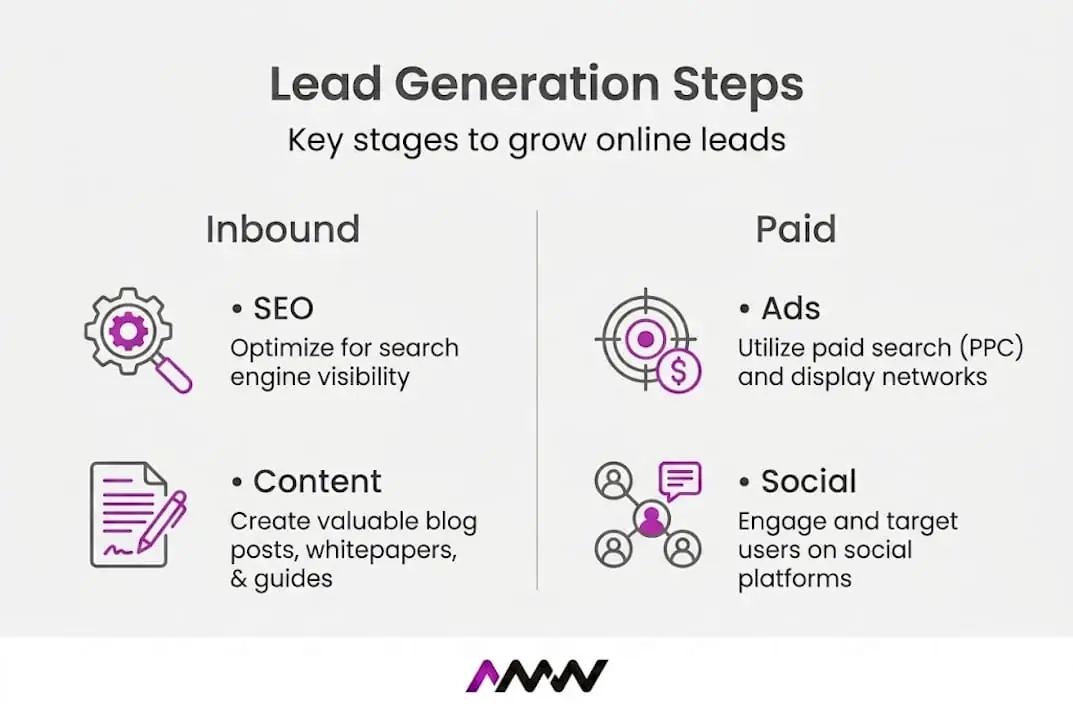
Avoid single-channel dependency above all else. It is a vulnerability that catches businesses off guard, particularly when algorithm changes, platform policy shifts, or rising competition erodes results overnight.
Why hybrid, measurement-first lead generation beats one-size-fits-all
Having covered the core systems and tactics, here is what most guides leave out, and what experience teaches about sustainable lead growth.
The most persistent myth in lead generation is the magic channel. Every few years, a new platform or format is heralded as the ultimate lead generation tool. Marketers pile in, competition rises, costs increase, and quality drops. Businesses that built their entire pipeline on a single channel learn the hard way that dependency is a liability.
The hybrid allbound approach consistently outperforms single-channel strategies because it creates multiple touchpoints across the buyer journey. Inbound content builds trust and brings in organic leads. Outbound paid campaigns fill gaps and accelerate volume when needed. Measurement ties it all together by showing you which combination is actually driving revenue, not just traffic.
In 2026, the teams winning at lead generation are not necessarily the ones with the biggest budgets. They are the ones reviewing attribution data weekly, iterating their nurture sequences monthly, and refusing to fall in love with any single channel. They treat content marketing for growth as a long-term infrastructure investment, not a campaign.
Most lead generation problems are measurement problems in disguise. You cannot optimise what you do not properly track, and you cannot scale what you do not understand.
Pro Tip: Audit your attribution model every quarter. Look beyond last-click data to understand which touchpoints influenced each conversion. You will almost certainly discover that certain channels are undervalued and others are getting credit they do not deserve.
Ready to scale your own lead generation strategy?
Putting these strategies into practice demands the right expertise, tools, and creative firepower working together. At AMW Media, we build custom lead generation systems that combine data-driven planning with compelling content and precision targeting. For a north west London business, our digital marketing agency Harrow page lists the results we can show and the area we cover.
Looking to dominate search results with our SEO packages, generate targeted leads at scale through our PPC management services or build a loyal audience through strategic social media management: we tailor every approach to your brand’s specific goals and market position. Our certified team of marketing strategists, content creators, and paid media specialists work as an extension of your team, not just another agency. Get in touch to discuss a lead generation strategy built around your business, not a template.
Frequently asked questions
What is the most effective way to generate quality leads online?
Inbound content and SEO channels consistently produce the highest quality leads at the lowest cost for most businesses, particularly when combined with well-crafted lead magnets.
How much does online lead generation typically cost?
Costs vary significantly by industry and channel. Average B2B cost per lead ranges from around £25 for SEO-driven leads to over £160 for competitive sectors such as legal or financial services.
Should I use inbound, outbound, or both for online lead generation?
A hybrid allbound approach combining inbound content strategies with targeted outbound paid campaigns delivers faster results and stronger long-term pipeline stability than either method alone.
Why do some online leads never convert to sales?
Up to 79% of leads fail to convert simply because there is no structured nurturing process in place. Without timely, relevant follow-up, even well-qualified prospects lose interest and move on.
How can I measure the success of my lead generation campaign?
Focus on cost per lead, conversion rate, lead quality score, and overall ROI rather than vanity metrics like total lead volume or impressions.
Recommended
- Essential digital marketing guide: strategies for brand growth
- Why invest in content creation for competitive brand growth
- Master your SEO strategy: guide for effective brand growth
- Email marketing strategies to engage and grow your business | AMW Media
- 8 Creative Sources for Ad Creative Inspiration, playablemaker.com 8 Creative Sources for Ad Creative Inspiration
Our free marketing audit looks at your site, your ads and your content, and comes back with a 30 day plan. No pitch deck.

Runs the content calendars and the community side of every social account, and keeps clients posted on what is going out and when. Meet the team.