
 Black Steel Doors
 Woodstock Campers
 Phillips Joinery
TL;DR:
- Marketers must adopt a hybrid AI approach that balances automation with human oversight to maintain brand authenticity and quality. AI enhances content creation by increasing efficiency and personalisation but requires human judgement to ensure nuance, accuracy, and strategic coherence. Building deliberate workflows and continuous oversight is essential for achieving sustainable success in AI-driven marketing.
Marketers are caught between two extremes: those who believe AI will fully automate their content output and those who fear it will strip away every ounce of brand authenticity. Neither camp is right. The real story is more nuanced and, frankly, more exciting. AI-shaped marketing strategies show that optimists cite measurable time savings and ROI, while sceptics point to real gaps in organic ranking and engagement quality. The consensus among serious practitioners is clear: a hybrid approach wins. This article cuts through the noise to show marketing leaders exactly how to use AI strategically, not blindly.
Key Takeaways
| Point | Details |
|---|---|
| Hybrid strategies win | Blending AI efficiency with human creativity delivers the strongest brand content and ROI. |
| AI is an enabler, not a replacement | Success comes from using AI as a smart tool, not as a substitute for strategy or voice. |
| Risks require review | Keep human checks in every workflow stage to maintain credibility, quality, and compliance. |
| Frameworks aid scalable adoption | Well-defined processes for AI integration boost efficiency and engagement without sacrificing brand values. |
Understanding AI-driven content creation
Before your team commits budget and bandwidth to any AI tool, you need a clear-eyed understanding of what these systems actually do. AI-driven content creation refers to the use of machine learning models and natural language processing systems to support or generate marketing assets. That includes written copy, social captions, email sequences, image generation, video scripting, audio transcription, and more.
The scope is impressive. Modern AI tools can:
- Generate first drafts of blog posts, product descriptions, and ad copy in seconds
- Conduct rapid research by synthesising large volumes of online information
- Personalise content at scale, adapting messaging for different audience segments
- Repurpose existing assets across multiple formats and channels automatically
- Assist with ideation, surfacing content angles and topic clusters based on keyword data
- Optimise distribution timing using predictive analytics and engagement data
These capabilities make AI a powerful ally for content teams under pressure to produce more with fewer resources. But the capabilities come with sharp limits. AI systems lack genuine empathy. They cannot reliably interpret cultural nuance or anticipate how a particular phrase will land with a specific community. They do not understand your brand’s history, values, or the unspoken expectations your audience carries. Compliance, legal review, and ethical judgement all remain firmly in human territory.
“The brands seeing the strongest results from AI are not replacing their strategists. They are giving their strategists better tools.” This observation captures the shift happening in leading marketing teams right now.
The rise of hybrid workflows reflects this reality. Teams are restructuring so that AI handles volume and velocity while human creatives focus on strategy, tone calibration, and final quality assurance. If you are working to improve brand engagement through content marketing, integrating AI into your workflow is no longer optional. It is a competitive necessity. Understanding the role of digital content for brand growth helps frame where AI fits most effectively within your broader strategy.

Key benefits of using AI for marketers and strategists
Understanding AI’s scope leads naturally to the practical question: what specific benefits can marketers and strategists actually expect when they begin adopting these tools?
The answer depends on how deliberately you integrate AI into your existing processes. Brands that treat AI as a bolt-on shortcut see modest gains. Brands that redesign their workflows around AI capabilities see transformative results. Here is what the evidence and experience consistently show.
1. Significant time savings across the entire content lifecycle
AI compresses the most labour-intensive stages of content production. Ideation sessions that previously consumed half a day can be completed in under an hour using AI to surface topic clusters, competitor gaps, and audience questions. Initial research briefs, which once required a junior team member to spend several hours sifting through sources, can be assembled in minutes. First drafts of mid-length blog posts or email sequences that optimise content production can be ready for human review within ten minutes of prompting. For marketing teams managing multiple brand channels simultaneously, this compression is transformative.
2. Greater consistency in tone, style, and publishing frequency
One of the most underrated benefits of AI is consistency. Human writers have good days and difficult days. Campaigns get delayed. Tone shifts subtly between contributors. AI, when properly prompted with brand guidelines and style parameters, maintains a consistent voice across high volumes of output. This matters enormously for audience trust. Impactful brand content relies on predictability and coherence, and AI helps enforce that at scale.
3. Faster content repurposing for multiple platforms
A long-form article can be repurposed into a series of LinkedIn posts, an email newsletter, a short-form video script, and a set of social captions. Doing this manually takes hours. AI can produce those derivative assets in minutes, allowing your human team to focus on refining and contextualising rather than rewriting from scratch. Brands publishing across five or more channels know how quickly content demands escalate. AI levels the playing field between large and lean teams.
4. Enhanced personalisation at scale
Personalisation used to require either significant manual effort or expensive technology. AI changes that calculus dramatically. You can now generate specific versions of the same core message for different audience segments, personas, or geographic markets without proportionally increasing workload. Time savings and ROI cited by early adopters are directly linked to this capacity for personalisation at volume.
5. Accelerated ideation and strategic planning
AI tools can analyse trending topics, identify content gaps in your competitors’ strategies, and suggest editorial angles you may not have considered. This is not about replacing your strategists. It is about giving them richer inputs faster so they can make better decisions sooner.
Pro Tip: Always review AI output for factual accuracy and brand alignment before publishing. AI tools can generate plausible-sounding but incorrect information. A single factual error in a published piece can undermine trust that took years to build. Build a mandatory human review stage into every AI-assisted workflow from day one.
Risks, limitations, and the need for human oversight
While the benefits are clear, it is equally important to acknowledge the limitations and why a purely AI-led approach carries genuine risk for ambitious brands.
Brand voice dilution
The most immediate risk is that AI-generated content sounds generic. Tools trained on vast datasets naturally gravitate towards average language. They produce content that reads competently but lacks the specific character, wit, or authority that distinguishes your brand from every other player in your market. If you publish unedited AI output at scale, your audience will notice. Not because they can necessarily identify AI writing, but because the content will feel flat and interchangeable.
Factual inaccuracies and AI hallucinations
AI language models sometimes generate information that sounds authoritative but is simply wrong. Dates, statistics, named sources, and specific claims are particularly vulnerable. This is sometimes called “hallucination,” and it is a genuine operational risk for brands whose credibility depends on accuracy. Any content making factual claims, citing research, or discussing regulated sectors needs solid human fact-checking before publication.
SEO and organic ranking limitations
Empirical ranking and traffic gaps remain a real concern for content produced without sufficient human expertise. Search engines are increasingly sophisticated at assessing content quality, depth, and originality. AI-generated content that lacks genuine insight or unique perspective tends to underperform in competitive search landscapes. The hybrid model exists precisely because human expertise adds the depth that search algorithms and readers both reward.
“AI can produce content that ranks adequately. It rarely produces content that resonates deeply. And deep resonance is what builds loyal audiences.”
Legal, ethical, and copyright considerations
AI models are trained on data from across the internet, which raises legitimate questions about intellectual property. Reproducing stylistic elements or near-verbatim passages from training data creates copyright exposure. Additionally, AI systems can inherit biases present in their training data, generating outputs that inadvertently stereotype or exclude certain groups. Legal and compliance review for AI-generated content is not optional in regulated sectors, and it is increasingly important across all sectors.
The following risks deserve explicit mitigation planning:
- Generic outputs that erode brand differentiation
- Factual errors that damage credibility
- Copyright and intellectual property exposure
- Implicit bias in generated content
- Regulatory non-compliance in sensitive sectors
Reviewing content marketing success stories from leading brands makes one thing clear: every high-performing campaign has a strong human editorial layer. AI accelerates production. Humans ensure the output is worth reading.
Pro Tip: Use human editors for every AI-generated asset, not just long-form content. Social captions, email subject lines, and short ad copy are all vulnerable to the same risks. Build editing time into your production schedule rather than treating it as optional.
AI-human collaboration: The hybrid approach as best practice
The drawbacks examined above make the case for hybrid workflows logical rather than tentative. The consensus from serious practitioners is that hybrid approaches outperform both pure automation and purely manual production for ambitious brands focused on engagement and growth.
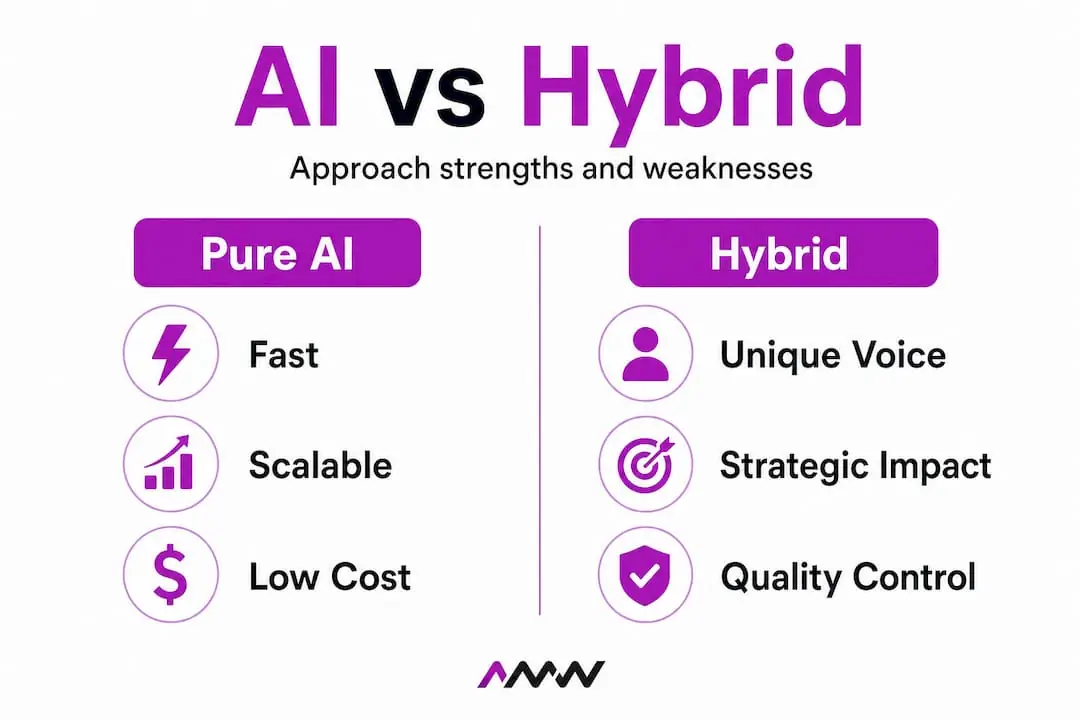
The following comparison clarifies exactly why.
| Approach | Strengths | Weaknesses |
|---|---|---|
| Pure AI | Fast, scalable, low cost per unit | Generic outputs, factual risk, brand voice dilution |
| Pure human | Deep nuance, authentic voice, strategic depth | Slow, expensive, difficult to scale |
| Hybrid | Speed and scale with quality control and brand alignment | Requires deliberate workflow design and skilled editors |
The table makes the case plainly. The hybrid approach captures the efficiency gains of AI while preserving the qualities that human creativity delivers uniquely. The practical question is how to implement this in your team.
Here is a proven step-by-step approach:
- AI-assisted ideation: Use AI tools to generate topic clusters, headline variations, and content angles. Have a strategist review and select the most relevant options based on campaign goals and audience knowledge.
- AI-generated first drafts: Prompt the AI using detailed briefs that include your brand tone, target audience, key messages, and any mandatory inclusions or exclusions.
- Human structural editing: A senior writer or content strategist reviews the draft for structure, argument quality, brand alignment, and factual accuracy before any further development.
- Cross-team quality assurance: Route finalised content through relevant stakeholders. Legal for compliance-sensitive material, subject matter experts for technical accuracy, and brand leads for tone consistency.
- Publication and performance review: Publish and track performance against pre-defined metrics. Feed insights back into subsequent AI prompting and editorial briefs to continuously improve output quality.
Building your hybrid workflow also requires deliberate decisions about competitive content investment. The brands winning with AI are not cutting their content budgets. They are reallocating them, spending less on repetitive production tasks and more on strategic oversight, editorial quality, and creative direction.
Actionable frameworks for integrating AI in your content workflow
With an understanding of when and how to balance AI with human input, it is time to look at processes and tools for operationalising this approach across your marketing team.
The following table maps key workflow stages to recommended AI tools and human responsibilities, giving you a clear starting framework.
| Workflow stage | Recommended AI tools | Human responsibilities |
|---|---|---|
| Strategy and planning | ChatGPT, Claude, Perplexity | Set objectives, define audience, approve topic direction |
| Ideation and research | Jasper, ChatGPT, SEMrush AI | Curate ideas, validate relevance, add brand context |
| Content creation | ChatGPT, Claude, Jasper, Midjourney | Review drafts, refine voice, fact-check all claims |
| Quality assurance | Grammarly, Hemingway App, Originality.ai | Final editorial review, compliance check, brand sign-off |
| Publication and distribution | Buffer, Hootsuite, HubSpot AI | Approve scheduling, monitor performance, manage community |
| Performance analysis | GA4, Hotjar, HubSpot reporting | Interpret data, inform strategy, update editorial briefs |
When assessing your current workflow for AI integration readiness, work through the following checklist.
- Do you have documented brand voice guidelines that can be used to prompt AI tools accurately?
- Is there a clear editorial review process with named owners at each stage?
- Do your team members understand the factual risk of AI outputs and know how to verify claims?
- Have you identified which content types in your mix are best suited to AI assistance?
- Do you track content performance metrics consistently enough to measure improvement post-AI adoption?
- Have you consulted your legal team about copyright and compliance considerations for AI-generated content?
The metrics you must track to assess whether your hybrid workflow is delivering include output quality scores (assessed via structured editorial rubrics), audience engagement rates across channels, organic search performance for AI-assisted content, production cycle time, and team satisfaction scores. That last metric matters more than many marketing leaders acknowledge. Poorly implemented AI workflows create stress and confusion for content teams. Digital marketing strategies that account for team wellbeing alongside performance metrics consistently outperform those that focus solely on output volume.
It is also worth monitoring how AI and SEO overviews are evolving, as search engine interfaces change rapidly and the hybrid approach that performs best in 2026 may need recalibration as algorithms and AI-generated answer panels continue to develop.
The strongest brands are not waiting for the perfect AI solution. They are building iterative frameworks now, learning fast, and adjusting based on real performance data rather than vendor promises.
Why hybrid outperforms hype: A practitioner’s view
Every few months, a new AI tool arrives promising to automate your content strategy entirely. The headlines are bold, the demos are impressive, and the case studies are carefully curated. And yet, the marketing teams producing the most consistently engaging content in competitive markets are not the ones running purely automated pipelines. They are the ones who have learnt to use AI as a skilled collaborator rather than a replacement workforce.
Buried beneath the AI enthusiasm is a plain fact: the majority of so-called “AI-driven” strategies still depend entirely on the quality of human judgement at critical decision points. The AI does not decide what your brand stands for. It does not recognise when a campaign angle is culturally misjudged. It does not push back when a brief is weak. Those responsibilities belong to experienced marketers, and no current AI tool is close to replacing them.
What chasing pure automation actually costs ambitious brands is differentiation. When every competitor in your sector is using the same AI tools and following the same prompting patterns, the outputs start to converge. Audiences notice the sameness even when they cannot articulate why. Brand loyalty is built on distinctiveness, and distinctiveness requires human creative judgement at the centre of the process.
What actually works over time is a layered model. Use AI for speed, for scale, for surfacing ideas and producing volume. Use humans for depth, for trust, for the creative decisions that determine whether your content connects or simply exists. Brands that optimise their digital strategy with this balance embedded into their culture see compound returns. Content quality improves over time because the human layer continuously raises the standard, and the AI layer continuously accelerates execution.
The hype will settle. The brands that will still be winning in three years are the ones building solid hybrid capabilities now, with genuine strategic investment rather than surface-level experimentation.
How AMW Media accelerates your AI-powered content success
Bridging the gap between AI potential and real-world brand performance is where most marketing teams struggle. Understanding the theory is one thing. Building the infrastructure, the workflows, and the skilled team to execute consistently is another challenge entirely. For a north west London business, our digital marketing agency Harrow page lists the results we can show and the area we cover.
AMW Media helps ambitious brands design and implement hybrid content strategies that harness AI for speed and scale while maintaining the creative quality and strategic rigour your audience expects. Whether you need a solid social media management framework that uses AI to maintain publishing consistency, a technically sound SEO content strategy that integrates AI-assisted production with expert editorial oversight, or integrated web design solutions that bring your content experience together cohesively, our team has the experience and the partnerships to deliver measurable results. Get in touch to explore how a specific AI-human content strategy can accelerate your brand’s growth.
Frequently asked questions
Can AI completely replace creative content teams?
No. The most effective content combines AI for speed and scale with human input for nuance, strategy, and compliance. Hybrid approaches outperform both fully automated and entirely manual methods for ambitious brands focused on genuine engagement.
What are the main risks when using AI for brand content?
The primary risks include brand voice dilution, factual inaccuracies, and organic ranking and traffic gaps if AI content is not carefully reviewed and refined by experienced human editors before publication.
Which types of content benefit most from AI?
Short-form, repetitive, and highly personalised content such as email campaigns and social posts benefit most from AI assistance, where time savings and ROI are most measurable, while long-form and brand-defining campaigns still require substantial human creative input.
How can our brand keep its voice while using AI?
Build detailed brand voice documentation that informs every AI prompt you use, and ensure a skilled human editor reviews and refines all AI-generated content. Consistency and authenticity come from deliberate human oversight at every stage, not from the AI tool itself.
Recommended
- How to create brand content that drives real results | AMW Media
- Why invest in content creation for competitive brand growth
- The role of digital content in brand growth and engagement
- Creative content production steps for marketing success in 2026
Our free marketing audit looks at your site, your ads and your content, and comes back with a 30 day plan. No pitch deck.

On site with the cameras most days of the week. Installs, interviews, products and events, from London to Liverpool. Meet the team.