
 Black Steel Doors
 Woodstock Campers
 Phillips Joinery

TL;DR:
- Storytelling in marketing is a fundamental principle that significantly enhances campaign impact by engaging the brain’s emotional and neurological responses.
- Effective storytelling requires characters, conflict, and resolution, using techniques like the 5 Cs framework and in media res to create memorable content.
Storytelling in marketing is not a trend. It is the reason certain campaigns live rent-free in your head for years while others vanish within seconds of the ad break ending. The proof is in the numbers: ads using storytelling lift campaign performance by 30%, compared to just 15% for ads communicating brand value alone. That gap is not a coincidence. It reflects something fundamental about how human brains work, how we remember things, and why we choose the brands we do. This guide covers what storytelling in marketing actually means, which techniques work, and how to use them without falling into the traps most brands stumble into.
Key takeaways
| Point | Details |
|---|---|
| Storytelling doubles ad impact | Campaigns built on narrative outperform simple brand value messaging by a significant margin. |
| Conflict is non-negotiable | Removing tension from your story kills engagement and makes content feel like a press release. |
| Authenticity beats polish | Especially with younger audiences, emotional honesty outperforms aspirational perfection every time. |
| Build a story bank | Systematically collecting real story material stops you from running dry mid-campaign. |
| Measure the right things | Track brand recall, sentiment, and engagement rather than expecting immediate direct conversions. |
What storytelling in marketing actually means
A lot of marketers hear “storytelling” and picture a heartwarming John Lewis Christmas ad or a three-minute brand film with a cinematic score. That framing is understandable, but it misses the point. Storytelling in marketing is not a content format. It is a structural principle that applies to a six-second pre-roll ad just as much as it does to a feature-length documentary.
At its core, a story needs four things: a character the audience can identify with, a conflict or tension that creates stakes, a narrative arc that moves the story forward, and a resolution that delivers meaning. Take away any one of those and you no longer have a story. You have a claim. Claims get scrolled past. Stories get remembered.
The neuroscience behind this is fascinating. Well-structured narratives produce neural coupling in the brain and trigger the release of oxytocin and dopamine, the hormones associated with trust and pleasure. When someone reads or watches a story, their brain simulates the experience rather than simply processing information. This is why a good brand story makes someone feel something, while a product spec sheet makes them shrug.
The distinction from ordinary messaging is worth spelling out clearly:
- Product claim: “Our coffee is ethically sourced and full of flavour.”
- Brand story: A founder who spent three years tracking down a small family farm in Ethiopia because they refused to settle for anything less, and the relationship they built that changed both their lives.
Both communicate similar facts. Only one of them makes you want to try the coffee.
This is what a sound marketing strategy recognises early: facts inform, but stories persuade. The importance of storytelling in advertising goes well beyond making content more enjoyable. It fundamentally changes how audiences encode, retain, and act on what they see.
Storytelling techniques in marketing
Knowing that you should tell stories is one thing. Knowing how to structure them effectively is another. The good news is that storytelling techniques in marketing are learnable frameworks, not mysterious creative gifts.
The 5 Cs framework
The 5 Cs framework is one of the most practical tools available: Character, Conflict, Context, Change, and Conclusion. Every element earns its place. Character gives the audience someone to root for. Conflict creates the tension that keeps them watching. Context explains why it matters. Change shows movement and growth. Conclusion delivers the payoff.
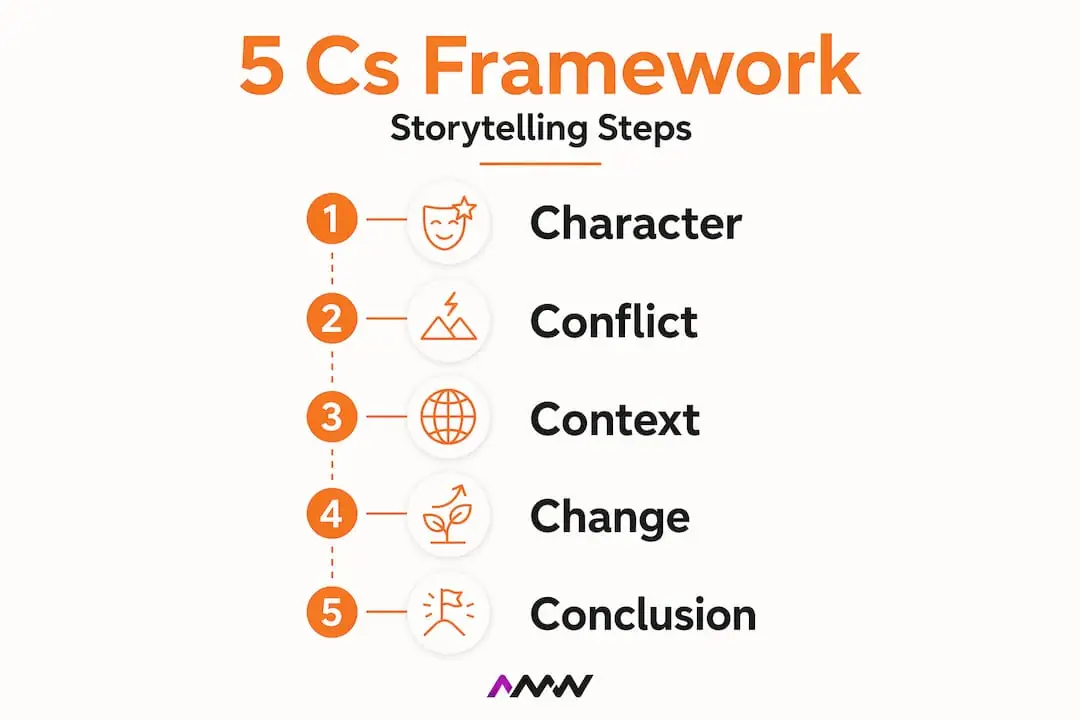
A social media campaign for a fitness brand, for example, might feature a real customer who struggled with motivation after a health scare (character and conflict), filmed in their actual home rather than a studio (context and authenticity), showing the gradual shift in their relationship with exercise (change), and ending with a moment of quiet pride rather than a dramatic transformation (conclusion). That structure works because every element is doing a job.
In media res and the mountain structure
Two other techniques worth knowing are in media res and the mountain structure. In media res means starting in the middle of the action rather than at the beginning. It is why great brand videos open with a dramatic moment before stepping back to explain how we got there. It creates immediate intrigue.
The mountain structure builds tension steadily, stacking obstacles before reaching a peak and then resolving. This mirrors the classic hero’s journey and is particularly effective in longer-form content like case study videos, brand documentaries, and email sequences.
Here is a quick comparison of the main techniques and where they work best:
| Technique | Best suited for | Key strength |
|---|---|---|
| 5 Cs framework | Social content, video scripts, blog posts | Ensures all story elements are present |
| In media res | Video ads, podcast intros, email subject lines | Creates immediate curiosity |
| Mountain structure | Long-form video, brand documentaries, landing pages | Builds sustained emotional investment |
| Personal anecdote | Founder content, email marketing, social captions | Builds relatability and genuine trust |
| Visual storytelling | Reels, YouTube, product photography sequences | Communicates emotion without words |
Pro Tip: Never remove the conflict from your story to make it more “on-brand.” Brands that omit tension produce content that reads like a press release. The conflict is precisely what makes audiences keep watching.
Visual storytelling through video has become particularly critical. LinkedIn data identifies it as the number one in-demand marketing skill in the UK as of 2026. If you are not thinking about your brand narrative in visual terms, you are already playing catch-up.
Authenticity and vulnerability in brand storytelling
There has been a notable shift in what audiences respond to over the past few years. Polished perfection, the kind of storytelling that presents an idealised version of your brand with no rough edges, is losing its grip. Audiences have become extraordinarily good at detecting when a brand is performing authenticity rather than actually embodying it.

Gen Z in particular responds far more strongly to brands that acknowledge friction, uncertainty, and vulnerability than to those projecting aspirational lifestyles. Hinge’s emotional campaign targeting Gen Z burnout is a good example: rather than selling romance as a perfect outcome, it leaned into the mess and exhaustion of modern dating. The result was significantly stronger engagement than their previous campaigns.
The shift towards emotional honesty does not mean airing your brand’s dirty laundry. It means letting real human complexity show up in your stories. A few things that signal genuine authenticity:
- Showing the struggle, not just the success
- Using real customers and employees rather than actors wherever possible
- Acknowledging what you got wrong and what you learned
- Letting the ending be quiet and earned rather than triumphant
The business case for this is clear. Cancer Research UK ran a long-form storytelling campaign that saw brand consideration rise from 54% to 58%, a four-point lift that would be difficult to achieve through product messaging alone. The campaign worked because it put real human stories at its centre, not polished promotional content.
“Treating storytelling as a direct response tool is a fundamental misunderstanding of what it does. Storytelling builds the emotional architecture of your brand over time. It is what makes someone choose you when they finally need what you sell.”
The trust that authentic narratives build compounds. Audiences who connect with your stories become advocates, not just customers. That is the real benefit of storytelling for businesses operating in competitive markets.
How to use storytelling in your marketing campaigns
Understanding storytelling in theory is one thing. Building it into your actual campaigns requires a few deliberate habits and some honest thinking about where your brand narrative currently sits.
Here is a practical process to follow:
Build a story bank. Most businesses have far more genuine story material than they realise. The barrier is retrieval. Systematically archiving customer conversations, team moments, product failures, and turning points gives you a reservoir to draw from rather than scrambling for content ideas each week.
Align stories with your brand values. A story that contradicts your positioning does more damage than no story at all. Before producing anything, ask whether this narrative reinforces what you want your brand to stand for.
Match format to channel. A long-form documentary works on YouTube and your website. It does not work as an Instagram Story. Every channel has its own storytelling grammar. Learn it.
Balance brand building with conversion. Narrative builds emotional memory and warms audiences before they are ready to buy, which lowers your long-term acquisition costs. But you still need clear calls to action in the right places. The mistake is expecting one piece of storytelling content to do both jobs simultaneously.
Audit your current content. Look at your last ten pieces of content and ask: does this have a character? Is there tension? Does it resolve in a meaningful way? If most of them read like product descriptions, you know where to start.
Pro Tip: Even a six-second ad can carry a complete story. Compressed storytelling works as long as all five narrative elements are implied rather than absent. A face, a problem, a single moment of change. That is enough.
Common pitfalls to avoid when implementing storytelling campaigns:
- Making the brand the hero instead of the customer
- Prioritising production value over genuine emotional honesty
- Publishing stories with no conflict or challenge shown
- Treating storytelling as a one-off campaign rather than an ongoing approach
- Ignoring common digital marketing mistakes that undermine even the best narratives
Measuring the impact of storytelling
One of the most common objections to investing in storytelling is that it is hard to measure. That objection is partly fair and mostly an excuse. Storytelling does not always show up in last-click attribution models. That does not mean it is not working.
The metrics that storytelling meaningfully influences include:
| Metric | What to track | Typical storytelling impact |
|---|---|---|
| Brand recall | Prompted and unprompted recall in surveys | Significant lift over non-narrative content |
| Brand consideration | Likelihood to choose brand when next buying | 4 percentage point uplift demonstrated in long-form campaigns |
| Engagement rate | Time on page, video completion, shares | Measurably higher for narrative-led content |
| Sentiment | Comments, reviews, social listening data | Positive shift linked to authentic storytelling |
| Lead quality | Conversion rate and sales cycle length | Shorter cycles when storytelling pre-warms audiences |
The indirect SEO benefits are real too. Content built around stories earns longer dwell times, more return visits, and more organic shares. These engagement signals feed back into organic search performance in ways that compound over months.
The efficiency gains from storytelling in performance marketing are particularly worth noting for business owners watching their cost-per-acquisition. When someone has encountered your brand narrative before they see a conversion ad, they are already predisposed to trust you. The conversion ad does not have to work as hard.
My honest take on storytelling in marketing
I have worked with enough brands to say this clearly: the biggest mistake is not a lack of storytelling skill. It is a fear of showing vulnerability.
Brands consistently water down their stories. They smooth out the conflict, resolve the tension too quickly, and leave audiences with something that feels safe and forgettable. I have seen it happen with founders who have fascinating, difficult origin stories, and they present a sanitised version because they worry about appearing weak. The irony is that the difficult parts are exactly what would make people care.
The unexpected and illogical moments in a story are often the most compelling. When a brand admits it nearly failed, changed direction entirely, or got something completely wrong, that is when audiences lean in. Not because people enjoy failure, but because honesty signals that everything else you say is probably true too.
The other misconception I see regularly is using storytelling as a direct response tool and then concluding it does not work when the conversion numbers do not move immediately. Storytelling builds brand sentiment over time. It operates over a longer arc than a PPC campaign. Measuring it by the same short-term metrics is like judging a film by its first ten minutes.
What I have seen work repeatedly is what I would call the “misfits mindset.” Brands that tell the stories others in their industry avoid, that acknowledge the uncomfortable realities their customers already know, earn a level of trust that no amount of polished content can manufacture. The brands that try to be everything to everyone end up meaning nothing to anyone. Pick the story only you can tell. Tell it. The audience will find you. Our London page is honest about this: the extraordinary shops at the top of every London list are real, and the question is which kind of agency your budget actually needs.
Amir
Bring your brand story to life with AMW Media
If this article has made you reconsider how your brand currently tells its story, the next step is deciding where to start.
At AMW Media, we work with ambitious brands to create content that actually connects. Whether that means a video series, a social media management strategy built around authentic narratives, or a website designed to tell your story the moment someone lands on it, we blend creative production with strategic thinking that gets measurable results. Our team has helped brands across competitive markets turn their real stories into content that builds genuine audiences. If you want to see what that could look like for your brand, explore our services or get in touch.
FAQ
What is storytelling in marketing?
Storytelling in marketing is the practice of communicating your brand’s message through narrative rather than direct claims. It uses characters, conflict, and resolution to create emotional connection and make content memorable.
Why is storytelling important in advertising?
Storytelling in advertising triggers emotional and neurological responses that simple product messaging does not. Research shows it doubles campaign effectiveness compared to communicating brand value alone.
What are the main storytelling techniques in marketing?
The most widely used techniques include the 5 Cs framework (character, conflict, context, change, conclusion), in media res, the mountain structure, and personal anecdote storytelling. Each suits different formats and audience types.
How do you measure storytelling success?
Track brand recall, engagement rate, sentiment, and brand consideration rather than direct conversions. Storytelling influences how audiences feel about your brand over time, which shows up in these longer-term metrics.
Can storytelling work in short-form content?
Yes. Even a six-second video can carry a complete narrative if the story elements are implied effectively. The key is ensuring character, tension, and resolution are all present, even in compressed form.
Recommended
- brand storytelling engage customers and drive growth | AMW Media
- What is marketing strategy and how to build one in 2026
- Creative content production steps for marketing success in 2026
- How to master your digital marketing process for 2026
Our free marketing audit looks at your site, your ads and your content, and comes back with a 30 day plan. No pitch deck.

Runs the content calendars and the community side of every social account, and keeps clients posted on what is going out and when. Meet the team.