
 Black Steel Doors
 Woodstock Campers
 Phillips Joinery
TL;DR:
- Brand visibility refers to how often and prominently a brand appears across multiple channels where purchasing decisions happen. It is the external input that builds awareness; without it, even strong products remain unnoticed. In 2026, brands must focus on multi-surface presence, including AI platforms, to ensure comprehensive visibility and recognition.
Brand visibility is defined as the frequency and prominence with which a brand appears to potential customers across every channel where buying decisions happen, from Google search results to AI-generated recommendations. HubSpot describes it as the input to awareness: the external presence a brand builds before a customer ever consciously recognises it. Without consistent visibility, even the best product sits in silence. In 2026, that means showing up in traditional search and across social feeds, review platforms, community forums, and increasingly, the answers generated by AI tools like ChatGPT and Google’s AI Overviews. This guide explains what brand visibility means, how to measure it, and how to build more of it.
What is brand visibility and how is it defined?
Brand visibility, in marketing terms, refers to how often and how prominently a brand surfaces in the environments where its audience spends time and makes decisions. It is not the same as brand awareness, though the two are closely linked. Visibility is the cause; awareness is the effect. You cannot build recognition in someone’s memory without first appearing in their world repeatedly.

The concept sits at the intersection of SEO, social media, content marketing, and digital branding. A brand with strong visibility appears in organic search results, gets mentioned in industry publications, shows up in social feeds, earns reviews on platforms like Trustpilot and Google Business Profile, and, in 2026, gets cited by AI systems when users ask relevant questions. Semrush frames this as a “Search Everywhere” challenge: winning means being retrieved, cited, and trusted across multiple surfaces simultaneously.
This multi-surface definition matters because buyers rarely follow a straight line from search to purchase. They encounter brands across a dozen touchpoints before making a decision. A business that only optimises for Google rankings while ignoring social, forums, and AI layers is leaving significant visibility on the table.
How is brand visibility measured across channels?
Brand visibility is not a single score you can pull from one dashboard. It is a composite metric that should be tracked per channel, combining several signals to build an accurate picture of how present a brand actually is.
The most useful signals to track are:
- Branded search volume: How many people search your brand name directly. Rising branded search is one of the clearest indicators that visibility is working.
- Share of voice: Your brand’s presence in a given channel relative to competitors. Tools like Semrush and Brandwatch calculate this for both search and social.
- Direct traffic: Users who type your URL directly into a browser. This reflects offline and cross-channel visibility converting into intent.
- Social mention share: The proportion of relevant conversations in your category that include your brand, tracked via tools like YouScan or Mention.
- AI citation tracking: Whether AI platforms like Perplexity, ChatGPT, or Google’s AI Overviews name or recommend your brand in generated answers.
The last point is new territory for most marketing teams. Conventional ranking reports may not capture AI layer visibility at all, which means brands can be invisible in the fastest-growing discovery channel while their traditional SEO metrics look perfectly healthy.
| Channel | Primary metric | Recommended tool |
|---|---|---|
| Organic search | Branded search volume, share of voice | Semrush, Google Search Console |
| Social media | Mention share, engagement rate | YouScan, Mention, Brandwatch |
| AI-powered search | AI citation frequency | Manual audits, emerging AI tracking tools |
| Direct traffic | Session volume trends | Google Analytics 4 |
| Reviews and forums | Mention volume, sentiment | Trustpilot, Google Business Profile |
Pro Tip: Run a monthly audit by asking ChatGPT, Perplexity, and Google’s AI Overviews the top five questions your customers ask. If your brand is not named in the answers, you have a visibility gap in the AI layer that traditional SEO tools will not show you.
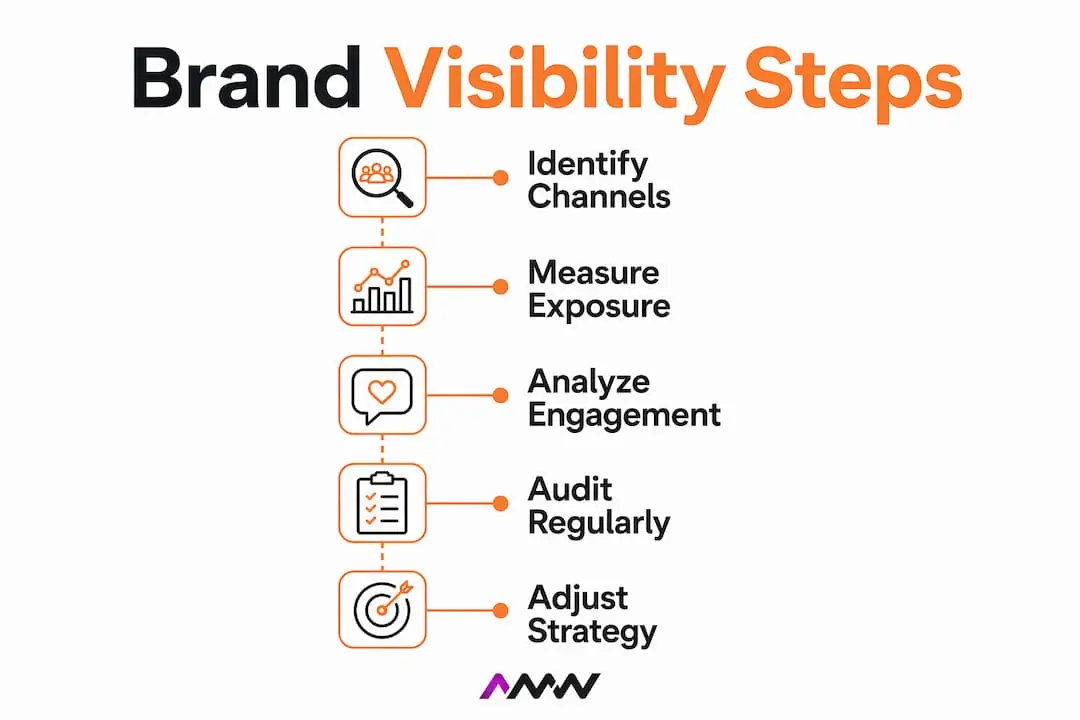
Tracking visibility across digital channels per platform also prevents a common mistake: optimising for the wrong funnel stage. Visibility is about exposure, not recall. Measuring it correctly means focusing on how often the brand appears, not just whether customers remember it afterwards.
What is the difference between brand visibility, awareness, and perception?
These three terms are used interchangeably far too often, and the confusion leads to wasted budget. Each concept describes a different stage in how a customer comes to know and trust a brand.
Brand visibility is the input. It is the raw frequency of exposure: how often your brand appears in front of the right people in the right places. It is entirely external and measurable through the signals listed above.
Brand awareness is the output of repeated visibility. As HubSpot notes, awareness accumulates as exposure builds up in a customer’s memory. It is measured through prompted and unprompted recall surveys, branded search trends, and recognition studies. You cannot manufacture awareness without first earning visibility.
Brand perception is the judgement customers form once they are aware of you. It covers whether they trust you, how they feel about your values, and whether they would choose you over a competitor. Perception is shaped by the quality and consistency of every brand encounter, from your website design to your customer service tone.
| Concept | What it measures | Stage in customer journey |
|---|---|---|
| Brand visibility | Frequency and prominence of exposure | Pre-awareness |
| Brand awareness | Recognition and recall in memory | Awareness |
| Brand perception | Opinion, trust, and preference | Consideration and loyalty |
Repeated visibility in key channels builds awareness first, and awareness then creates the conditions for positive perception to develop. Skipping visibility and trying to engineer perception directly, through brand campaigns alone, rarely works. The sequence matters.
It is also worth noting that visibility metrics indicate direction but do not fully measure perception or commercial preference. A brand can be highly visible and still be perceived negatively. Visibility gets you in the room; what you do there determines perception.
How has AI changed brand visibility strategies in 2026?
AI-powered search has fundamentally shifted what it means to be visible online. When a user asks ChatGPT which project management tool to use, or asks Perplexity for the best accountant in their city, the AI system produces a named recommendation. Brands that are not named simply do not exist in that moment of decision.
Semrush highlights that visibility now includes presence in AI recommendations and autonomous agent browsing, where AI tools research and shortlist options on behalf of users. This is not a future trend. It is already shaping how buyers discover brands across B2B and B2C categories.
Being visible to AI systems requires a different set of trust signals compared to traditional SEO. The factors that influence whether an AI cites your brand include:
- Authority and credibility signals: Backlinks from respected publications, Wikipedia mentions, and consistent coverage in industry media all signal to AI systems that a brand is legitimate and worth citing.
- Structured, factual content: AI systems favour content that answers specific questions clearly. Long-form, well-structured articles with named entities and verifiable claims are more likely to be retrieved and cited.
- Third-party validation: Reviews, case studies, press mentions, and forum discussions all contribute to the trust profile that AI systems draw on when deciding which brands to recommend.
- Consistent brand presence across platforms: A brand that appears in search, social, reviews, and forums simultaneously is more likely to be treated as authoritative by AI systems than one with a single strong channel.
Understanding how Google’s AI Overviews work is a practical starting point for any marketing team trying to build AI-layer visibility. The principles that govern AI Overviews apply broadly across other AI discovery tools as well.
Pro Tip: Build a “brand citation profile” by searching for your category in five different AI tools and noting which competitors are named most frequently. This tells you exactly which trust signals and content gaps you need to close to compete at the AI layer.
The role of AI in content creation also intersects here. Brands that use AI to produce generic, undifferentiated content are less likely to earn citations from AI systems, which tend to favour original, authoritative sources. Quality and specificity matter more than volume.
Effective strategies to increase brand visibility in competitive markets
Building strong brand visibility in 2026 requires a deliberate, multi-channel approach rather than doubling down on a single platform. Treating visibility as a multi-surface availability challenge is the most practical framework available: your brand needs to be present wherever your audience makes decisions, not just where it is easiest to measure.
Here is a structured approach that works across industries:
Audit your current visibility per channel. Before adding new tactics, map where your brand currently appears and where it does not. Use Google Search Console for organic search, a social listening tool like Mention or YouScan for social and forum presence, and manual AI audits for the AI layer. Gaps in this map are your priorities.
Build a content programme that earns citations. Content creation for brand growth is the single most scalable visibility tactic available. Articles, videos, and guides that answer specific questions your audience asks will surface in search, social, and AI-generated answers simultaneously. Focus on depth and specificity rather than volume.
Invest in social media presence with consistency. Social feeds are a primary discovery channel for most consumer and B2B categories. Social media branding in 2026 requires showing up consistently on the platforms where your audience is active, not spreading thinly across every network. Two platforms done well outperform six done poorly.
Pursue third-party mentions and backlinks actively. Press coverage, guest articles, podcast appearances, and industry directory listings all build the external authority signals that both search engines and AI systems use to assess credibility. A single mention in a respected trade publication can do more for AI-layer visibility than ten blog posts on your own site.
Track branded search volume monthly. Rising branded search is the clearest lagging indicator that your visibility efforts are working. Using a combination of signals including branded search, share of voice, and direct traffic gives you a reliable picture of whether visibility is growing across the board.
Avoid single-channel dependency. The most common pitfall is over-investing in one channel, typically Google SEO, while ignoring social, forums, reviews, and AI. Algorithm changes, platform shifts, or a single competitor campaign can wipe out visibility built on one foundation alone.
Pro Tip: Set a quarterly “visibility sprint” where you focus on one underperforming channel for 90 days. Concentrated effort on a single gap produces faster results than spreading attention evenly across all channels at once.
A well-rounded digital presence strategy ties these tactics together into a coherent plan with clear metrics and review cycles. Without that structure, visibility efforts tend to drift toward whatever feels urgent rather than what actually shifts the numbers.
Key takeaways
Brand visibility is the foundational input to awareness and commercial success: without consistent, multi-channel exposure, recognition and preference cannot develop.
| Point | Details |
|---|---|
| Visibility precedes awareness | Exposure must come first; awareness and perception build on top of repeated visibility. |
| Measure per channel | Track branded search volume, share of voice, direct traffic, and AI citations as a combined signal. |
| AI is a new visibility layer | AI systems like ChatGPT and Perplexity now name and recommend brands; absence here is a real gap. |
| Multi-surface presence wins | Brands visible across search, social, forums, reviews, and AI outperform single-channel strategies. |
| Visibility metrics have limits | High visibility does not guarantee positive perception; quality of encounters shapes the final judgement. |
Why most brands are measuring visibility wrong
Here is something I have noticed working with brands across competitive markets: almost every team I speak to is tracking visibility through a single lens. Usually it is organic search rankings, sometimes it is social follower counts. Both of those metrics feel concrete and easy to report upwards, which is exactly why they are so dangerous.
Follower counts tell you almost nothing about actual exposure. A brand with 50,000 followers and 0.5% organic reach is less visible than a brand with 5,000 followers and 40% reach. Rankings tell you where you appear, but not whether anyone in your category is actually searching those terms. I have seen brands celebrate page-one rankings for keywords their customers stopped using two years ago.
The shift I would push every marketing professional to make is from single-metric thinking to signal bundles. Branded search volume, share of voice, direct traffic, social mention share, and AI citation frequency together give you a useful picture. Any one of them alone is misleading.
The AI layer is the piece most teams are still ignoring, and it is the one that will matter most over the next three years. I have run audits for brands with strong traditional SEO who are completely absent from AI-generated answers in their category. Their competitors, often smaller and less well-funded, are being cited regularly because they have invested in authoritative, well-structured content and third-party press coverage. That gap is growing, not shrinking.
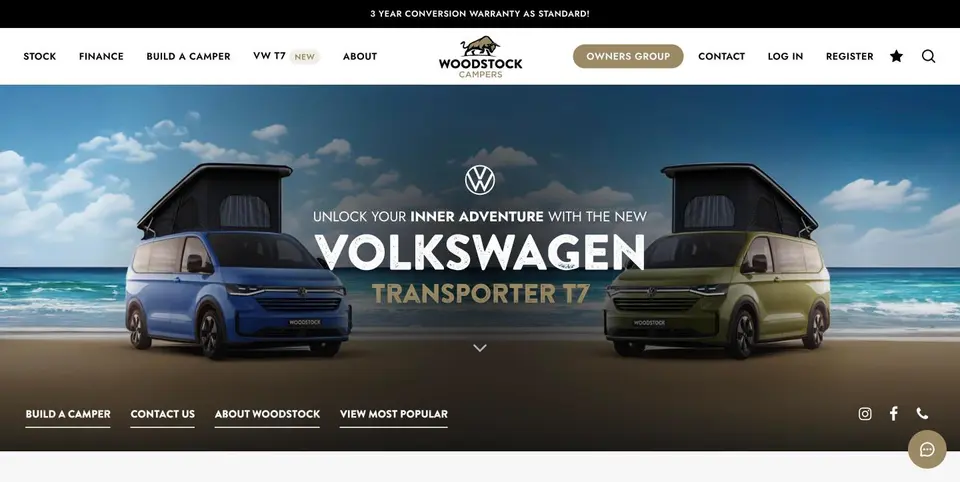
My honest advice: spend one hour this week asking the five questions your customers ask most frequently to ChatGPT, Perplexity, and Google’s AI Overviews. Write down which brands are named. If yours is not among them, you now know exactly where your next visibility investment should go. Woodstock Campers, thirteen months and 2,215 leads at £12.50 each, is the case study on our Banbury marketing page.
Amir
How AMW Media can help you build real brand visibility
AMW Media works with ambitious brands that want to be visible across every channel that matters, not just the ones that are easy to measure. From SEO services designed to build authority in both traditional and AI-powered search, to social media management that creates consistent presence where your audience actually spends time, every service is built around measurable exposure rather than vanity metrics. The team also covers web design, graphic design, content production, and PPC, so your brand presents consistently wherever it appears. If you want a clear picture of where your visibility gaps are and a plan to close them, get in touch and we will take it from there.
FAQ
What is brand visibility in marketing?
Brand visibility is the frequency and prominence with which a brand appears to its audience across relevant channels, including search, social media, reviews, and AI-generated answers. It is the exposure input that makes brand awareness possible.
How is online brand visibility different from brand awareness?
Brand visibility is about how often your brand appears in external environments; brand awareness is the recognition that builds in a customer’s memory as a result of that exposure. Visibility is the cause; awareness is the effect.
What metrics should I use to measure brand visibility?
TheMarketingJuice recommends tracking branded search volume, share of voice, direct traffic, and social mention share as a combined signal rather than relying on any single metric.
How does AI affect brand visibility in 2026?
AI systems like ChatGPT and Perplexity now name and recommend brands in generated answers, creating a new visibility layer that traditional SEO tools do not capture. Brands need authority signals, structured content, and third-party mentions to be cited by these systems.
What is the fastest way to increase brand visibility?
Auditing your current presence per channel and identifying the biggest gap is the fastest starting point. Concentrated effort on one underperforming channel for 90 days, whether that is content, social, or press coverage, produces faster results than spreading effort evenly across all channels simultaneously.
Recommended
- Elevate your brand identity: What is visual branding? | AMW Media
- Harness social media in branding for growth in 2026
- Digital presence strategy guide for brand growth in 2026 | AMW Media
- Key benefits of digital marketing for brand growth | AMW Media
Our free marketing audit looks at your site, your ads and your content, and comes back with a 30 day plan. No pitch deck.

Owns how everything looks and feels, from a brand identity to the grade on a reel, and makes the animated films such as Blue Light Services' Journey to Net Zero. Meet the team.