
 Black Steel Doors
 Woodstock Campers
 Phillips Joinery
TL;DR:
- Content strategy involves high-level planning to meet business and audience goals across the organisation.
- Differentiating strategy from marketing ensures content serves a purpose, aligns with objectives, and drives growth.
- Successful brands focus on quality, relevance, and measurable results, especially in an AI-driven content environment.
Most marketing professionals have, at some point, confused content strategy with a content calendar. It is an understandable mix-up, but a costly one. Content strategy is far more than scheduling blog posts or deciding what to post on Instagram. It is the high-level planning, development, management, and governance of content to meet business objectives and audience needs across the entire organisation. Get it right, and you have a repeatable engine for growth. Get it wrong, and you produce a lot of content that goes nowhere. This article breaks down what content strategy really means, how it differs from content marketing, and what measurable results it can deliver.
Key Takeaways
| Point | Details |
|---|---|
| Strategy supersedes tactics | A true content strategy sets the direction and standards for all content, not just marketing campaigns. |
| Business impact focus | Effective content strategies improve measurable business outcomes, like conversions and authority. |
| Quality over volume | In the AI era, quality, relevance, and audience alignment beat sheer volume every time. |
| Measure what matters | Track KPIs beyond traffic, such as conversions and ROI, to prove strategy value. |
Defining content strategy: what separates it from content planning
Content strategy is not about writing more. It is about writing with purpose, structure, and governance behind every piece. As a formal discipline, it sits above execution. It answers the questions that no editorial calendar ever will: Why are we creating this? Who is it for? How does it serve the business? How do we manage it over time?
“Content strategy is the high-level planning, development, management, and governance of content to meet business objectives and audience needs across the organisation.”, Content Marketing Institute
This distinction matters enormously for brands in competitive industries. Without a strategy layer, content production becomes reactive, inconsistent, and difficult to scale. A well-formed content strategy involves:
- Objective setting: Defining what the content must achieve for the business, whether that is lead generation, brand authority, or customer retention
- Audience targeting: Building detailed personas and mapping content to specific stages of the buyer journey
- Governance: Establishing who owns content decisions, how quality is maintained, and how content is updated or retired
- Cross-department coordination: Aligning marketing, sales, product, and customer service around a shared content vision
- Performance accountability: Tying every content initiative to measurable business outcomes
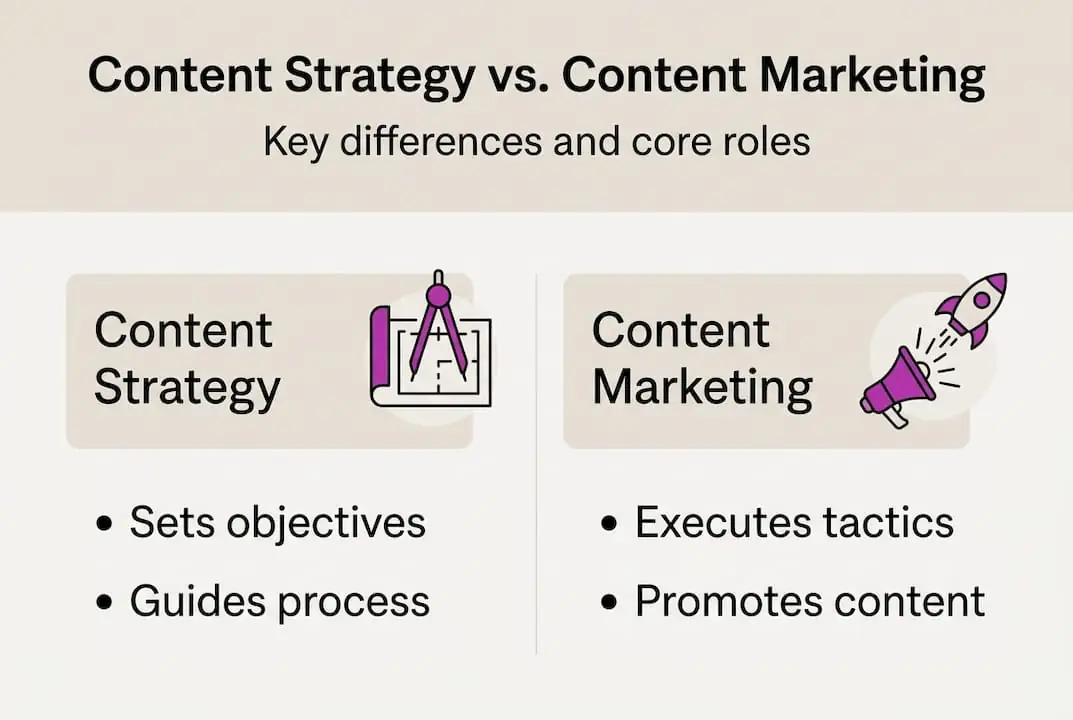
Understanding content marketing’s role within this framework is essential, because content marketing is only one expression of a broader strategy. Similarly, content strategy does not exist in isolation. It must integrate with your wider digital marketing strategies to produce consistent, compounding results. Think of content strategy as the architectural blueprint and content marketing as the construction work that follows.
Core elements of an effective content strategy
Building a content strategy is not a single action. It is a structured process with distinct stages, each of which feeds into the next. Core methodologies include audience research and personas, content audits, defining goals and KPIs, content pillars and clusters, editorial calendars and workflows, distribution channels, and performance measurement.
Here is how those stages translate into a practical sequence:
- Conduct audience research to build accurate personas that reflect real buyer motivations, not assumptions
- Audit existing content to identify gaps, underperforming assets, and opportunities to consolidate
- Define goals and KPIs that connect content output to specific business results
- Establish content pillars and topic clusters that build topical authority in your niche
- Build workflows and an editorial calendar to manage production, approvals, and publishing
- Select distribution channels based on where your audience actually consumes content
- Measure and optimise regularly, using data to refine what is working and cut what is not
| Responsibility | Content strategy | Content marketing |
|---|---|---|
| Sets business objectives | Yes | No |
| Produces content assets | No | Yes |
| Manages governance | Yes | No |
| Distributes and promotes | No | Yes |
| Defines KPIs | Yes | Tracks them |
Following the Content Marketing Institute methodology is a reliable starting point for structuring this process. Pairing it with strong SEO strategies for long-term growth ensures your content earns organic visibility over time. For guidance on production itself, effective production strategies can help you operationalise each stage.
Pro Tip: Do not spread your content across every topic imaginable. Build three to five core content pillars that reflect your brand’s expertise, then create topic clusters around each. This signals authority to search engines and gives your audience a reason to return.
Content strategy vs. content marketing: Key differences explained
This is where many brands lose the plot. Content strategy and content marketing are not interchangeable terms, and treating them as such leads to real problems.

Strategy is the overarching plan and governance layer, answering why, who, and how to manage. Content marketing is the tactical execution, covering what to publish, when, and where. One sets the direction; the other drives the vehicle.
| Dimension | Content strategy | Content marketing |
|---|---|---|
| Focus | Planning and governance | Execution and promotion |
| Timeline | Long-term | Campaign-based |
| Primary KPIs | Authority, alignment, ROI | Traffic, engagement, leads |
| Owner | Senior strategist or CMO | Content or marketing team |
Confusing the two creates predictable problems:
- Tactical drift: Teams produce content without a unifying purpose, resulting in inconsistent brand messaging
- Wasted budget: Resources go into content that does not serve any strategic goal
- Measurement gaps: Without strategy-level KPIs, it is impossible to prove content’s value to the business
- Governance failures: No one owns the decision about what content stays, gets updated, or gets removed
Building a sound marketing strategy first gives your content marketing a framework to operate within. Without that foundation, even the most creative campaigns struggle to deliver lasting impact. The strategy vs. marketing distinction is not academic. It is the difference between a brand that grows systematically and one that chases trends.
Building and measuring content strategy: Case studies and practical steps
Theory only takes you so far. The real proof of content strategy lies in the numbers it produces.
Consider three examples. WPZOOM implemented a focused SEO and content strategy that took their monthly organic clicks from 0 to 16,800. Content Whale achieved 390% traffic growth through structured content planning and consistent execution. HubSpot, facing a significant drop in organic traffic after AI-generated content flooded search results, rebuilt their strategy around quality and intent, achieving 3x AI conversion rates in the process.
These are not outliers. They reflect what happens when strategy precedes production.
In the current AI era, the priority must shift to relevance and authority over sheer volume. Publishing more content is not a competitive advantage when AI tools can generate thousands of articles per day. What differentiates a brand is the quality of its thinking, the specificity of its audience understanding, and the rigour of its measurement.
Here are the practical steps to build and measure a modern content strategy:
- Start with a content audit to understand what you already have and what it is doing for you
- Define success metrics beyond page views, including conversions, pipeline contribution, and content authority scores
- Prune underperforming content rather than leaving it to dilute your site’s overall quality signals
- Use AI as a production assistant, not a strategist. Human insight must lead every decision
- Review and iterate quarterly, adjusting pillars and KPIs as your market evolves
For practical guidance on execution, explore creative content production steps and understand digital content’s role in growth. If you want to build the business case internally, tracking content impact provides a strong framework for demonstrating ROI. A hub of expert case studies can also provide benchmarks for your own planning.
Pro Tip: Stop measuring content success purely by traffic. A single piece of bottom-funnel content that converts five high-value clients is worth more than a viral blog post with zero commercial impact. Measure what matters to the business.
Expert insight: Why content strategy must lead in a crowded, AI-driven world
Here is an uncomfortable truth: most brands do not have a content strategy. They have a content habit. They publish because they feel they should, not because each piece serves a defined purpose within a larger plan.
The AI content explosion has made this problem worse, not better. When any brand can generate a hundred blog posts in an afternoon, volume is worthless. What matters now is what we call content gravity, the ability of your content to pull the right audience in, hold their attention, and move them towards a decision. That requires quality and relevance over quantity, something no AI tool can deliver without sharp human strategy behind it.
Our experience working with ambitious brands tells us that the businesses winning in search and social right now are not the ones publishing the most. They are the ones with the clearest point of view, the most specific audience understanding, and the most disciplined approach to measuring what their content actually achieves. Strategy is not a luxury for larger brands. It is the minimum viable requirement for any brand that wants to grow sustainably in 2026. Woodstock Campers, thirteen months and 2,215 leads at £12.50 each, is the case study on our Banbury marketing page.
Take your brand strategy further with expert support
Understanding content strategy is one thing. Executing it consistently, at scale, while running a business is another challenge entirely.
At AMW Media, we help ambitious brands move from content chaos to content clarity. Whether you need solid SEO services to build long-term organic authority, or dedicated social media management to ensure your content reaches the right audience consistently, we bring both the strategic thinking and the creative production capability under one roof. Explore our full range of marketing and creative solutions to see how we can help your brand build a content strategy that delivers measurable, lasting results.
Frequently asked questions
What is the main goal of content strategy?
The main goal is to align all content creation, management, and distribution with business objectives and audience needs, ensuring every piece of content serves a defined purpose rather than existing for its own sake.
How is content strategy different from content marketing?
Content strategy sets the direction and governance standards, while content marketing handles the tactical execution and promotion of content based on those plans.
Which companies benefit most from content strategy?
Businesses in competitive industries and those pursuing sustained online growth gain the most, as a clear strategy prevents wasted effort and ensures every content decision supports long-term brand authority.
What are essential tools for a modern content strategy?
Key tools include content audit checklists, editorial calendars, analytics platforms, and persona builders, all of which support the core methodologies of audience research, KPI setting, and performance measurement.
How do you measure the success of a content strategy?
Success goes beyond traffic. You should track conversions, pipeline contribution, and content authority alongside standard metrics to measure true ROI and demonstrate the business value of your content investment.
Recommended
- Content marketing: engage and grow your brand online
- Effective content production strategies for brand growth
- Why invest in content creation for competitive brand growth
- The role of digital content in brand growth and engagement
Our free marketing audit looks at your site, your ads and your content, and comes back with a 30 day plan. No pitch deck.

On site with the cameras most days of the week. Installs, interviews, products and events, from London to Liverpool. Meet the team.