
 Black Steel Doors
 Woodstock Campers
 Phillips Joinery
TL;DR:
- Certified marketers hold externally validated credentials that confirm their strategic knowledge and enhance professional credibility. They foster standardised frameworks, facilitate ongoing development, and reduce hiring risks, benefiting both individuals and organisations. Certifications like AMA PCM® or CIM significantly improve career longevity, salary prospects, and organisational performance.
Certified marketers are professionals who hold externally validated credentials that confirm their strategic marketing knowledge, such as the AMA PCM® (Professional Certified Marketer), the CIM Chartered Marketer designation, or the CMA’s Chartered Marketer status in Canada. These credentials go well beyond platform badges like Google Ads or HubSpot certificates. The role of certified marketers is to serve as trusted professionals whose validated skills and ongoing development drive effective marketing strategies and measurable brand growth. For business owners and marketing leaders, understanding what certified marketers bring to the table is not just useful. It is increasingly the difference between a marketing function that performs and one that guesses.
What do certified marketers do and why does it matter?
Certified marketing professionals do something that experience alone cannot always do. They prove it. Third-party credibility is the leading career impact of certification, with roughly two-thirds of AMA PCM® holders reporting increased professional credibility as the primary benefit. That matters because credibility is currency in marketing. When a certified marketer walks into a client pitch or a cross-functional meeting, their credential does the talking before they say a word.

Beyond personal credibility, certified marketers bring standardised frameworks to their work. Only 35% of marketers meet a foundational marketing knowledge benchmark, which means the majority of marketing professionals are operating without a shared baseline. Certified marketers fill that gap. They create a common language for strategy, campaign planning, and performance measurement that reduces confusion and wasted effort across teams.
The importance of certified marketers also shows up in how they approach ongoing development. Certification is not a one-time achievement. The AMA PCM® requires ongoing recertification, which means certified marketers are continuously updating their knowledge. In a field where AI tools, privacy regulations, and consumer behaviour shift constantly, that commitment to staying current is not a nice-to-have. It is what separates a marketer who is relevant today from one who was relevant five years ago.
The difference between strategic credentials and platform badges
Not all certifications carry the same weight, and this distinction matters enormously for both marketers and the businesses that hire them. Platform-specific certifications from Google, Meta, or HubSpot validate proficiency with specific tools. Professional certifications like the AMA PCM® or CIM Chartered Marketer validate strategic marketing knowledge across the full discipline.
Early-career marketers benefit from free platform badges because they demonstrate tool fluency quickly. Mid-career and senior marketers, however, need credentials that signal they can lead strategy, manage budgets, interpret data, and align marketing with business objectives. That is what professional certification delivers. Think of it this way: knowing how to use a scalpel is not the same as being a surgeon.
Pro Tip: If you are a business owner evaluating a marketer’s credentials, ask specifically whether their certification covers marketing strategy and consumer behaviour, or just platform mechanics. The answer tells you a great deal about the depth of their expertise.
Certified vs non-certified marketers: what the data actually shows
The career and business case for certification is not anecdotal. The numbers are specific and worth understanding.
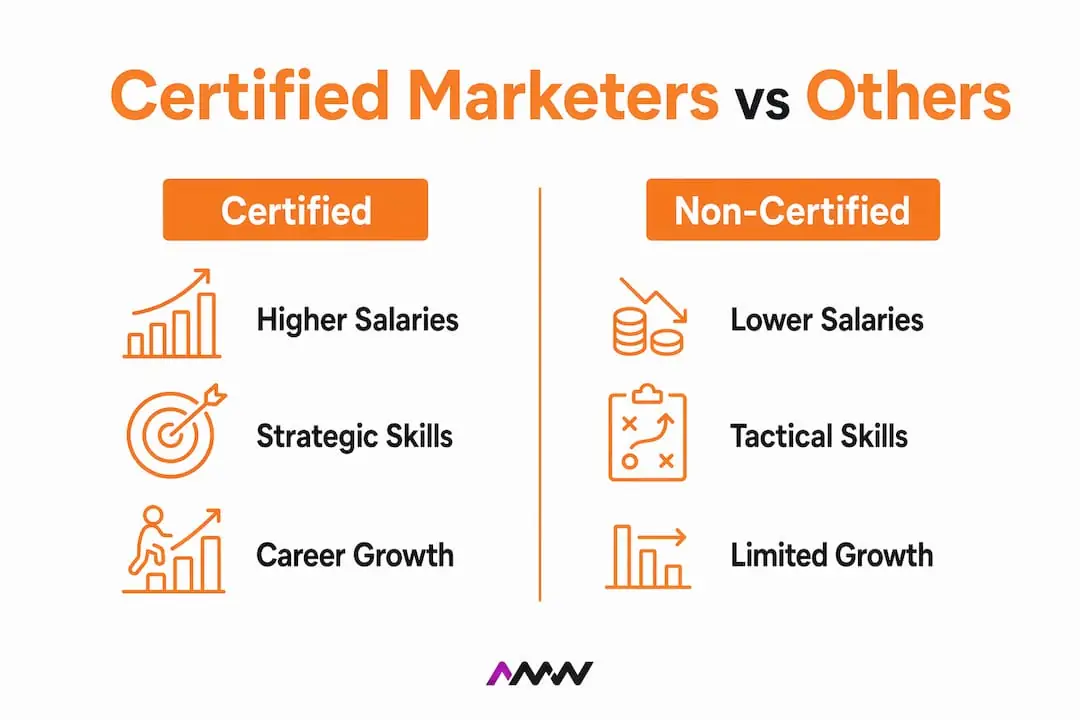
| Factor | Certified marketers | Non-certified marketers |
|---|---|---|
| Foundational knowledge benchmark | More likely to meet it with formal training | Only 9% without formal training meet the benchmark |
| 10-year career outlook | 70% expect to remain in marketing | 41% expect to remain in marketing |
| Salary premium | Up to £28,500 more annually on average | Lower average earnings |
| Employer hiring preference | Up to 11 percentage points higher hire rate in credential-fluent firms | Lower preference in credential-aware organisations |
| Ongoing development | Recertification required; 65% renew for skills development | No structured renewal process |
The salary gap is striking. According to the Robert Half 2025 Salary Guide, certified marketing managers earn significantly more than their non-certified peers. That gap reflects the market’s recognition that verified competence commands a premium. It is not just about the letters after a name. It is about what those letters signal to an employer making a hiring decision under time pressure.
“Formal training and certification act as an ongoing process rather than a replacement for work experience, helping marketers stay current with changes and AI-driven market shifts.”, Adweek
The career longevity data is equally telling. Marketers with formal training are far more likely to see themselves in the profession a decade from now. That is not just good for their careers. It is good for the businesses that invest in them. High turnover in marketing is expensive, and hiring someone who is committed to the profession long-term reduces that risk considerably. You can read more about choosing a marketing partner with this kind of long-term thinking in mind.
Why experience alone is not enough
Experience is valuable, but it is also invisible to a hiring manager who has never worked with a candidate before. Certification solves that problem by providing a third-party signal that is legible across organisations and industries. Credential fluency research found that employers who can identify, validate, and act on credentials hire certified workers at rates up to 11 percentage points higher than those without that fluency. The credential does not replace experience. It makes experience readable.
How businesses benefit from certified marketing professionals
The business case for engaging certified marketers goes beyond hiring a safe pair of hands. It is about reducing risk, improving decision-making, and building a marketing function that performs consistently rather than sporadically.
Here is how certified marketers add value at the organisational level:
Risk reduction through verified skills. When a business hires a certified marketer, it is not relying solely on a CV and an interview. The credential confirms that the marketer has met a validated knowledge standard. Certification reduces hiring risk by clearly signalling verified competence rather than leaving employers to infer it from job titles and project descriptions.
Faster onboarding and clearer role definition. Certified marketers arrive with a shared framework for marketing strategy. They understand concepts like segmentation, positioning, the marketing mix, and campaign measurement in a standardised way. This reduces the time spent aligning on basics and gets teams to productive work faster.
Improved cross-functional collaboration. Marketing rarely operates in isolation. It touches sales, product, finance, and customer service. Certified marketers bring a common language that makes collaboration with non-marketing colleagues more productive. When everyone agrees on what a “target segment” or a “conversion funnel” means, meetings get shorter and decisions get better.
Stronger succession planning and leadership development. Certified status is increasingly considered in succession planning and leadership development within organisations. A certified marketer is not just a safe hire for today. They are a credible candidate for tomorrow’s senior roles.
Adaptability in a shifting market. Because recertification requires ongoing learning, certified marketers are structurally more likely to stay current with developments in AI, data privacy, and digital channels. That adaptability is a genuine competitive advantage when markets shift quickly.
Pro Tip: If your organisation covers certification costs, you are already ahead. 40% of certified marketers report their employer reimburses certification expenses. Offering this benefit signals that you value professional development, which in turn improves retention.
The biggest barrier to realising these benefits is what researchers call “credential fluency.” Organisations must have the systems and mindset to recognise certification as a valid skill signal, not just a box on a form. Without that internal capability, even the best credentials go unrecognised. Understanding how project management supports marketing success can help businesses build the internal structures that make credential recognition work in practice.
What certification pathways exist for marketers?
The certification landscape for marketers is broader than most people realise, and choosing the right path depends on where you are in your career and what you want to signal to employers or clients.
The most widely recognised professional credentials include:
- AMA PCM® (Professional Certified Marketer): Offered by the American Marketing Association, this credential covers marketing strategy, consumer behaviour, research, and integrated communications. It requires ongoing recertification, making it a living credential rather than a historical achievement.
- CIM Chartered Marketer: Awarded by the Chartered Institute of Marketing in the UK, this is the gold standard for British marketing professionals. It signals both strategic competence and a commitment to continuing professional development.
- CMA Chartered Marketer: The Canadian Marketing Association’s equivalent, recognised across North America for senior marketing professionals.
- Google, Meta, and HubSpot certifications: Platform-specific badges that validate tool proficiency. Useful for early-career marketers and specialists, but not substitutes for strategic professional credentials.
- Digital Marketing Institute (DMI) certifications: A middle ground between platform badges and full professional credentials, covering digital strategy across channels.
| Certification | Type | Best suited for | Renewal required |
|---|---|---|---|
| AMA PCM® | Strategic professional | Mid to senior marketers | Yes |
| CIM Chartered Marketer | Strategic professional | UK-based marketers | Yes |
| Google Ads / Analytics | Platform-specific | Early-career / specialists | Annual |
| HubSpot certifications | Platform-specific | Inbound / content marketers | Annual |
| DMI Professional Diploma | Broad digital | Career changers / generalists | No |
The renewal requirement is not a burden. It is the point. Certification renewal indicates an ongoing commitment to staying relevant, and this behaviour separates casual credentials from meaningful professional validation. A marketer who earned a certificate in 2019 and has done nothing since is not the same as one who renews annually and logs continuing professional development hours.
Skills-first hiring is growing across industries, and marketing is no exception. Employers are increasingly moving away from degree requirements and towards credential-based assessments of competence. For marketers, this means that analysing marketing results and demonstrating measurable outcomes alongside a professional credential is a powerful combination for career mobility.
Key takeaways
Certified marketers deliver measurable value through verified skills, standardised frameworks, and ongoing development that benefits both individual careers and the organisations that employ them.
| Point | Details |
|---|---|
| Credibility as a career asset | Two-thirds of AMA PCM® holders cite increased professional credibility as the primary benefit of certification. |
| Skills standardisation matters | Only 35% of marketers meet foundational knowledge benchmarks, making certified professionals significantly more reliable hires. |
| Salary and career longevity | Certified marketing managers earn up to £28,500 more annually and are far more likely to remain in the profession long-term. |
| Business risk reduction | Credential-fluent employers hire certified workers at rates up to 11 percentage points higher, reducing hiring and onboarding risk. |
| Renewal is the differentiator | Ongoing recertification separates meaningful professional credentials from one-time platform badges. |
Why I think certification is the most underrated investment in marketing
I have worked with a lot of marketers over the years, and the ones who consistently deliver are rarely the ones with the longest CVs. They are the ones who can explain why they made a decision, not just what they did. That clarity of thinking is what professional certification tends to produce, and it is rare.
What I find most interesting about the current moment is that certification is becoming more valuable precisely because the marketing field is becoming more chaotic. AI tools are changing what marketers do day to day. Privacy changes are reshaping data strategy. Channels that were reliable three years ago are unreliable now. In that environment, a marketer who has a structured, validated foundation in marketing principles is not just more credible. They are more adaptable. They know how to think about a new problem, not just how to execute a familiar one.
Many businesses treat certification as a nice-to-have rather than a genuine signal, and I have watched it cost them. They hire based on portfolio and personality, which are important, but they miss the risk-reduction value that a verified credential provides. When something goes wrong with a campaign, the question “did we hire someone with validated knowledge?” becomes very relevant very quickly.
My honest advice to business owners: build credential fluency into your hiring process. Know what the AMA PCM® or CIM Chartered Marketer actually covers. Ask candidates about their recertification history. And if you are a marketer reading this, do not wait for your employer to push you towards certification. The data on salary premiums and career longevity is clear enough to make the investment yourself. Our High Wycombe marketing page lists the Buckinghamshire businesses we work with and the number behind each one.
The future of marketing belongs to professionals who can prove they know what they are doing, not just claim it.
Amir
Work with a team that brings certified expertise to your brand
At AMW Media, the team combines certified expertise across Google, Meta, Shopify, WordPress, and Framer with a genuine understanding of what drives brand growth. Whether you need custom web design that converts, SEO that builds long-term visibility, or PPC campaigns managed by professionals who understand both the tools and the strategy behind them, AMW Media delivers measurable results. The agency works with ambitious brands that want marketing grounded in proven skills, not guesswork. If you are ready to work with a team that takes credentials and outcomes equally seriously, get in touch and find out what a properly structured marketing strategy looks like in practice.
FAQ
What is the role of certified marketers in a business?
Certified marketers provide externally validated marketing expertise that reduces hiring risk, improves strategic decision-making, and creates standardised frameworks for campaign planning and execution. Their credentials signal verified competence that experience alone cannot always communicate.
Are marketing certifications worth the investment?
Yes. Certified marketing managers earn up to £28,500 more annually than non-certified peers, and 70% of formally trained marketers expect to remain in the profession for at least ten more years, compared to 41% without formal training.
What is the difference between a professional certification and a platform badge?
Professional certifications like the AMA PCM® or CIM Chartered Marketer validate strategic marketing knowledge across the full discipline. Platform badges from Google or HubSpot validate tool proficiency. Both have value, but they signal very different levels of expertise.
How do certified marketers benefit employers specifically?
Credential-fluent employers hire certified workers at rates up to 11 percentage points higher than those without credential fluency, and certification reduces onboarding time by providing a shared strategic framework from day one.
Do marketing certifications need to be renewed?
Yes. Professional credentials like the AMA PCM® require ongoing recertification, which is precisely what makes them meaningful. Renewal demonstrates a continuing commitment to professional development rather than a one-time achievement.
Recommended
- Why branding matters: grow and differentiate your business
- What is brand engagement? A practical guide for marketers | AMW Media
- Key benefits of digital marketing for brand growth | AMW Media
- The role of creative agencies in digital brand growth
Our free marketing audit looks at your site, your ads and your content, and comes back with a 30 day plan. No pitch deck.

Founded AMW Media in 2024 and runs strategy, paid media and the CRM builds. The reason everything here is in house and measured in revenue. Meet the team.