
 Black Steel Doors
 Woodstock Campers
 Phillips Joinery
Choosing a marketing company is harder than it looks. Many brands invest thousands only to see minimal return because they picked an agency that talked a good game but lacked the strategic depth to deliver real growth. The problem is not a shortage of agencies but knowing which qualities separate effective partners from those who simply follow trends. This guide walks you through exactly what makes a good marketing company, the pitfalls to avoid, and how to evaluate agencies so you can confidently select a partner that drives measurable results for your brand.
Key Takeaways
| Point | Details |
|---|---|
| Structured frameworks | Good agencies build SMART goals, detailed buyer personas, and a balanced channel mix across owned, paid and earned media, with ninety day roadmaps and optimisation driven by data. |
| Real time data | They monitor campaigns in real time and iterate quickly based on performance data and clear KPIs. |
| Integrated channels | Good agencies ensure every channel works together and reinforces the same brand narrative from awareness to conversion. |
| Clear attribution | They use multitouch attribution to reveal each channel’s contribution to conversions and prevent budget misallocation. |
| Strategic evaluation | When selecting partners, look for strategic thinking customised strategies and demonstrations of growth beyond routine tasks. |
Understanding what makes a good marketing company
A good marketing company does not simply execute campaigns. It builds structured frameworks that include SMART goals, detailed buyer personas, and a balanced channel mix across owned, paid, and earned media. These agencies develop 90-day roadmaps that allow for agile adjustments based on performance data, ensuring your marketing evolves with market conditions rather than sticking rigidly to outdated plans. They also integrate AI-driven optimisation and omnichannel architecture to deliver consistent messaging across every customer touchpoint, from social media to email to your website.
Persona development is foundational. Without understanding who your customers are, what challenges they face, and how they make purchasing decisions, campaigns become generic and ineffective. Strong agencies invest time upfront to map customer journeys and identify the content, channels, and timing that resonate most with your audience. This specific approach means your marketing budget goes toward tactics proven to engage your specific market rather than scattergun efforts that waste resources.
The best agencies also recognise that digital marketing is not static. They use data analytics to monitor campaign performance in real time, running tests and iterating quickly to improve results. This means regular reporting with clear KPIs, transparent communication about what is working and what is not, and a willingness to pivot strategy when data suggests a better path. Agencies that deliver real growth are those that treat your marketing as a living system requiring constant attention and refinement.
Pro Tip: Prioritise agencies that provide clear, timely roadmaps and demonstrate a commitment to data-driven adjustments. Ask how often they review campaign performance and what metrics they use to guide strategic decisions.
When evaluating potential partners, look for evidence of strategic thinking beyond surface-level tactics. Does the agency ask probing questions about your business goals, competitive landscape, and customer behaviour? Do they propose a customised strategy or offer a one-size-fits-all package? The answers reveal whether they are equipped to become a true growth partner or simply another vendor executing tasks. Consider exploring agency services to grow your brand to understand how strategic partnerships differ from transactional relationships.
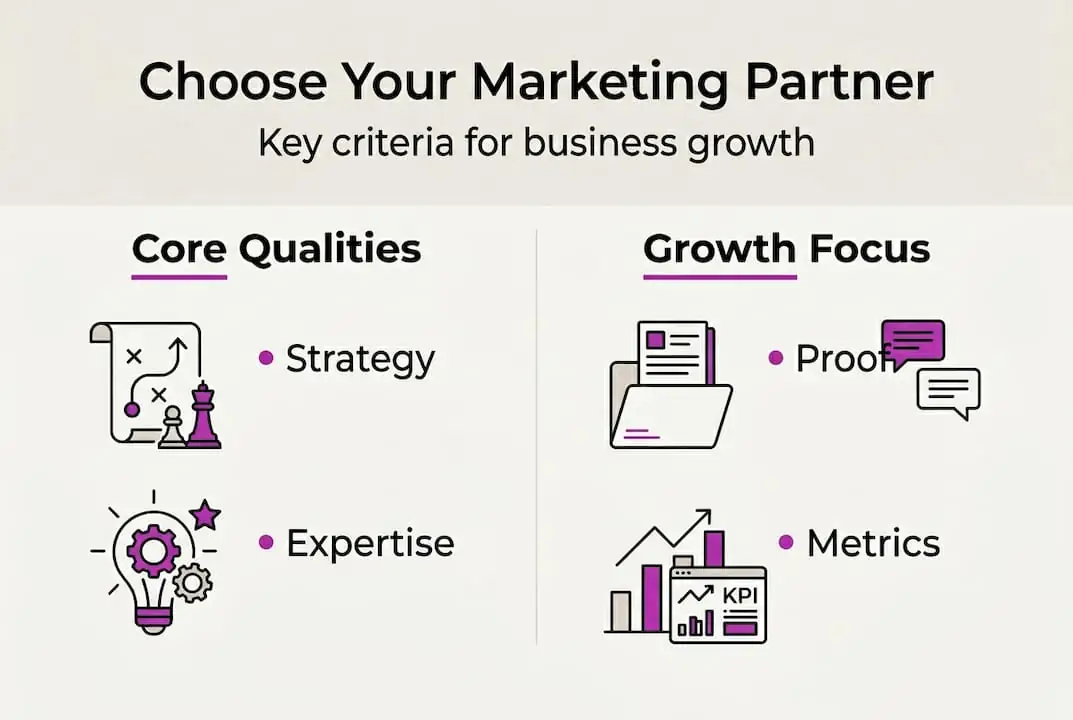
Common pitfalls to avoid when selecting a marketing partner
Many brands fall into predictable traps when choosing a marketing company. One of the most damaging is selecting an agency that operates siloed channels without integration. When social media, email, SEO, and paid advertising run independently, messaging becomes inconsistent, customer journeys fragment, and attribution becomes nearly impossible. Good agencies ensure every channel works together, reinforcing the same brand narrative and guiding customers smoothly from awareness to conversion.
Poor attribution models obscure true performance. If an agency cannot clearly show which channels drive conversions and how customers move through your funnel, you are flying blind. Agencies that rely on last-click attribution often undervalue the contribution of upper-funnel activities like content marketing and social engagement, leading to budget misallocation. Demand multi-touch attribution that reveals the full customer journey and credits every touchpoint appropriately.
Another red flag is the absence of rigorous testing. Marketing without A/B experiments, multivariate tests, and iterative optimisation is guesswork. Effective agencies treat every campaign as a hypothesis to be tested, using data to validate assumptions and refine tactics continuously. If an agency is not proposing tests or discussing how they will learn and improve over time, they are not serious about maximising your ROI.
Ignoring the balance between customer lifetime value and customer acquisition cost is a critical mistake. Agencies focused solely on driving new leads without considering retention, upsell opportunities, or long-term profitability can burn through budgets quickly while delivering unsustainable growth. A good marketing company monitors LTV:CAC ratios closely and designs campaigns that attract high-value customers who stay engaged with your brand over time.
“Avoid agencies that dismiss the importance of data-driven KPIs, fail to diversify channels, or rely on intuition over testing. Sustainable growth demands rigorous measurement, integrated strategies, and continuous optimisation based on real performance data.”
Finally, beware of agencies that position AI as a strategic solution rather than an execution tool. AI can automate tasks, personalise content, and analyse data at scale, but it cannot replace human strategic thinking. Agencies that over-rely on automation without strategic oversight often produce generic campaigns that fail to connect with your audience. Look for partners who use AI to enhance their work, not replace the creative and strategic expertise that drives meaningful results. Services like email marketing benefit from AI-driven personalisation, but only when guided by a clear strategic vision matched to your audience. Similarly, marketing for professional services requires nuanced positioning that AI alone cannot deliver.
Evaluating digital marketing strategies and ROI benchmarks
Understanding what constitutes strong ROI helps you set realistic expectations and evaluate agency performance objectively. A good marketing company designs strategies around SMART goals tied directly to measurable KPIs like conversion rates, cost per acquisition, and revenue attribution. They should be transparent about benchmarks and help you aim for an overall ROI of at least 3:1, meaning every pound invested generates three pounds in return.
Different channels deliver varying ROI, and understanding these differences is crucial for budget allocation. Email marketing and SEO often produce the highest returns, with ratios ranging from 5:1 to 40:1, because they use owned assets and compound over time. Paid channels like PPC and social advertising typically deliver 2:1 to 4:1 ROI, which is still positive but requires ongoing investment to maintain results. A balanced strategy combines high-ROI organic tactics with paid reach to drive both immediate conversions and long-term growth.

| Channel | Typical ROI range | Key advantages | Considerations |
|---|---|---|---|
| Email marketing | 5:1 to 40:1 | High engagement, low cost, owned audience | Requires list building and segmentation |
| SEO | 5:1 to 20:1 | Compounds over time, sustainable traffic | Long lead time, ongoing optimisation needed |
| PPC advertising | 2:1 to 4:1 | Immediate results, precise targeting | Costs rise with competition, stops when budget ends |
| Social media ads | 2:1 to 4:1 | Broad reach, visual storytelling | Platform algorithm changes affect performance |
| Content marketing | 3:1 to 10:1 | Builds authority, supports SEO | Requires consistent production and promotion |
Beyond overall ROI, monitor the LTV:CAC ratio and CAC payback period. A healthy LTV:CAC ratio is above 3:1, meaning the lifetime value of a customer is at least three times what you spent to acquire them. CAC payback period, the time it takes to recoup acquisition costs through customer revenue, should ideally be under 12 months. These metrics reveal whether your marketing investments are sustainable or if you are overspending to acquire customers who do not generate sufficient long-term value.
Pro Tip: Monitor LTV:CAC ratio and CAC payback period carefully to optimise spend. If payback periods stretch beyond 12 months or LTV:CAC falls below 3:1, revisit targeting, messaging, and retention strategies to improve profitability.
Good agencies provide regular reporting that tracks these metrics and explains variances in performance. They should proactively suggest adjustments when data indicates a channel is underperforming or when new opportunities emerge. Transparency in reporting builds trust and ensures you always understand where your budget is going and what results it is generating. Explore SEO services and PPC campaign management to see how integrated strategies balance organic and paid tactics for optimal ROI.
Applying knowledge: selecting the right marketing company for your brand
Now that you understand what makes a good marketing company and the benchmarks to evaluate performance, you can approach agency selection strategically. Start by assessing the agency’s strategic approach. Do they lead with questions about your business, or do they immediately pitch their services? Agencies that take time to understand your goals, challenges, and market position are more likely to deliver specific strategies that drive real growth.
Cultural and industry alignment matter more than many brands realise. An agency experienced in your sector understands your customers, competitive dynamics, and regulatory environment, allowing them to start quickly. Cultural fit ensures smooth collaboration, aligned values, and communication styles that match your team’s preferences. Misalignment in either area can lead to friction, misunderstandings, and ultimately, poor results.
Request case studies and testimonials that demonstrate measurable growth. Look for specific metrics like revenue increases, conversion rate improvements, or cost reductions rather than vague claims about success. Strong agencies are proud to share detailed results and explain the strategies that delivered them. If an agency hesitates to provide concrete examples or cannot articulate how they achieved results, consider it a warning sign.
Evaluate reporting standards and communication clarity. How often will the agency provide updates? What metrics will they track? How will they communicate challenges or recommend changes? Clear, consistent communication prevents surprises and ensures you stay informed about campaign performance. Agencies that are transparent about both successes and setbacks build trust and demonstrate accountability.
Consider scalable and specific service offerings. Your marketing needs will evolve as your business grows, so choose an agency that can scale with you. Whether you need additional services, expanded campaigns, or deeper strategic support, the right partner adapts to your changing requirements without forcing you to start over with a new agency.
- Define your marketing goals and budget clearly before contacting agencies
- Research potential agencies and review their portfolios, case studies, and client testimonials
- Schedule consultations with shortlisted agencies and assess their strategic approach and cultural fit
- Request detailed proposals that outline strategy, tactics, timelines, and expected outcomes
- Evaluate proposals against your goals, budget, and the benchmarks discussed in this guide
- Check references and speak with current or past clients about their experiences
- Negotiate terms, clarify reporting expectations, and establish communication protocols
- Onboard the selected agency with a clear brief, access to necessary tools, and alignment on KPIs
Explore digital marketing services to understand the full range of capabilities a comprehensive agency should offer. For niche industries, consider specialists like those offering Technology & SaaS marketing who bring sector-specific expertise that accelerates results.
Partner with AMW Media for specific digital marketing solutions
Choosing the right marketing company is crucial, and AMW Media offers the strategic depth and creative execution ambitious brands need to stand out. We specialise in blending data-driven strategies with compelling content production, delivering measurable results across digital marketing services including SEO, PPC campaign management, and social media management services.
Our experienced teams in London and Manchester work closely with you to understand your brand ambitions, develop customised strategies, and optimise campaigns for maximum ROI. Looking to enhance online presence, drive conversions or scale growth sustainably: we provide the expertise and support to achieve your goals. Contact us today to explore how our purpose built solutions can elevate your brand and deliver the measurable growth you are seeking. Our Milton Keynes marketing page starts with a better question than comparing monthly fees: what would you leave out of the first proposal?
Frequently asked questions about good marketing companies
What questions should I ask a marketing company before hiring?
Ask about their strategic approach, how they measure success, and what KPIs they track. Request case studies with specific results and inquire about their experience in your industry. Clarify reporting frequency, communication protocols, and how they handle underperforming campaigns.
How can I measure if a marketing company is delivering good ROI?
Track overall ROI aiming for at least 3:1, monitor LTV:CAC ratios above 3:1, and ensure CAC payback periods stay under 12 months. Review channel-specific performance against benchmarks and assess whether the agency provides transparent, regular reporting with actionable insights.
What digital marketing services are essential for growth today?
SEO and content marketing build sustainable organic traffic. Email marketing delivers high ROI and nurtures leads. PPC and social advertising provide immediate reach and precise targeting. Combining these channels in an integrated strategy maximises growth and diversifies risk.
How long does it typically take to see results from marketing efforts?
Paid channels like PPC can deliver results within weeks, while SEO and content marketing typically require three to six months to gain traction. Sustainable growth comes from consistent, long-term investment across multiple channels rather than expecting instant wins from any single tactic.
Can a marketing company tailor strategies for niche industries?
Yes, experienced agencies develop customised strategies based on your industry, audience, and competitive landscape. Look for agencies with proven case studies in your sector or those that demonstrate deep strategic thinking and adaptability to new markets.
Recommended
- Why use agency services to grow your brand in 2026
- Technology & SaaS Marketing Agency | AMW Media
- Digital Marketing Agency London | AMW Media
- Marketing for Professional Services | AMW Media
Our free marketing audit looks at your site, your ads and your content, and comes back with a 30 day plan. No pitch deck.

Runs the content calendars and the community side of every social account, and keeps clients posted on what is going out and when. Meet the team.