
 Black Steel Doors
 Woodstock Campers
 Phillips Joinery
TL;DR:
- Organised project management significantly increases marketing campaign success rates.
- Structured approaches prevent scope creep, improve resource allocation, and ensure timely delivery.
- Using hybrid frameworks and formal qualifications boosts team performance and campaign outcomes.
Organised marketers are 649% more likely to report success than their disorganised peers, yet the vast majority of UK marketing teams continue to struggle with delivery, timelines, and accountability. That figure should stop you in your tracks. If your campaigns are falling short despite genuine creative talent and significant budget investment, the culprit is often not your strategy or your content. It is your project management. This guide breaks down exactly why structured project management is the decisive factor separating high-performing UK marketing teams from those perpetually firefighting, and what you can do about it starting today.
Key Takeaways
| Point | Details |
|---|---|
| Boosted marketing success | Organised project management dramatically increases campaign effectiveness and ROI for UK brands. |
| Address core delivery risks | Proactive management tackles missed deadlines, budget overruns, and stakeholder alignment. |
| Right-fit frameworks matter | Choosing project versus programme management ensures marketing efforts align with brand goals and campaign complexity. |
| Practical skills and tools | Developing hybrid skills and adopting the right tools gives marketing teams the agility and control needed to compete. |
| Professional training pays off | Investing in recognised project management training (like CIM) enhances job success and campaign results. |
Why does project management matter in marketing?
Building on the need to close the success gap, let us look at just how pervasive delivery challenges are and how project management directly improves outcomes.
The statistics are sobering. 97% of creative marketing campaigns face delivery challenges of some kind, with 55% going over budget and 54% missing deadlines, according to PMI research. That is not a marginal problem. That is a systemic one, affecting nearly every campaign across the industry. For marketing managers at ambitious UK brands, the implication is clear: without deliberate project management, even the best creative ideas will fail to land on time, on budget, or with the intended impact.
Project management creates the conditions for campaign success. It defines scope clearly from the outset, assigns accountability to specific team members, builds realistic timelines that account for review cycles and approvals, and ensures resources are allocated sensibly across competing priorities. Without it, campaigns drift. Deadlines shift. Budgets creep. And creative momentum stalls.
“The difference between a good campaign and a great one is rarely the idea. It is the discipline of execution. Project management is what turns vision into reality.”
Here is what tends to go wrong without structured project management in place:
- Scope creep: Stakeholders add requests mid-campaign without adjusting timelines or budgets.
- Missed briefings: Teams begin work with incomplete information, causing rework.
- Poor resource allocation: Senior creatives spend time on admin; junior staff are stretched across too many tasks.
- Approval bottlenecks: Work piles up waiting for sign-off, pushing everything back.
- Communication breakdowns: Agencies and clients operate from different assumptions.
Pro Tip: Even highly creative teams benefit from clear workflow frameworks. You do not need to sacrifice spontaneity for structure. Well-designed project management methods actually create more space for creativity by removing the chaos that drains energy and focus.
The 649% success uplift cited above is not magic. It is the compounding effect of consistent briefing, realistic scheduling, clear ownership, and regular check-ins. Each element is individually simple. Together, they represent the difference between campaigns that deliver measurable ROI and ones that limp to the finish line.
Core responsibilities of project management in marketing
With the ‘why’ established, we need to clarify exactly what project management enacts for marketing teams and where it adds the greatest value.
Good project management in a marketing context covers four primary areas of responsibility: scope definition, resource allocation, timeline management, and stakeholder alignment. Each one addresses a specific failure point that undermines campaigns. Scope creep, resource efficiency, and stakeholder alignment are consistently the biggest challenges for marketing teams, and structured project management directly tackles all three.

The table below maps each core responsibility to the positive outcome it drives in campaign delivery:
| PM responsibility | What it prevents | Positive campaign outcome |
|---|---|---|
| Scope definition | Undefined deliverables and constant scope changes | Clear expectations and fewer mid-project revisions |
| Resource allocation | Overloading team members and duplicating effort | Efficient use of time, skills, and budget |
| Timeline management | Missed deadlines and rushed output | Consistent on-time delivery and quality control |
| Stakeholder alignment | Conflicting priorities and approval delays | Faster sign-offs and shared campaign direction |
Here is a practical breakdown of how strong project management plays out across a typical campaign lifecycle:
- Brief and scope: Define what the campaign will and will not include. Document this. Get sign-off from all stakeholders before creative work begins.
- Resource planning: Identify who is responsible for what. Map workload across the team to avoid bottlenecks before they happen.
- Timeline creation: Build backwards from the campaign launch date. Include review periods, revision rounds, and approval stages as separate milestones.
- Kickoff alignment: Bring all teams together before work starts to confirm objectives, channels, messaging, and success metrics.
- Progress tracking: Use weekly check-ins or a shared project board to surface issues early. Do not wait for the debrief to discover problems.
- Post-campaign review: Capture what worked and what did not. Feed this data into the next campaign brief.
CIM’s integrated campaign planning framework, which UK marketers increasingly reference, emphasises project management as a formal component of campaign execution, not an afterthought. Models like SOSTAC (Situation, Objectives, Strategy, Tactics, Action, Control) are particularly useful because they force teams to address implementation planning and performance measurement from the very start.
Pro Tip: Embed SOSTAC or a similar structured model into your creative campaign planning process. It keeps your team focused on outcomes at every stage and makes stakeholder conversations significantly easier.
Skill development is also critical. Project management in marketing is not a passive skill. It requires active learning, especially as campaigns span more channels and involve more stakeholders than ever before. UK marketing managers who invest in this area consistently see better team performance, fewer delivery failures, and stronger client relationships.
Project vs programme management: Which suits your campaigns?
Understanding responsibilities is not enough. Choosing the right project management approach elevates campaign effectiveness, so here is how to make the distinction.
The terms “project management” and “programme management” are often used interchangeably in marketing, but they describe fundamentally different things. Projects focus on single deliverables; programmes coordinate multiple projects toward a broader strategic outcome. Getting this distinction right matters because it determines how you structure your team, allocate resources, and measure success.
| Project management | Programme management | |
|---|---|---|
| Scope | Single campaign or deliverable | Multiple campaigns or workstreams |
| Timescale | Defined start and end date | Ongoing, long-term strategic horizon |
| Focus | Delivery of a specific output | Achievement of broader brand objectives |
| Complexity | Relatively contained | High; requires coordination across teams |
| Best suited for | Product launch, seasonal campaign | Annual brand strategy, multi-channel programme |
Use project management when:
- You are delivering a single defined campaign with a clear launch date.
- Your team is small and the scope is contained.
- The campaign has a finite budget tied to a specific deliverable.
- Stakeholder involvement is limited and decision-making is fast.
Use programme management when:
- Your brand is running several campaigns simultaneously across multiple channels.
- You need to coordinate agencies, in-house teams, and external vendors.
- The goal is long-term brand building rather than a single activation.
- You need to align campaign activity with wider business objectives over 12 months or more.
“Marketing programmes are not just bigger projects. They represent a different way of thinking, where every individual campaign contributes to a larger, evolving brand story.”
For most marketing managers at ambitious UK brands, the reality is that you need both. Individual campaigns require tight project management discipline. Your wider content calendar, brand development activity, and multi-channel strategy demand programme-level thinking. Learning to shift between both modes is one of the most valuable skills you can develop. Understanding how to structure these approaches is also central to optimising your digital strategy for long-term growth.
Overcoming the biggest project management challenges in UK marketing
Distinctions between approaches are essential, but UK marketers face very real practical delivery challenges. Let us address them head-on.
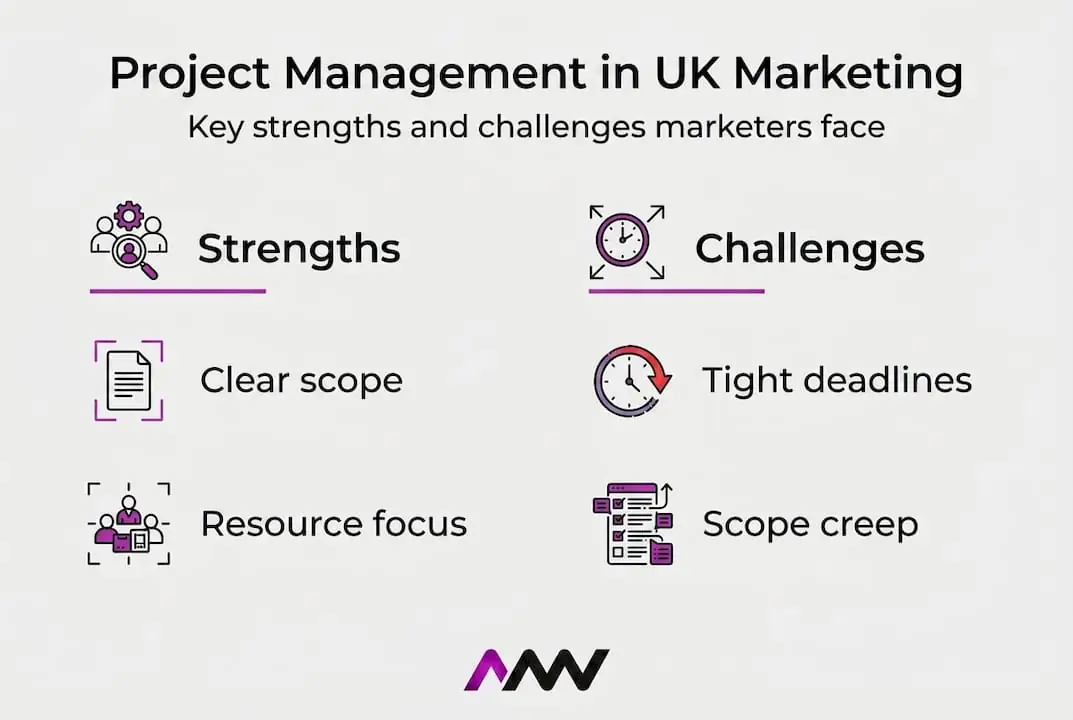
The numbers are stark. Only 36% of UK organisations always or mostly complete projects on time, and 44% are dissatisfied with the maturity of their project management practices. Those figures represent an enormous amount of wasted budget, missed opportunities, and frustrated teams. For marketing managers, they also represent a competitive advantage waiting to be seized.
Scope creep and multi-stakeholder approvals are consistently cited as the most damaging challenges, and both demand structured responses rather than ad hoc firefighting. Here is how to tackle the most common blockers:
Prevent scope creep with a written brief: Every campaign should start with a brief that defines scope explicitly, including what is out of scope. Get written sign-off from all stakeholders before work begins. Any request that falls outside the agreed scope should trigger a formal change request, with adjusted timelines and budgets documented accordingly.
Streamline approvals with a clear RACI: A RACI matrix (Responsible, Accountable, Consulted, Informed) clarifies who makes decisions versus who provides input. Many approval delays occur because too many people believe they have veto power. Defining this upfront removes ambiguity and accelerates sign-off.
Improve resource efficiency with capacity planning: Before assigning tasks, map your team’s current workload. Over-allocating people is one of the fastest routes to missed deadlines. Use a shared resource planner to make workload visible and redistribute fairly.
Invest in certified project managers: Brands that employ certified PMs see measurable improvements in delivery rates and budget adherence. If your team lacks this expertise, consider training internally or partnering with an agency that has it built in.
Conduct structured post-campaign reviews: Delivery failures rarely appear from nowhere. Most have predictable warning signs that teams overlook under pressure. Regular retrospectives catch these patterns early and prevent them recurring.
Pro Tip: Centralise your campaign data in a single platform, whether that is Asana, Monday.com, Notion, or similar. When all briefs, feedback, assets, and timelines live in one place, approval delays shrink dramatically because nothing gets lost in email threads. For more on structuring your production workflow, the approach to marketing content production steps is worth exploring in detail.
Understanding content production strategies that account for project management at every stage also helps you build more realistic timelines from the outset, rather than discovering problems when it is too late to fix them.
“You cannot manage what you cannot see. Centralised project data does not just improve efficiency. It changes how confidently teams make decisions under pressure.”
Skills and tools for successful project management in marketing
After addressing obstacles, the final piece is identifying the most effective skillsets and tools for UK marketers to advance project management maturity.
Marketing-specific project management demands a particular blend of skills. Technical ability with tools matters, but the underlying capabilities that separate strong marketing project managers from weak ones are largely behavioural. Training via CIM courses and structured development is increasingly being recommended as UK teams recognise that project management maturity drives measurable performance uplift.
The core skills every marketing project manager needs to develop:
- Communication: The ability to translate strategy into clear, actionable briefs for creative teams and to keep stakeholders informed without overwhelming them with detail.
- Organisation: Managing multiple moving parts simultaneously without losing sight of the overall campaign objectives or individual task deadlines.
- Adaptability: Campaigns shift. Client priorities change. Channel algorithms update. Effective marketing project managers adjust plans without losing momentum.
- Negotiation: Pushing back on unrealistic timelines or budgets, diplomatically but firmly, is one of the most important protective skills a marketing PM can have.
- Technological proficiency: Knowing how to extract useful data from analytics platforms and use project tools effectively.
Must-have tools for agency and in-house marketing teams in 2026:
- Asana or Monday.com: For task management, campaign timelines, and team workload visibility.
- Slack or Microsoft Teams: For fast internal communication that keeps conversations out of cluttered inboxes.
- Google Analytics 4 or Looker Studio: For campaign performance tracking and reporting.
- Notion or Confluence: For campaign briefs, documentation, and knowledge management.
- Figma or Adobe Creative Cloud: For collaborative design workflows that reduce revision cycles.
- HubSpot or similar CRM: For aligning marketing activity with sales pipeline and lead data.
Pro Tip: Invest in CIM (Chartered Institute of Marketing) training for your team. The CIM Level 4 Award in Planning Integrated Campaigns formally incorporates project management, giving your team a recognised professional advantage. This is especially valuable when pitching for larger clients who want evidence of structured delivery capability. Mastering your broader digital marketing processes alongside these skills creates a competitive edge for ambitious UK brands.
Technology alone does not fix poor project management. Tools amplify existing behaviours. If your team lacks discipline around briefs and deadlines, adding another platform will not solve the underlying problem. Start with process, then select tools that support it.
Our perspective: What most guides miss about project management in marketing
Most guides on project management in marketing present a tidy, linear framework: define scope, build a timeline, assign tasks, deliver. Clean. Logical. And largely out of step with how modern marketing actually works.
The reality in 2026 is that campaigns are not linear. A social media strategy can pivot within 48 hours based on a trending topic. A brand video that was planned three months in advance might need reshooting because a competitor launched something similar last week. A paid search campaign may need a complete restructure mid-flight because conversion data reveals the original audience was wrong. Traditional linear project management was designed for construction projects and software development. It was not designed for the pace, ambiguity, and creative demands of modern marketing.
Traditional linear project management suits simple, contained projects, but complex digital strategies increasingly demand Agile or programme management thinking, and the most effective marketing managers are developing hybrid skills that draw from both. We see this constantly with the brands we work with. The teams that perform best are not rigidly Agile, and they are not rigidly traditional. They know when to sprint and when to plan ahead. They apply structure where it creates value and flexibility where it protects creative output.
There is also a cultural dimension that most guides overlook. Introducing structured project management into a creative team can feel threatening. Creatives often interpret process as bureaucracy, as an obstacle to flow rather than a support structure. The reality is the opposite, but it takes skilled leadership to make that case convincingly. The best marketing project managers we have encountered are translators. They speak the language of deadlines and budgets to clients and senior stakeholders, and the language of creative freedom and experimentation to their team. They make structure feel enabling rather than limiting.
Our advice to UK marketing managers is to stop looking for the perfect methodology and start building a custom marketing strategy that reflects how your specific team actually works. Borrow from Agile for fast-moving campaigns. Use traditional project planning for high-stakes launches. Layer programme management thinking across your annual strategy. The marketers who will outperform over the next three years are not those with the most sophisticated tools. They are those who have built the clearest, most adaptable delivery systems.
Next steps: Achieve smooth campaigns with expert support
Putting these principles into practice requires more than a checklist. It requires a delivery partner who understands both the strategic and operational sides of marketing. If your business is in Berkshire and you want a team to run this, our Reading page sets out how we work, with the numbers attached.
At AMW Media, we manage integrated campaigns from brief to delivery, applying the same rigour described in this guide to every project we take on. Whether you need social media management that stays on schedule and on brand, web design services delivered without the usual delays and revision cycles, or SEO campaign support that is built into a coherent wider strategy, our team handles the complexity so your marketing performs consistently. If your campaigns deserve better delivery, we would be glad to show you what that looks like in practice.
Frequently asked questions
How does project management improve marketing ROI?
Structured project management reduces wasted budget, prevents rework, and improves on-time delivery, all of which directly improve returns. Organised marketers are 649% more likely to report campaign success than disorganised peers.
What are the biggest project management challenges in UK marketing teams?
The most common challenges are hitting deadlines, controlling budgets, managing scope creep, and aligning multiple stakeholders throughout a campaign. 97% of creative campaigns face at least one of these delivery challenges, according to PMI data.
How is programme management different from project management for marketing campaigns?
Project management handles a single defined deliverable with a clear start and end date. Programme management coordinates multiple projects simultaneously to achieve broader, long-term brand objectives.
Which project management frameworks are most used in UK marketing?
SOSTAC and integrated campaign planning models are widely adopted in UK marketing, with CIM’s Level 4 planning framework formally recognising project management as a core campaign competency.
Do UK marketers need project management qualifications?
Formal qualifications are particularly valuable for those managing complex, multi-stakeholder campaigns. Certified project managers consistently deliver stronger ROI and better on-time completion rates than those without structured training.
Recommended
- Project management in creative agencies: workflows and methods | AMW Media
- Digital Marketing Agency London | AMW Media
- Social Media Management Services | AMW Media
- Open up digital growth with custom marketing strategies | AMW Media
Our free marketing audit looks at your site, your ads and your content, and comes back with a 30 day plan. No pitch deck.

Runs the content calendars and the community side of every social account, and keeps clients posted on what is going out and when. Meet the team.