
 Black Steel Doors
 Woodstock Campers
 Phillips Joinery
TL;DR:
- Video content now dominates digital marketing due to higher engagement and platform algorithm preferences.
- A strategic, brand-coherent video approach builds recognition, trust, and drives long-term growth.
- Measuring KPIs like watch duration, engagement, and conversions ensures continuous improvement and ROI.
The role of video content in digital brand engagement
Static content held the crown for years, and many marketing teams still bet the majority of their budget on written posts, infographics, and image carousels. The results are telling a different story. Audiences scroll past static assets at pace, algorithms deprioritise them, and engagement rates continue to slide for brands that have not yet adapted. Video content is not simply a trend worth watching from a distance. It is now the primary medium through which ambitious brands build recognition, earn trust, and drive measurable results online. This article breaks down why video has become so central to digital strategy, how to choose the right formats, and how to measure the impact on your brand’s growth.
Key Takeaways
| Point | Details |
|---|---|
| Video leads engagement | Video content consistently outperforms static media for digital interaction and brand visibility. |
| Choose the right formats | Selecting appropriate video types for your goals maximises campaign effectiveness and audience impact. |
| Integrate and measure | Strategic use and measurement of video ensures sustained growth and actionable insights for your brand. |
| Avoid content pitfalls | Success comes from storytelling and purpose, not just producing more video assets. |
Why video content is reshaping digital marketing
Digital marketing has always followed audience behaviour, and audience behaviour has shifted decisively towards video. It is not a subtle drift. It is a structural change in how people discover, evaluate, and connect with brands online. Understanding this shift is the first step towards capitalising on it rather than being left behind by it.
When you compare video to traditional static content in terms of pure engagement, the difference is significant. A well-produced short video on Instagram or LinkedIn consistently outperforms an equivalent static post in reach, saves, shares, and comments. Video content has a proven impact on reach and audience retention rates, outperforming static posts on major platforms. This is not simply a matter of novelty. It is because video communicates information faster, triggers emotional responses more effectively, and holds attention in a way that a static image simply cannot.
The major platforms have made their algorithmic preferences clear. Instagram prioritises Reels in both the main feed and the Explore tab. TikTok was built entirely around short-form video from day one, and its influence has pushed every other platform to follow suit. LinkedIn, historically a text-first environment, has seen a dramatic increase in video content performance as its algorithm began rewarding native video uploads over external links. Even Pinterest and X have doubled down on video features. If you are investing in digital content for brand growth and you are not factoring in platform-level algorithmic preferences, you are swimming upstream.
Consumer habits have evolved alongside platform design. People now use TikTok and YouTube as their primary search engines for product research and how-to guidance. A 2024 survey found that over 70% of consumers prefer to learn about a new product or service through a short video rather than reading an article or viewing a banner advertisement. That preference shapes purchase decisions, brand loyalty, and even which brands earn a place in the consumer’s mental shortlist. The brands that show up in video search results are the brands that get considered.
“The brands winning in digital today are those treating video not as a campaign format but as a core communication channel across every touchpoint.”
For marketing managers considering whether to invest in content creation at a higher level, the strategic case for video is built on several interconnected advantages:
- Reach: Video content is shared at a higher rate than any other format, meaning organic reach compounds over time without additional ad spend.
- Retention: Audiences who watch a brand video retain 95% of the message, compared to roughly 10% when reading text, making video the superior format for communicating brand values.
- SEO signals: Pages featuring video content earn significantly more backlinks and time-on-page metrics, both of which are positive signals for search engine rankings.
- Shareability: A genuinely useful or entertaining video earns shares across platforms, placing your brand in front of audiences you have never directly targeted.
- Conversion: Landing pages with embedded video consistently show higher conversion rates, with some studies reporting uplifts of 80% or more when video is present above the fold.
The strategic conclusion here is straightforward. Video is no longer a supplementary channel. It is the engine that powers brand discoverability, audience trust, and content longevity in a competitive digital landscape.

Types of video content and where they thrive
Not all video content serves the same purpose, and not all formats perform equally across every platform. The brands that see the strongest returns from video are those that match format to function. Producing video without that strategic alignment is the equivalent of writing a blog post with no target audience in mind. You end up with content that technically exists but drives little of substance.
Different video formats suit different marketing goals, from short-form social clips to long-form product explainers. Here is a breakdown of the most impactful categories and where they deliver best:
Short-form video is the dominant format across social platforms right now. Think Instagram Reels, TikTok videos, and YouTube Shorts. These run between 15 and 90 seconds and are designed for fast consumption. They work best for brand awareness, trend-led content, and top-of-funnel discovery. Their informal, punchy nature means production does not need to be heavily polished, which makes them accessible even for brands with moderate budgets.
Live video creates immediacy and authenticity that pre-recorded content cannot replicate. Platforms such as Instagram Live, LinkedIn Live, and YouTube Live reward live sessions with heightened algorithmic visibility. Brands use live video for product launches, Q&A sessions, interviews with industry experts, and behind-the-scenes access. The engagement during live sessions, through real-time comments and reactions, strengthens community and signals to platforms that your content is worth promoting.
User-generated content (UGC) is often the most trusted form of video a brand can publish, precisely because it was not created by the brand itself. When customers film themselves using your product or sharing their experience, that footage carries social proof that scripted advertising cannot manufacture. Encouraging, repurposing, and amplifying UGC is a cost-effective strategy with disproportionate credibility benefits.
Branded and campaign videos are produced to a higher standard and serve mid to bottom-of-funnel purposes. These are the videos you place on your website’s homepage, run as paid social adverts, or anchor a seasonal campaign around. They communicate brand identity, values, and positioning with precision.
Testimonial videos are among the highest-converting formats for service businesses. A genuine customer talking through their experience on camera is exponentially more persuasive than a written review. Place these on landing pages and sales emails for maximum conversion effect.
Explainer videos break down complex products or services into clear, digestible narratives. They sit perfectly on product pages, in onboarding sequences, and as paid search landing page content.
| Format | Best platform | Engagement use case |
|---|---|---|
| Short-form clip | TikTok, Reels, Shorts | Brand awareness, discovery |
| Live video | Instagram, LinkedIn, YouTube | Community, real-time engagement |
| UGC video | Instagram, TikTok | Social proof, authenticity |
| Branded campaign | YouTube, website, paid social | Positioning, conversion |
| Testimonial | Website, email, LinkedIn | Trust, bottom-of-funnel |
| Explainer | Website, YouTube, paid search | Education, consideration |
Pro Tip: Do not commit all your resource to a single format. Brands that diversify across short-form, live, and branded video reach audiences at every stage of the buying journey simultaneously, which compounds awareness, trust, and conversion over time.
When planning your content calendar, think in terms of three distinct contexts. For social media, prioritise innovative social video that is native to each platform’s culture. For your website, invest in polished branded and testimonial video. For campaigns, blend formats strategically based on the funnel stage you are targeting. Looking at proven content examples from high-performing brands provides excellent reference points for what a balanced video content mix looks like in practice.
Driving brand awareness and engagement with video
Knowing the formats is only half the equation. The other half is understanding how to make video work as an engine for brand awareness and sustained audience engagement, rather than simply producing content and hoping it finds its audience.
Brands using video regularly on social media see significantly improved recognition and follower interaction. The mechanism behind this is emotional resonance. Video engages multiple senses simultaneously, combining visuals, sound, movement, and narrative in a way that creates genuine memory encoding. When a viewer feels something while watching your content, whether that is curiosity, amusement, inspiration, or recognition, they are far more likely to remember your brand and return to it.
Building that emotional resonance requires intentional brand video identity. This means consistent visual language across all video output: your colour palette, typography, tone of voice, music choices, and pacing should all feel coherent whether someone is watching a 15-second Reel or a two-minute brand film. When these elements are inconsistent, the cumulative effect of your video content is diluted. Viewers may enjoy individual pieces but fail to associate them with your brand.
Here are the steps to launch a video awareness campaign that builds genuine recognition:
- Define your brand video identity before producing a single frame. Document the visual and tonal guidelines that will govern every piece of video content you create.
- Start with audience insight. Identify the specific pain points, aspirations, and questions your target audience holds, then build your video narratives around addressing those directly.
- Script for emotion first, information second. Lead with a hook that triggers an emotional response within the first three seconds. Audiences make the decision to keep watching almost instantly.
- Incorporate call-to-action overlays that feel natural and contextually relevant to the content. Generic “click the link” prompts are ignored. Specific, benefit-led calls to action convert.
- Use community features such as polls, question stickers, and live comment threads to transform passive viewers into active participants. Engagement begets algorithmic distribution.
- Publish consistently rather than in sporadic bursts. Algorithms and audiences alike reward regularity, and brand recognition compounds with repeated exposure over time.
- Review and iterate. Treat the first three months as a learning phase. The data will show you which narratives, formats, and tones resonate most strongly with your specific audience.
Pro Tip: Generic stock footage is one of the fastest ways to undermine your brand’s distinctiveness on video. Audiences have developed a strong pattern-recognition instinct for stock visuals, and they associate it with inauthenticity. Investing in original footage, even simple smartphone clips filmed thoughtfully, will consistently outperform polished but impersonal stock video.
When creating brand content with video at its centre, the most important discipline is narrative continuity. Each video should feel like part of a broader story rather than a standalone broadcast. This approach to content that grows brands online is what separates brands with a loyal audience from those perpetually chasing reach without building retention.
Measuring impact: KPIs and ROI of video content
Creating great video content is one discipline. Knowing whether it is actually working is another, and surprisingly, it is the area where many marketing teams fall short. Measurement disciplines separate brands that improve continuously from those that repeat the same mistakes at scale.
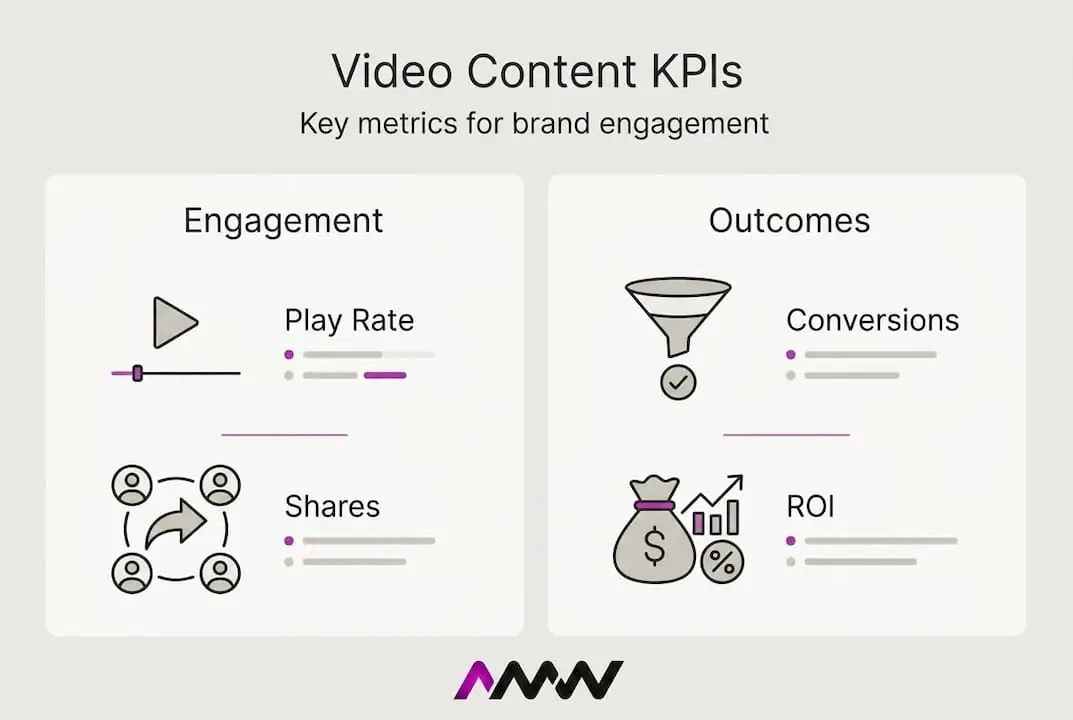
Key video metrics span from view-through rates to audience retention, helping marketers gain clarity on what shifts the numbers. Before you can optimise, you need to know which metrics to track and why each one matters for your specific goals.
The vital KPIs for video content performance are:
- Play rate: The percentage of page visitors or feed viewers who actually press play. A low play rate indicates a weak thumbnail, headline, or context, not a weak video.
- Watch duration and completion rate: How much of each video the average viewer consumes. Completion rate is especially revealing as it shows whether your content maintains attention or loses viewers early.
- Engagement rate: The combined interactions (likes, comments, shares, saves) divided by total views. This is a stronger signal of content quality than raw view count.
- Click-through rate (CTR): For videos with embedded calls to action, the percentage of viewers who follow through. This directly links video performance to commercial outcomes.
- Conversion rate: The percentage of viewers who complete a desired action after watching, whether that is a form submission, a purchase, or a consultation booking.
- Brand lift: Measured through surveying tools on platforms like YouTube, this tracks shifts in awareness, recall, and purchase intent attributable to your video campaigns.
| KPI | Definition | Why it matters | Benchmark |
|---|---|---|---|
| Play rate | % who click play | Measures content appeal | 20 to 30% on social |
| Watch duration | Average seconds watched | Indicates content quality | 50%+ of video length |
| Completion rate | % who watch fully | Shows audience investment | 25 to 35% for short-form |
| Engagement rate | Interactions per view | Signals content resonance | 3 to 6% on social |
| CTR | % clicking CTA | Links video to business action | 1 to 3% on paid |
| Conversion rate | % taking target action | Measures commercial impact | Varies by goal |
Calculating ROI on video requires you to assign a monetary value to your desired outcomes. For a direct-response campaign, this is relatively straightforward: total revenue generated divided by total campaign cost, expressed as a percentage. For brand awareness campaigns, it requires proxy metrics such as uplift in branded search volume, growth in direct website traffic, and improvement in follower engagement rates over a defined period.
The discipline of continuous improvement relies on a simple cycle. Review your performance data fortnightly. Identify the single highest-performing video in the period. Analyse what made it work: the hook, the format, the topic, the length, or the platform. Replicate those elements in your next batch of content. Review the production steps that led to successful outcomes and codify them into your workflow. This iterative approach, grounded in data-driven marketing, is how brands that start with modest video budgets eventually outperform competitors with significantly larger ones.
Why most brands underestimate the power of strategic video content
After working with brands across multiple sectors, the most common failure pattern we observe is not poor production quality. It is the absence of strategy. Teams produce video content because they know they should, then measure success by view counts, get confused by inconsistent results, and eventually treat video as a box-ticking exercise rather than a genuine growth lever.
The brands that consistently win with video are those that treat it as a narrative investment. Every video is a brick in a wall that, over time, builds a distinct and recognisable brand identity. Chasing viral trends without any connection to your brand story is the digital equivalent of shouting in a crowded room. You might get heads to turn briefly, but nobody remembers you.
Volume without purpose actively damages brand perception. A brand that posts ten mediocre videos creates more confusion and less trust than a brand that posts two deeply considered, beautifully executed pieces. Audiences are sophisticated. They can sense when content has been produced to fill a calendar rather than to serve their interests.
The smarter approach is to anchor every video to a strand of your brand’s overarching narrative. This does not mean every video needs to be a brand film. It means every video, whether it is a 20-second Reel or a three-minute case study, should feel unmistakably like it came from you. That coherence is what builds the kind of brand recall that drives organic searches, word-of-mouth referrals, and long-term customer loyalty. Reviewing effective production strategies will show you how the best brands systematise this kind of strategic coherence without sacrificing creative spontaneity.
Level up your brand with expert video and digital strategy
If the principles covered in this article have sharpened your thinking about video’s role in your brand’s growth, the natural next question is how to move from strategy to execution with confidence and precision.
At AMW Media, we work with ambitious brands to develop and produce video content that is rooted in strategic intent, not just creative flair. From scripting and production through to distribution and performance analysis, our team handles the full cycle so your video content consistently earns its place in your marketing mix. We pair video production with social media strategy to ensure your content reaches the right audiences on the right platforms. We also align video with your web design so every touchpoint reinforces your brand identity and drives conversion. If your brand is ready to use video as a genuine growth engine rather than a creative afterthought, we would love to show you what purposeful, measurable video strategy looks like in practice.
Frequently asked questions
What are the most effective types of video content for brand engagement?
Short-form clips and behind-the-scenes videos typically drive the highest engagement, especially on platforms like Instagram and TikTok, because they feel immediate and authentic. Short-form video consistently outperforms static posts for engagement across major social platforms.
How do you measure ROI on video content in a marketing campaign?
ROI is best tracked by monitoring play rates, engagement, conversions, and comparing outcomes to campaign costs over a defined period. Key video metrics guide campaign analysis and help identify which content types drive the strongest commercial returns.
Can video content help small brands compete with larger players?
Yes, compelling video can level the playing field by boosting reach, relatability, and shareability regardless of budget. Video content can increase reach and engagement cost-effectively, making it one of the most democratising formats available to brands of any size.
What common mistakes should brands avoid in video content creation?
Avoid generic stock visuals, a lack of narrative coherence, and producing videos without a clear strategic goal tied to a specific audience or funnel stage. The most damaging mistake is producing volume without purpose, which dilutes brand identity rather than strengthening it.
Recommended
- The role of digital content in brand growth and engagement
- How to create brand content that drives real results | AMW Media
- Innovative social media content ideas to boost engagement
- What is video marketing: effective strategies for 2026
Our free marketing audit looks at your site, your ads and your content, and comes back with a 30 day plan. No pitch deck.

On site with the cameras most days of the week. Installs, interviews, products and events, from London to Liverpool. Meet the team.