
 Black Steel Doors
 Woodstock Campers
 Phillips Joinery
TL;DR:
- A content marketing package bundles strategy, content creation, SEO, and distribution into a predictable service.
- Retainers offer ongoing growth and authority building, while project packages suit one-time needs like audits or launches.
A content marketing package is a bundled service combining strategy, content production, on-page optimisation, and distribution, typically sold as a monthly retainer or a defined project. If you want sustained organic growth and topical authority, a retainer is almost always the better call. One-off projects suit audits, migrations, or a single campaign push. For UK businesses looking for retained content support that actually shifts the numbers, AMW Media is worth a serious look.
What are content marketing packages and how do they work?
At its simplest, a content marketing package takes everything involved in producing and distributing content and wraps it into a single, predictable engagement. Instead of hiring a freelance writer here, a social media manager there, and an SEO consultant somewhere else, you get a coordinated service under one roof.
Three main formats exist in the UK market:
- Monthly retainers cover ongoing delivery: blogs, social posts, email newsletters, reporting, and strategy. You pay a fixed monthly fee and get a set output.
- Project packages are scoped to a specific goal: a website copy overhaul, a content audit, or a launch campaign. Once the project ends, so does the engagement.
- Hybrid packages blend AI-assisted production for volume with human editors for quality control. These hybrid models can lower monthly costs for smaller businesses that need consistent output without enterprise-level spend.
Packages typically tier into four broad levels: starter, growth, competitive, and enterprise. A starter tier might deliver two to four blog posts a month with basic keyword targeting. A growth tier adds keyword research, social amplification, and monthly reporting. Competitive and enterprise tiers layer in video, PR support, email sequences, and dedicated strategy time.
Pro Tip: Before you compare packages by price, compare them by deliverable format. A package heavy on social posts but light on SEO-led long-form content will not build the organic authority that compounds over time.
The five things every strong content marketing package must include
Not all packages are built the same. Some agencies bundle deliverables to look impressive on paper while skipping the strategic work that actually drives results. Here is what to insist on.
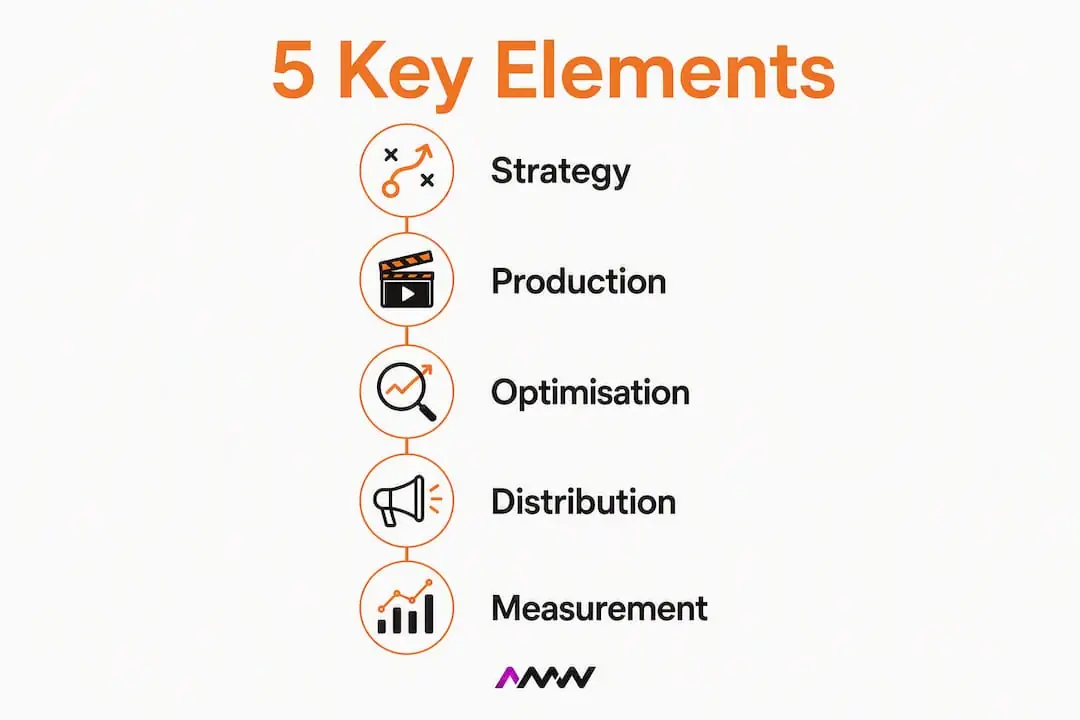
Planning and strategy
A package without a documented strategy is just a production line. Look for audience research, topic cluster mapping, an editorial calendar, and defined KPIs before a single word is written. A useful planning framework is the 70/20/10 split: 70% proven formats, 20% test ideas, and 10% experiments. It keeps output consistent while leaving room to discover what works for your specific audience.

Content production
This covers research, briefs, writing, and media production. Quality here depends on writer seniority, research depth, and whether the agency uses subject-matter experts or generalist writers. For technical industries, the difference matters enormously.
On-page optimisation
Every piece should arrive with metadata, internal linking, and structured data where relevant. Content that is not optimised for search is content that largely goes unseen.
Distribution and amplification
Production without distribution is a waste. A strong package includes organic social scheduling, email deployment, PR outreach where relevant, and content repurposing across formats. Targeted content distribution is one of the clearest levers for improving conversion rates from existing content.

Measurement and optimisation
Monthly reporting, A/B testing where volume allows, and a content refresh schedule for older posts. Without this, you are flying blind after month three.
Pro Tip: Always clarify content ownership upfront. You should own every piece outright, with full rights to reuse, republish, and repurpose. Some agencies retain licensing rights or restrict syndication. Get it in writing.
What deliverables should you expect at each package tier?
The table below maps the three most common tiers to realistic deliverables, typical UK budget shapes, and the business stage each suits best.
| Tier | Typical deliverables | Monthly budget (UK) | Best for |
|---|---|---|---|
| Starter | Several blog posts, basic keyword targeting, editorial calendar | £500 to £1,500 per month | Early-stage SMEs building organic presence |
| Growth | Multiple content pieces, keyword research, SEO optimisation, social posts, regular reporting | £1,500 to £3,000 per month | Established SMEs scaling content output |
| Authority / Enterprise | Numerous pieces, video, email sequences, PR support, dedicated strategy, frequent reporting | £5,000+ per month | Scale-ups and enterprise brands competing for high-volume keywords |
A few things worth noting per tier:
- Starter packages are often the right place to begin if you have never run a content programme. They let you test an agency’s process before committing to a larger spend.
- Growth tier is popular among UK SMBs for scaling content output with a more comprehensive service.
- Authority packages are suited to competitive markets needing varied and extensive content formats beyond blogging.
UK pricing benchmarks and realistic timelines
What does a content marketing retainer actually cost in the UK?
UK content marketing agency retainers for SMBs generally require a moderate monthly investment, with enterprise programmes costing more depending on output volume and channel complexity.
Per-piece pricing is common for one-off work, with blog post prices varying widely depending on quality and length. Per-piece models work well for occasional needs, but they rarely deliver the strategic continuity that a retainer provides.
| Engagement type | Typical UK cost | When it makes sense |
|---|---|---|
| Per blog post | £75 to £500 (quality range £150 to £350) | One-off content needs |
| Starter retainer | £500 to £1,500 per month | Building an initial content presence |
| Growth retainer | £1,500 to £3,000 per month | Scaling an existing programme |
| Enterprise retainer | £5,000+ per month | High-volume, multi-channel programmes |
How long before you see results?
Content marketing is not a paid channel and does not yield immediate spikes. Typically, initial strategy and content deployment are followed by gradual growth in impressions and rankings over several months, with measurable ROI becoming clearer after sustained activity.
Factors that speed this up include a technically healthy website, an existing domain with some authority, and a niche with moderate rather than extreme competition. Factors that slow it down include a brand-new domain, a highly competitive sector, and inconsistent publishing.
Key stat: Businesses that treat SEO and content as ongoing strategic functions consistently outperform those running one-off projects in traffic growth, brand visibility, and revenue outcomes.
Contract terms to watch
Most UK agencies ask for a minimum three-month term, with one month’s notice after that. Watch for clauses around revision rounds (two is standard), content ownership (you should own it outright), and what happens to your content if you cancel. Some agencies retain the right to unpublish or repurpose work they produced. That is a red flag.
We publish every figure rather than hiding behind a proposal. The pricing page runs from £299 a month for social media management up to £2,499 for a website, and adds up whatever you tick.
How do you choose the right content marketing package?
A practical decision checklist
Before you speak to a single agency, answer these four questions:
- What is the primary goal: SEO traffic, lead generation, or brand awareness?
- What is your realistic monthly budget, including a buffer for ad spend if distribution is part of the plan?
- Do you have internal capacity to review and approve content, or do you need a fully managed service?
- How quickly do you need results, and are you prepared to commit for at least six months?
Questions to ask prospective providers
- Who writes the content, and what is their background in your industry?
- How do you handle keyword research and topic selection?
- What does your reporting cover, and how often do we review performance?
- Who owns the content after delivery?
- Can you show examples of results for businesses similar to ours?
Red flags to watch for
- No documented strategy or editorial calendar before production starts
- Vague or opaque pricing with no breakdown of what is included
- Reporting that covers vanity metrics (page views, social followers) but not conversions or rankings
- Content produced at scale with no named writer or editor
- Pressure to sign a long minimum term before you have seen any work
A simple scorecard for shortlisting
Rate each prospective agency out of five across these five dimensions:
| Dimension | What to look for |
|---|---|
| Deliverables | Clear scope, realistic volume, right formats for your goals |
| Strategy | Documented process, topic clusters, editorial calendar |
| Proof | Case studies, portfolio, named client results |
| Communication | Dedicated contact, clear reporting cadence |
| Price | Transparent, itemised, fair for the scope |
Any agency scoring below three on strategy or proof deserves a harder conversation before you sign anything.
Why retainers usually outperform one-off projects
Retainers give continuous adaptation to algorithm changes and competitor moves. One-off projects often lose value quickly as search engines and markets shift. That is not a sales pitch for retainers; it is just how compounding works.
The logic is simple. A project delivers a fixed output at a fixed point in time. A retainer delivers ongoing monitoring, optimisation, and rapid response. Each month builds on the last. Topic clusters deepen. Internal linking strengthens. Older posts get refreshed as search intent evolves.
AMW Media’s retained content service covers strategy, production, optimisation, and distribution, with a dedicated account manager, monthly reporting against agreed KPIs, and a team holding Google, Meta, Shopify, WordPress, and Framer certifications. Their content production capabilities span video, photography, and written formats, which matters when your package needs to go beyond blog posts.
For businesses that want to test fit before committing to a longer engagement, a structured trial period is the sensible route.
Pro Tip: Ask for a 60 to 90 day trial scope before signing a 12-month retainer. A good agency will agree to it. If they push back hard, that tells you something.
How content marketing packages connect with your other channels
Content does not live in isolation. A well-structured package should feed every other marketing channel you run.
SEO is the most direct connection. Long-form SEO content builds the organic rankings that reduce your dependence on paid media over time. Social media takes the same content and extends its reach, driving traffic back to your site and building audience familiarity. Email remains one of the highest-return channels available; it is commonly included in growth-tier and above packages, and it works best when it repurposes content your audience has already shown interest in.
PPC and content also complement each other more than most businesses realise. Paid campaigns that send traffic to well-optimised, content-rich landing pages consistently outperform those pointing to thin pages. Custom content delivery that matches the user’s intent at each stage of the funnel improves both conversion rates and quality scores.
The practical implication: when you are evaluating a package, ask how the agency coordinates content output with your paid, social, and email activity. A package that operates in a silo from the rest of your marketing is leaving value on the table.
What does ROI from a content marketing package actually look like?
The honest answer is that it varies, and any agency promising specific traffic numbers before they have audited your site is guessing. What the evidence does show is a consistent pattern.
Businesses that move from sporadic content production to a structured, keyword-led retainer often experience significant growth in organic traffic within several months, provided the technical foundations are sound. The mechanism is not mysterious: consistent publishing builds topical authority, which improves rankings across a cluster of related terms, which compounds as more content is added.
For a concrete illustration, consider a UK SME in a moderately competitive sector. Before a retainer, they publish content occasionally, rely heavily on paid social, and rank for a handful of branded terms. After six months on a growth-tier retainer covering eight pieces per month, keyword research, and monthly reporting, organic sessions increase substantially, branded search volume grows as content circulates, and cost-per-lead from organic falls as paid dependence reduces.
Email, when included in the package, tends to show the fastest measurable return because the audience is already warm. Investing in content creation for a competitive market builds an asset that keeps working after the campaign budget runs out. Rankings are the smaller half of it.
How do you assess whether an agency really knows your industry?
Certifications matter, but they are table stakes. Google and Meta certifications tell you an agency understands the platforms. They do not tell you the agency understands your customers.
The better test is their portfolio. Ask to see content they have produced for businesses in your sector or an adjacent one. Look at whether the writing demonstrates genuine subject-matter knowledge or whether it reads like a well-structured summary of the first page of Google results. There is a difference, and your customers will notice it.
Ask specifically about their research process. Do they interview subject-matter experts? Do they use primary sources? Do they have writers with industry backgrounds, or do they rely entirely on generalist freelancers?
Also look at their own content. An agency that publishes thoughtful, well-researched articles about content marketing and SEO is demonstrating the same skills they would apply to your account. An agency with a sparse or generic blog is showing you something too. AMW Media’s content marketing examples give a practical sense of the range and depth of work they produce across different brand contexts.
Finally, ask for references from clients in your sector. A confident agency will provide them without hesitation.
Key takeaways
The most effective content marketing package for a UK SME combines a monthly retainer with documented strategy, SEO-led production, and regular reporting against business KPIs rather than vanity metrics.
| Point | Details |
|---|---|
| Retainers beat projects for growth | Monthly retainers build compounding topical authority; one-off projects lose value as markets and algorithms shift. |
| UK pricing ranges are clear | SMB retainers typically run £1,500 to £3,000 per month; starter packages begin around £500 to £1,500; enterprise packages £5,000+ per month. |
| Five core components matter | Every strong package needs strategy, production, on-page optimisation, distribution, and measurement. |
| Vet agencies on proof, not promises | Ask for case studies, named results, and references in your sector before signing anything. |
| AMW Media offers retained content support | AMW Media provides strategy, production, optimisation, and distribution for UK SMEs and growth brands. |
What makes a content marketing package worth paying for
Most articles about content packages focus on deliverable counts. Four blogs a month, twelve social posts, one email newsletter. That framing misses the point entirely.
The deliverables are outputs. What you are actually buying is strategic continuity: someone who understands your market, tracks how your content performs, adapts when something is not working, and builds on what is. A package that produces eight pieces a month with no strategic oversight is just a production line. A package that produces four pieces a month with genuine keyword research, proper briefs, and monthly performance reviews will outperform it consistently.
The agencies that produce the best results treat themselves as partners in your growth, not vendors filling a content quota. That means they push back when a topic idea will not rank. They flag when a piece needs refreshing. They connect content performance to revenue, not just traffic.
AMW Media takes that approach with every retained client: a dedicated account manager, monthly reporting tied to agreed KPIs, and a team with certifications across Google, Meta, Shopify, WordPress, and Framer. Packages are built for SMEs and scaled for enterprise clients, with production capabilities spanning written content, video, and photography. The digital marketing price packages guide on their site gives a useful breakdown of how agency pricing structures typically work.
The question is not which package has the most deliverables. It is which agency will still be improving your content in month nine.
AMW Media’s content marketing packages
If you have read this far, you know what a strong content package looks like. AMW Media builds retained content programmes for UK SMEs and growth brands that cover the full picture: strategy and editorial planning, content production across written and video formats, SEO optimisation, and distribution including social media management.
Every retained client gets a dedicated account manager, monthly reporting against agreed KPIs, and a team that holds Google, Meta, Shopify, WordPress, and Framer certifications. Packages are scoped to your goals and budget, not sold off a shelf. Pricing shapes range from starter retainers through to full-service enterprise programmes, and there is no pressure to commit to a long minimum term before you have seen how the team works. For London businesses, our London agency page sets out four clients with four different problems and what each one was sold.
The clearest next step is a discovery call. You will come away with a clear picture of what a specific package would include, what it would cost, and what realistic results look like for your sector. Get started with AMW Media and book your discovery call today.
FAQ
What is typically included in a content marketing package?
A content marketing package usually covers strategy and editorial planning, content production (blogs, social posts, email, video), on-page SEO optimisation, distribution, and monthly performance reporting. The exact mix depends on the tier and the agency.
How much do content marketing packages cost in the UK?
SMB retainers typically run £1,500 to £3,000 per month; starter packages begin around £500 to £1,500; enterprise programmes start at £5,000+ per month.
How long does it take to see results from a content marketing retainer?
Organic traffic and ranking improvements typically become visible between months three and six. Measurable ROI, including lead generation and revenue attribution, usually appears by month six to twelve, depending on domain authority and competition.
Should I choose a retainer or a project-based package?
A retainer suits businesses that need sustained organic growth and ongoing optimisation. A project package works for one-off needs such as a content audit, a website copy overhaul, or a single campaign.
How do I know if an agency is right for my industry?
Ask to see case studies and content examples from your sector or a closely adjacent one. Check whether their writing demonstrates genuine subject-matter knowledge, and ask specifically about their research and briefing process before committing.
Recommended
- Content Production Packages Matched to Your Brand’s Voice | AMW Media
- Content marketing: engage and grow your brand online
- Types of content formats: the complete 2026 guide | AMW Media
- Website optimisation checklist: your 2026 UK guide | AMW Media
Our free marketing audit looks at your site, your ads and your content, and comes back with a 30 day plan. No pitch deck.

Runs the content calendars and the community side of every social account, and keeps clients posted on what is going out and when. Meet the team.