
 Black Steel Doors
 Woodstock Campers
 Phillips Joinery
Most marketing managers treat SEO like a slow cooker: set it up, leave it running, and check back in six months. That assumption is costing businesses real money. SEO drives organic traffic and delivers long-term ROI in ways that paid channels simply cannot sustain over time. Far from being passive, a well-executed SEO strategy is one of the most active, data-driven disciplines in your entire marketing mix. This guide breaks down what SEO actually does, how it works across your funnel, and how to embed it into your marketing plan for measurable, lasting results.
Key Takeaways
| Point | Details |
|---|---|
| SEO is foundational | SEO is essential to digital marketing, driving long-term organic growth and visibility. |
| Multi-layered approach | Success requires technical, on-page, and off-page optimisation working in harmony. |
| Proven ROI | Meta-analyses show SEO far outpaces outbound methods for return on investment and conversion rates. |
| Adapting for the future | Stay ahead by prioritising originality and authority, especially with the rise of AI-generated content. |
| Action drives results | Effective integration of SEO in your marketing strategy translates knowledge into growth. |
What is SEO and why does it matter?
SEO stands for search engine optimisation. In plain terms, it is the practice of making your website more visible to people who are actively searching for what you offer. Search engines like Google process billions of queries every day, and the businesses that appear at the top of those results earn the lion’s share of clicks, trust, and revenue. Our SEO agency Banbury page shows how a small town with a large catchment changes the keyword plan.
The distinction between organic and paid traffic matters enormously here. Paid traffic stops the moment your budget runs out. Organic traffic, earned through SEO, compounds over time. A well-optimised page can continue attracting visitors for years without additional spend. That is a fundamentally different economic model, and one that rewards consistency.
“SEO is a core component of digital marketing that drives organic traffic, improves visibility, and provides long-term ROI.”
SEO has evolved dramatically since the early days of keyword stuffing and link farms. Today, integrating SEO in wider marketing means aligning content, technical infrastructure, and brand authority into a single coherent strategy. When you think about optimising your digital strategy, SEO is not a bolt-on. It is the foundation.
Key reasons SEO remains indispensable in 2026:
- It targets users with active purchase intent
- It builds brand credibility through consistent visibility
- It reduces customer acquisition costs over time
- It generates compounding returns unlike most paid channels
- It supports every other marketing channel you run
The three pillars of SEO: technical, on-page, and off-page
SEO methodologies consist of three pillars: Technical SEO, On-Page SEO, and Off-Page SEO. Each one plays a distinct role, and neglecting any single pillar weakens the entire structure. Think of it like a three-legged stool. Remove one leg and the whole thing collapses.

| Pillar | Focus area | Examples |
|---|---|---|
| Technical SEO | Site infrastructure and performance | Page speed, mobile optimisation, crawlability, structured data |
| On-page SEO | Content and keyword relevance | Title tags, meta descriptions, headings, internal linking |
| Off-page SEO | External authority and trust signals | Backlinks, brand mentions, digital PR, reviews |
Technical SEO ensures search engines can actually find, crawl, and index your site. If your pages load slowly or your site structure is confusing, even brilliant content will underperform. On-page SEO is about making sure each page clearly communicates its topic and value to both users and search engines. Off-page SEO builds the external credibility that tells Google your site deserves to rank.
For marketing managers, the practical implication is clear. You cannot simply commission great content and expect results if your technical foundations are broken. Equally, a technically perfect site with no authority will struggle to compete. When mastering your SEO strategy, all three pillars must be developed in parallel.
- Audit your technical setup before investing heavily in content
- Ensure on-page elements are consistent across all key landing pages
- Build off-page authority through genuine partnerships and earned media
How SEO powers the marketing funnel
SEO does not just drive traffic. It drives the right traffic at every stage of the buyer journey. From the moment a potential customer types a question into Google, to the point they are comparing providers, to the moment they convert, SEO can be present and influential throughout.
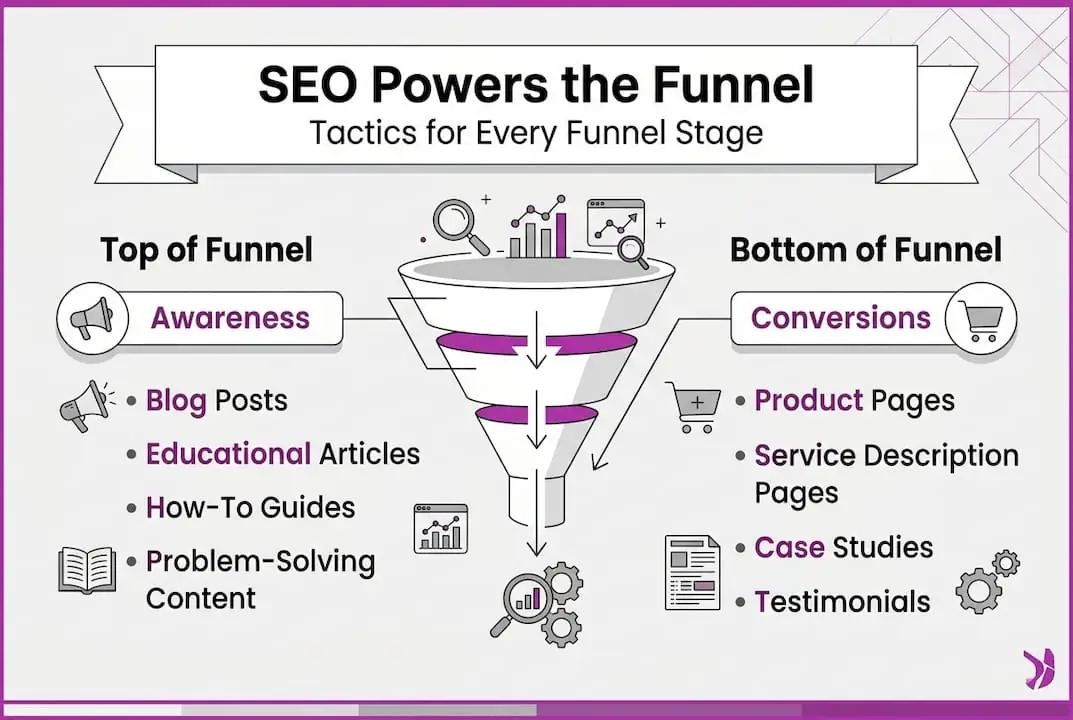
Integrating SEO into full-funnel marketing means mapping your keyword strategy to user intent at each stage. Awareness-stage content targets broad, informational queries. Consideration-stage content addresses comparisons and solutions. Conversion-stage content targets high-intent, transactional searches.
| Funnel stage | SEO tactic | Key metric |
|---|---|---|
| Awareness | Blog content, informational keywords | Impressions, organic reach |
| Consideration | Comparison pages, case studies | Click-through rate, time on page |
| Conversion | Service pages, local SEO, reviews | Conversion rate, leads generated |
Pro Tip: At the consideration and conversion stages, apply E-E-A-T principles (Experience, Expertise, Authoritativeness, Trustworthiness) to your content. Google uses these signals to assess content quality, and they directly influence whether your pages rank for high-value, competitive queries.
Here is how to integrate SEO with your broader digital marketing strategies effectively:
- Map your keyword research to each funnel stage before creating content
- Align your role of digital content plan with SEO priorities
- Use social media to amplify content and generate engagement signals
- Coordinate paid campaigns with organic efforts to dominate search results pages
- Measure performance at each funnel stage and adjust your content mix accordingly
What the data says: proven ROI and performance
If you have ever had to justify an SEO budget to a sceptical stakeholder, the numbers are on your side. A meta-analysis of SEO effectiveness found a median ROI of 748%, which dwarfs the returns from most paid marketing channels. That is not a typo.
The lead quality argument is equally compelling. SEO leads close at a rate of 14.6%, compared to just 1.7% for outbound marketing methods like cold calling or direct mail. The reason is simple: someone who finds you through a relevant search is already looking for what you offer. They arrive pre-qualified.
For business owners weighing SEO against short-term paid campaigns, the data suggests a blended approach works best. Paid campaigns deliver immediate visibility. Effective SEO strategies build the organic foundation that reduces your dependence on paid spend over time. Explore SEO services and packages that align with your growth targets.
Tangible business benefits of a well-executed SEO campaign:
- Sustained organic traffic that does not disappear when budgets are cut
- Higher quality leads with stronger purchase intent
- Improved brand credibility through consistent search visibility
- Lower cost per acquisition compared to paid channels over 12 to 24 months
- Competitive advantage in your niche through authority-building
Expert nuances, current trends, and evolving best practice
One of the most honest things an SEO professional can tell you is: it depends. Context shapes every SEO decision, from the industry you operate in, to the intent behind a search query, to whether your content falls into YMYL (Your Money or Your Life) categories that Google scrutinises more heavily.
In 2026, three trends are reshaping how SEO fits into marketing strategy. First, schema markup (structured data that helps search engines understand your content) is now essential for earning rich results in search. Second, Generative Engine Optimisation (GEO) is emerging as a discipline focused on making your content visible within AI-generated search summaries. Third, E-E-A-T has become the dominant quality framework, rewarding brands that demonstrate genuine expertise and real-world experience.
Hybrid AI-human content workflows are becoming standard practice. AI tools can accelerate research, drafting, and optimisation. But originality, lived experience, and authoritative perspective are what separate content that ranks from content that gets ignored. Explore content creation and hybrid AI-human approaches to understand how to balance both effectively.
Pro Tip: Your best defence against AI content commoditisation is genuine authority. Publish original research, feature real expert voices, and document your own case studies. These signals are extremely difficult for AI to replicate and are exactly what Google rewards.
Top mistakes to avoid and practical tips for 2026:
- Do not chase algorithm updates reactively. Build for users first.
- Avoid thin, generic content that adds nothing new to the conversation
- Do not ignore adapting SEO for AI disruption as search behaviour shifts
- Prioritise page experience signals: speed, mobile usability, and Core Web Vitals
- Treat E-E-A-T as a content brief requirement, not an afterthought
Practical steps to integrate SEO into your marketing strategy
Knowing SEO matters is one thing. Building it into your team’s daily workflow is another. The good news is that schema is vital for rich results and newer sites can outrank established competitors when they build authority more effectively. You do not need a decade-old domain to compete.
Here is a practical roadmap for embedding SEO into your marketing operations:
- Conduct a full technical audit of your current website and fix critical issues first
- Build a keyword map that aligns with your customer journey and business goals
- Create a content calendar that addresses each funnel stage with targeted, authoritative content
- Integrate social media integration into your content amplification plan
- Set up tracking for organic traffic, keyword rankings, and conversion rates from organic sources
- Review and update existing content quarterly to maintain relevance and performance
Key tools and skills your team will need:
- Keyword research tools (Google Search Console, Ahrefs, or Semrush)
- Technical audit capabilities (Screaming Frog or similar)
- Content strategy and copywriting skills aligned with SEO principles
- Analytics literacy to interpret organic performance data
Knowing when to bring in outside support is equally important. If your team lacks the bandwidth or specialist knowledge, working with an agency that understands professional services marketing can accelerate results significantly. Platforms like agency resource integration can also help streamline how you manage external marketing support. Explore the full suite of marketing services available to ambitious brands ready to scale.
How AMW Media can help drive your SEO success
If this guide has clarified one thing, it is that SEO is not a single task. It is an ongoing discipline that touches your content, your technical infrastructure, your brand authority, and your entire marketing funnel.
At AMW Media, we work with marketing managers and business owners to build SEO strategies that deliver real, measurable results. Our SEO services are designed to integrate smoothly with your wider marketing activity, from content production and social media expertise to paid campaigns and web design. We do not offer generic packages. We build specific strategies based on your industry, your audience, and your growth ambitions. If you are ready to make SEO a genuine growth engine rather than a background task, explore our full suite of marketing services or get in touch to discuss where to start.
Frequently asked questions
How does SEO differ from paid advertising in marketing?
SEO drives organic traffic and builds long-term visibility, while paid advertising delivers immediate traffic by paying for placement in search results. The key difference is sustainability: organic rankings persist without ongoing spend, whereas paid traffic stops the moment your budget does.
What is the fastest way to see SEO results in my marketing?
Technical fixes and targeted on-page updates often deliver the quickest early gains, but SEO is a long-term investment that compounds over time. Refreshing underperforming content and improving page speed are good starting points for faster visibility improvements.
Does AI content harm SEO rankings?
AI content is not inherently harmful, but low-quality, generic AI output will underperform. Prioritising original content and applying E-E-A-T principles ensures your content meets the quality standards that Google rewards, regardless of how it was produced.
Is SEO still relevant in 2026?
Absolutely. SEO continues to provide long-term ROI and sustains online visibility even as search algorithms and user behaviour evolve. The discipline has adapted to AI-driven search and remains central to any serious digital marketing strategy.
Can small businesses compete with larger brands using SEO?
Smaller sites can outrank larger competitors by building stronger relevance and authority within specific niches. Targeted keyword strategies and genuine expertise in a defined area often outperform broad, unfocused efforts from bigger brands.
Recommended
- Master your SEO strategy: guide for effective brand growth
- How to optimise digital strategy for marketing success
- Why invest in content creation for competitive brand growth
- SEO Services & Packages London | AMW Media | AMW Media
Our SEO manager runs the technical checks by hand, looks at who is beating you, and sends back the order to fix it in. Free, and you keep it either way.

Runs the content calendars and the community side of every social account, and keeps clients posted on what is going out and when. Meet the team.