
 Black Steel Doors
 Woodstock Campers
 Phillips Joinery
Nearly every major brand invests in content marketing, yet the results tell a sobering story. 92% of large B2B brands use content marketing, yet only 28% rate their strategies as very effective. That gap between effort and outcome is not a coincidence. It reflects a widespread confusion between simply producing content and building a genuine content marketing strategy. This guide cuts through that confusion. We will cover what content marketing actually means, why strategy beats tactics every time, how AI is reshaping the landscape, and what it takes to build a content approach that drives real business growth.
Key Takeaways
| Point | Details |
|---|---|
| Strategy over tactics | A documented, goal-aligned content strategy delivers better outcomes than a focus on isolated tactics. |
| Blend AI with human insight | Combining AI efficiency with unique human perspectives is essential for effective content marketing in 2026. |
| Quality beats volume | High-performing brands prioritise quality content and strategic distribution over producing lots of generic posts. |
| Measure meaningful impact | Go beyond engagement metrics, track leads, conversions, and revenue to show real value. |
Defining content marketing: what it is beyond posting
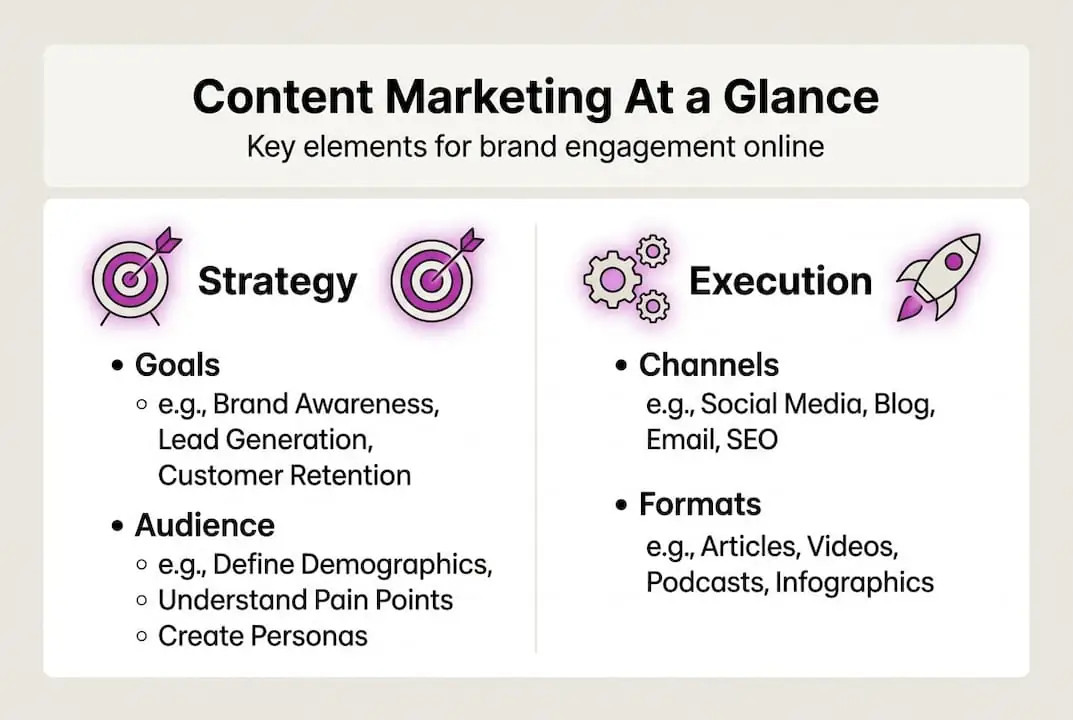
Content marketing is the strategic creation and distribution of valuable, relevant content designed to attract, engage, and retain a clearly defined audience. The goal is not to sell immediately. It is to build trust, demonstrate expertise, and position your brand as the go-to resource in your space. That distinction matters enormously.
Traditional advertising interrupts. Content marketing attracts. An inbound, pull-based model focused on organic attraction sits at the heart of content marketing, contrasting sharply with outbound push advertising that chases audiences wherever they go.
Common content formats include:
- Blog articles and long-form guides that answer specific audience questions
- Videos and short-form clips that demonstrate products or share expertise (explore video marketing strategies for a deeper look)
- Infographics that simplify complex data into shareable visuals
- Case studies that prove real-world results with evidence
- Podcasts and webinars that build community and authority over time
“Content marketing is not about creating more content. It is about creating the right content for the right audience at the right moment.”
The approach also differs significantly between B2B and B2C brands. B2B content tends to be longer, more technical, and distributed through professional channels like LinkedIn and email. B2C content leans towards emotional storytelling, short-form video, and social platforms. Understanding your audience’s content marketing goals before you produce a single piece is the foundation everything else is built on.
Strategy vs. tactics: building a foundation for brand growth
Here is where most brands go wrong. They confuse tactics with strategy. Posting three times a week on Instagram is a tactic. Knowing why you are posting, who you are reaching, and what business outcome you expect is strategy. Without the latter, the former is just noise.
Strategy sets your objectives, defines your audience personas, and determines which channels will reach them most effectively. Tactics are the formats, posting schedules, and content calendars that bring the strategy to life. Both matter, but strategy must come first.
Only 28% of enterprise brands rate their content strategy as very effective, and the brands that do succeed share one habit: they document their strategy and measure outcomes beyond simple engagement metrics. They track lead generation, pipeline contribution, and revenue impact.
| Element | Strategy | Tactics |
|---|---|---|
| Focus | Goals and audience | Formats and schedules |
| Question answered | Why and what | How and when |
| Time horizon | Long-term | Short-term |
| Example | Brand awareness for B2B buyers | Weekly LinkedIn article series |
Pro Tip: Before building a content calendar, write a one-page strategy document. Define your audience, your top three business goals, and the two or three channels where your audience actually spends time. Everything else flows from there.
If you are building a marketing strategy from scratch, start with audience research before touching any content format. And when you are ready to produce, understanding the content production steps will save you significant time and budget. Aligning content with business goals is what separates brands that grow from brands that simply stay busy.
The evolution of content marketing in the AI era
AI has changed content marketing faster than almost any other technology in recent memory. Tools can now draft articles, generate social captions, repurpose long-form content into short clips, and even personalise email sequences at scale. The efficiency gains are real. But so are the risks.

AI speeds up content creation but does not directly boost effectiveness. Success comes from blending AI efficiency with human creativity, genuine experience, and aspirational storytelling. A tool can write a blog post. It cannot replicate your brand’s unique point of view, your team’s hard-won expertise, or the emotional resonance that makes content memorable.
The market is already correcting for this. Generic AI-generated SEO posts are being replaced by high-quality, creator-led or insight-driven content as old playbooks become obsolete. Audiences are sharper than ever. They can sense when content is hollow, and they disengage quickly.
What works in 2026:
- Original research and proprietary data that no AI can replicate
- Creator-led content with a distinct voice and genuine perspective
- Content optimised for both human readers and AI-powered search (LLMs increasingly surface content that demonstrates real expertise)
- Emotionally resonant storytelling that connects with audience values and aspirations
- Interactive formats such as quizzes, calculators, and assessments that drive engagement
Investing in competitive content creation means going beyond volume. It means producing fewer, better pieces that serve your audience. Understanding the role of digital content in brand growth will help you see where quality investment pays off most. For a broader view of AI’s impact on content strategies, the shift is clear: human insight is the differentiator.
Frameworks, channels and content types: practical examples
Knowing what to create is only half the challenge. Knowing where to distribute it and how to structure your approach across the buyer journey is equally important.
The funnel framework remains one of the most practical tools available:
- Awareness stage: Blog posts, social content, short-form video, and infographics that introduce your brand to new audiences
- Consideration stage: Case studies, comparison guides, webinars, and email sequences that help prospects evaluate their options
- Conversion stage: Testimonials, product demos, free trials, and detailed landing pages that remove final objections
- Retention stage: Newsletters, exclusive content, loyalty programmes, and community-building that keep existing customers engaged
Social content has the most impact at 32% across enterprise brands. B2B brands lean towards long-form articles and case studies, while B2C brands prioritise short-form video and social engagement. Choosing the right channel is not about being everywhere. It is about being excellent in the places your audience actually is.
Pro Tip: Map your content to funnel stages before you produce anything. If 80% of your content sits at the awareness stage, you are likely losing prospects who are ready to buy but have no content guiding them towards a decision.
For inspiration on what works in practice, reviewing successful social media campaigns reveals patterns you can adapt for your own brand. And if you are exploring the full picture, understanding digital marketing strategies will show you how content fits within a broader growth framework.
How to measure content marketing effectiveness
Most brands measure what is easy rather than what matters. Pageviews, follower counts, and likes are visible and satisfying. They are also largely meaningless without context. Real measurement connects content activity to business outcomes.
Only 28% of enterprises view their content marketing as very effective, and poor measurement is a significant reason why. If you cannot show how content contributes to revenue, it becomes the first budget line cut when times get tough. Our graphic design and branding work runs from a £99 logo to a full identity at £599, with the rules that keep it consistent.
Here is a practical measurement framework:
- Set KPIs aligned with business goals. If your goal is lead generation, track form completions and qualified leads, not just traffic.
- Track the full funnel. Measure how content moves prospects from awareness through to conversion and retention.
- Review attribution across channels. A prospect might read three blog posts, watch a video, and then convert via email. Credit the journey, not just the last click.
- Analyse lead quality, not just quantity. High traffic from the wrong audience wastes sales team time and distorts your data.
- Feed results back into strategy. Monthly reviews of what is working should directly inform what you create next.
“Brands should measure beyond engagement; focus on lead quality, conversions, and revenue impact to prove ROI.”
Tracking content impact properly requires the right tools and a clear attribution model. If your current reporting only shows surface-level metrics, optimising your digital strategy is the logical next step. Brands that measure beyond engagement and focus on lead quality and revenue impact are the ones that justify and grow their content budgets year on year.
Ready to build a content strategy that actually works?
Understanding content marketing is one thing. Executing it consistently, at quality, across the right channels is another challenge entirely. That is where having the right creative and strategic partner makes a measurable difference. Our Birmingham page is built around considered purchases, where nobody signs off eleven thousand pounds of anything from a stock photograph.
At AMW Media, we work with ambitious brands to build content strategies grounded in genuine audience insight and measurable business goals. From video production and social media management to SEO, email marketing, and full-funnel content planning, our team brings both the creative firepower and the strategic rigour your brand needs to stand out. If your current content efforts are not delivering the results you expect, we would love to show you what a properly built strategy looks like in practice. Get in touch with the AMW Media team today and let us build something worth reading.
Frequently asked questions
What makes content marketing different from traditional advertising?
Content marketing focuses on providing genuine value and building trust over time, while traditional advertising relies on direct, interruption-based messaging. An inbound, pull-based model sits at the core of content marketing, contrasting with outbound push advertising.
How has AI changed content marketing in 2026?
AI accelerates production but brands win by combining AI tools with human insight and unique perspectives. AI accelerates production but success still hinges on human creativity and visionary, original content that generic tools simply cannot produce.
What are the key formats and channels for content marketing?
Formats range from blog posts and social media to videos and case studies, with channel choice driven by brand goals and audience behaviour. Enterprise B2B brands favour articles and case studies, while B2C brands prioritise short-form video and social platforms.
How can I measure if my content marketing is working?
Beyond engagement metrics, track sales, lead quality, customer retention, and overall business impact. Brands that measure content impact via lead quality, conversions, and revenue outcome are far better positioned to justify and scale their content investment.
Recommended
- Why invest in content creation for competitive brand growth
- The role of digital content in brand growth and engagement
- Master your SEO strategy: guide for effective brand growth
- Social media marketing tips to boost brand engagement
Our free marketing audit looks at your site, your ads and your content, and comes back with a 30 day plan. No pitch deck.

Runs the content calendars and the community side of every social account, and keeps clients posted on what is going out and when. Meet the team.