
 Black Steel Doors
 Woodstock Campers
 Phillips Joinery
TL;DR:
- Organic SEO is a continuous process that requires ongoing testing, measuring, and refinement for sustained visibility. Focusing on on-page elements, technical health, and quality backlinks, while using data insights, boosts long-term search performance effectively. Patience and strategic, consistent efforts are essential for meaningful organic growth over time.
Most business owners assume organic SEO optimisation is a one-time task. Set it up, tick the box, watch the traffic roll in. The reality is considerably more interesting. Organic search engine optimisation, the recognised industry term for earning traffic through unpaid search results, is a continuous process that rewards patience, precision, and structured thinking. This guide walks you through every major layer of that process, from foundational principles and on-page tactics to technical performance and data analysis, so you can build visibility that does not disappear the moment you stop spending.
Key takeaways
| Point | Details |
|---|---|
| SEO is a continuous workflow | Treat organic search engine optimisation as an ongoing cycle of testing, measuring, and refining rather than a one-off task. |
| On-page factors drive quick wins | Title tags, headers, and internal links are high-impact elements that move rankings measurably when optimised with focus. |
| Technical health underpins everything | Crawlability, mobile design, and Core Web Vitals like INP are non-negotiable foundations for organic performance in 2026. |
| Data must guide decisions | Google Search Console’s Performance report gives you clicks, impressions, and CTR data to shape your next optimisation move. |
| Backlinks still signal authority | Quality backlinks from credible sites remain a strong ranking signal; one authoritative link beats ten irrelevant ones. |
What organic SEO optimisation actually involves
Before getting practical, it helps to understand what search engines are actually doing when they decide where your page ranks. Google and Bing send crawlers across the web to read, index, and evaluate billions of pages. When a user types a query, the algorithm pulls from that index and ranks results based on three core factors: relevance, authority, and usability.
Relevance is about whether your content answers what the user is looking for. Authority comes largely from how other sites link to and reference yours. Usability covers how fast your site loads, how easy it is to navigate, and whether it works properly on mobile. Technical SEO underpins organic success by tying all three together through crawlability, fast load times, secure connections, and clear site structure.
The key elements of an effective SEO optimisation process include:
- Keyword strategy: Identifying the specific search terms your audience actually uses, not just the terms you think they use.
- Content quality: Creating pages that answer queries clearly, accurately, and in the depth the topic demands.
- Backlink profile: Earning mentions and links from credible websites in your industry.
- Technical SEO: Making your site easy for search engines to crawl and fast for users to load.
- User experience: Structuring pages so visitors stay, explore, and convert.
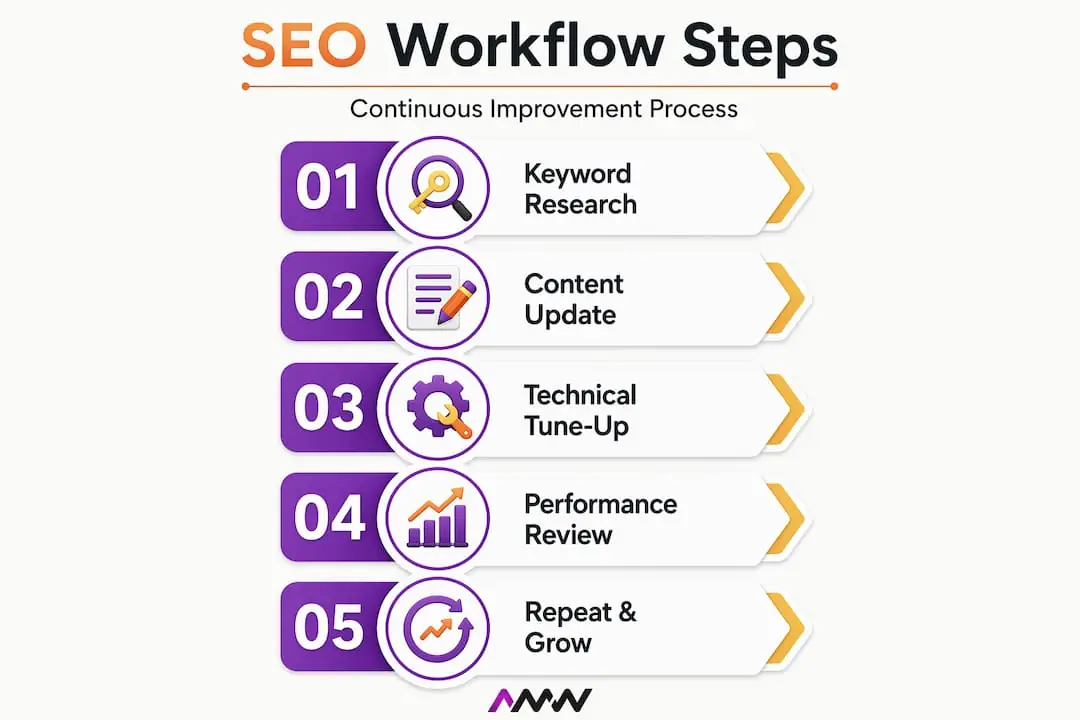
What makes this a workflow rather than a checklist is the continuous nature of it. Google updates its algorithm hundreds of times each year. Your competitors are not standing still. Effective SEO functions as an operating system with repeating cycles of finding issues, making changes, and measuring results, rather than a project with a finish line.
Pro Tip: When starting out, resist the urge to work on everything at once. Pick one element, change it, and give it four to six weeks before drawing conclusions. Changing ten things simultaneously makes it impossible to know what actually worked.
On-page SEO: the elements you control directly
On-page optimisation is where most people start, and for good reason. These are the factors entirely within your control, and the gains can be significant when you approach them with intent.
Here is a practical, prioritised process to follow:
Audit your title tags. Every page should have a unique title tag that includes your primary keyword naturally. Keep it under 60 characters so it displays fully in search results. A weak or duplicate title tag is a missed ranking opportunity every single day.
Write meta descriptions that earn the click. Meta descriptions do not directly affect rankings, but they influence click-through rate, which matters enormously for organic traffic. Treat each one as a short pitch. Tell the reader what they will get, and make it specific.
Use headers logically. Your H1 is the page’s main topic. H2s break the content into sections. H3s drill into sub-points. Search engines use this structure to understand content hierarchy, and so do readers who scan before they commit to reading.
Match your content to search intent. Content matching user intent with clear, direct answers ranks better than verbose content that buries the point. Before writing, search your target keyword yourself and study the top results. What format do they use? What questions do they answer? That is your brief.
Tighten your URL structure. Short, descriptive URLs that include your keyword outperform long, parameter-laden strings. Compare “/blog/seo-tipswith/blog/?p=4782`. One tells both the user and the search engine exactly what the page is about.
Build internal links deliberately. Topic clusters built through internal linking help search engines crawl your site more effectively, distribute authority across pages, and guide visitors to related content they actually want. Every new article you publish should link to and from at least two or three existing pages.
Refresh older content regularly. A post published three years ago with outdated statistics or thin coverage will gradually lose its ranking position. Updating it with current data, expanded sections, and better formatting often restores or improves its position faster than writing something brand new.
The On-page SEO checklist tied to ranking impact covers title tags, meta descriptions, headers, content quality, internal links, URL structure, alt text, and page load time. If two or more of those are weak on a given page, you have immediate, measurable wins waiting for you.
Pro Tip: Use Google Search Console’s Performance report to identify pages with decent impressions but low click-through rate. Those pages rank but are not compelling enough to earn the click, and better title tags or meta descriptions can fix that quickly.
Technical SEO: performance, speed, and crawlability
Technical SEO is the part that often gets postponed because it feels less tangible than writing content. That is a mistake. Without a technically sound site, even exceptional content struggles to rank.

The table below covers the core technical areas and their impact on organic performance:
| Technical area | What to address | Ranking impact |
|---|---|---|
| Site architecture | Logical URL hierarchy, XML sitemap, clean navigation | Directly affects crawl efficiency and indexation |
| Mobile optimisation | Responsive design, no horizontal scrolling, readable fonts | Google uses mobile-first indexing; non-responsive sites rank lower |
| Core Web Vitals (INP) | Reduce JavaScript execution time, break up long tasks | INP above 500ms is classified as poor and affects rankings |
| Page speed | Image compression, caching, CDN usage | Speed optimisation baseline fixes positively impact rankings and user retention |
| Rendering method | Server-side rendering (SSR) or static site generation (SSG) for JS-heavy sites | Ensures search engines can read your content without relying on client-side JS |
| HTTPS and security | Valid SSL certificate, no mixed content warnings | A basic trust and ranking signal since 2014 |
The metric worth your attention right now is Interaction to Next Paint, or INP. It replaced First Input Delay as a Core Web Vital in 2024 and measures how quickly your page responds to user interactions like clicks and taps. A good INP score sits at 200ms or less. Anything above 500ms puts you at a measurable disadvantage compared to competitors with faster, more responsive pages.
For JavaScript-heavy websites, the most common cause of poor INP is oversized JavaScript bundles and long tasks blocking the main thread. Breaking up those tasks and reducing bundle size directly improves INP and, by extension, organic performance. If your site runs on a modern framework, check with your developer about whether server-side rendering or static generation is feasible. It makes your content far more accessible to search engine crawlers. For a deeper look at how technical SEO fits your broader digital strategy, the connection between site performance and marketing outcomes is clearer than most people expect.
Using data to sharpen your SEO optimisation process
Getting traffic is one thing. Understanding where it comes from, why it fluctuates, and what to do next requires good data habits.
Google Search Console is the starting point. The Performance report tracks four metrics for every page and query on your site:
- Clicks: The number of times users clicked through to your site from search results. This is the definitive measure of whether you are earning actual visits.
- Impressions: How often your pages appeared in search results, regardless of whether anyone clicked. High impressions with low clicks points to a title or meta description problem.
- CTR (click-through rate): The ratio of clicks to impressions. Google Search Console Performance tracking powers the data-driven decisions that separate improving sites from stagnating ones.
- Average position: Where your pages rank on average for a given query. A position of 8 moving to 4 is significant progress, even if clicks have not spiked yet.
One thing that trips people up is the difference between the chart view and the query table in Search Console. The chart reflects total data across all queries. The query table only shows a filtered subset due to Google’s anonymisation process, which means your total impressions in the chart will almost always exceed the sum you see in the table. Do not try to reconcile the two. Use the chart for total volume trends and the table for query-level insights.
Google has also introduced AI-powered configuration in Search Console that lets you set up filters and metric views using natural language. It is useful for quickly segmenting data by page type or query category, though accuracy can vary and manual review remains worthwhile. For a broader look at how AI features are reshaping SEO analysis, the implications for your Search Console workflow are worth understanding.
One often-overlooked reality: Search Console data reflects a 28-day lag behind the changes you deploy. Making a change today and checking results next week will mislead you. Build patience into your measurement cycle.
Beyond basics: backlinks, local SEO, and voice search
Once your on-page and technical foundations are solid, the next layer of organic search engine optimisation involves signals that extend beyond your own website.
Building a quality backlink profile
Backlinks from credible, authoritative sites strongly influence organic rankings by signalling trustworthiness. The quality-over-quantity principle is not just good advice; it reflects how modern algorithms actually work. A single link from a respected industry publication carries far more weight than fifty links from low-quality directories.
Effective approaches to earning backlinks include:
- Publishing original research or data that others in your industry want to reference.
- Writing useful guest posts for established publications in your niche.
- Identifying broken links on relevant sites and suggesting your content as a replacement.
- Creating resources like tools, templates, or guides that naturally attract links over time.
Local SEO for location-based visibility
If your business serves a specific geographic area, location-targeted optimisation is not optional. Your Google Business Profile needs to be complete, accurate, and actively managed. Local landing pages should include the area you serve, relevant local keywords, and content that reflects genuine local relevance. Reviews matter significantly here as both a ranking signal and a conversion factor.
Voice search and conversational queries
Voice search continues to grow as a channel, particularly for local and informational queries. The key adjustment for voice is writing content that answers questions conversationally. People speak to voice assistants differently from how they type. They ask full questions: “What is the best way to improve my website’s Google ranking?” rather than typing fragments like “improve Google ranking.” Including an FAQ section in your content, using natural question-and-answer formatting, and targeting featured snippet positions all improve your chances of appearing in voice results.
Integrating these strategies into your long-term SEO workflow keeps your organic growth compounding over time, rather than spiking and dropping with each algorithm update.
My honest take on making organic SEO work
I have watched businesses invest heavily in SEO and see minimal results, not because the strategy was wrong, but because the expectations were completely misaligned from the start.
The most common mistake I see is treating organic SEO optimisation as a series of isolated tasks rather than a connected system. Someone fixes their title tags, writes a few blog posts, gets a handful of backlinks, and then waits for page-one rankings. When they do not arrive in six weeks, they conclude that SEO does not work. What they actually have is a collection of unconnected actions without a feedback loop.
What does work is thinking about SEO as a discipline that compounds. Small, consistent improvements accumulate into significant gains over months. A page that moves from position 12 to position 6 might double its organic traffic. A site that improves its INP score from 600ms to 180ms gives search engines a measurable reason to favour it over a slower competitor. None of these are dramatic, individual wins. Together, they are transformative.
The role of AI in SEO workflows is also worth addressing. AI tools are useful for content research, identifying keyword gaps, and analysing Search Console data at scale. But they do not replace judgement. I have seen AI-assisted content strategies produce large volumes of thin, intent-mismatched content that actually hurt organic performance. The marketers who get the most from AI are the ones who use it to speed up research and structure, then apply real expertise to the output.
My advice is to build your SEO strategy on a clear measurement cycle. Identify your highest-priority issues, fix one category at a time, wait for the data to reflect the change, and then decide what to address next. That cadence, repeated consistently over 12 to 18 months, produces results that paid advertising simply cannot replicate in the long run.
Amir
How AMW Media can support your organic growth
If this guide has given you a clear picture of what effective organic SEO optimisation involves but a less clear picture of where to start, that is exactly where AMW Media comes in.
AMW Media works with ambitious brands to build and execute SEO strategies that cover every layer of what you have read here: technical audits, on-page improvements, content strategy, and performance measurement. The team holds Google and Shopify certifications and brings genuine hands-on experience to both the strategic and execution sides of organic search. Whether you need a full SEO audit and ongoing management or a technically sound, search-optimised website built from the ground up through AMW Media’s web design services, the starting point is a conversation about where your site is now and where you want it to go.
FAQ
What is organic SEO optimisation?
Organic SEO optimisation is the process of improving a website’s visibility in unpaid search engine results through tactics such as keyword strategy, on-page improvements, technical fixes, and backlink building. Unlike paid advertising, organic rankings are earned rather than bought.
How long does organic SEO take to show results?
Most sites begin to see measurable ranking improvements within three to six months of consistent optimisation work, though Search Console data lags behind deployed changes by around 28 days. Competitive niches may take longer.
What are Core Web Vitals and why do they matter for SEO?
Core Web Vitals are Google’s performance metrics for user experience, covering load speed, visual stability, and interactivity. Interaction to Next Paint (INP) is the current interactivity metric, with a good score being 200ms or below. Poor scores can directly disadvantage your rankings.
Which on-page SEO elements have the biggest impact?
Title tags, headers, content quality, internal links, and URL structure consistently produce the strongest ranking impact. Treating all elements equally dilutes effort; focus on whichever combination is weakest on your highest-traffic pages first.
Do backlinks still matter in 2026?
Yes. Authoritative backlinks remain one of the strongest ranking signals available. The emphasis has shifted firmly toward quality over quantity, with links from relevant, credible sources carrying significantly more weight than volume-based link building.
The same steps apply locally, with one difference: the Google Business Profile does as much work as the website. Our SEO agency page for Milton Keynes covers the local version.
Recommended
- Types of SEO strategies: a practical 2026 guide | AMW Media
- Master your SEO strategy: guide for effective brand growth
- SEO in marketing: strategies for long-term growth
- How to optimise digital strategy for marketing success
Our SEO manager runs the technical checks by hand, looks at who is beating you, and sends back the order to fix it in. Free, and you keep it either way.

Technical, on page and local SEO. Turns the numbers in Search Console into pages that rank and enquiries that convert. Meet the team.