
 Black Steel Doors
 Woodstock Campers
 Phillips Joinery
TL;DR:
- Case studies are essential in B2B marketing because they turn claims into proven results and accelerate sales. They impact every buying stage by providing measurable outcomes, building credibility, and addressing buyer objections. Creating structured, outcome-focused case studies that are repurposed and properly promoted can significantly boost pipeline and conversion rates.
Case studies are the single most powerful proof asset in B2B marketing. They convert vague claims into verifiable outcomes, give procurement committees something concrete to evaluate, and consistently shorten sales cycles. Landing pages featuring customer stories can increase conversion rates by up to 34%, and sales teams using relevant case studies can improve their own conversion rates by up to 22%. If you do one thing this quarter, pick your highest-impact customer story, capture the measurable outcomes, and publish it.
Why case studies matter so much in B2B buying
B2B buyers are cautious by nature. They are spending company money, often with a committee watching, and the consequences of a bad decision follow them around. A case study addresses that anxiety directly. It says: here is a real organisation, with a real problem, and here is exactly what happened when they worked with us.
Case studies in B2B marketing document how an external organisation solved a genuine problem using a supplier’s product or service. That distinction matters. A testimonial says “we loved working with them.” A case study says “we reduced cost per lead by 38% in 90 days.” One is a compliment; the other is evidence.
Stat to know: 76% of UK software companies use case studies or customer stories on their websites, and case studies rank in the top three content types for effectiveness in B2B marketing.
Where case studies sit in the funnel is worth mapping out. At the awareness stage, a well-optimised case study page pulls in organic search traffic from buyers researching their problem. At the consideration stage, it gives evaluators something to share internally with stakeholders who were not in the first sales call. At the decision stage, it removes the last objection: “Has this worked for someone like us?” Each stage has a different job, and a single case study can do all three if it is structured correctly.
The commercial upside can be significant. One integrated case study and GTM repositioning effort generated £14.5M in qualified pipeline for a client. That is not typical for every business, but it illustrates what happens when proof assets are treated as commercial tools rather than website decoration.
Pro Tip: Prioritise case studies that match your highest-value buyer persona and address the objections that most often stall deals. A case study that speaks directly to a CFO’s concern about ROI will outperform a generic success story every time.
What does a compelling B2B case study actually contain?
Structure is everything. A case study that buries the results on page three, or spends four paragraphs describing the supplier’s history, will lose the reader before they reach the point. The essential elements are:
- Headline: outcome-first, specific (e.g. “How [Client] cut onboarding time by 60% in eight weeks”)
- Subheadline: one sentence naming the client’s industry, challenge, and result
- Customer-as-hero framing: the client is the protagonist; you are the guide
- The challenge: what was broken, costly, or holding them back
- The strategic approach: what was done and why, with enough methodology to be credible
- Quantified results: percentage improvements, revenue figures, time saved, NPS changes
- Testimonial quote: attributed to a named person with their job title and company
- Visuals and KPI callouts: charts, screenshots, or a summary box of key metrics
- Clear call to action: what the reader should do next
- Methodology note: a single sentence explaining how results were measured
- Legal and approval line: confirmation that the client has approved the content for publication
A mini-template to copy:
Headline: [Client name] achieved [specific result] in [timeframe] One-sentence result: Working with [Agency], [Client] reduced [metric] by [X%], saving [£Y] per [period]. KPI line: Cost per lead down 38% | Pipeline up £220K | Sales cycle shortened by 3 weeks Quote: “The results were faster than we expected. We now use this as our benchmark for every new campaign.”, Head of Marketing, [Company]
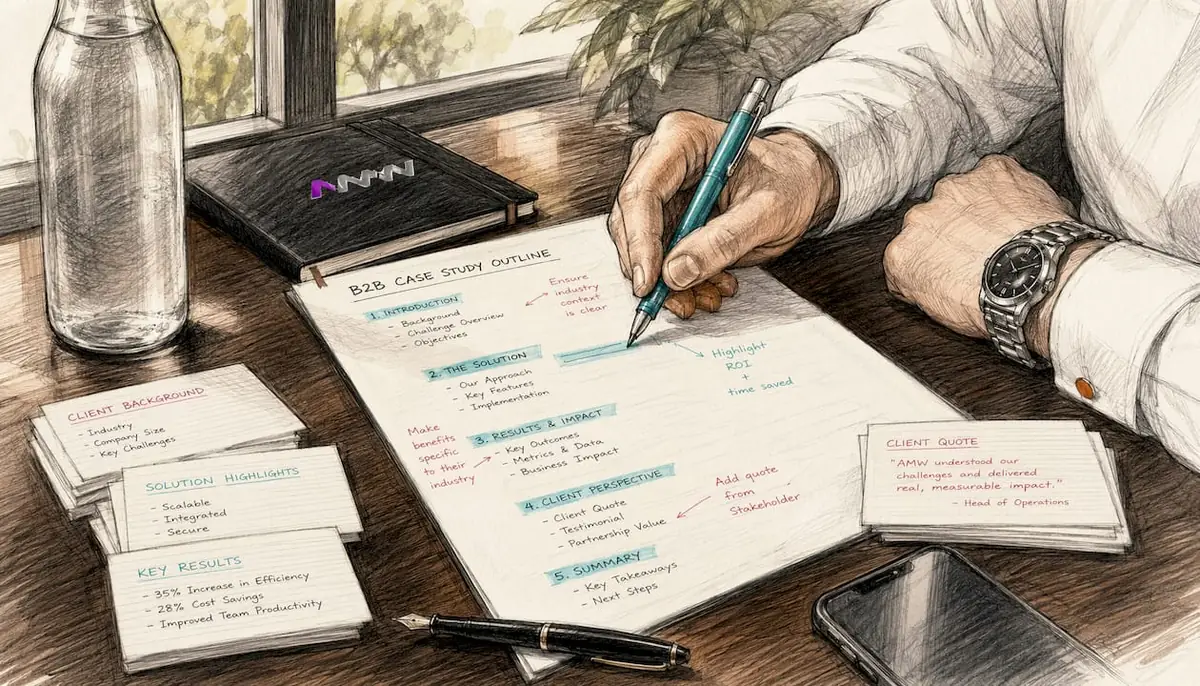
The methodology note does not need to be long. Something like: “Results measured via CRM attribution over a 90-day period, comparing the same quarter year-on-year” is enough to make the numbers credible. Case studies allow analysis of unique situations and can demonstrate applied methodology and measured outcomes in ways that generic content simply cannot.
The relationship between case studies and testimonials in marketing is complementary. A testimonial is a signal; a case study is the proof behind it.
How do you create, approve and publish a B2B case study?
The production process trips up more marketing teams than the writing itself. Here is a practical workflow with realistic timelines and budget guidance.
Selecting the right customer story
Not every happy client makes a good case study. Prioritise customers who have measurable outcomes you can quantify, who represent your ideal client profile, who have a named champion willing to participate, and whose story addresses a common objection in your sales process. Impact and relevance beat volume every time.
Capture: interviews, permissions and assets
The interview is where the story lives. Prepare eight to twelve open questions focused on the before state, the decision process, and the after state. Record the call (with permission). Collect the metrics directly from the client’s data, not from memory. Gather any supporting assets: screenshots, dashboards, video footage if you are producing a video version.
Permissions paperwork should be sorted before you write a word. A simple one-page approval form covering publication rights, use of the company name and logo, and any confidentiality constraints will save weeks of back-and-forth later. For regulated industries, check whether the client needs legal sign-off before any figures are published.
Drafting, approvals and publishing
A structured five-step approach covers research objective, data collection, analysis, write-up, and dissemination. In practice, allow two rounds of client review. The first round catches factual errors; the second round catches anything the legal or comms team flags. Build that time into your schedule.

| Milestone | Typical duration |
|---|---|
| Select customer and confirm participation | 1 to 2 weeks |
| Interview and asset capture | 1 week |
| First draft | 1 week |
| Client review (round 1) | 1 to 2 weeks |
| Revisions and legal/comms check | 1 week |
| Final approval and sign-off | 3 days |
| Design, publish and promote | 1 week |
| Total | 6 weeks |
Budget tiers vary considerably depending on format:
- Simple written case study (copy only, basic layout): £500 to £1,500
- Designed PDF and webpage (copywriting, design, web build): £1,500 to £4,000
- Video case study (filming, editing, written version): £4,000 to £10,000+
- Premium multimedia (video, interactive webpage, paid activation pack): £10,000+
Roles to assign: a marketing lead owns the project and client relationship; a copywriter handles the interview and draft; a designer or producer handles layout and video; the client contact coordinates internal approvals. Keep the client’s workload light. The easier you make it for them, the faster you get sign-off.
Pro Tip: Send the client a one-page brief before the interview that explains what you will ask and what metrics you need. Clients who arrive prepared give you better quotes and more accurate data.
Which KPIs belong inside the case study, and how do you measure its impact?
There are two distinct measurement questions here. The first is what to report inside the case study itself. The second is how to measure whether the case study is generating commercial value for your business.
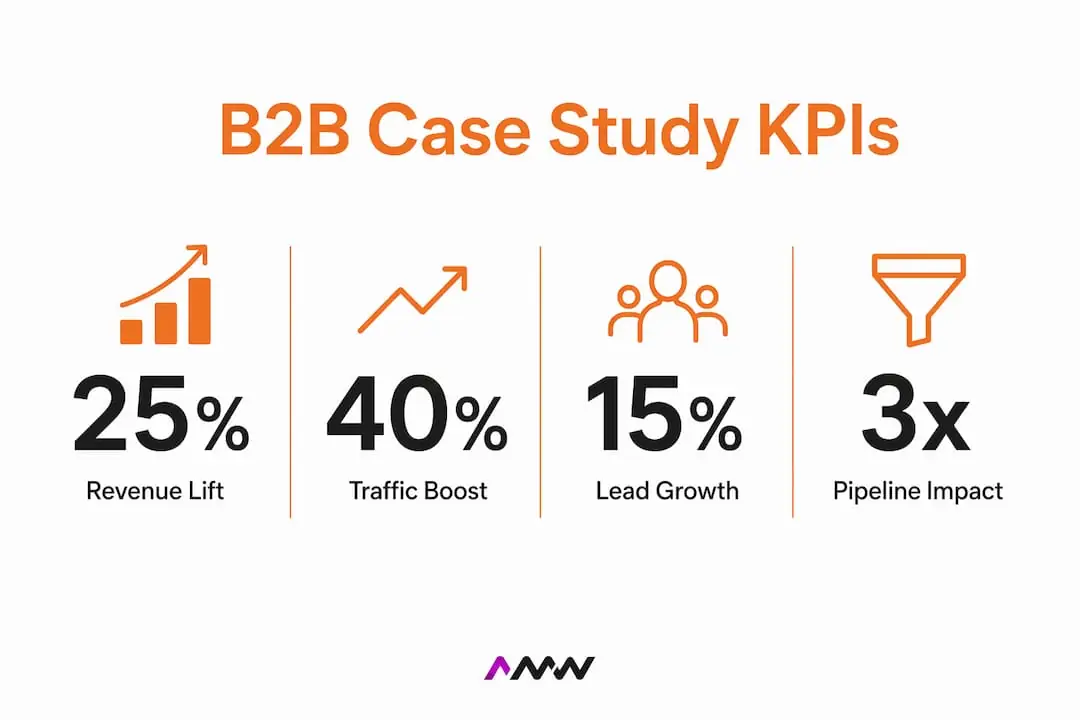
Inside the case study, lead with the metrics that matter to your buyer. Revenue uplift and percentage improvements in cost or efficiency tend to resonate most with procurement committees. Time saved, NPS or CSAT improvements, and reduction in churn are strong secondary metrics. Always state the baseline so the improvement is meaningful: “reduced cost per lead from £85 to £52” is far more persuasive than “reduced cost per lead by 39%.”
For measuring the case study’s own commercial impact, the table below maps common KPIs to practical measurement approaches:
| KPI | Measurement method | Data source |
|---|---|---|
| Organic traffic to case study page | Page-level sessions and impressions | Google Search Console, GA4 |
| Gated PDF downloads | Form completions attributed to asset | CRM or marketing automation |
| Sales-accepted leads citing case study | Sales rep tagging at qualification | CRM deal notes |
| Conversion rate on case study landing page | Page conversion rate vs. site average | GA4 or landing page tool |
| Pipeline influenced by case study | Opportunity tagging in CRM | CRM pipeline report |
| Email click-through on case study snippet | CTR vs. campaign average | Email platform analytics |
Tag every asset at publication with a UTM parameter and a CRM campaign code. That single step makes attribution possible months later when a deal closes and someone asks what content influenced it.
Pro Tip: Last-click attribution will undervalue case studies because buyers rarely convert on the first read. Use multi-touch attribution in your CRM to capture the full influence of a case study across a longer buying cycle. Even a simple “first touch / last touch / assisted” model tells a more honest story than last-click alone.
How do you turn one case study into a full portfolio of proof assets?
One well-produced case study can generate a dozen distinct assets. The written long-form version is the foundation. From there, a short video interview (two to three minutes) covers the buyer who prefers to watch rather than read. Video case studies are particularly persuasive for complex or technical B2B purchases because they show people, processes and outcomes, making abstract benefits tangible.
Beyond video, the same story becomes: a downloadable PDF for sales enablement, a one-slide summary for pitch decks, a LinkedIn carousel post, a testimonial pull-quote graphic for social, a short snippet for email nurture sequences, a landing page for paid campaigns, and a section in the sales playbook. Repurposing case studies into multiple proof assets increases content ROI materially because the same evidence reaches buyers in the format and channel they prefer.
For channel activation, sequence your promotion deliberately. In the first week, publish the webpage and send it to your email list. In weeks two and three, run LinkedIn sponsored content targeting your ICP. From week four onwards, add the case study to relevant PPC landing pages and brief the sales team to include it in active proposals. Using case studies in paid channels brings data to life and can significantly improve lead quality because prospects arrive pre-qualified by the evidence they have already read.
For email specifically, a case study snippet in a nurture sequence works best when it is framed around the reader’s problem, not the client’s success. “Here is how a company in your sector solved [X]” outperforms “Read our latest case study.” See email campaigns that actually work for practical sequencing ideas.
Pro Tip: Gate the PDF version behind a short form to capture leads, but keep the webpage version ungated for SEO and AI-search visibility. You get both lead generation and organic reach from the same asset.
What mistakes kill case study effectiveness, and what actually works?
Most case studies fail for the same handful of reasons. Here is what to avoid and what to do instead.
Avoid:
- Vague claims with no numbers (“we significantly improved their performance”)
- Burying the KPIs at the bottom after three paragraphs of company background
- Making the story about your agency or product rather than the client’s outcome
- Publishing without a methodology note, which makes metrics look invented
- Skipping the CTA, leaving the reader with no obvious next step
- Omitting the client’s job title from the quote, which reduces credibility
Do:
- Lead with the outcome in the headline and the first sentence
- Name the client’s role and company in every quote
- Include a KPI summary box near the top of the page
- Add a one-sentence methodology note for every percentage or revenue figure
- Place a clear CTA at the end and again mid-page for long-form content
- Surface case studies on relevant product and service pages, not just a dedicated “case studies” section
Three quick wins you can implement this week:
- Add a KPI summary box to your existing case studies (three to five metrics, formatted as a callout near the top).
- Add a CTA to every case study page that links to a relevant service page or contact form.
- Brief your sales team on which case studies match which buyer personas, and add them to active proposal templates.
The evidence-based principle behind all of this is simple. Buyers trust outcomes-focused content that shows transparent methodology. When a case study reads like a press release, it loses credibility. When it reads like a documented result with named people and sourced metrics, it converts.
What can you learn from AMW Media’s Blue Light Services case study?
AMW Media’s work with Blue Light Services is a useful example of how to translate a client engagement into a proof asset that does commercial work. The case study documents the scope of the project, the strategic approach taken, and the measurable outcomes achieved, with attribution to named roles and supported by documented methodology.
Three takeaways worth copying:
1. Lead with the outcome, not the brief. The AMW Media case study opens with what changed for the client, not with a description of the services delivered. That framing keeps the reader focused on the result they want for themselves.
2. Credibility signals are built in, not bolted on. Named job titles, specific metrics, and a clear explanation of how results were measured all appear within the body of the case study. This is what separates a credible proof asset from a marketing brochure.
3. The case study feeds the sales process directly. Rather than sitting on a “case studies” page that nobody visits, it is positioned as sales enablement material, shared at the proposal stage to address the specific objection: “Has this worked for a business like ours?”
You can review the full Blue Light Services case study on the AMW Media website to see how these principles are applied in practice.
Key takeaways
Case studies are the primary proof asset in B2B marketing: they convert claimed expertise into verifiable outcomes, shorten sales cycles, and generate qualified leads when structured with clear KPIs, transparent methodology, and a deliberate activation plan.
| Point | Details |
|---|---|
| Lead with outcomes | Open every case study with the measurable result, not the brief or the supplier background. |
| Structure drives credibility | Include a KPI summary box, named quotes with job titles, and a one-sentence methodology note. |
| Repurpose deliberately | One case study can produce a webpage, PDF, video, social posts, and sales deck slides for higher content ROI. |
| Measure commercial impact | Tag assets with UTM parameters and CRM codes at publication; use multi-touch attribution to capture full influence. |
| AMW Media as your next step | AMW Media produces case studies end-to-end, from interview and copywriting to video, SEO, and paid activation. |
Why proof assets sit at the centre of everything we do
There is a version of marketing that looks busy but does not convert. Blog posts, social updates, brand videos, all of it can feel productive without moving a single deal forward. Case studies are different because they are the one content format that a procurement committee will actually read at the decision stage.
The commercial logic is simple. A buyer who has already read a case study from a company in their sector, with a named contact and a documented result, arrives at the sales conversation with most of their objections already answered. That shortens the sales cycle. It also raises the quality of the conversation, because you are no longer explaining what you do, you are discussing how to replicate a result they have already seen.
If you are not sure where to start, pick the client relationship where you are most confident about the outcome, where you have the metrics to back it up, and where the client would be willing to put their name to it. That is your first case study. Publish it, measure what happens to your conversion rate, and build from there. If you want help getting it right, get in touch with AMW Media.
AMW Media produces case studies that generate pipeline
If you have strong client results but no structured way to turn them into proof assets, that is a gap worth closing. AMW Media works with B2B brands across the UK to produce case studies that do commercial work, not just fill a portfolio page.
The service covers the full production cycle: customer interviews and copywriting, designed PDFs and case study landing pages, short-form video production, and distribution across SEO, PPC campaigns, and social media. Engagements run as one-off projects or as part of an ongoing content programme, depending on how many stories you need to capture each quarter.
The starting point is a case-study review: a short conversation to identify your two or three highest-impact customer stories and map them to your sales process. From there, AMW Media handles the production and activation, so your team is not pulled away from pipeline work. If you would rather have this done for you, our Reading marketing page starts with what £12.50 a lead actually bought Woodstock Campers over thirteen months.
Book a case-study review to get started.
Further reading and useful sources
These sources are worth bookmarking if you want to go deeper on any of the topics covered above.
- Why Your Brain Loves Good Storytelling, Harvard Business Review: The neuroscience behind why narrative-driven case studies are more persuasive than feature lists.
- Case Study Proof to Revenue Framework for B2B Growth, Remedy Marketing: A practical UK-focused framework for turning case studies into pipeline.
- How to Write B2B Case Studies That Drive Revenue, Edify Content: Detailed guidance on structure, tone and commercial framing for written case studies.
- The Top Benefits of Case Studies in B2B Marketing, Attract and Engage: A concise overview of the commercial and credibility benefits, with UK market context.
- How UK Software Companies Use Case Studies, Rob Beadle: Original UK research on case study usage and format preferences among software companies.
- How to Successfully Use Case Studies in Your Marketing, Marketing 4 Manufacturing: Practical activation guidance including conversion rate data and repurposing strategies.
- eSign generates £14.5M+ in qualified pipeline, Demand Conversion: A real-world example of case study-led repositioning generating substantial pipeline.
- Why Case Studies Are Valuable B2B Content, Extu: A clear explanation of where case studies fit in the B2B content mix and why buyers trust them.
FAQ
What is a B2B case study?
A B2B case study documents how a real organisation solved a specific business problem using a supplier’s product or service, with a focus on measurable outcomes rather than product features. It acts as verifiable proof that the supplier’s approach works in practice.
What is the role of case studies in B2B marketing?
Case studies reduce perceived risk for buyers, provide evidence at the decision stage of the sales process, and shorten sales cycles by answering objections before the sales conversation begins. They also support organic search visibility and sales enablement when distributed across the right channels.
What are the four types of case studies?
The four common types are: illustrative (describing a real outcome to make it accessible), exploratory (investigating a situation before drawing conclusions), cumulative (aggregating findings across multiple instances), and critical instance (examining a unique or high-stakes scenario). In B2B marketing, illustrative and critical instance formats are most commonly used.
What are the five core components of a B2B case study?
The five components are: the client challenge (what problem they faced), the strategic approach (what was done and why), the measurable results (quantified outcomes with methodology), a customer quote attributed to a named role, and a clear call to action for the reader. A methodology note explaining how results were measured strengthens credibility significantly.
How do you use case studies to generate leads?
Gate the downloadable PDF version behind a short form to capture contact details, keep the webpage version ungated for SEO, and promote the asset via LinkedIn sponsored content, email nurture sequences, and PPC landing pages. Tagging assets with UTM parameters and CRM campaign codes lets you attribute leads and pipeline directly to the case study.
Recommended
- The role of testimonials in marketing: 2026 guide | AMW Media
- Proven content marketing examples to boost your brand | AMW Media
- Why branding matters: grow and differentiate your business
- What is blogging for business? a 2026 growth guide | AMW Media
Our free marketing audit looks at your site, your ads and your content, and comes back with a 30 day plan. No pitch deck.

Runs the business alongside Amir: contracts, onboarding and making sure every client knows what is happening and when. Meet the team.