
 Black Steel Doors
 Woodstock Campers
 Phillips Joinery
TL;DR:
- A creative strategy aligns imaginative ideas with measurable business goals for consistent branding.
- Collaboration and clear research are essential for developing effective and differentiated creative campaigns.
- Most strategies fail when ideas are disconnected from strategic intent and audience insights.
Creativity in marketing is not guesswork. That misconception costs brands real money, real time, and real market share. A creative strategy is a structured, deliberate framework that aligns imaginative ideas with measurable business objectives, and it is the difference between campaigns that drift and campaigns that deliver. Many marketing managers treat creative work as something that simply happens between briefs and deadlines, leaving it to instinct rather than intention. This article breaks down what creative strategy actually means, why it matters for your digital growth, how collaboration shapes its quality, what real-world examples reveal, and precisely how to build and execute one that sets your brand apart from competitors.
Key Takeaways
| Point | Details |
|---|---|
| Creative strategy defined | A creative strategy aligns ideas, messaging, and business goals for standout marketing. |
| Collaboration boosts results | Teams working together generate more original and flexible creative ideas. |
| Frameworks support execution | Successful creative strategies have clear steps from research through to measurement. |
| Real examples matter | Studying proven marketing cases helps apply the principles in your own campaigns. |
| Expert support is available | Specialist agencies can accelerate creative growth with targeted services and advice. |
Defining creative strategy: what it is and why it matters
A creative strategy is a structured plan that unites creative thinking with commercial goals. It answers three fundamental questions: who are you speaking to, what do you want them to feel or do, and how will your creative work make that happen? Unlike a marketing strategy guide that covers channels, budgets, and targeting, a creative strategy governs the ideas, the tone, and the narrative that run through every piece of content your brand produces.
This distinction matters because many mid-sized businesses conflate the two. They build a solid media plan and assume the creative will take care of itself. It rarely does. Without strategic direction baked into the creative process, you end up with inconsistent messaging, fragmented brand identity, and campaigns that look polished but fail to convert.
The core benefits of a well-built creative strategy are tangible. First, it gives your team clear messaging guardrails, so every asset from a social post to a landing page speaks with one coherent voice. Second, it builds consistent branding over time, which compounds in value as your audience recognises and trusts you. Third, it improves return on investment by reducing wasted creative effort on ideas that do not serve a clear objective. As a resource that explores the creative campaign process makes clear, creative strategy provides direction and coherence for all marketing communications, functioning as the connective tissue between inspiration and execution.
Common misconceptions are worth challenging here. Some teams believe creative strategy is only relevant for large agencies with dedicated brand departments. Others assume it is too time-consuming for the pace of digital marketing. Both assumptions are wrong. In fact, the more agile your environment, the more you need a strategic creative foundation, because speed without direction produces noise.
A strong creative strategy typically includes these core elements:
- Goal setting: Defining what success looks like before a single idea is generated
- Audience insight: Deep understanding of your target audience’s motivations, pain points, and language
- Concept development: Translating insight into a central creative idea or theme
- Messaging hierarchy: Identifying the primary message, supporting points, and calls to action
- Tone of voice: Deciding how your brand communicates, not just what it says
Research published in the Journal of Business Economics found that teams collaborating virtually outperform individuals in creative tasks, producing higher idea fluency, flexibility, and originality. Building your creative strategy through structured team collaboration is a competitive advantage, and good culture on top of that.
With the foundational importance of creative strategy clear, let us examine the building blocks every successful plan must include.
Key components of an effective creative strategy
Knowing that a creative strategy matters is one thing. Knowing what to actually put inside it is another. The components below are not abstract concepts; they are practical tools that shape how your audience experiences your brand across every digital touchpoint.
Begin with audience research. Not demographic data alone, but psychographic understanding: what drives your ideal customer, what language they use, what frustrations they carry into their buying decisions. This research becomes the soil in which every creative idea is rooted. Without it, campaigns reflect what your team finds interesting rather than what your audience finds compelling.
Next comes your unique value proposition. This is the single, specific reason why someone should choose your brand over a competitor. It must be honest, differentiated, and defensible. Your creative strategy exists, in large part, to express this proposition in ways that feel fresh and relevant across formats.

Your brand narrative ties everything together. People do not remember bullet points; they remember stories. Your narrative gives your brand a consistent arc that audiences can follow over time, building familiarity and emotional resonance. This sits alongside tone of voice, which dictates whether you are authoritative, conversational, bold, or empathetic. Tone must remain consistent even as formats change.
Finally, campaign objectives provide the commercial anchor. Every creative decision should be traceable back to a specific outcome, whether that is awareness, lead generation, or customer retention. A framework for optimising digital strategy confirms that creative strategy frameworks involve explicit steps from concept to execution, ensuring practical application rather than artistic ambiguity.
Here is a practical numbered process for moving from research to creative output:
- Conduct audience and competitor research
- Define your unique value proposition and creative territory
- Develop a central campaign concept or theme
- Write a messaging hierarchy (primary, secondary, and supporting messages)
- Establish tone of voice guidelines
- Brief creative teams with context, objectives, and constraints
- Review and refine concepts against strategic criteria
The table below illustrates what separates strong creative strategies from weak ones in practice:
| Element | Strong creative strategy | Weak creative strategy |
|---|---|---|
| Audience insight | Specific psychographic research | Broad demographic assumptions |
| Central idea | Clear, differentiated concept | Generic, product-led messaging |
| Tone of voice | Consistent across all channels | Varies by designer or copywriter |
| Objectives | Tied to measurable KPIs | Vague or unmeasurable |
| Creative brief | Detailed, insight-led | One paragraph or missing entirely |
Pro Tip: The fastest way to produce “me too” creative is to brief your team on what to make before you have defined why it matters. Always anchor your creative brief in a specific audience insight and a clear strategic objective. That single discipline separates memorable campaigns from forgettable ones.
Having established the core elements, the next step is understanding how collaborative teams and smart processes elevate your creative strategy.
The role of collaboration in creative strategy development
One of the most reliable ways to improve your creative strategy is also one of the most underused: structured collaboration. The evidence here is compelling. Paired collaborators outperform individuals in virtual creative tasks, demonstrating higher fluency and originality in idea generation. This is not simply about having more people in a room; it is about the dynamic that emerges when two or more minds engage actively with a creative problem together.
For marketing managers at mid-sized companies, this finding has a practical implication. Rather than assigning creative strategy tasks to a single senior person and circulating the result for feedback, build your process around genuine co-creation from the start. Pair your strategist with your creative lead early. Involve your brand manager before concepts are finalised, not after.
The key roles every creative strategy team needs include:
- Strategist: Owns the brief, the audience insight, and the commercial objectives
- Creative lead: Translates strategy into concepts, visual direction, and narrative
- Brand manager: Guards consistency, tone, and alignment with brand identity
- Content producer: Understands what is executable across formats and platforms
- Analytics lead: Defines measurement frameworks and interprets performance data
In remote and hybrid environments, collaboration requires deliberate structure. Digital collaboration tools demonstrably enhance creative outcomes in marketing environments when teams use them intentionally rather than reactively. The difference between a tool and a process is discipline: tools enable, processes ensure.
Beyond tools, the cadence of collaboration matters. Weekly creative reviews, shared concept boards, and structured critique sessions keep ideas moving and prevent the bottleneck that occurs when decisions sit with one person. Teams working on creative content production benefit from clear handoff points between strategy, ideation, and execution phases.
Pro Tip: Start every creative strategy project with a short “creative alignment” session of no more than 30 minutes, where strategist and creative lead agree on the single most important thing the campaign must communicate. This prevents the most common cause of creative drift: different team members pursuing different interpretations of the brief.
With collaborative foundations explained, it is useful to ground theory with practical, real-world marketing examples.
Real-world examples and case studies of creative strategy in action
Theory becomes convincing when you can see it working. Two scenarios illustrate how creative strategy drives measurable digital growth and brand differentiation.
Scenario one: B2B software brand entering a crowded market. A mid-sized SaaS company struggled to differentiate in a sector where every competitor claimed to be “powerful, simple, and affordable.” By conducting audience research, they discovered their customers were not primarily motivated by features but by the fear of implementation failure. Their creative strategy pivoted to address this anxiety directly, leading with social proof, implementation success stories, and a tone of reassurance rather than technical specification. Engagement rates on their content increased significantly, and their sales cycle shortened as a result of more qualified inbound leads.
Scenario two: Consumer brand rebuilding after a reputation dip. A retail brand facing declining social engagement used content marketing examples from similar recoveries to inform a creative strategy centred on customer stories rather than product promotion. By shifting from brand-centric to audience-centric storytelling, they rebuilt trust and increased organic reach over a six-month period. Creative strategy was at the heart of these award-winning, business-building campaigns.
The comparison below shows what happens when a clear creative strategy is in place versus when campaigns are produced without one:
| Metric | With creative strategy | Without creative strategy |
|---|---|---|
| Brand message consistency | High across all channels | Inconsistent, channel-dependent |
| Campaign engagement rate | Above industry benchmark | Below or at benchmark |
| Content production efficiency | Streamlined briefs, fewer revisions | Frequent revisions, higher cost |
| Audience recall | Strong brand recognition over time | Low recall, weak differentiation |
| ROI measurement | Clear KPIs, measurable outcomes | Difficult to attribute results |
Additional lessons from real campaigns, validated through SEO case studies and performance data, reinforce consistent patterns:
- Campaigns anchored in audience insight consistently outperform product-led campaigns
- Consistent tone of voice across formats significantly improves brand recall
- Teams that brief against strategic objectives revise creative work less frequently
- Measurement built into the strategy from day one produces cleaner attribution
Inspired by what works in practice, the final step is to equip you with practical guidance for building your own creative strategy.
How to build and implement your creative strategy
Building a creative strategy is not a one-time event. It is a repeatable process that improves with every campaign cycle. The following steps give you a practical starting point.
- Research: Gather audience data, competitor creative analysis, and market context before generating any ideas. The richer your inputs, the stronger your strategic foundation.
- Ideation: Run structured creative sessions with your core team. Use frameworks like “How Might We” or SCAMPER to push beyond the obvious first ideas.
- Validation: Test your central concept against your audience insight and your commercial objective. Ask: does this idea solve the right problem for the right person?
- Execution: Brief your creative team with specifics: audience, objective, tone, format, and success criteria. The brief is not a constraint; it is creative fuel.
- Measurement: Define your KPIs before launching. Track engagement, conversion, brand sentiment, and ROI. Use what you learn to refine the next cycle.
Setting the right KPIs is critical. Vanity metrics like impressions tell you little without context. Prioritise metrics that connect to business outcomes: cost per lead, customer acquisition cost, organic search growth, and content-driven revenue. A structured approach, as outlined in the campaign process steps resource, ensures creative strategy is not left to chance but is measurable and adaptable across every phase.
Tools worth considering include shared creative brief templates, collaborative mood-boarding platforms, and performance dashboards that connect creative output to commercial results. Investing in content creation at a strategic level, rather than as a reactive task, consistently produces stronger long-term returns for brands competing in digital markets.
Statistic callout: Brands that document their creative strategy and review it quarterly are significantly more likely to report above-average marketing ROI than those that operate without a formal framework. The discipline of iteration is what separates good strategies from great ones.
Having mapped the practical steps, let us reflect on what most guides overlook about creative strategy.
Why most creative strategies fail (and how to succeed)
Most creative strategies do not fail because the ideas are bad. They fail because the ideas are disconnected from strategic intent. We call this “pretty but pointless” creative: work that wins internal approval, looks impressive in a presentation, and then produces no measurable impact in market.
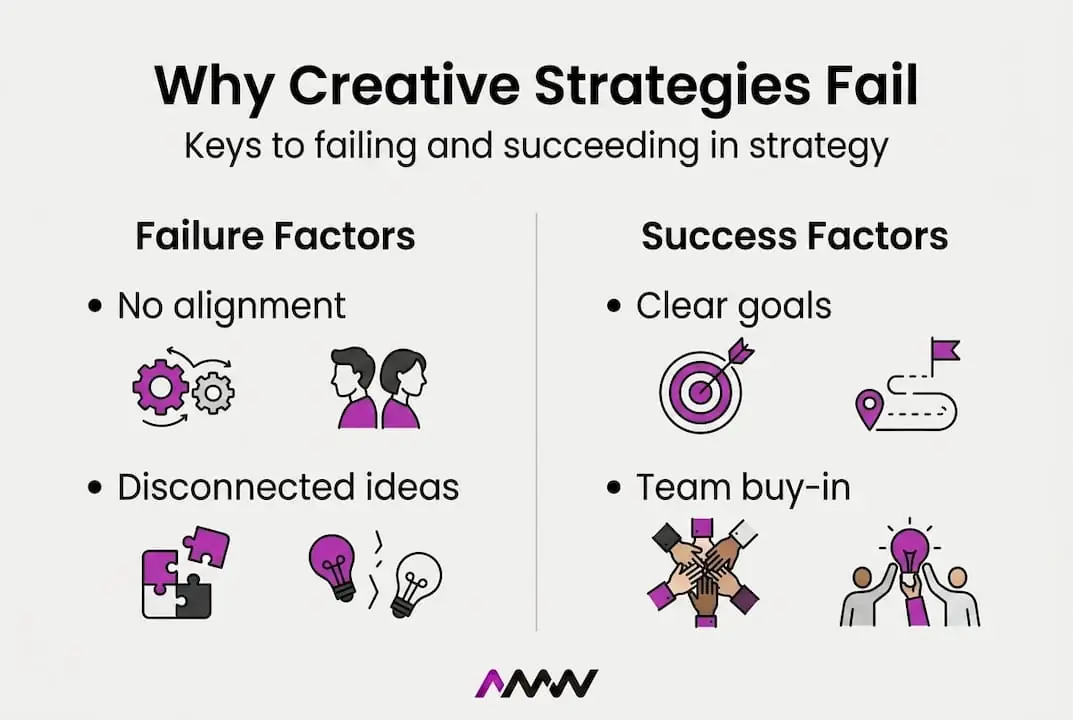
The pattern is consistent. A team generates exciting concepts, leaders respond to the most visually striking option, and the chosen direction is never rigorously tested against the audience insight or the commercial objective. By the time results come in, there is no framework for interpreting what went wrong or how to improve.
Experienced strategists do something different. They treat creative ideas as hypotheses rather than conclusions. Every concept is held up against the question: “What problem does this solve for whom, and how will we know if it worked?” This is not a creativity-killer; it is the discipline that makes creativity sustainable.
Alignment is the other chronic failure point. When marketing, design, and senior management operate from different assumptions about what a campaign is trying to achieve, the creative process becomes a negotiation rather than a collaboration. The overlooked process details that experienced teams return to repeatedly are the ones that keep everyone oriented around the same objective.
The brands that succeed with creative strategy long-term are those that combine rigour with genuine creative ambition. They do not choose between being strategic and being bold. They insist on both, and they build the processes to make that combination repeatable.
Open up creative growth with expert support
Building a creative strategy that differentiates your brand and delivers measurable growth requires more than good intentions. It requires experience, process, and the right creative infrastructure. If you would rather have this done for you, our Reading marketing page starts with what £12.50 a lead actually bought Woodstock Campers over thirteen months.
At AMW Media, we work with marketing managers and business owners to develop creative strategies that translate into real digital growth. From graphic design services that bring brand identity to life, to social media strategies that build engaged audiences, and web design solutions that convert visitors into customers, our team combines strategic thinking with creative production at every level. If your current approach feels reactive rather than strategic, speak to our team about how we can help you build a framework that works.
Frequently asked questions
What is the difference between a creative strategy and a marketing strategy?
A creative strategy focuses on the ideas, messaging, and storytelling used to engage audiences, while a marketing strategy sets overall goals, channels, and targeting. Think of marketing strategy as the map and creative strategy as the vehicle that moves along it.
How do you measure the success of a creative strategy?
Success is measured through KPIs such as engagement rates, brand awareness lift, conversions, and achievement of specific campaign objectives, all of which should be defined before a campaign launches. The creative campaign process provides a useful structure for building measurement into strategy from the outset.
What roles are essential for building a strong creative strategy team?
Every team needs a strategist, creative lead, copywriter, designer, and someone with analytics skills, as creative agencies consistently demonstrate in high-performing campaigns. Each role brings a distinct perspective that strengthens the overall strategy.
Can small marketing teams create effective creative strategies?
Yes. Small teams succeed by focusing on strong collaboration, clear goals, and using digital tools for efficient execution, as detailed in the content production steps guide. Clarity of purpose often compensates for limited resources.
Recommended
- Digital presence strategy guide for brand growth in 2026 | AMW Media
- How to optimise digital strategy for marketing success
- Essential digital marketing guide: strategies for brand growth
- Key benefits of digital marketing for brand growth | AMW Media
Our free marketing audit looks at your site, your ads and your content, and comes back with a 30 day plan. No pitch deck.

Owns how everything looks and feels, from a brand identity to the grade on a reel, and makes the animated films such as Blue Light Services' Journey to Net Zero. Meet the team.