
 Black Steel Doors
 Woodstock Campers
 Phillips Joinery
The fastest route to better engagement is a simple loop: know your audience, pick the right format, then show up consistently. That’s it. Everything else is just execution.
Before you read another word, try these three things in the next 30 minutes. Film a 15-second “behind the scenes” clip on your phone and post it as a Reel or TikTok. Write a caption that ends with a genuine question your followers can answer in one word. Then go and leave five thoughtful comments on posts from accounts in your niche. Those three actions alone will drive more profile visits and comments than a week of perfectly polished graphics sitting in your drafts.
Key takeaways
Creating engaging social media content comes down to three things done consistently: knowing your audience, choosing the right format for the goal, and showing up regularly enough to build momentum.
| Point | Details |
|---|---|
| Audience-first always | Build a mini-persona before planning content; every post should answer a specific need. |
| Format matches the goal | Use carousels for saves, short video for reach, Stories for daily interaction. |
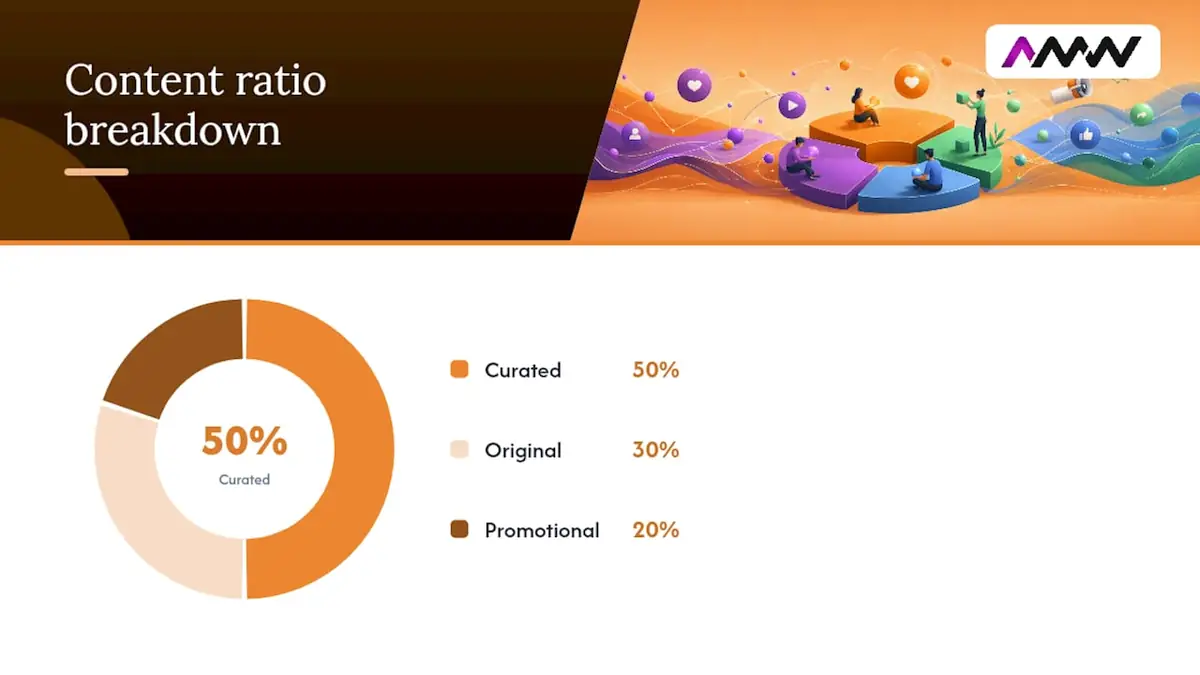
| Content ratios prevent fatigue | The 5-3-2 rule (50% curated, 30% original, 20% promotional) keeps feeds valuable. |
| Engagement rate is your north star | A 1 to 3% engagement rate is typical; saves and shares signal the strongest content. |
| AMW Media for hands-off delivery | AMW Media manages social media content production and strategy for UK brands end-to-end. |
How to start creating engaging social media content
The four-stage workflow that simplifies production for small teams is: understand, brainstorm, create, schedule. Most small brands skip straight to “create” and wonder why nothing lands. Spend even 20 minutes on the first two stages and every post becomes sharper.
Short-form video continues to outperform static posts for discovery and reach, so if you’re only going to change one thing today, make it this: add one short video per week. Not polished. Not scripted. Just real and relevant.

Who are you talking to, and what does success look like?
Every post that flops usually has the same problem: it was written for everyone, which means it resonated with no one. Build a quick mini-persona before you plan a single piece of content.
Mini-persona template:
- Demographics: Age range, location, job role or life stage
- Behaviour: Which platforms they use, when they scroll, what they save
- Needs: The question they’re trying to answer or the problem they want solved
- Preferred formats: Short video, carousels, long captions, or quick polls
Once you know who you’re writing for, map your metrics to actual goals. Profile visits usually signal new leads are warming up. Saves tell you the content resonated. Shares extend your reach to cold audiences. Comments indicate community trust.
Pick one primary goal per campaign (e.g. grow email sign-ups) and one secondary (e.g. increase saves). Trying to hit five metrics at once means you’ll optimise for none of them. For a deeper look at aligning content with business results, it’s worth thinking through your goals before you touch a design tool.
Which formats work, and when should you use them?
Mixing photos, text overlays and video increases visual appeal and lets you match the format to the message rather than defaulting to whatever’s easiest. Here’s a quick reference:
| Format | Best for | Production effort | Quick post concept |
|---|---|---|---|
| Single image | Brand awareness, quotes | Low | “One tip that changed how we work: [tip]” |
| Carousel | Saves, education | Medium | “5 mistakes to avoid when [topic], swipe to see all” |
| Short video (Reels/TikTok) | Discovery, reach | Low, Medium | “We tried [thing] for a week. Here’s what happened.” |
| Stories | Polls, quick updates | Very low | “Which would you choose? A or B?” |
| Long-form video (YouTube) | Trust, depth | High | “Full walkthrough: how we [achieved result]” |
| GIF/animation | Personality, shares | Low | Branded reaction to a trending moment |
Video, interactive posts, GIFs and polls are among the most effective formats for small brands looking to diversify their feeds without a big production budget.
Pro Tip: Film one piece of content and repurpose it across three formats: the full clip goes to YouTube, a 30-second cut becomes a Reel, and a still frame with a text overlay becomes an Instagram post. One shoot, three assets.
How storytelling and brand voice keep people following
People don’t follow brands. They follow personalities, opinions, and stories they recognise themselves in. That’s the whole game.
Three caption formulas worth keeping on your desk:
- Hook → Value → CTA: “Most people get this wrong. [Insight]. Save this for next time.”
- Problem → Solution → Proof: “Struggling with [pain point]? Try [approach]. It worked for [result].”
- Relatable moment → Lesson → Invite: “We posted every day for a month and got zero traction. Then we stopped and did this instead. What’s your experience?”
Two micro-story templates that consistently drive comments:
- The honest mistake: Share something that went wrong, what you learned, and what you’d do differently. Vulnerability earns trust faster than polished success stories.
- The before/after: Show a real transformation (a product, a process, a mindset shift) with enough specifics that the reader can picture themselves in it.
Storytelling and caption formulas are reliable techniques for building connection and improving shareability, because they give the reader something to respond to rather than just consume.
Your brand voice should carry through your visual choices too. If your tone is warm and direct, your colour palette and font choices should feel the same. And when someone comments, reply in that same voice rather than switching to corporate-speak.
Pro Tip: For video, you have roughly two seconds before someone scrolls past. Open with a visual that creates immediate curiosity: a surprising result, an unexpected object, or a direct question on screen. Don’t save the hook for the end.
Content pillars, batching and a simple weekly calendar
A content pillar is a theme your brand posts about consistently. Three to five pillars tied to your audience’s real pain points means you never stare at a blank screen wondering what to post.
Example pillars for a UK small business:
- Education, tips, how-tos, myth-busting
- Behind the scenes, process, team, culture
- Social proof, results, testimonials, case snippets
- Community, curated content, questions, polls
- Promotion, offers, products, services (used sparingly)
Content ratios explained:
The 5-3-2 rule prescribes 50% curated, 30% original and 20% promotional content across each 10-post batch. The real value of frameworks like 5-3-2 isn’t the numbers themselves, it’s the behaviour shift they force. Most small brands over-promote. These ratios push you toward socialising with your audience rather than broadcasting at them.
The 5-3-1 rule is a daily engagement habit: engage with five posts, comment on three, follow one relevant account. More on that in the engagement section below.
Weekly content calendar template:
| Day | Pillar | Format | Platform |
|---|---|---|---|
| Monday | Education | Carousel | Instagram / LinkedIn |
| Wednesday | Behind the scenes | Short video | TikTok / Reels |
| Thursday | Community | Poll or question | Instagram Stories / X |
| Friday | Social proof | Single image + caption | Facebook / LinkedIn |
| Saturday | Promotion | Short video or image | Instagram / Facebook |
Batch your content on one day per week. Write all captions, design all graphics, and schedule everything in one sitting. It takes roughly 2 to 3 hours but removes the daily decision fatigue that kills consistency. For production and batching workflows that suit small teams, planning in blocks is the single biggest time-saver.
Practical design and caption tips that increase saves and shares
Users read very little on-screen, so scannability isn’t a nice extra, it’s the difference between a post that gets saved and one that gets scrolled past.
Visual checklist:
- Thumbnail or first frame grabs attention without needing sound
- Text overlays use no more than 6 to 8 words and a font size readable on a 5-inch screen
- Brand colours appear consistently (pick two or three and stick to them)
- Composition is mobile-first: key elements sit in the centre third, not the edges
- Contrast between text and background passes a basic readability check
Caption formatting rules:
- Open with a hook in the first line (it’s all most people see before “more”)
- Use line breaks every 1 to 2 sentences to create white space
- Place your CTA at the end, not buried in the middle
- Emoji use: one or two to add personality, not ten to fill space
- Keep captions under 150 words for awareness posts; longer is fine for education or storytelling
Pro Tip: Add alt text to every image and caption to every video. It improves accessibility for visually impaired followers and gives platforms additional context to index your content, a small effort with a genuine reach benefit.
For more examples of engaging social posts that apply these principles in practice, it’s worth seeing how real brands execute them.
Tactics that actually get people to interact
Engagement doesn’t happen by accident. You have to design for it.
High-impact engagement actions:
- Ask a question with a clear, easy answer (“Coffee or tea while you work?”)
- Run a poll in Stories, binary choices get the highest response rates
- Ask followers to tag someone who needs to see this (works well for relatable content)
- Request UGC: “Share a photo using [your product] and tag us for a feature”
- Run a micro-contest: comment to enter, no purchase required (UK law requires clear rules and no purchase necessary for a prize draw)
- Reply to every comment within the first hour of posting, the algorithm notices
Sample CTA phrases to test:
- “Drop a 🙋 in the comments if this sounds familiar”
- “Save this for later, you’ll want it”
- “What would you add? Tell us below”
- “Share this with someone who needs to hear it”
The 5-3-1 rule on Instagram, engaging with five posts, commenting on three, and following one account daily, can increase profile visits and attract higher-quality followers within 7 to 14 days when applied consistently. Micro-interactions like these send community signals that algorithms reward more than additional posts alone.
Test two CTA styles over two weeks and compare comment rates. Whichever drives more replies becomes your default for that audience. For more social media marketing tips on building genuine interaction, the principle is always the same: make it easy and low-effort for someone to respond.
Platform-specific dos and don’ts
One idea, three platforms, three different executions:
Idea: “Three things we wish we’d known before starting our business”
- Instagram Reels: Film a 30-second talking-head clip with text overlays on each point. Use trending audio. Hashtags: 5 to 8 niche-specific tags.
- LinkedIn: Write it as a carousel with one point per slide. Professional tone, no trending audio. Hashtags: 3 to 5 industry terms.
- TikTok: Same clip but looser, more conversational, with a direct question at the end. Lean into the platform’s native text and sound tools.
Platform quick-reference:
- Instagram: Reels for reach, carousels for saves, Stories for daily connection. Post 3 to 5x per week. Best times: Tuesday, Friday, 9AM, 11AM.
- Facebook: Longer captions work here. Video and event posts outperform images. Groups drive more engagement than pages for small brands.
- X (Twitter): Short, opinionated text posts. Threads for depth. Engage in replies more than you post. Hashtags: 1 to 2 maximum.
- LinkedIn: Thought leadership and results-focused content. Personal posts from founders outperform brand-page posts. Post 2 to 3x per week.
- TikTok: Authenticity over production quality. Post daily if possible. Use native text, sounds and trending formats. Hashtags: 3 to 5.
- YouTube: Invest in thumbnails and titles, they drive clicks more than content quality alone. Shorts for discovery, long-form for trust.
For UK-focused social media insights on which platforms are growing fastest for small brands, the picture shifts regularly, so check platform analytics quarterly.
Which metrics should you track, and what do they mean?
Engagement rate is the metric that matters most for organic content. It tells you whether the people who saw your post cared enough to do something.
KPI mapping:
- Engagement rate (likes + comments + shares ÷ reach): measures content resonance
- Saves: the strongest signal that content has lasting value
- Shares: indicates content is worth passing on, great for awareness goals
- Click-through rate (CTR): measures how well your CTA converts interest to action
- Follower growth rate: a slow, steady climb beats sudden spikes that drop off
Engagement rate and saves are the two metrics most predictive of long-term audience growth for small accounts, track them weekly, not daily.
Simple A/B test template:
- Variable: One element only (caption hook, image style, or CTA phrasing)
- Hypothesis: “Changing [X] will increase [metric] because [reason]”
- Run time: 1 to 2 weeks, same posting time and day
- Decision rule: If the test version outperforms by more than 15%, adopt it
After two weeks, look at which posts earned the most saves and shares. Those formats and topics become your next batch. Targeted content that lifts conversions follows the same logic: find what resonates, then do more of it deliberately.
Realistic time and cost budgets for DIY versus agency
Honest numbers matter here. Most guides underestimate how long good content actually takes.
| Approach | Hours per week | Typical monthly cost (UK) | Best for |
|---|---|---|---|
| Solo DIY | 5 to 8 hours | £50 (tools only) | Bootstrapped founders, personal brands |
| Part-time in-house | 10 to 15 hours | £1,500 (salary pro-rata) | Small teams with one marketing person |
| Dedicated in-house | 30 hours | £3,500 (salary) | Brands with consistent content volume |
| Agency-managed | 1 to 2 hours (briefing) | £3,000+ per month | Brands wanting consistent output without the overhead |
One-off photography or video shoots in the UK typically run £300 to £1,500 depending on scope. Small paid social campaigns (boosting posts or running targeted ads) start from around £200 to £500 per month for meaningful reach.
Agency-briefing checklist, prepare these before you make contact:
- Your primary goal (awareness, leads, sales) and a rough timeline
- Two or three examples of content you admire (even from other industries)
- Your approximate monthly budget
- Any brand guidelines, existing assets, or tone-of-voice notes
- The platforms you want to prioritise and your current follower counts
A one-page checklist and sample captions to use today
From idea to publish, your checklist:
- Identify the pillar and goal for this post
- Choose the format based on the goal (see format table above)
- Write the caption: hook first, value second, CTA last
- Design or film the visual with mobile composition in mind
- Add alt text (images) or captions (video)
- Choose 3 to 8 relevant hashtags (platform-dependent)
- Schedule for your audience’s peak time
- Reply to every comment within the first hour
Three sample captions:
Engagement goal: “We asked 10 small business owners what they’d do differently in year one. The answers were surprisingly similar. What would yours be? Drop it below. 👇”
Save goal: “5 free tools we use every week to plan and schedule content, save this so you don’t have to Google it again. [List tools]. Which one are you trying first?”
Conversion goal: “If your social media feels like shouting into a void, it’s usually one of three things. We fix all three for UK brands. Link in bio to see how.”
Two-week calendar template:
| Week | Mon | Wed | Thu | Fri | Sat |
|---|---|---|---|---|---|
| Week 1 | Education carousel | Behind-the-scenes video | Stories poll | Social proof post | Soft promo |
| Week 2 | Myth-busting post | UGC feature or reshare | Q&A in Stories | Results/case snippet | Product/service post |
For innovative content ideas to fill those slots when inspiration runs dry, a swipe file of formats you’ve seen work elsewhere is worth building from day one.
What AMW Media sees working for UK small brands
The brands that make the most progress aren’t the ones with the biggest budgets or the slickest cameras. They’re the ones that post consistently, reply to every comment, and treat their social channels like a conversation rather than a billboard.
What typically fails is over-polishing. A small brand spending three days perfecting a graphic will get outperformed by a founder who films a 45-second honest video on their lunch break. Audiences on every platform have become remarkably good at detecting effort-for-effort’s-sake content. Raw and real consistently outperforms glossy and generic.
The other common failure is inconsistency. Posting five times in one week, then going quiet for three, resets your algorithmic momentum every time. A modest schedule you can actually maintain beats an ambitious one you’ll abandon by week two.
One tactic that works reliably for UK small brands: share a genuine opinion about something in your industry. Not a hot take for its own sake, but a considered view that your audience hasn’t heard a hundred times. That kind of content gets saved, shared, and remembered.
Want consistent content without the time drain?
Most small business owners know what good social content looks like. The problem is finding the hours to produce it every week while running everything else.
AMW Media handles social media management and content production for UK brands that want consistent, quality output without building an in-house team. From strategy and content planning to filming, design, scheduling and community management, the work gets done while you focus on the business. No long lock-in contracts, no vague deliverables. Just a clear brief, a consistent output, and results you can measure. Our Oxford page starts with a number, 157 leads at £4.59 each for Cotswold Gloss, because that is the only part of an agency page you can check.
If you’re ready to hand it over, see how AMW Media’s social media management works and get in touch for a conversation about what your brand needs.
Sources
Authoritative resources:
- Create engaging & effective social media content
- 10 Ways to Create More Engaging Content
- The 5 3 2 Rule for Social Media: Content Mix That Works
- 7 Engaging Social Media Content Ideas to Enhance Your …
- The 4 Stages of Creating Engaging Social Media Content
Tools to speed production:
FAQ
What is the 5-3-2 rule for social media?
The 5-3-2 rule means that for every 10 posts, five should be curated content from others, three should be original content you’ve created, and two should be promotional. It prevents follower fatigue by keeping your feed valuable rather than sales-heavy.
What is the 5-3-1 rule on Instagram?
The 5-3-1 rule is a daily engagement habit: like five posts in your niche, leave genuine comments on three, and follow one relevant account. Applied consistently, it can increase profile visits and attract higher-quality followers within 7 to 14 days.
How do you make social media content more engaging?
Start with a strong hook in the first line or first two seconds of video, ask a question your audience can answer easily, and reply to every comment promptly. Formats like polls, carousels and short video consistently outperform static images for interaction.
What is the 5-5-5 rule on social media?
The 5-5-5 rule is an informal engagement habit: like five posts, comment on five, and follow five accounts in your niche each day. Definitions vary across platforms, but the principle is the same as the 5-3-1 rule, consistent micro-interactions build community signals that algorithms reward.
Recommended
- Examples of engaging social posts that actually work | AMW Media
- Innovative social media content ideas to boost engagement
- How to create brand content that drives real results | AMW Media
- Your essential social media strategy checklist for growth | AMW Media
Our free marketing audit looks at your site, your ads and your content, and comes back with a 30 day plan. No pitch deck.

On site with the cameras most days of the week. Installs, interviews, products and events, from London to Liverpool. Meet the team.