
 Black Steel Doors
 Woodstock Campers
 Phillips Joinery
TL;DR:
- Online engagement is about meaningful, two-way interactions that foster trust and build relationships across digital channels.
- Focusing on quality signals like comments, shares, and user-generated content is more valuable than vanity metrics such as likes or impressions.
Most marketing managers assume they understand online engagement because they can see the numbers. Follower counts go up, likes pour in, impressions climb. But those figures tell you almost nothing about whether your audience actually cares. What is online engagement, really? It is the quality of the two-way relationship between your brand and its audience across every digital channel you occupy. Getting that distinction right is what separates brands that grow communities from brands that merely accumulate an audience that never buys, never advocates, and never comes back.
Key Takeaways
| Point | Details |
|---|---|
| True engagement defined | Online engagement means meaningful two-way interaction beyond vanity metrics like likes and reaches. |
| Customer journey role | Engagement occurs across the funnel stages, each needing specific interaction types to build relationships. |
| Quality over quantity | Meaningful interactions such as comments and shares build trust and customer intent better than surface-level metrics. |
| Practical tactics | Interactive content, community participation loops, and authentic responses drive sustainable engagement. |
| Measure with intent | Tracking engagement linked to buyer intent and retention offers actionable insights over simple views or likes. |
Understanding what online engagement really means
Online engagement is not a single action. It is a category of behaviour that spans everything from a reader bookmarking your blog post to a customer posting an unboxing video on Instagram. The common thread is interaction, not passive consumption.
Online engagement is measurable two-way interaction through digital channels that builds awareness and relationships, generating leads and sales. That definition matters because it sets a clear standard: if the interaction is one-directional, it is reach, not engagement. A thousand people seeing your post is reach. Twenty of those people sharing it with a comment is engagement. The distinction shapes how you allocate budget, create content, and measure success.
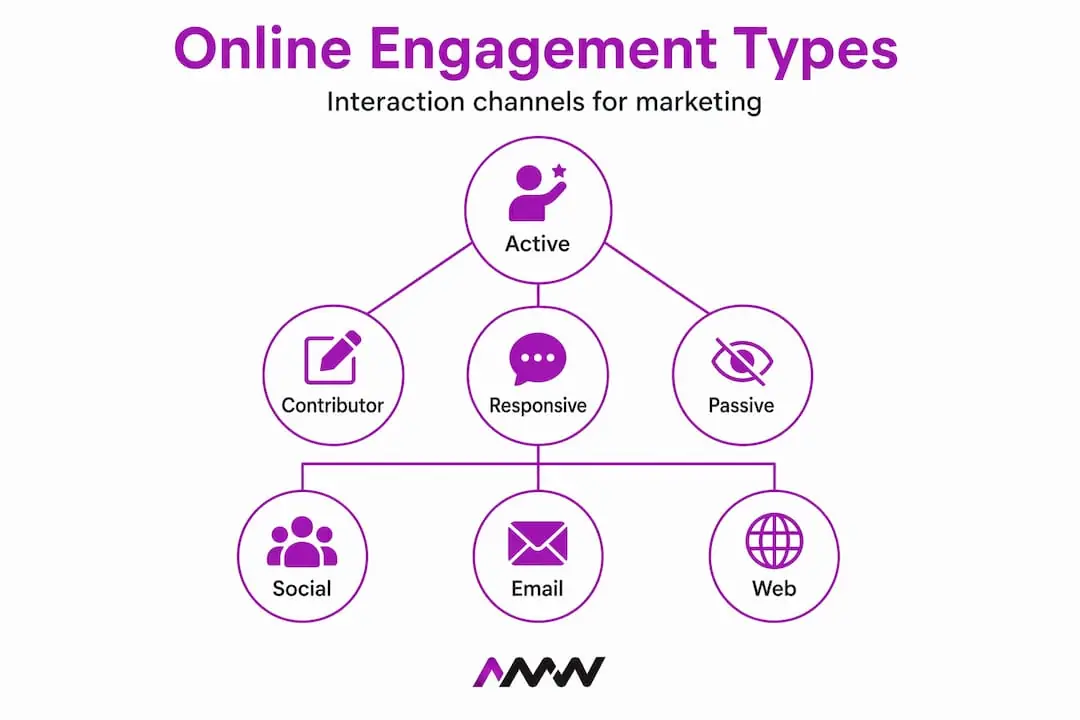
Social media engagement includes likes, comments, shares, clicks, conversations, saves, mentions, and DMs that show audience connection. Notice the breadth of that list. Engagement is not one thing you either have or lack; it is a spectrum of interactions with very different levels of audience intent and commitment behind them.
Understanding what drives genuine connection is also central to understanding brand engagement more broadly. Here is how the key types of online engagement break down:
- Passive engagement: views, impressions, and time spent on page. These indicate reach, not relationship.
- Reactive engagement: likes, emoji reactions, and single-tap responses. Low effort, low signal.
- Active engagement: comments, shares, saves, and direct messages. These require intent and thought.
- Contributory engagement: user-generated content, reviews, referrals, and forum participation. The highest form of audience investment.
“The depth of an interaction determines its commercial value. A brand that generates 500 comments earns more trust than one that earns 50,000 views in silence.”
Defining online engagement clearly from the outset allows your team to build content strategies around the interactions that actually matter, rather than chasing numbers that look impressive in a monthly report but do not move revenue.
How online engagement fits across the customer journey
Engagement does not live in one place. It occurs at every stage of the buyer journey, and the type of engagement that is appropriate shifts significantly depending on where a person is in their relationship with your brand.
Digital customer engagement spans the funnel from discovery through to retention, each stage with distinct interaction types. Here is what that looks like in practice:
- Discovery (top of funnel): A prospect encounters your brand through a social post, a paid ad, or an organic search result. The engagement actions here are shares, saves, clicks, and follows. Your goal is to make a strong enough first impression that they want more.
- Consideration (mid funnel): They read your blog, watch your videos, or sign up for a webinar. Engagement becomes deeper: email opens, blog comments, video watch time, and webinar Q&A participation. This is where trust is built.
- Conversion (bottom of funnel): They book a call, fill in a contact form, or make a purchase. The engagement here is transactional but still relational: live chat interactions, onboarding messages, and post-purchase surveys.
- Retention (post-purchase): They write a review, refer a friend, or engage with loyalty programme content. This is the most valuable engagement of all because it costs you little and earns you a great deal.
| Journey stage | Engagement type | Example action |
|---|---|---|
| Discovery | Reactive and passive | Social share, ad click, follow |
| Consideration | Active | Blog comment, webinar Q&A, email reply |
| Conversion | Transactional | Live chat, form submission, purchase |
| Retention | Contributory | Review, referral, user-generated content |
Thinking about your boosting online presence efforts through this lens changes how you prioritise channels. A brand obsessed with top-of-funnel reach often neglects the retention stage entirely, which is exactly where loyal customers and free word-of-mouth advocacy live.
Audience engagement strategies that account for all four stages tend to outperform those focused solely on acquisition. Pair this with well-crafted email marketing strategies and you have a funnel where no stage is left unattended.
Pro Tip: Map every piece of content you produce to one specific journey stage. If you cannot identify which stage it serves, it probably serves none of them effectively.
Why meaningful engagement matters more than vanity metrics
Here is the uncomfortable reality most agencies will not tell you: your engagement rate can look excellent and your business can still be failing to convert. That happens when the metrics you are tracking are vanity metrics disguised as engagement.

Views, impressions, follower counts, and even raw like counts fall into this category. They are visible, they feel significant, and they are almost entirely disconnected from business outcomes unless paired with more intentional signals. The true value of social media engagement lies in quality interactions like discussions and user-generated content rather than just likes.
What counts as meaningful engagement?
- Comments that contain questions or opinions. These signal genuine interest and often indicate purchase intent.
- Saves. When someone saves your post, they are telling the algorithm and themselves that the content has lasting value.
- Direct messages. A person who slides into your brand’s DMs is one step away from becoming a customer.
- Shares with commentary. Not a passive repost but a share where the person adds their own voice. This is advocacy in action.
- User-generated content. When customers create content featuring your product or service unprompted, that is the highest quality engagement signal available.
Engagement defined by intent and progression aligns better with buyer journey goals than vanity metrics alone. This is why the importance of online engagement is less about volume and more about signal quality. Ten comments from people asking about your product are worth more than a thousand passive likes from people who scrolled past in two seconds.
“A post with 12 comments full of product questions is doing more commercial work than a post with 1,200 likes and zero conversation.”
Optimising your digital strategy requires building this thinking into how you brief content creators, set KPIs, and evaluate campaigns. The role of digital content in brand growth becomes much clearer when you measure content not by how many people saw it, but by how many people responded to it.
Pro Tip: In your next monthly report, add a column for “quality engagements” alongside your standard metrics. Define quality engagements as comments, DMs, saves, and shares with commentary. Track it for three months and compare it to your conversion data. The correlation will likely surprise you.
Practical tactics to boost online engagement effectively
Understanding what engagement is matters, but knowing how to generate it is what separates brands that theorise from brands that grow. Here are the tactics that consistently produce results across channels.
Build interactive content into every campaign. Polls, quizzes, and open-ended questions prompt responses in a way that static images simply cannot. A fashion brand asking “Which colourway would you wear?” gets comments. A post that just shows the new colourway gets likes. The difference is intent.
Engagement spikes with structured participation loops like prompts, events, Q&A sessions, and interactive elements that turn lurkers into contributors. Structure matters here. A vague call to action like “let us know what you think” performs far worse than a specific prompt like “comment with your biggest challenge when scaling paid ads.”
Practical tactics to implement now:
- Host monthly live Q&A sessions on Instagram or LinkedIn. Announce them in advance and compile questions from comments beforehand to guarantee interaction.
- Use carousel posts to create “swipe to reveal” moments that reward active engagement with useful payoffs.
- Run community challenges that invite user-generated content, such as asking customers to share how they use your product.
- Reply to every comment within 24 hours, particularly in the first hour after posting, when platform algorithms are watching engagement velocity most closely.
- Use social media content ideas that match your audience’s interests rather than your brand’s talking points.
Measure what you prompt. Once you implement these tactics, track which participation loops generate the most downstream conversions. User engagement metrics help understand user behaviour to improve product value and retention, connecting engagement to real business outcomes.
| Tactic | Engagement type generated | Difficulty to implement |
|---|---|---|
| Live Q&A sessions | Active, contributory | Medium |
| Carousel “swipe to reveal” | Reactive, active | Low |
| Community challenges | Contributory | Medium |
| Prompt-driven comments | Active | Low |
| User-generated content campaigns | Contributory | High |
Successful social media campaigns consistently combine several of these tactics rather than relying on a single approach. And pairing high-engagement social activity with customer retention strategies creates a feedback loop where engaged audiences become loyal customers who then generate further engagement.
Pro Tip: Do not launch community challenges without a clear mechanism for spotlighting participants. If people contribute and see nothing happen with their contribution, they will not contribute again.
Measuring and interpreting online engagement for marketing success
Knowing which engagement metrics to track is as important as generating the engagement itself. Without the right framework, you will spend time optimising for numbers that do not connect to growth.
User engagement metrics reveal how users interact with products, and when combined with retention analytics, inform improvements to user experience and marketing effectiveness. The key is pairing activity metrics with outcome metrics so that you are never looking at behaviour in isolation.
Here are the online engagement metrics that marketing managers should be tracking:
| Metric | What it tells you | Business outcome linked |
|---|---|---|
| Engagement rate | Percentage of audience that interacts | Content relevance, audience fit |
| Comment quality score | Depth and intent of comments | Purchase intent, trust |
| Share rate | Willingness to amplify your content | Organic reach, brand advocacy |
| Save rate | Perceived long-term value of content | Content authority |
| DM volume | Direct interest and intent | Lead generation |
| Onboarding completion | Post-conversion engagement | Retention, lifetime value |
| Product adoption rate | Active usage post-purchase | Churn risk, upsell potential |
- Engagement rate is the baseline. Calculate it as total interactions divided by reach, multiplied by 100. Industry benchmarks vary by platform but anything above 3% on Instagram or 1% on LinkedIn is worth noting.
- Session duration and pages per visit on your website reveal content engagement that social metrics miss entirely.
- Email click-to-open rate is one of the most underrated engagement signals. It tells you whether your content earns action once someone is already paying attention.
The mistake most teams make is treating each metric as a separate report. Combining digital strategy data across channels gives you a clearer view of which touchpoints are actually moving people along the journey. Similarly, tracking online presence performance over time reveals whether engagement growth is translating into genuine brand authority.
Pro Tip: Set up a shared dashboard that displays engagement metrics alongside conversion data for each campaign. When a spike in engagement does not correspond with a conversion movement, that is a signal worth investigating before you repeat the tactic.
Why chasing likes is backwards: real engagement builds brands
Here is the perspective that most brand teams need to hear, but rarely do.
The obsession with likes is not just a measurement problem. It is a cultural one. When marketing teams are internally rewarded for posts that “perform well” based on likes and impressions, they start creating content optimised for passive approval rather than active relationship-building. The result is polished, pleasant, perfectly forgettable content.
Most comments show buying intent yet 97% go unanswered, representing lost opportunities to convert and build trust. Let that figure settle for a moment. Nearly every buying signal your audience sends in the comments goes ignored. Not because brands do not care, but because they are too busy producing the next piece of content to respond to the engagement the last one generated.
This is the engagement paradox: the more a brand focuses on content output, the less it invests in engagement response. And the response is where the relationship actually lives.
We have seen this play out repeatedly. A brand invests heavily in production quality, posting frequency, and creative direction. Their content looks exceptional. Their engagement rate is mediocre at best. Then they implement a simple rule: every comment gets a thoughtful reply within four hours. Within weeks, their comment counts double because people notice that this brand listens. The content itself has not changed. The relationship posture has.
The brand engagement guide principle is simple: audiences return to places where they feel seen. They buy from brands they feel a connection with. And that connection is built through consistent, authentic response, not through how many people passively scrolled past your last post.
Sustainable brand growth through online engagement is not about reaching more people. It is about mattering more to the people you already reach.
Enhance your brand’s online engagement with AMW Media
If these strategies have shifted how you think about engagement, the next step is putting them into practice with a team that understands how to make them work for your specific brand and audience. If you are in north west London and would rather hand this to one team, our Harrow marketing page shows how that works.
AMW Media works with ambitious brands to build genuine, measurable engagement across every digital channel. Our social media management services go beyond scheduling posts, we create participation loops, manage community responses, and track the engagement signals that actually matter to your business. Our custom web design services shape experiences that keep visitors active and invested, while our SEO services ensure the right audiences find you in the first place. If you are ready to turn engagement insights into real brand growth, we are ready to help.
Frequently asked questions
What is the difference between online engagement and social media engagement?
Online engagement covers all two-way interactions across digital channels including websites, email, webinars, and messaging platforms, while social media engagement refers specifically to interactions on social platforms such as likes, comments, shares, and DMs.
Why are likes not enough to measure engagement?
Likes require a single tap and reveal almost nothing about a person’s actual interest or intent. Meaningful engagement turns passive followers into active customers, and that shift happens through comments, saves, shares, and DMs, not through likes.
How can businesses stimulate meaningful online engagement?
By building structured participation into their content strategy. Engagement spikes when brands use Q&A sessions and community prompts, and by responding consistently to every comment and message they receive.
What metrics should marketing managers track to understand online engagement?
Focus on metrics tied to intent: comment quality, share rate, DM volume, onboarding completion, and retention rates. User engagement metrics paired with retention data give the clearest picture of what is actually working.
How does online engagement affect the buyer journey?
Every digital interaction either accelerates or slows a prospect’s path to purchase. Online interactions either help or hinder buyers at every stage from discovery through to retention, which is why engagement strategies must serve the entire journey, not just the top of the funnel.
Recommended
- What is brand engagement? A practical guide for marketers | AMW Media
- Social media marketing tips to boost brand engagement
- Essential digital marketing guide: strategies for brand growth
- Email marketing strategies to engage and grow your business | AMW Media
Our free marketing audit looks at your site, your ads and your content, and comes back with a 30 day plan. No pitch deck.

Founded AMW Media in 2024 and runs strategy, paid media and the CRM builds. The reason everything here is in house and measured in revenue. Meet the team.