
 Black Steel Doors
 Woodstock Campers
 Phillips Joinery
Posting consistently on social media and seeing little in return is one of the most frustrating experiences for marketing managers and business owners. The problem is rarely effort. It is almost always strategy. Most brands treat social media as a broadcast channel rather than a campaign engine, which means their content disappears into the feed without purpose or measurable impact. Short-form video outperforms all other formats, with TikTok leading engagement benchmarks at 3.70% compared to Instagram’s 0.48%, yet most brands still rely on static posts and hope for the best. This guide gives you a practical, data-backed blueprint for building social media campaigns that actually shift the numbers.
Key Takeaways
| Point | Details |
|---|---|
| Short-form video wins | TikTok and Instagram Reels are outperforming all other formats for brand engagement in 2026. |
| Strategy multiplies success | Brands with documented campaign strategies see over four times higher success rates. |
| Authenticity drives conversions | User-generated content delivers greater trust and up to 1.4 times more conversions than polished ads. |
| AI with a human touch | Using AI boosts efficiency, but maintaining authenticity is essential to avoid eroding audience trust. |
| Cultural sensitivity is vital | Campaigns that overlook cultural context risk backlash and significant reputation damage. |
Understanding social media campaigns in 2026
To address the problem of posting without purpose, it helps to first clarify what separates a true campaign from day-to-day content. Ongoing posting keeps your brand visible. A campaign, by contrast, is a time-bound, objective-driven effort with defined creative, messaging, and success metrics. The distinction matters because campaigns create momentum, whereas routine posting simply maintains presence.
Marketing strategist Tom Roach makes this point clearly: time-bound campaigns with clear objectives consistently outperform brands that rely on always-on content alone. A campaign has a beginning, a middle, and an end, and every piece of content within it serves a specific purpose.
Platform choice shapes everything. Here is what the 2026 landscape looks like for campaign marketers:
- TikTok leads on raw engagement and is essential for brands targeting under-35 audiences with short-form video
- Instagram remains strong for visual storytelling, Reels, and influencer-led campaigns
- Facebook suits community-building and retargeting, particularly for older demographics
- X (formerly Twitter) works best for real-time conversation and reactive campaign moments
- LinkedIn is the go-to for B2B campaigns focused on thought leadership and lead generation
“The brands winning on social in 2026 are not the ones posting the most. They are the ones with the clearest campaign intent and the sharpest creative.”
Short-form video is now central to campaign strategy across almost every platform. If your campaigns do not include it, you are working against the algorithm. Explore our brand engagement tips and branding for growth resources to see how leading brands are structuring their content mix.
Planning your campaign: goals, audience, and timing
Now that we distinguish campaigns from ongoing posts, it is crucial to start strong by defining your objectives and preparing the groundwork. Vague goals produce vague results. Before a single piece of content is created, you need to know exactly what success looks like.
Effective campaign goals are measurable and outcome-focused. Consider these categories:
- Awareness: reach, impressions, share of voice
- Engagement: likes, comments, shares, saves, video views
- Conversion: click-through rate, leads generated, sales attributed
- Retention: repeat visits, community growth, email sign-ups
Documented strategies are 414% more likely to succeed than undocumented ones. That single statistic should be enough to convince any marketing manager to write their campaign plan down before touching a scheduling tool.
| Planning element | Questions to answer |
|---|---|
| Campaign goal | What specific outcome do we need? |
| Target audience | Who are we speaking to and on which platform? |
| Campaign window | When does it start and end? |
| Budget allocation | How much goes to paid vs. organic? |
| Success metrics | How will we measure performance? |
Audience audits are often skipped, but they are where campaigns are won or lost. Look beyond your existing followers. Identify niche segments, emerging communities, and the platforms where your ideal customer is most active. Seasonality and cultural moments also matter enormously. A campaign launched at the right cultural moment can achieve ten times the organic reach of the same campaign launched in a quiet period.
Pro Tip: Map your campaign calendar to cultural events, industry moments, and seasonal buying patterns at least eight weeks in advance. This gives your creative team enough runway to produce assets without rushing quality.
Use our guide to build a strategy and explore how branding in social campaigns can sharpen your positioning before launch.
Preparing assets and tools: creative, platforms, and technology
With your goals and audience settled, the next step is assembling what you need for a high-performing campaign. This is where many brands underinvest, producing polished but inauthentic content that audiences scroll straight past.

User-generated content (UGC) is one of the most powerful assets available to campaign marketers. It performs because it feels real. Audiences trust other people more than they trust brands, which is why UGC consistently outperforms traditional creative in both engagement and conversion. Pair UGC with professionally produced hero content and you have a creative mix that covers both trust and impact.
Choosing the right platform for your campaign objective is non-negotiable. TikTok and Instagram Reels drive the highest engagement through short-form video, making them the default choice for awareness and product launch campaigns. LinkedIn suits thought leadership and B2B lead generation. Facebook works for community activation and retargeting.
| Platform | Best campaign type | Primary format |
|---|---|---|
| TikTok | Awareness, product launches | Short-form video |
| Visual storytelling, influencer | Reels, Stories, carousels | |
| Retargeting, community | Video, posts, ads | |
| B2B, thought leadership | Articles, video, ads | |
| X | Reactive, real-time | Text, short video |
AI tools have become useful for campaign teams. Use them for ideation, caption drafting, scheduling, and performance reporting. However, AI and multi-platform strategies that maintain a human creative voice see 25 to 35% better performance than fully automated campaigns. The technology should accelerate your team, not replace its judgement.
Pro Tip: Build a content library before launch. Aim for at least two weeks of approved assets ready to go, including backup creative for underperforming ad sets. This prevents the scramble that kills campaign quality mid-flight.
Our resources on video marketing strategies, digital strategy optimisation, and content production workflow cover the production side in detail.
Execution: launching and optimising your campaign
All the preparation sets you up for this crucial stage: getting your campaign live and ensuring it meets its goals. A strong launch checklist prevents the avoidable errors that derail even well-planned campaigns.
- Confirm all tracking pixels, UTM parameters, and conversion events are firing correctly
- Review every piece of content for brand consistency, spelling, and link accuracy
- Obtain all necessary approvals from stakeholders before scheduling
- Set up your reporting dashboard so day-one data is captured immediately
- Brief your community management team on tone, FAQs, and escalation protocols
- Schedule content across platforms and confirm time zones are correct
- Prepare your first-24-hours monitoring rota so someone is watching performance in real time
The first 24 hours after launch are critical. Algorithms reward early engagement signals, so monitor closely and be ready to boost top-performing organic content with paid spend. If an ad set is underperforming after 48 hours, swap in alternative creative rather than waiting for the algorithm to correct itself.
Campaign ROAS benchmarks matter here. Average ROAS of $4.20 to $5.20 per dollar spent is achievable for well-structured campaigns, as demonstrated by brands including Nike, Sephora, and Colgate in recent case studies. These figures are not outliers. They reflect what happens when creative quality, targeting precision, and real-time optimisation work together.
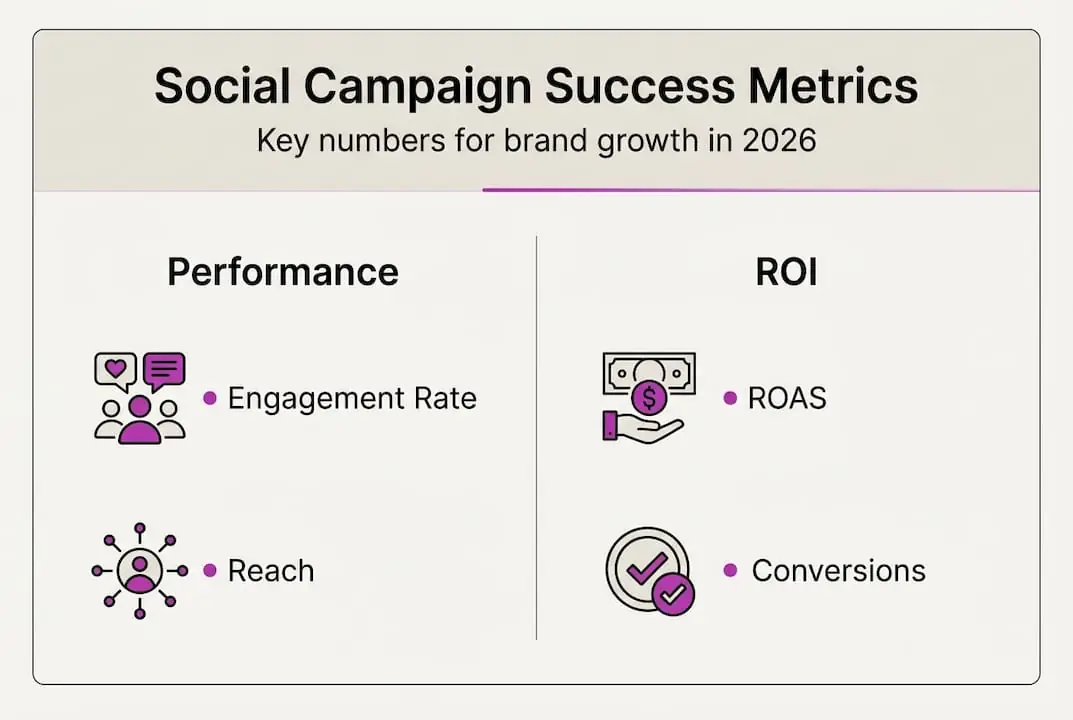
Multi-touch attribution is worth implementing from day one. Most conversions involve multiple touchpoints across organic, paid, and email channels. Single-touch attribution (crediting only the last click) will undervalue your social campaign’s contribution and lead to poor budget decisions.
Explore how content creation investments and boosting campaign engagement translate into measurable business outcomes.
Avoiding common pitfalls and crisis management
Even the best-planned campaigns can stumble. Here is how to avoid major pitfalls and react swiftly if things go wrong.
The top causes of campaign backlash in 2026 include:
- Cultural insensitivity: Campaigns that fail to account for diverse audience perspectives cause rapid, public backlash
- Over-reliance on AI: Fully automated content erodes brand trust and often misses emotional nuance
- Poor crisis preparation: Brands without a response protocol take too long to act when problems emerge
- Misaligned messaging: Campaigns that contradict brand values confuse audiences and damage credibility
- Ignoring negative feedback: Failing to monitor and respond to comments amplifies problems rather than containing them
Cultural pitfalls and insufficient crisis preparation are among the most cited causes of campaign failure, with brands like State Farm and Gucci serving as cautionary examples of how quickly a misstep can escalate. Recent campaign failures such as the Mariah Carey and Sephora situation illustrate how even well-resourced brands can misjudge audience sentiment.
“Speed and sincerity are the two non-negotiables in social media crisis management. A slow, corporate response makes everything worse.”
If a campaign does go wrong, act within the first two hours. Acknowledge the issue publicly, pause the relevant content, and issue a clear, human apology. Avoid defensive language. Audiences are far more forgiving of brands that respond quickly and than those that go quiet or deflect.
Diverse testing panels before launch are one of the most effective preventative measures available. Show your campaign to people outside your immediate team, particularly those from different cultural backgrounds and age groups. What feels clever internally can land very differently with a broader audience.
See our guidance on brand sensitivity in campaigns for a practical framework.
Measuring impact and scaling success
Once your campaign concludes, it is time to learn, measure, and expand on your successes. The metrics you choose to track will determine whether you make useful decisions or simply feel good about vanity numbers.
Focus on metrics that connect directly to business outcomes:
- Engagement rate (ER): Measures how actively your audience interacts with content, not just how many people saw it
- Return on ad spend (ROAS): Directly links campaign spend to revenue generated
- Reach and frequency: Shows how many unique people saw your campaign and how often
- Conversion rate: Tracks the percentage of people who took the desired action
- Cost per acquisition (CPA): Reveals the true cost of each customer or lead generated
| Metric | What it tells you | Why it matters |
|---|---|---|
| Engagement rate | Audience interest and content quality | Predicts organic reach potential |
| ROAS | Revenue per pound spent | Justifies and guides budget decisions |
| Reach | Total unique audience size | Measures campaign scale |
| CPA | Efficiency of conversion | Identifies most cost-effective channels |
Platform-specific benchmarks and documented campaign results increase ROI on future campaigns by giving your team a reliable baseline for comparison. Without benchmarks, you are guessing.
Scaling winning creative is simpler than most brands realise. When a piece of content performs strongly on one platform, adapt it for others rather than starting from scratch. A TikTok that drives high engagement can be reformatted as an Instagram Reel, a YouTube Short, and a paid social ad with minimal additional production cost. This cross-platform approach multiplies the return on your original creative investment.
Building a learning loop is the habit that separates brands that improve campaign over campaign from those that repeat the same mistakes. After every campaign, document what worked, what did not, and what you would change. Feed those insights into your next planning cycle.
Our guide to video content impact covers how to repurpose and scale video assets effectively across channels.
Take your social campaigns further with expert support
If you are ready to move beyond trial and error and build campaigns that consistently deliver measurable growth, having an experienced partner makes a significant difference. At AMW Media, we work with ambitious brands to create, execute, and optimise social media campaigns that are grounded in strategy and driven by creative quality. Our marketing agency Reading page asks the question that follows from all of this: what should small business marketing actually earn?
Our social media management services cover everything from campaign planning and content production to paid social management and performance reporting. Whether you need a full campaign build or a strategic audit of your current approach, we bring the expertise to accelerate your results. Explore our full range of all services and get in touch to discuss a custom campaign strategy matched to your brand’s goals and competitive landscape.
Frequently asked questions
How do you measure ROI for social media campaigns in 2026?
Track engagement rate, reach, and ROAS of $4.20 to $5.20 per dollar spent using platform analytics combined with multi-touch attribution tools to get an accurate picture of campaign performance.
Which platforms deliver the best engagement for social campaigns?
TikTok leads at 3.70% engagement and Instagram follows, with short-form video consistently outperforming static formats across both platforms in 2026.
What is the biggest cause of campaign failure on social media?
Lack of audience understanding and cultural missteps are the leading causes, with 38% of failures linked to insufficient audience research and slow crisis response when problems emerge.
How important is user-generated content in campaigns?
UGC delivers 1.4 times higher conversions than polished branded creative alone, making it one of the highest-value assets a campaign team can incorporate into their content mix.
Recommended
- Harness social media in branding for growth in 2026
- Social media marketing tips to boost brand engagement
- Social Media Management Services | AMW Media | AMW Media
- Master your SEO strategy: guide for effective brand growth
Our free marketing audit looks at your site, your ads and your content, and comes back with a 30 day plan. No pitch deck.

Runs the content calendars and the community side of every social account, and keeps clients posted on what is going out and when. Meet the team.