
 Black Steel Doors
 Woodstock Campers
 Phillips Joinery
TL;DR:
- Effective digital success relies on designing an interconnected system rather than isolated efforts.
- Auditing platforms, setting clear business goals, and choosing strategic channels optimise resource use and drive measurable growth.
- Focusing on content architecture, distribution, and conversion points ensures visibility translates into tangible revenue outcomes.
You post consistently, you run campaigns, you update the website now and then, and yet the traffic stays flat, leads are thin, and the board keeps asking for numbers you can’t quite justify. The problem is rarely effort. It’s architecture. Most brands treat their online presence as a collection of separate activities rather than a system designed to produce measurable business outcomes. This guide gives you a proven, step-by-step method to assess where you stand, choose the right channels, build content with real strategic intent, and convert your visibility into verifiable revenue growth.
Key Takeaways
| Point | Details |
|---|---|
| Start with clear goals | Defining your audience and business objectives is crucial for a measurable online presence. |
| Choose channels wisely | Prioritise foundational channels like website, SEO, and email before expanding efforts. |
| Build topic clusters | Structuring content with pillars and internal linking strengthens authority and reach. |
| Measure beyond vanity metrics | Track real business outcomes like conversions and attributed revenue, not just followers. |
| Consider AI search trends | Adapting for AI-driven discovery keeps your brand visible as search behaviours evolve. |
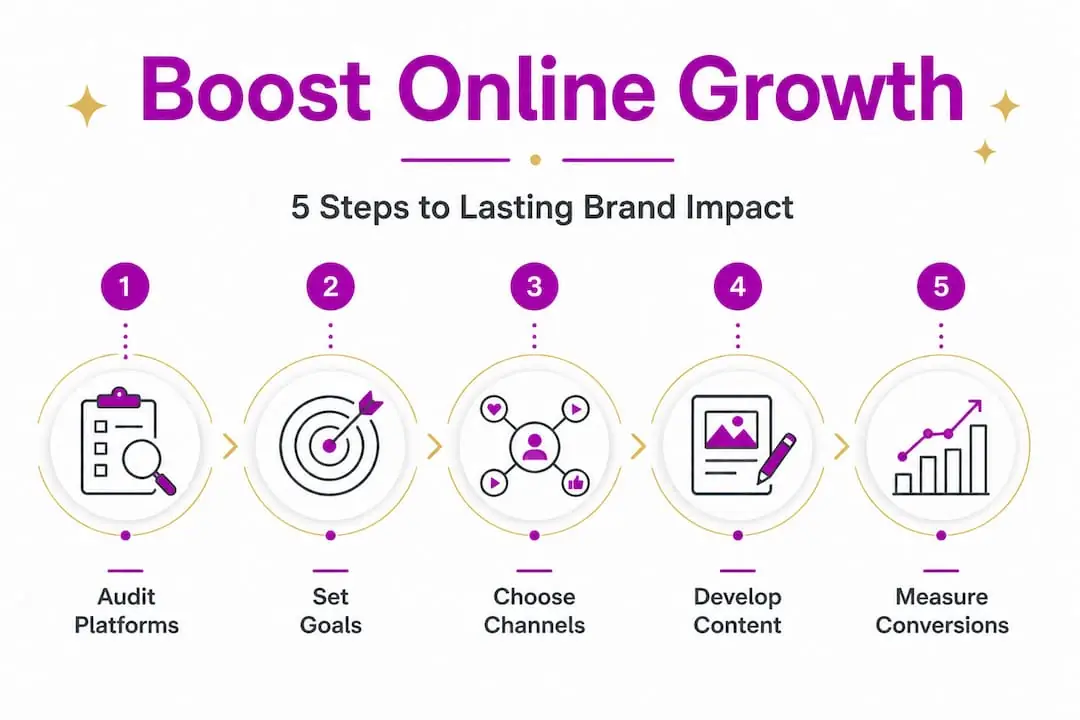
Assess your foundations and set measurable goals
Before launching new initiatives, you need a true read on your current online presence and where it falls short.
Most marketing teams underestimate how fragmented their digital footprint actually is. You might have a website that hasn’t been technically audited in 18 months, three social profiles with inconsistent brand voice, an email list nobody has segmented since launch, and Google Analytics configured to track the wrong events. Sound familiar? The first step is an honest audit of what you’re working with.
Start by listing every platform where your brand has an active or semi-active presence. Website, blog, LinkedIn, Instagram, X, email newsletter, YouTube, Google Business Profile, map them all out and rate each one on two dimensions: audience engagement quality and alignment with your current business goals. You’ll quickly see which platforms are pulling weight and which are phantom presences consuming resource without returning value.
Identifying gaps and strengths requires looking at three layers: technical readiness (page speed, mobile performance, tracking setup), content quality and consistency, and channel reach relative to where your target buyers actually spend time. A gap in any one layer creates friction that kills conversions downstream.
Defining your business goals in quantifiable terms is non-negotiable. Vague ambitions like “grow our social following” or “get more web traffic” produce vague results. Instead, frame goals around metrics that connect directly to pipeline: cost per acquisition (CAC), monthly qualified leads generated, organic search sessions, email-to-demo conversion rate. Treat your online presence as a system: define audience and business goals, map content formats to funnel stages, plan distribution before production, and measure beyond vanity metrics.
| Metric type | Vanity metric | Business metric |
|---|---|---|
| Social | Follower count | Click-through to landing page |
| SEO | Impressions | Organic conversions |
| Open rate | Revenue per recipient | |
| Paid | Clicks | Cost per qualified lead |
| Content | Page views | Time on page + lead attribution |
This table illustrates how simple it is to shift from numbers that feel good to numbers that inform decisions. Once your goals are expressed in business terms, every tactic you choose can be evaluated against them.
Pro Tip: Before touching any channel, verify your tracking setup. Confirm that Google Analytics 4 (GA4) events are firing correctly, that UTM parameters are applied consistently across campaigns, and that your CRM is logging lead sources. Broken tracking means you’re flying blind.
Auditing your team’s readiness matters just as much as auditing your platforms. Who owns each channel? Is there a documented content workflow? Do you have the tools, scheduling, analytics, SEO software, email platform, in place and actually being used? A thorough digital presence strategy review at this stage saves enormous wasted effort later and forms the foundation on which every subsequent tactic is built. If you’re newer to this approach, the essential digital marketing guide offers a solid grounding in how the ecosystem fits together.
Choose the right mix of channels and content formats
Once your goals are clear, the next step is choosing the right blend of platforms to reach and influence your audience most effectively.
The instinct for most ambitious brands is to be everywhere. LinkedIn, Instagram, TikTok, YouTube, podcast, newsletter, blog. The problem is that spreading your resources across eight channels produces eight mediocre presences instead of two or three excellent ones. Channel selection is a strategic commitment, not a defensive hedge.
For many brands, websites, blogs, SEO, and email remain foundational, with social media driving meaningful impact when used with intentional strategy rather than habitual posting. The website is your owned asset: it compounds over time, it isn’t subject to algorithm changes, and it’s where most purchase decisions are ultimately validated. Email gives you direct, unmediated access to an audience you actually own. SEO brings compounding organic traffic. These three form the core.
Social platforms serve a different function. They’re best understood as distribution and discovery channels rather than conversion engines in isolation. LinkedIn excels at building B2B authority and driving referral traffic. Instagram and TikTok work best for brands with strong visual identities or those targeting consumer audiences. The key is choosing platforms where your specific audience is active and where the content formats suit your production capabilities.
Here’s a practical comparison to help you decide:
| Channel | Primary strength | Best content format | Compounds over time? |
|---|---|---|---|
| Website/blog | Authority, SEO, conversion | Long-form, how-to, pillar content | Yes |
| Direct reach, nurture, retention | Newsletters, sequences, offers | Yes | |
| B2B authority, referrals | Insights, case studies, thought leadership | Partially | |
| Brand awareness, visual identity | Reels, carousels, Stories | Limited | |
| YouTube | Discovery, trust-building | Explainers, tutorials, case studies | Yes |
| Paid search | Demand capture | Landing pages, offers | No (paid) |
Content format alignment is equally important. Long-form blog content supports SEO and top-of-funnel awareness. Case studies and comparison pages address mid-funnel consideration. Testimonials, pricing pages, and demo CTAs serve bottom-of-funnel intent. Matching format to funnel stage ensures each piece of content has a clear job to do. For a detailed breakdown of how the different disciplines interact, our guide on digital marketing strategies covers the practical intersections clearly.

The core and spoke model is worth adopting here. Choose one primary channel, your “core,” where you publish your most substantial content. Then create “spoke” content, shorter, platform-native adaptations, that distribute the same ideas across secondary channels and point back to your core asset. This is how brands build presence efficiently without burning out their teams or diluting quality. Understanding the types of digital marketing available to you makes this selection process significantly more systematic.
Consider AI-driven content discovery as part of your channel strategy in 2026. Answer engines like ChatGPT, Perplexity, and Google’s AI Overviews are surfacing content differently from traditional search. Brands that optimise for clear, structured, authoritative content are beginning to show up in AI-generated answers, representing a new category of organic reach.
Develop a content strategy that builds authority and reach
With platforms and formats chosen, it’s time to focus on strategy: what you publish and how it’s organised and distributed for maximum reach.
A common mistake is publishing content in isolation. Individual blog posts that aren’t connected to a wider architecture rarely build cumulative authority. Instead, the most effective approach is to organise your content into topic clusters, where a central pillar page addresses a broad subject in depth, and multiple supporting pages explore specific subtopics in detail, each linking back to the pillar. This structure helps search engines understand topical authority, which directly improves rankings across all related pages, not just individual posts.
Internal linking is the connective tissue of this system. Every supporting page should link to the pillar, and the pillar should reference supporting content. This distributes page authority, reduces bounce rates by guiding readers deeper into your site, and creates logical pathways that match how buyers actually research decisions. It sounds simple. Most brands still don’t do it consistently.
Here’s a step-by-step framework for building and distributing content with genuine strategic intent:
- Define three to five core topics that directly relate to your audience’s most pressing challenges and your business’s areas of expertise.
- Create a pillar page for each topic that is comprehensive, well-structured, and written for a specific buyer persona.
- Plan six to ten supporting articles per pillar that each address a specific question, subtopic, or stage of the buyer journey.
- Build internal links between supporting pages and their pillar before publishing.
- Plan distribution before you write, not after. Identify which formats, platforms, and audiences will receive each piece.
- Repurpose systematically: each long-form piece generates social posts, email content, short video scripts, and FAQ answers.
- Review performance monthly and update underperforming pieces with new data, expanded sections, or improved internal links.
“Social presence gains compound when you treat it as a distribution engine: repurpose insights into platform-native formats instead of approaching it as a posting chore.”
This distribution mindset is one of the most impactful shifts an in-house marketing team can make. Rather than asking “what should we post today?”, you ask “how do we extract maximum reach from the content we’ve already invested in?” A 2,000-word pillar article contains material for at least 10 social posts, two email newsletters, one short-form video, and a handful of FAQ answers that can be optimised for AI search.
Pro Tip: When repurposing for LinkedIn specifically, the highest-performing posts tend to lead with a counterintuitive insight or a specific result, followed by the method, and then a link to the full piece. Native formats always outperform bare links in algorithmic reach.
Common distribution mistakes to avoid include publishing and forgetting, only sharing new content rather than resharing evergreen pieces, and failing to adapt the tone and format for each platform. A paragraph that works in a long-form blog post will not work as an Instagram caption. Platform-native adaptation is essential.
For brands building this architecture, a solid SEO strategy guide will help you understand how topic clusters interact with technical SEO and keyword strategy. Understanding how SEO fits within marketing as a whole also ensures you’re not treating search in isolation from your broader content and distribution efforts.
Optimise conversion points and measure real business impact
Strong distribution is only effective if those touchpoints ultimately convert, so the final step is maximising and measuring tangible impact.
Visibility without conversion is just branding. And branding without measurement is just hope. The goal of every click, every social visit, every email open is to move a prospective buyer closer to a decision. That means every landing page, every CTA, every form must be actively optimised rather than set up once and left.
A high-converting landing page has five non-negotiable elements: a headline that matches the intent of the traffic source, a clear and singular value proposition, social proof in the form of testimonials or case studies, a frictionless CTA that is specific rather than generic (“Book a 20-minute strategy call” outperforms “Contact us” every time), and trust signals such as client logos, certifications, or security badges.
Benchmarking by industry and channel is critical. Generic cross-sector conversion rate averages are almost meaningless for practical decision-making. A B2B software brand converting at 2.5% from organic search is performing well; a retail brand at the same rate from paid social may be underperforming. Optimise landing pages and CTAs and benchmark performance by industry, channel, device, and funnel stage. In 2026, also begin tracking conversions from AI search referral sources separately, as intent and behaviour differ meaningfully from traditional organic traffic.
Here’s a structured approach to conversion analysis:
- Segment traffic by channel: organic search, paid, email, social, direct, and referral all convert differently.
- Measure micro-conversions (time on page, scroll depth, form starts) alongside macro-conversions (form completions, purchases, bookings).
- A/B test CTAs and headlines on your highest-traffic landing pages before optimising lower-traffic pages.
- Review by device: mobile and desktop conversion rates frequently diverge, requiring separate optimisation strategies.
- Attribute revenue to marketing channels using multi-touch attribution rather than last-click only, which systematically undervalues awareness-stage touchpoints.
| Channel | Typical conversion strength | Key optimisation lever |
|---|---|---|
| Organic SEO | Mid to high intent | Content match to query + CTA clarity |
| Paid search | High intent | Landing page specificity + ad message match |
| High (warm audience) | Personalisation + clear single action | |
| Social referral | Lower intent | Trust-building content + low-friction CTA |
| AI search (2026) | Variable, emerging | Structured content + authority signals |
Online visibility is increasingly shaped by non-traditional discovery paths including AI search and answer engines. This means your measurement framework must evolve. Start tagging and monitoring referral traffic from AI sources in your analytics now, before it becomes the dominant discovery channel in your sector.
Pipeline validation is the final step. Track marketing-attributed revenue monthly. Validate that the leads generated by each channel are progressing through your sales process at a worthwhile rate. If organic content drives high volume but low-quality leads, the content strategy needs refinement. If paid drives expensive but high-quality leads, the CAC may still justify the spend. For guidance on how to optimise your digital strategy based on this kind of performance data, we’ve covered the methodology in detail.
Why the typical ‘more content, more channels’ approach fails
We’ve seen this pattern with brands of all sizes. A marketing team decides to “get serious” about digital growth. They hire a content writer, set up a content calendar, start posting on five platforms, and commit to two blog posts per week. Three months later, the numbers are marginally better or entirely unchanged. The team is exhausted. Leadership is frustrated. Sound familiar?
The failure point is almost always the same. Content production is mistaken for content strategy. Publishing is mistaken for distribution. Impressions are mistaken for impact.
If you only publish content but don’t operationalise distribution and measurement, you end up with visibility without business impact. A post that earns 800 impressions but generates zero tracked actions has no measurable value in your pipeline, regardless of how well it was written. The solution is building a workflow where each piece of content has a defined purpose in the funnel, a planned distribution path across owned and social channels, and a measurement point that connects it to a business outcome.
Spreading thin across too many channels compounds the problem. When resource is divided eight ways, no single channel receives the depth of attention needed to build compounding authority. Algorithms reward consistency and engagement quality. Audiences reward specificity and value. A brand that publishes exceptional content on two channels consistently will outperform one that posts average content everywhere.
The shift that matters most is moving from vanity metrics to funnel metrics. Follower count and impressions feel good in a weekly report. Conversion rate, CAC, and marketing-attributed revenue tell you whether the business is actually growing. The benefits of digital marketing only materialise fully when the work is connected to a system of measurement and iteration, not when it’s treated as a broadcast activity.
In our experience working with ambitious brands, the ones that grow fastest are not the ones publishing the most. They’re the ones with the clearest feedback loops. They know which content type produces qualified leads. They know which channel drives the lowest CAC. They know which landing pages convert and which bleed spend. That intelligence comes from measurement discipline, not production volume. Intentional and measured beats busy, every time.
Need help strengthening your online presence?
Building a systematic, measurable online presence takes clear strategy, the right technical foundations, and consistent execution across multiple disciplines. Many ambitious brands have the vision but find the day-to-day execution stretched across a small team with competing priorities. Our High Wycombe marketing page lists the Buckinghamshire businesses we work with and the number behind each one.
At AMW Media, we specialise in turning fragmented digital efforts into integrated growth systems. Whether you need social media management that builds genuine audience relationships, web design and development that converts visitors into qualified leads, or SEO solutions built on the topic-cluster model described in this guide, our team brings both strategic thinking and production expertise to every engagement. If you’re ready to move from inconsistent activity to a measurable, scalable online presence, get in touch and let’s map out what that looks like for your brand.
Frequently asked questions
What is the most effective first step to boost online presence quickly?
Defining your ideal audience and business goals is the foundation; without clarity on goals, platform and content choices will likely miss the mark entirely. Without this step, even high-quality content ends up speaking to the wrong people through the wrong channels.
How do I prioritise between website, social media, and email?
Start with the channel where your audience is most engaged, but most brands should make website, SEO, and email essential foundations before expanding into social. For most brands, website and email are foundational because they’re owned assets that compound over time.
What metric best proves my online presence is driving revenue?
The key is attributing converted leads and revenue to specific channels using multi-touch attribution, focusing on conversion rate and marketing-attributed revenue. Sales-ready measurement examples include conversion rate, customer acquisition cost, and marketing-attributed revenue linked through multi-touch attribution models.
Will AI search affect my brand’s visibility in 2026?
Yes, AI search and answer engines are shifting discovery paths meaningfully, so optimising for AI-search is essential for maintaining organic visibility. Online visibility is increasingly shaped by non-traditional discovery paths including answer engines and AI-generated results.
How can I tell if content repurposing is working?
Track reach and conversions by channel; consistent increases in qualified traffic and engagement across platforms confirm your repurposed content is extending impact. Social presence gains compound when repurposed content is adapted to platform-native formats rather than simply copied across channels.
Recommended
- Digital presence strategy guide for brand growth in 2026 | AMW Media
- Harness social media in branding for growth in 2026
- Key benefits of digital marketing for brand growth | AMW Media
- Essential digital marketing guide: strategies for brand growth
- Social networks: What are the benefits for your business?
- The real role of social media platforms for brand growth
Our free marketing audit looks at your site, your ads and your content, and comes back with a 30 day plan. No pitch deck.

Founded AMW Media in 2024 and runs strategy, paid media and the CRM builds. The reason everything here is in house and measured in revenue. Meet the team.