
 Black Steel Doors
 Woodstock Campers
 Phillips Joinery
TL;DR:
- High-quality, targeted content outperforms high-volume publishing in driving long-term results.
- Combining AI tools with human expertise enhances efficiency without sacrificing originality.
- Focus on ROI metrics and building a valuable asset library ensures sustainable content success.
Most marketing managers assume that publishing more content automatically translates to better results. It does not. 83% of experts believe higher-quality, less frequent content is more effective than a relentless publishing schedule. Yet many mid-sized businesses still pour budget into volume, ending up with a cluttered content library that fails to convert. This article cuts through that confusion. We will define what content production involves today, explore why quality consistently outperforms quantity, show you how to build efficient hybrid workflows, and explain how to measure what actually matters for your brand’s digital presence.
Key Takeaways
| Point | Details |
|---|---|
| Quality outperforms volume | Producing high-quality content brings more sustainable brand growth than simply increasing quantity. |
| Hybrid workflows maximise impact | Combining AI efficiency and human review enhances both speed and creative authenticity in content production. |
| Update and benchmark for growth | Regularly refreshing assets and benchmarking against peers drives measurable improvements in digital performance. |
| Measure success with real metrics | Tracking leads, conversions, and ROI gives a clearer picture of content effectiveness than vanity metrics alone. |
Defining content production in a modern marketing context
Content production is not simply writing blog posts or filming videos. It is the full process of creating, organising, and publishing digital assets that serve a specific business purpose. That includes everything from long-form articles and social media posts to product photography, web copy, email sequences, and branded video. Each format serves a different stage of the customer journey, and the most effective brands treat them as interconnected rather than isolated outputs.
The process itself involves several distinct roles working in sequence. Strategy comes first: identifying what your audience needs and which formats will reach them. Creation follows, whether that is a copywriter, videographer, or designer doing the actual work. Then comes review and approval, where brand consistency and accuracy are checked before anything goes live. Understanding these content production steps prevents costly rework and keeps campaigns on schedule.
Modern production has also shifted significantly. Today’s workflows often combine AI tools for structure and humans for voice and expertise. AI can generate outlines, suggest keywords, and draft initial copy at speed. But it cannot replicate your brand’s specific tone, your team’s hard-won industry knowledge, or the nuanced judgement that makes content useful to your audience. That combination is what separates forgettable content from assets that build lasting trust. For a broader view of how this fits into growth, our content marketing guide is a useful starting point, and the role of digital content in brand engagement explains the strategic rationale in detail.
Key formats to consider in a modern content production plan:
- Blog articles and long-form guides for SEO and thought leadership
- Short-form video for social media engagement and product demonstration
- Photography and visual assets for brand consistency across channels
- Email sequences for nurturing leads through the funnel
- Web copy and landing pages for conversion-focused messaging
Pro Tip: Before you commission a single piece of content, map each format directly to a business goal. If you cannot explain how a piece of content moves a prospect closer to buying, it probably should not be created.
Quality versus quantity: Where the real impact lies
The temptation to publish constantly is understandable. More content feels like more opportunity. But the evidence points firmly in the opposite direction. 83% of marketers agree that quality produces more sustainable results than volume. Publishing ten mediocre articles a month does not outperform two useful, well-researched pieces that answer real questions your audience is searching for.
The long-term case for quality becomes even clearer when you consider compounding. Updating and improving existing high-quality content can deliver a 106% boost in site traffic. That is not a one-off spike. It is a compounding return on an asset you have already paid to create. Brands that build a library of strong evergreen content and refresh it regularly consistently outperform those chasing new topics every week.
“Compounding updates to quality content can deliver up to a 106% boost in site traffic, making your existing library one of your most valuable marketing assets.”
Here is a direct comparison of the two approaches:
| Factor | High-volume strategy | Quality-driven strategy |
|---|---|---|
| Short-term output | High | Moderate |
| Long-term traffic growth | Flat or declining | Compounding |
| Lead quality | Often low | Consistently higher |
| Resource efficiency | Poor | Strong |
| Brand authority | Diluted | Reinforced |
For businesses investing in competitive brand growth, the quality argument is not just philosophical. It is financial. High-volume production burns budget on content that rarely ranks, rarely converts, and rarely gets shared. Quality content, supported by content marketing benchmarks, consistently shows better ROI across B2B sectors.
The practical takeaways for shifting to a quality-first approach:
- Audit your existing content and identify your top-performing 20%
- Prioritise updating and expanding those pieces before creating new ones
- Set a minimum standard for depth, accuracy, and usefulness before any piece is published
- Reduce publishing frequency if it means each piece receives proper attention
Hybrid workflows: Using AI and human expertise
The most efficient content teams in 2026 are not choosing between AI and human creativity. They are combining both in structured workflows that get the best from each. The result is faster production without sacrificing the originality that makes content worth reading.
Here is a practical workflow structure that works well for mid-sized marketing teams:
- Define the brief with clear goals, target audience, and key messages before any tool is opened
- Use AI to generate a structure including suggested headings, key points, and supporting data prompts
- Draft with AI assistance to produce a working first version quickly
- Human review for brand voice ensuring the tone, terminology, and perspective match your brand identity
- Expert input layer where relevant team members add specific knowledge, case studies, or proprietary data
- Final approval and optimisation covering SEO, formatting, and compliance before publication
The risk in this process is real. AI speeds production but requires oversight to avoid sameness. When every brand uses the same AI tools with similar prompts, the output starts to look identical. Your differentiation lives in the human layer: the specific examples, the honest opinions, the brand-specific knowledge that no AI can generate from scratch.

This matters particularly for formats like social media content and video marketing, where personality and authenticity drive engagement far more than technical correctness.
Pro Tip: Use AI for structure and speed, but always pass the final content through someone who knows your brand. If a piece could have been written by any company in your sector, it needs another editing pass.
A useful way to think about it: AI is the scaffolding, your team’s expertise is the building. The scaffolding gets you there faster, but it is the building that people actually use.
Measuring success: Beyond vanity metrics
Publishing quality content consistently is only half the job. The other half is knowing whether it is actually working. Too many marketing teams track likes, impressions, and follower counts because they are easy to see, not because they reflect business outcomes. Benchmarking quarterly output and measuring ROI, not just vanity metrics, is what separates effective content programmes from expensive ones.
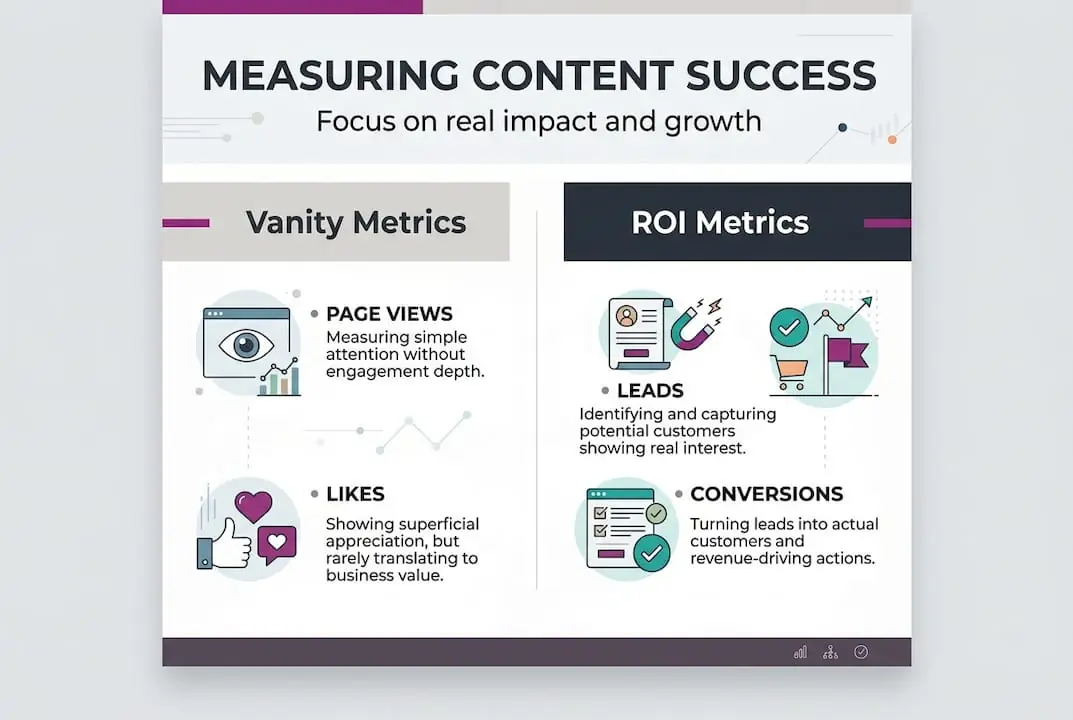
Here is how vanity metrics compare to ROI-focused metrics in practice:
| Vanity metric | What it tells you | ROI-focused metric | What it tells you |
|---|---|---|---|
| Page views | Volume of visits | Leads generated | Business impact |
| Social media likes | Surface engagement | Conversion rate | Funnel effectiveness |
| Follower count | Audience size | Cost per lead | Budget efficiency |
| Email open rate | Subject line appeal | Revenue attributed | True return |
The shift in mindset is simple. Ask not “how many people saw this?” but “how many people took a meaningful action because of this?”
For optimising your digital strategy, focus on these metrics:
- Leads generated per content piece to identify your highest-performing assets
- Conversion rate by content type to understand which formats move prospects forward
- Organic traffic growth tracked monthly to measure SEO impact over time
- Time on page and scroll depth as indicators of genuine engagement
- Revenue attributed to content using UTM parameters and CRM tracking
Combining these with digital marketing strategies and solid SEO strategies gives you a complete picture of content performance that you can actually act on. Review your content performance benchmarks quarterly against industry peers to stay calibrated.
Why sustainable content production means flexible asset libraries, not endless pipelines
Here is an uncomfortable truth that most content strategies ignore: the goal should never be to produce more content. It should be to build a library of assets that keep working for you long after they were created.
We see this pattern repeatedly. Brands invest heavily in a constant production pipeline, burning out their teams and their budgets, only to find that last month’s content is already irrelevant. The smarter approach is to create fewer, stronger assets that can be repurposed, updated, and adapted across channels and campaigns.
Early capture of subject-matter expertise prevents costly failures down the line. When you document your team’s knowledge properly from the start, you avoid the expensive situation of rebuilding content foundations every time a campaign changes direction. A well-built marketing strategy treats content assets as long-term investments, not disposable outputs.
The contrarian advice here is this: if your content calendar feels like a treadmill you cannot get off, you are probably doing it wrong. Slow down, invest in depth, and build assets that compound. That is where the real return lives.
Boost your content strategy with AMW Media
If this article has clarified what effective content production looks like, the natural next question is how to execute it without stretching your team beyond capacity. If you would rather have this done for you, our Reading marketing page starts with what £12.50 a lead actually bought Woodstock Campers over thirteen months.
At AMW Media, we work with marketing managers and business owners to build content strategies that are grounded in measurable outcomes, not just output. Our content production services cover everything from strategy and creation through to distribution and performance tracking. Whether you need support with social media management or a complete overhaul of your web design solutions to better showcase your content, we have the expertise to help. Get in touch to discuss what a quality-first content approach could mean for your brand.
Frequently asked questions
What does content production actually entail?
Content production covers planning, creating, reviewing, and publishing a mix of digital assets. Hybrid workflows are now standard, balancing AI structure with human expertise to maintain quality and originality.
How do mid-sized businesses benchmark their content production?
Compare your quarterly output and budget against peer companies in your sector and focus on ROI rather than vanity metrics. Benchmarking and ROI measurement are key indicators of a successful content programme.
What makes quality content more valuable than volume?
Quality content engages audiences more deeply and compounds over time through updates and repurposing. Quality-driven content delivers more sustainable growth than high-volume publishing strategies.
How can AI be used in content production without undermining originality?
Use AI for drafting and structuring, then ensure humans edit for brand voice and inject unique expertise. AI speeds production but requires oversight to avoid the similarity pitfalls that make content generic.
What metrics should be tracked to measure content success?
Prioritise leads generated, conversion rates, and revenue attributed to content over basic engagement numbers. ROI-focused metrics yield the actionable insights needed to refine and improve your content strategy over time.
Recommended
- Why invest in content creation for competitive brand growth
- Content marketing: engage and grow your brand online
- Innovative social media content ideas to boost engagement
- Creative content production steps for marketing success in 2026
- Crafting Local Content That Connects: Tips for Small Businesses | King Digital Marketing Agency
Our free marketing audit looks at your site, your ads and your content, and comes back with a 30 day plan. No pitch deck.

On site with the cameras most days of the week. Installs, interviews, products and events, from London to Liverpool. Meet the team.