
 Black Steel Doors
 Woodstock Campers
 Phillips Joinery
TL;DR:
- Influencer marketing involves brands partnering with content creators to promote products to trusted audiences. It is a mainstream industry valued at $24 billion in 2024, driven by platforms like Instagram, TikTok, and YouTube. Success depends on building genuine relationships, using targeted niches, and tracking conversions with clear measurement strategies.
Influencer marketing is defined as a strategy where brands partner with trusted content creators to promote products or services to engaged, targeted audiences. Rather than broadcasting a message to everyone, you reach people who already trust the person delivering it. The global influencer marketing industry reached $24 billion by 2024, which tells you this is no longer a niche experiment. Platforms like Instagram, TikTok, YouTube, and LinkedIn have made it one of the most direct routes to building brand awareness and driving real revenue. Tools like Later and platforms tracked by eMarketer confirm the channel is growing faster than most traditional media formats.
What is influencer marketing and how does it work for brands?
Influencer marketing works because people trust people. An influencer builds an engaged community over time through consistent content, whether that is beauty tutorials on YouTube, finance tips on LinkedIn, or food reviews on TikTok. When a brand partners with that creator, it borrows that trust for a moment.
The mechanics are simple. A brand identifies a creator whose audience matches its own customers. They agree on a collaboration format, which might be a sponsored post, a product review, an unboxing video, or a longer brand partnership. The influencer then creates content that features the brand in a way that feels natural to their usual output.
Compensation models vary widely. Flat fees are common for one-off posts. Performance-based payments tie earnings to clicks, sales, or sign-ups. Gifting works well for smaller creators who are willing to post in exchange for free products. Each model suits different budgets and campaign goals.
Platforms matter enormously here. Instagram remains the dominant channel for lifestyle and fashion brands. TikTok drives discovery for younger audiences at speed. YouTube suits longer, more considered content like tutorials and reviews. LinkedIn is the go-to for B2B brands targeting professionals. Choosing the right platform is as important as choosing the right creator.
Think of influencer marketing as digital word-of-mouth at scale. A recommendation from a friend carries weight. A recommendation from someone 500,000 people follow and trust carries even more.
- Nano-influencers (1,000 to 10,000 followers): tight-knit communities, very high engagement rates, lower cost
- Micro-influencers (10,000 to 100,000 followers): strong niche authority, excellent for targeted campaigns
- Macro-influencers (100,000 to 1,000,000 followers): broad reach, good for awareness campaigns
- Mega-influencers and celebrities (1,000,000+ followers): maximum exposure, highest cost, lower engagement rates
Pro Tip: Start with micro-influencers if you are testing the channel for the first time. They typically deliver stronger engagement rates and cost a fraction of what a macro-influencer charges.
What are the benefits of influencer marketing for business growth?
The return on investment from influencer marketing is one of the most compelling arguments for using it. Brands earn an average of £5.78 for every £1 spent on influencer campaigns. That figure puts it ahead of many paid advertising channels when executed well.

Consumer trust is the engine behind those returns. 92% of consumers trust recommendations from individuals, including influencers, over traditional brand messages. That is a significant gap. It means a well-placed influencer post can outperform a polished TV advert simply because it feels like a genuine recommendation rather than a sales pitch.
The objectives brands pursue through influencer marketing are split fairly evenly. 66% of brands use it to drive brand awareness, while 55% use it specifically for revenue growth. Those two goals are not mutually exclusive, and the best campaigns achieve both simultaneously.
Targeting is another clear advantage. You can reach a very specific niche by partnering with a creator who owns that space. A vegan food brand partnering with a plant-based recipe creator on Instagram reaches exactly the right people, with no wasted spend on audiences who will never convert.
| Metric | Figure | What it means |
|---|---|---|
| Average ROI | £5.78 per £1 spent | Strong return compared to many paid channels |
| Consumer trust in influencers | 92% | Far exceeds trust in traditional advertising |
| Brands using it for awareness | 66% | Brand visibility is the primary driver |
| Brands using it for revenue | 55% | Direct sales impact is a major secondary goal |
| Global market value (2024) | $24 billion | Confirms this is a mainstream marketing channel |
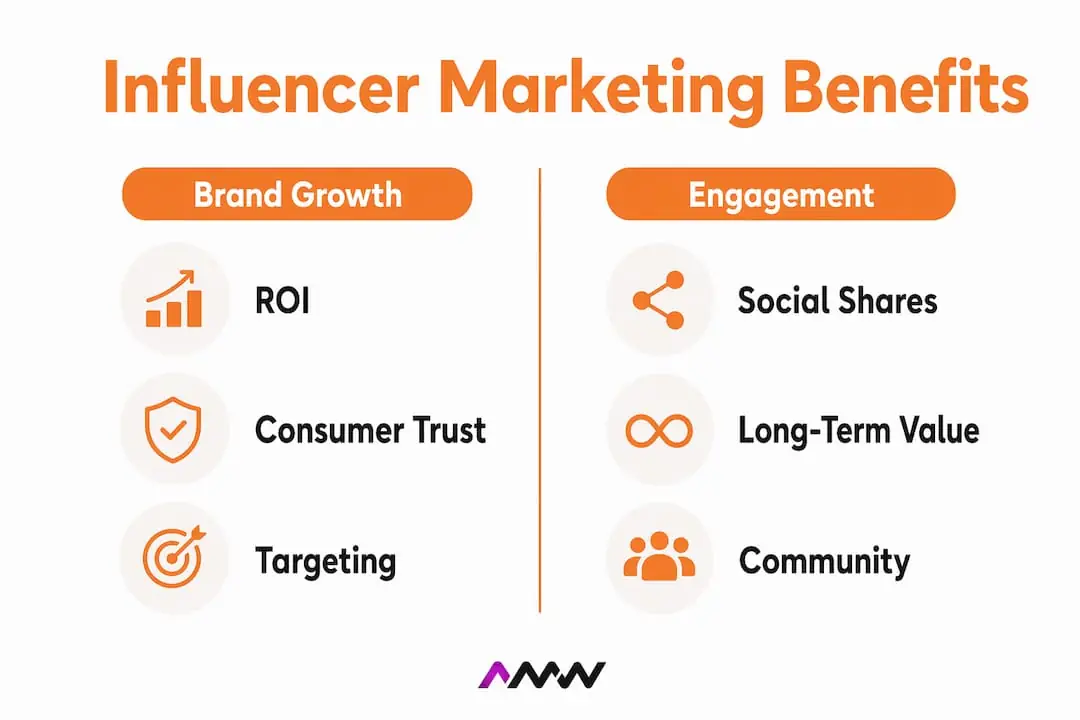
The social media engagement benefits extend beyond the campaign itself. Influencer content often gets shared, saved, and repurposed, giving your brand organic reach long after the original post goes live.
How does influencer marketing differ from traditional celebrity endorsements?
The distinction matters more than most brands realise. A traditional celebrity endorsement puts a famous face on a product. Think of a footballer advertising a sports drink or an actor fronting a perfume campaign. The celebrity lends their fame, but the relationship with their audience is largely one-directional.
Influencers operate differently. Influencers engage continuously with niche communities, responding to comments, sharing personal stories, and building genuine relationships over time. That ongoing dialogue creates perceived authenticity that a celebrity billboard simply cannot replicate.
| Factor | Celebrity endorsement | Influencer marketing |
|---|---|---|
| Audience relationship | Passive, one-directional | Active, community-driven |
| Perceived authenticity | Lower, often seen as paid promotion | Higher, feels like a personal recommendation |
| Cost | Very high | Varies widely, accessible at all budgets |
| Targeting precision | Broad, general audience | Specific niche communities |
| Content format | Polished, brand-controlled | Creator-led, platform-native |
Authenticity is the central challenge for brands in 2026. Audiences are more media-literate than ever. They can spot a forced partnership immediately, and when they do, it damages both the influencer’s credibility and the brand’s reputation.
Transparency plays a critical role here. Transparency in sponsorships is key to maintaining long-term credibility for both influencers and brands. Clearly labelling paid content is not just a legal requirement in the UK under ASA guidelines. It is also the honest approach, and audiences respect it.
Long-term ambassadorships outperform one-off posts on almost every measure. When a creator uses a product over months and talks about it repeatedly, the recommendation carries far more weight than a single sponsored post. Brands that invest in ongoing relationships build a library of authentic content and genuine audience loyalty.
Pro Tip: Before signing any influencer, check their comment section. Real engagement looks like genuine questions and conversations. Fake engagement looks like rows of emoji and generic praise.
What are the best strategies for successful influencer marketing campaigns?
The brands that get the most from influencer marketing treat it as an integrated channel, not a one-off tactic. Treating creators as integrated partners through the customer journey, rather than a bolt-on addition, consistently delivers stronger results. That means involving influencers at the awareness stage, the consideration stage, and even the conversion stage.
The single biggest mistake brands make is over-scripting their creators. Over-scripting reduces authenticity, which leads directly to poor audience engagement. Give the influencer a clear brief with your key messages, your brand guidelines, and any mandatory disclosures. Then step back and let them create in their own voice.
Measuring results is where many campaigns fall short. Conversion tracking with UTM parameters and affiliate links is the most reliable way to tie influencer activity to actual revenue. Without tracking, you are guessing at ROI rather than proving it. This matters especially when you are making the case for budget internally.
Here is a practical framework for running a campaign that actually delivers:
- Define your goal clearly. Awareness, engagement, and conversions each require different influencer types and content formats.
- Vet influencers thoroughly. Check audience demographics, engagement rates, past brand partnerships, and content quality before reaching out.
- Brief well, script minimally. Share your brand story, key messages, and non-negotiables. Leave the creative execution to the creator.
- Set up tracking from day one. Use unique discount codes, UTM-tagged links, or affiliate programmes so every conversion is attributable.
- Build for the long term. Long-term ambassadorships create significantly higher brand loyalty and revenue than single posts. Aim for ongoing relationships with creators who fit your brand.
- Review and iterate. Analyse what worked, which formats drove the most conversions, and which creators delivered the best ROI. Use that data to refine your next campaign.
Understanding how to analyse your marketing results sits at the heart of making influencer marketing pay. Without measurement, you cannot improve.
The brands winning at influencer marketing in 2026 are the ones who treat it as a relationship-driven channel with clear commercial goals, not a shortcut to viral content. Patience, consistency, and genuine creator partnerships are what separate the campaigns that build brands from the ones that get a few likes and disappear.
Key takeaways
Influencer marketing delivers the strongest results when brands treat creators as genuine partners, track conversions rigorously, and commit to long-term relationships rather than one-off posts.
| Point | Details |
|---|---|
| ROI is measurable and strong | Brands earn an average of £5.78 per £1 spent when campaigns are tracked properly. |
| Consumer trust drives results | 92% of consumers trust influencer recommendations over traditional brand advertising. |
| Authenticity requires creative freedom | Over-scripting creators reduces engagement; brief clearly but let them create in their own voice. |
| Long-term beats transactional | Ongoing ambassadorships build more brand loyalty and revenue than single sponsored posts. |
| Tracking is non-negotiable | UTM parameters, affiliate links, and discount codes are the only reliable way to prove ROI. |
Why I think most brands are still getting influencer marketing wrong
Most brands approach influencer marketing like a media buy. They pick a creator with a big number next to their name, hand over a script, and wait for the sales to roll in. When it does not work, they blame the channel.
The problem is almost never the channel. The problem is the mindset. Influencer marketing is a relationship business. The brands I have seen get the most from it are the ones who invest in understanding the creator, their audience, and what makes their content work. They treat the influencer as a collaborator, not a billboard.
Budget allocation is another area where I see consistent mistakes. Brands pour money into one mega-influencer post and get a spike that disappears in 48 hours. The smarter play is spreading that same budget across several micro-influencers with highly engaged niche audiences. The reach might look smaller on paper, but the conversion rates tell a very different story.
The transparency issue is also worth taking seriously. UK audiences are increasingly savvy about sponsored content. Hiding the commercial relationship does not make the content feel more authentic. It makes it feel dishonest when people figure it out, and they always do. Clear disclosure, done well, actually builds trust rather than undermining it.
My honest view is that influencer marketing is one of the most effective channels available to brands right now. But it rewards patience, genuine relationships, and proper measurement. Treat it as a long game, and it pays off considerably.
Amir
How AMW Media can support your influencer and social media strategy
Running influencer campaigns alongside a broader social media strategy takes time, expertise, and the right infrastructure to measure what is actually working. Our Oxford page starts with a number, 157 leads at £4.59 each for Cotswold Gloss, because that is the only part of an agency page you can check.
AMW Media’s social media management services are built for brands that want real results, not just follower counts. The team handles everything from campaign planning and creator vetting to content scheduling, performance tracking, and reporting. Just starting out with influencer partnerships or looking to scale what is already working: AMW Media brings the strategic thinking and creative production to make it count. Get in touch to find out how the team can build a social and influencer strategy that fits your brand and your budget.
FAQ
What is the influencer marketing definition in simple terms?
Influencer marketing is a strategy where brands pay or gift creators to promote their products or services to the creator’s audience. It works because audiences trust the creator’s recommendations more than traditional advertising.
How much does influencer marketing cost in the UK?
Costs vary widely depending on the influencer’s reach and platform. Nano-influencers may work for gifting or small fees, while macro-influencers and celebrities command thousands of pounds per post.
How do you measure influencer marketing success?
The most reliable method is conversion tracking using UTM parameters, unique discount codes, and affiliate links. These tools tie influencer activity directly to clicks, sign-ups, and sales.
What types of influencer marketing campaigns work best?
Long-term ambassadorships consistently outperform one-off posts. Campaigns that give creators genuine creative freedom and integrate them across the full marketing funnel deliver the strongest results.
Is influencer marketing better than traditional advertising?
For trust and targeted reach, influencer marketing has a clear edge. 92% of consumers trust individual recommendations over brand messages, making influencer content more persuasive than most traditional ad formats.
Recommended
- What is inbound marketing? A practical 2026 guide | AMW Media
- What is marketing innovation? A guide for ambitious brands | AMW Media
- What is storytelling in marketing: a 2026 guide | AMW Media
- Essential digital marketing guide: strategies for brand growth
Our free marketing audit looks at your site, your ads and your content, and comes back with a 30 day plan. No pitch deck.

Runs the content calendars and the community side of every social account, and keeps clients posted on what is going out and when. Meet the team.