
 Black Steel Doors
 Woodstock Campers
 Phillips Joinery
You can start growing sales and leads with social media in seven focused steps. Around 84% of UK small businesses already generate at least some work through social channels, which means your competitors are almost certainly there already. The question is not whether to show up, but how to do it without wasting six months posting into the void.
Here is the sprint:
- Choose 1 to 2 platforms that match your business type
- Set 1 to 2 measurable goals and sketch a buyer persona
- Build a content plan using the 5:3:2 mix
- Optimise every profile so visitors know what to do next
- Prioritise short-form video and carousel formats
- Engage daily, collaborate monthly, and build community
- Measure weekly, experiment monthly, and scale what works
Your 30/60/90-day action plan in brief: In the first 30 days, pick your platforms, set up profiles, and publish baseline content three to four times a week. By day 60, test small paid boosts on your best-performing posts and start one collaboration. By day 90, you should have enough data to scale winning content, document your playbook, and decide whether you need agency support.
Key takeaways
Growing a business with social media comes down to three things done consistently: choosing the right platforms for your audience, publishing content that follows a proven mix, and measuring outcomes tied to real business goals rather than follower counts.
| Point | Details |
|---|---|
| Pick 1 to 2 platforms | Match your platform choice to your business type; spreading across five platforms produces mediocre results everywhere. |
| Use the 5:3:2 content mix | Five curated, three original, two personal posts per ten keeps your feed valuable without constant self-promotion. |
| Post 3 to 4 times per week | Minimum viable consistency beats daily posting that sacrifices quality; batch content to stay sustainable. |
| Scale paid from organic winners | Only spend on posts that have already earned organic engagement; paid amplifies what works, it does not fix what does not. |
| AMW Media for managed growth | AMW Media provides strategy, content production, and paid social management with reporting tied to business outcomes. |
Which platforms should you actually focus on?
Not all platforms are worth your time, and trying to be everywhere at once is one of the fastest ways to burn out and produce mediocre content everywhere. Pick one primary platform and one secondary, then commit.
Here is a practical comparison to help you choose:
| Platform | Best for | Top content type | Time investment | Paid-ad potential | Primary KPIs |
|---|---|---|---|---|---|
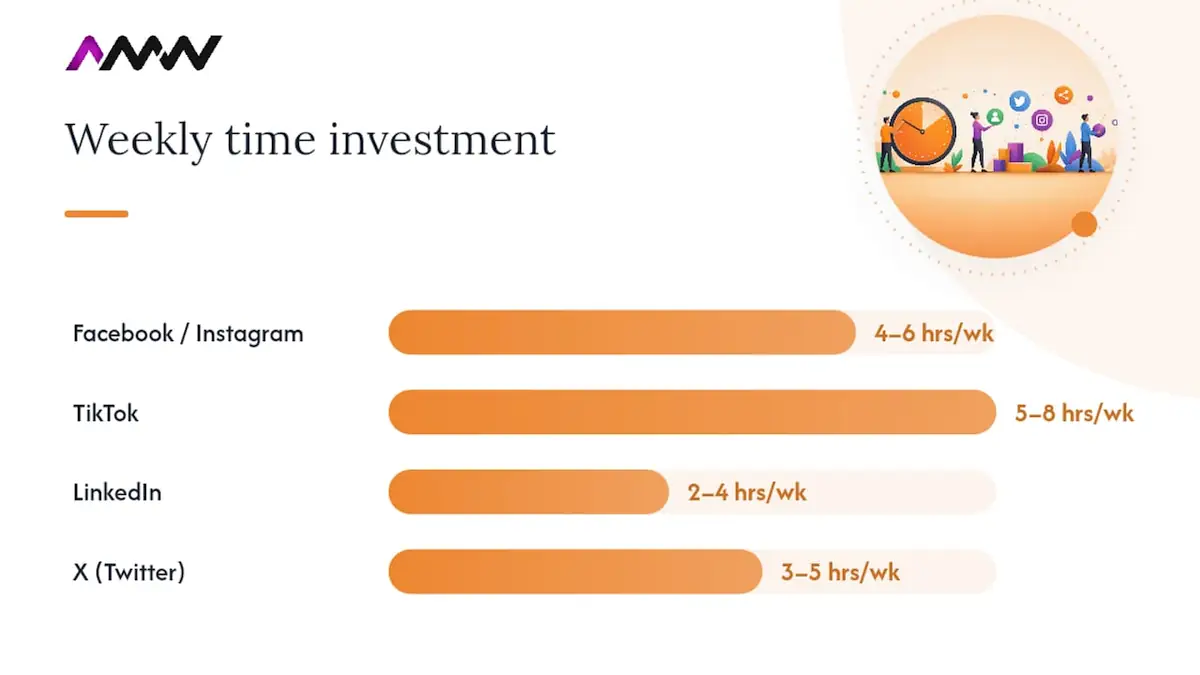
| Facebook / Instagram (Meta) | Local services, e-commerce, B2C brands | Reels, carousels, Stories | 4 to 6 hrs/week | High; from ~£5/day | Reach, link clicks, conversions |
| TikTok | Consumer brands, food, fashion, trades | Short-form video (15 to 60 sec) | 5 to 8 hrs/week | Growing; from ~£10/day | Views, follows, profile visits |
| B2B services, consultants, recruiters | Text posts, short video, articles | 2 to 4 hrs/week | Expensive; from ~£15/day | Impressions, leads, InMail replies | |
| X (Twitter) | PR, news-adjacent brands, tech | Short text, threads, polls | 3 to 5 hrs/week | Moderate; from ~£5/day | Impressions, link clicks, mentions |
| YouTube | Education, tutorials, product demos | Long video (5 to 15 min), Shorts | 6 to 10 hrs/week | High via Google Ads | Watch time, subscribers, clicks |
Facebook and Instagram share Meta’s ad infrastructure, which is the most mature small-business ad platform in the UK. If you sell to consumers or run a local service, this combination is almost always the right primary choice. Reels get the widest organic reach right now; Stories keep you top of mind with existing followers.
TikTok rewards consistency and authenticity over production polish. A plumber filming a satisfying drain unblock can outperform a polished brand video. If your product or service has a visual or entertaining angle, TikTok is worth serious attention.
LinkedIn is the obvious home for B2B businesses. Organic reach per post is still relatively strong compared to Facebook, and a well-written personal post from the founder often outperforms a company-page post by a wide margin.
X suits businesses that want to be part of industry conversations or build a media presence. It is harder to convert followers into customers directly, so treat it as a brand-awareness and PR channel rather than a sales driver.
YouTube has the highest time investment but also the longest content shelf life. A well-optimised tutorial video can drive traffic for years, especially when paired with SEO services that target the same search terms.
Recommended combinations for UK small businesses:
- Local service business (plumber, salon, café): Facebook + Instagram primary, TikTok secondary
- B2B consultancy or agency: LinkedIn primary, X secondary
- E-commerce brand: Instagram primary, TikTok secondary
- Education or coaching: YouTube primary, Instagram secondary
Pro Tip: Film one piece of content per week and repurpose it across platforms. A 60-second video becomes a TikTok, an Instagram Reel, a YouTube Short, and a LinkedIn post with a text intro. You get four posts from one filming session.
How do you set goals that actually drive results?
Vague goals produce vague results. “Get more followers” is not a goal; it is a wish. Before you post anything, decide what business outcome you are chasing and which metric proves you are getting there.
Step 1: Pick 1 to 2 priority goals from this list:
- Brand awareness (more people know you exist)
- Website traffic (social drives visitors to your site)
- Lead generation (enquiries, sign-ups, DMs)
- Sales (direct purchases or bookings)
Step 2: Match each goal to a KPI:
- Awareness → reach, impressions, follower growth
- Traffic → link clicks, sessions from social in GA4
- Leads → form submissions, DM enquiries, email sign-ups
- Sales → revenue attributed to social, conversion rate
Step 3: Build a simple buyer persona. You do not need a 20-page document. Answer these four questions:
- Who are they? (age range, job, location, income bracket)
- What problem are they trying to solve?
- Where do they spend time online?
- What objection stops them buying from you?
Step 4: Set 30/60/90-day targets. For example: by day 30, reach 500 people per week on Instagram. By day 60, generate five inbound enquiries per month from social. By day 90, attribute at least two sales to social channels in GA4.
Tracking metrics closer to revenue, clicks, leads, and conversions, rather than vanity metrics like likes is what separates social strategies that drive growth from those that do not.
How to build a content plan that keeps you consistent
The biggest reason small businesses stall on social media is not lack of ideas. It is lack of a system. A content plan turns “I should post something” into a repeatable process.
Start with three content pillars linked to your buyer journey:
- Awareness pillar: content that introduces your brand to new audiences (tips, trends, behind-the-scenes)
- Consideration pillar: content that builds trust with people already aware of you (case studies, FAQs, comparisons)
- Conversion pillar: content that prompts action (offers, testimonials, direct CTAs)
Use the 5:3:2 content mix. For every ten posts, the 5:3:2 rule recommends five curated posts (useful content from others), three original posts (your own expertise), and two personal or humanising posts (team, behind-the-scenes, values). This balance helps brands avoid constant promotion and builds the kind of trust that converts followers into customers. Note that the 5:3:2 rule governs your content mix, not your posting frequency.
Minimum viable consistency for most small businesses is 3 to 4 posts per week. Daily posting sounds impressive but produces diminishing returns if quality drops. Batch your content creation: set aside two hours on Monday to plan and create the week’s posts, then schedule them using Meta Business Suite, Buffer, or Later.
A simple editorial calendar template:
- Monday: Awareness post (tip, trend, or curated share)
- Wednesday: Original content (your expertise, a short video)
- Friday: Conversion or personal post (offer, testimonial, team moment)
Content brief template (one per post):
- Platform and format
- Pillar (awareness / consideration / conversion)
- Core message in one sentence
- CTA (what should the viewer do next?)
- Visual or video description
- Caption draft and hashtags
Pro Tip: Batch-create four weeks of content in one afternoon using Canva templates. Swap out the text and images, keep the branded layout, and you have a month of posts in under three hours.
Does your profile turn visitors into leads?
Your profile is your shop window. Someone who discovers you through a post will check your profile before they follow or enquire. If it is incomplete, inconsistent, or confusing, they leave.
Profile optimisation checklist:
- Profile image: your logo or a clear headshot (consistent across all platforms)
- Bio / About: one sentence on what you do, one on who you help, and one CTA or link
- Header / cover image: branded, current, and sized correctly for each platform
- Contact details: phone, email, or booking link visible without clicking through
- Link in bio: use a link tool (Linktree, Beacons, or a custom landing page) to send traffic to your highest-priority destination
- Username: consistent across platforms so you are easy to find
- Pinned post: pin your best-performing or most important post to the top of your profile
Where to send traffic first: if you have an e-commerce shop, link directly to a product collection or a landing page with a clear offer. If you sell services, link to a contact or booking page rather than your homepage. A homepage gives people too many choices; a well-designed landing page with one CTA converts far better.
Bio examples by business type:
- Café: “Specialty coffee and homemade food in Manchester. Open Mon, Sat 7am, 5pm. Order online 👇”
- B2B consultant: “I help UK manufacturers cut production costs. 10+ years in ops. Book a free call 👇”
- E-commerce brand: “Sustainable activewear made in the UK. Free delivery over £50. Shop now 👇”
Keep your brand colours, fonts, and tone consistent across every platform. Canva’s Brand Kit feature lets you lock these in so every graphic you produce stays on-brand without thinking about it.
Which content formats actually shift the numbers?
Not all content formats drive business results equally. Here is the priority order for most UK small businesses, with the reasoning behind it.
- Short-form video (Reels, TikToks, YouTube Shorts): the highest organic reach of any format right now. Aim for 15 to 60 seconds, hook in the first two seconds, and add captions because most people watch without sound.
- Carousels (Instagram and LinkedIn): high save rates, which signals value to the algorithm. Use them for tips, step-by-step guides, or before-and-after content.
- Stories: low-effort, high-frequency touchpoints. Use polls, questions, and countdown stickers to drive interaction without needing polished production.
- Static images: still effective for product shots, quotes, and announcements. Use Canva templates to keep production fast.
- Long-form video (YouTube): slower to build but compounds over time. A 10-minute tutorial can drive traffic for years.
- User-generated content (UGC): customer photos, reviews, and unboxing videos. Ask happy customers to tag you, then reshare with permission.
Production hacks that save time:
- Film on your phone in good natural light. A ring light costs under £30 and makes a visible difference.
- Use Canva for graphics, carousels, and video thumbnails. The free tier covers most small-business needs.
- For higher-quality visual assets, particularly aerial or location footage, a specialist like Clear Focus Imaging can produce content that stands out from standard smartphone footage.
- Record three to five videos in one session rather than one at a time.
- Repurpose a single idea: one blog post becomes a carousel, a short video, a quote graphic, and a LinkedIn text post.
For creative post formats and real examples that have worked for UK brands, it is worth seeing what performs before you start experimenting from scratch.
How do you grow reach and build a real community?
Posting consistently is the floor, not the ceiling. The businesses that grow fastest on social media treat it as a two-way channel, not a broadcast.
Daily engagement habits (takes 15 to 20 minutes):
- Reply to every comment on your posts within 24 hours
- Leave three to five genuine comments on posts from potential customers or partners
- Respond to DMs promptly, even if just to acknowledge and set a follow-up time
- React to Stories from followers you want to keep warm
Weekly actions:
- Check which posts got the most saves and shares, then plan more of that type
- Engage with relevant hashtag feeds to get your profile in front of new audiences
- Post one Story with an interactive element (poll, question box, quiz)
Collaborations and micro-influencer partnerships: a collaboration does not need to involve a celebrity or a large budget. A local business with 2,000 engaged followers in your target area is often more valuable than a national influencer with 200,000 passive ones. Structure a simple reciprocal promotion: you feature them, they feature you, both audiences see something new.
When working with influencers or gifting products in exchange for posts, ASA guidance requires that ads are clearly labelled at the start of the post. Both the brand and the influencer can be held responsible if the disclosure is missing or buried. “#Ad” or “Ad:” at the very beginning of the caption is the standard. Do not leave this to chance.
Hashtag and CTA tactics:
- Use 3 to 5 targeted hashtags rather than 30 generic ones; niche hashtags reach more relevant people
- End every caption with a specific CTA: “Save this for later”, “Drop your question below”, or “Click the link in bio to book”
- Ask questions in captions to prompt comments, which boosts algorithmic reach
Pro Tip: Your most engaged followers are your best unpaid advocates. DM them personally to say thank you, offer them early access to something, or ask for a testimonial. That personal touch turns a fan into a referral source. When collecting contact details through DMs or sign-up forms, follow ICO guidance on PECR before adding anyone to an email list.
When should you start spending on paid social?
Paid social is not where you test ideas. It is where you scale ideas that already work. Spend money on a post that has already earned organic engagement, not on a creative you have never tested.
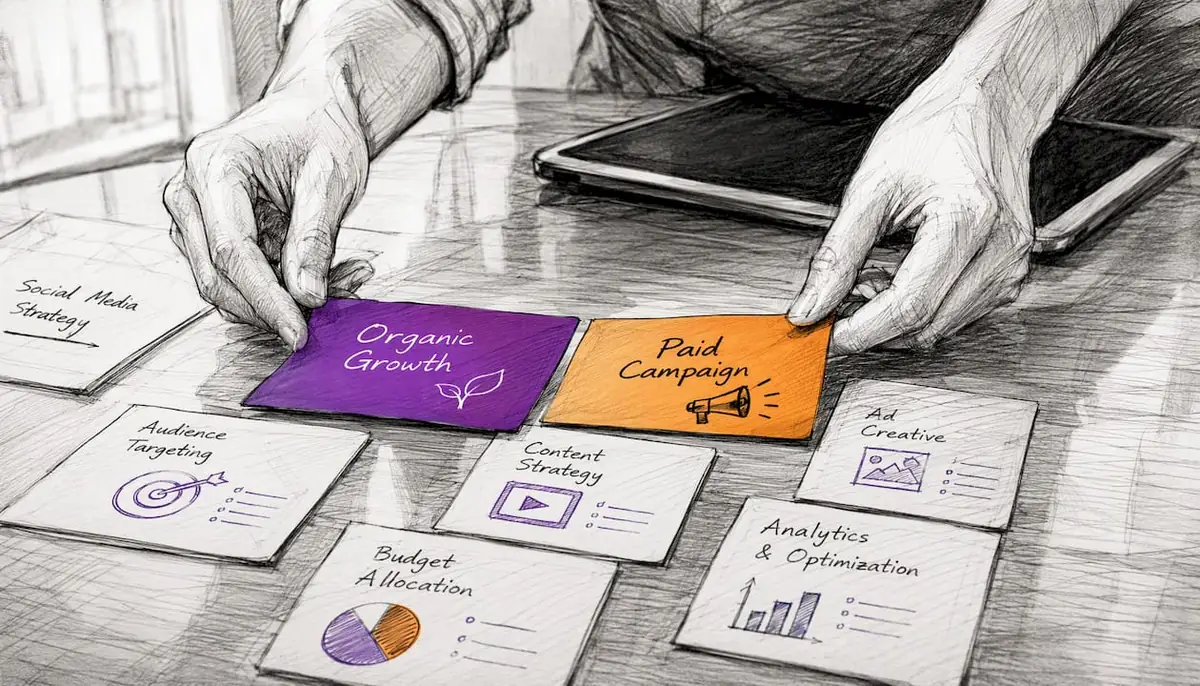
The signal to scale: a post that achieves above-average organic reach, saves, or click-through rate is a candidate for paid amplification. If it resonates without budget behind it, budget will make it reach further.
Basic campaign structure for SMEs:
- Awareness campaign: broad targeting, optimised for reach or video views, £5 to £10/day, run for 7 to 14 days
- Consideration campaign: retarget people who engaged with the awareness content, optimised for link clicks or video views, £5 to £10/day
- Conversion campaign: retarget website visitors or warm audiences, optimised for conversions or lead generation, a moderate daily budget range generally used for conversion campaigns
Ad test checklist before you spend:
- Is the creative proven organically (saves, shares, comments)?
- Is the audience defined (location, age, interest, or lookalike)?
- Is the CTA specific and matched to the landing page?
- Is the landing page optimised to convert (clear headline, one action)?
Simple A/B approach: change one variable at a time. Test two versions of the creative with the same audience, or two audiences with the same creative. Run each test for at least seven days before drawing conclusions. Meta’s ad platform makes this simple with its built-in split-test tool.
Lookalike audiences (people who resemble your existing customers) and retargeting (people who visited your site or engaged with your content) consistently outperform cold interest-based targeting for conversion campaigns. Start with what you know works, then expand.
What should you actually be measuring?
Most small businesses do not measure social media performance effectively. It is recommended to focus on a few key metrics closely linked to your business goals and review them regularly, for example:
- Awareness: reach and impressions
- Traffic: link clicks and sessions from social media
- Lead generation: form submissions and enquiries
- Sales: conversion rate and attributed revenue
Use analytics tools like GA4 and platform insights to track these metrics.
Reporting rhythm:
- Daily: check for comments, DMs, and any unusual spikes or drops in reach
- Weekly: review top-performing posts, note what format and topic drove the most engagement or clicks
- Monthly: compare against your 30-day targets, decide what to do more of and what to cut
- Quarterly: full strategy review, update your buyer persona, adjust platform priorities
Experiment template:
- Hypothesis: “If I post short-form video tutorials on Wednesday mornings, I will get more link clicks than static image posts”
- Metric: link clicks per post
- Sample size: eight posts of each type
- Decision rule: if video averages 30% more clicks, shift the Wednesday slot permanently to video
Learning from competitors: check their public content for posting frequency, format mix, and engagement rates. Meta’s Ad Library shows you exactly what ads any business is running. Use this to spot gaps, not to copy. If every competitor posts static images and you post video, you stand out by default. A data-first approach that treats social as a performance engine rather than a broadcast channel is what separates businesses that grow from those that plateau.
When is it time to bring in agency help?
There is a point where doing it yourself costs more than hiring someone. Here is how to know you have reached it.
Hiring threshold checklist:
- You are spending more than eight hours a week on social media and still not posting consistently
- You have been active for three months but cannot attribute a single lead or sale to social
- You want to run paid campaigns but do not know how to set up targeting or read the data
- You need content production (video, photography) that exceeds your in-house capability
- You are ready to scale and need a system, not just more posts
What an agency like AMW Media delivers:
- A strategic audit of your current profiles, content, and competitors
- A content production plan with video, photography, and graphics
- Paid social campaign setup, targeting, and ongoing optimisation
- Monthly reporting tied to your business goals, not vanity metrics
- A team with social media management experience across multiple UK industries
When evaluating agency proposals, ask for:
- Examples of campaigns with measurable outcomes (leads, sales, ROAS)
- A clear breakdown of what is included in the monthly retainer
- Who will actually work on your account (not just who pitches it)
- How they report results and how often
- A minimum contract term and exit clause
Red flags: agencies that guarantee follower counts, promise viral content, or cannot show you a single case study with real numbers. Good agencies talk about reach and revenue; average ones talk about likes.
How does social media fit with your other marketing channels?
Social media works best when it is connected to everything else you are doing, not running in isolation. Think of it as the top of a funnel that feeds into email, SEO, and paid search.

Email marketing: use social media to grow your email list (lead magnets, sign-up CTAs in bio, gated content). Email then nurtures those leads at a lower cost per touch than paid social. When moving social contacts into email sequences, you must have clear consent and comply with UK PECR rules. The ICO guidance on electronic mail marketing sets out exactly what is required.
SEO: the content you create for social often maps directly to search queries. A YouTube tutorial on “how to tile a bathroom” can rank on Google as well as YouTube. Publishing the same topic as a blog post on your website, then promoting it via social, compounds the reach. AMW Media’s SEO services and social strategy work together for exactly this reason.
Paid search (PPC): social media builds brand awareness; paid search captures people who are already looking for what you sell. Running both together means you appear at the awareness stage (social) and the intent stage (search). Retargeting audiences from social on Google Ads, and vice versa, closes the loop.
Content repurposing as integration: a single piece of cornerstone content (a detailed guide, a video series, a case study) can feed your social calendar, your email newsletter, your blog, and your paid ads simultaneously. This is how small teams punch above their weight. For a broader view of building lasting online presence across channels, the principle is the same: consistency and connection between channels beats isolated effort every time.
A note from the AMW Media team
The businesses I see succeed on social media are not the ones with the biggest budgets or the most followers. They are the ones that pick a lane, show up consistently, and treat every post as a small experiment rather than a performance. The 90-day framework in this guide is the same structure we use when onboarding new clients: start with clarity on goals and audience, build a repeatable content system, then layer in paid spend once you have organic proof of what works. Results follow the process, not the other way around.
AMW Media’s social media services: what’s included and how to get started
If you have read this far and thought “I know what to do, I just do not have the time or team to do it”, that is exactly the gap AMW Media fills. The agency handles the full picture: content production (video and photography), social media management, paid social campaigns, and monthly reporting tied to real business outcomes. No vanity metrics, no mystery retainers.
Services that map directly to the hiring thresholds above:
- Social media strategy and profile audits
- Content production: video, photography, graphics, and copywriting
- Paid social campaign management across Meta, TikTok, and LinkedIn
- Monthly performance reporting with GA4 and platform analytics
- Social media management on a retainer or project basis
The starting point is a social media audit: a review of your current profiles, content performance, competitor positioning, and paid activity. From there, you get a clear picture of what is working, what is not, and where the fastest wins are. To book an audit or get a quote for ongoing management, visit the social media services page or get in touch directly via the contact page.
Sources
- Business
- Social media surge: over 8 in 10 UK SMEs generate work through social media (Yellow Business News)
Growing your business with social media takes longer than the plan suggests
The ninety day plan above works, but it is worth setting expectations. Growing your business with social media is compounding rather than linear, and the first two months usually look like nothing is happening.
What actually changes first is not follower count. It is that people who already know you start seeing you regularly, which shortens the gap between somebody needing what you sell and remembering that you sell it. That shows up as more direct enquiries and more people arriving already sold, neither of which appears in a social dashboard.
FAQ
What is the best way to grow a small business on social media?
Choose one or two platforms that match your audience, post consistently using a structured content mix like the 5:3:2 rule, and measure results against business goals (leads, sales, traffic) rather than follower counts.
What is the 5:3:2 rule for social media?
The 5:3:2 rule is a content distribution framework: for every ten posts, five should be curated content from other sources, three should be your own original content, and two should be personal or humanising posts. It governs your content mix, not how often you post.
What is the 5-3-1 rule on social media?
The 5-3-1 rule is a less widely standardised framework; definitions vary across sources. The most common version suggests spending five minutes engaging with others’ content, sharing three pieces of content, and publishing one original post per session or day. It is a time-management guide rather than a content-mix strategy like the 5:3:2 rule.
How much should a UK small business spend on paid social?
A sensible starting point is £5 to £10 per day per campaign, run for at least seven days before drawing conclusions. Spend on posts that have already performed well organically; use awareness campaigns first, then retarget engaged audiences with conversion-focused ads.
Do I need to label paid partnerships and gifted posts?
Yes. ASA guidance requires that any post involving payment, gifting, or brand direction is clearly labelled as an ad at the very start of the caption, before any “see more” break. Both the brand and the creator can be held responsible for missing or unclear disclosures.
Recommended
- Your essential social media strategy checklist for growth | AMW Media
- How to run successful social media campaigns for brand growth
- How to boost your online presence for lasting brand growth | AMW Media
Our free marketing audit looks at your site, your ads and your content, and comes back with a 30 day plan. No pitch deck.

Runs the content calendars and the community side of every social account, and keeps clients posted on what is going out and when. Meet the team.