
 Black Steel Doors
 Woodstock Campers
 Phillips Joinery
TL;DR:
- Marketing innovation involves implementing significantly improved marketing methods across the entire marketing mix to gain a competitive edge. It enables brands to capitalise on cultural moments, reduce costs with AI, and improve engagement and sales. Overcoming organisational resistance and refining measurement models are essential for embedding innovation into long-term strategies.
Marketing innovation is defined as the implementation of new or significantly improved marketing methods that change how a business designs, packages, promotes, places, or prices its products. This goes well beyond running a clever ad. Think of Lidl launching a fashion brand to hijack Oasis’s reunion tour without a penny of official sponsorship, or Lysol using Google’s generative AI tools to cut creative costs by 80% while matching the quality of traditionally produced assets. For marketing professionals and business leaders, understanding what is marketing innovation means understanding the single most reliable lever for competitive advantage in a crowded market.
What is marketing innovation and how does it differ from product innovation?
Marketing innovation is the adoption of new marketing methods that produce significant changes across the marketing mix. The Oslo Manual is the most widely referenced framework for classifying it, and it draws a clear line between three types of innovation that businesses often confuse.
| Innovation type | What changes | Example |
|---|---|---|
| Marketing innovation | How you reach, position, and sell | New pricing model, cultural campaign, AI-generated creative |
| Product innovation | What you sell | A new product feature or entirely new service |
| Process innovation | How you operate internally | Automating fulfilment or supply chain logistics |
The distinction matters because the three types require different budgets, teams, and success metrics. A business can achieve significant marketing innovation without changing its product at all. Lidl did not invent a new type of clothing. It invented a new way to own a cultural moment.
The scope of marketing innovation covers the full marketing mix, not just promotion. Changes to distribution channels, packaging design, pricing architecture, and communication strategy all qualify. This breadth is what makes it such a powerful growth engine. You are not limited to one lever.
The four areas where marketing innovation actually happens
- Product design and packaging. Significant changes to how a product looks, feels, or is presented to the customer count as marketing innovation when the change is intended to increase appeal or reach a new audience.
- Promotion and communication. New channels, new formats, and new creative approaches all qualify. This includes generative AI content, influencer models, and cultural moment campaigns.
- Placement and distribution. Selling through a new channel, whether that is a marketplace, a pop-up, or a digital platform, is a form of marketing innovation.
- Pricing models. Subscription pricing, dynamic pricing, and freemium models are all marketing innovations when they represent a significant departure from industry norms.
Understanding this breadth is the first step. The second is seeing what it looks like when it works at scale.
How does marketing innovation drive competitive advantage?

The most compelling evidence for marketing innovation comes from campaigns that outperformed their categories without outspending them. Lidl’s ‘Lidl by Lidl’ campaign is the clearest recent example. The retailer generated 1.1 billion reach and 195,000 purchase attempts, with the product selling out in two minutes. More striking still, Lidl achieved more share-of-voice than four major competitors combined, none of whom held official sponsorship rights either.
That result was not a media budget story. It was a marketing innovation story. Lidl identified a cultural moment, built a product narrative around it from the start, and executed before anyone else could react.
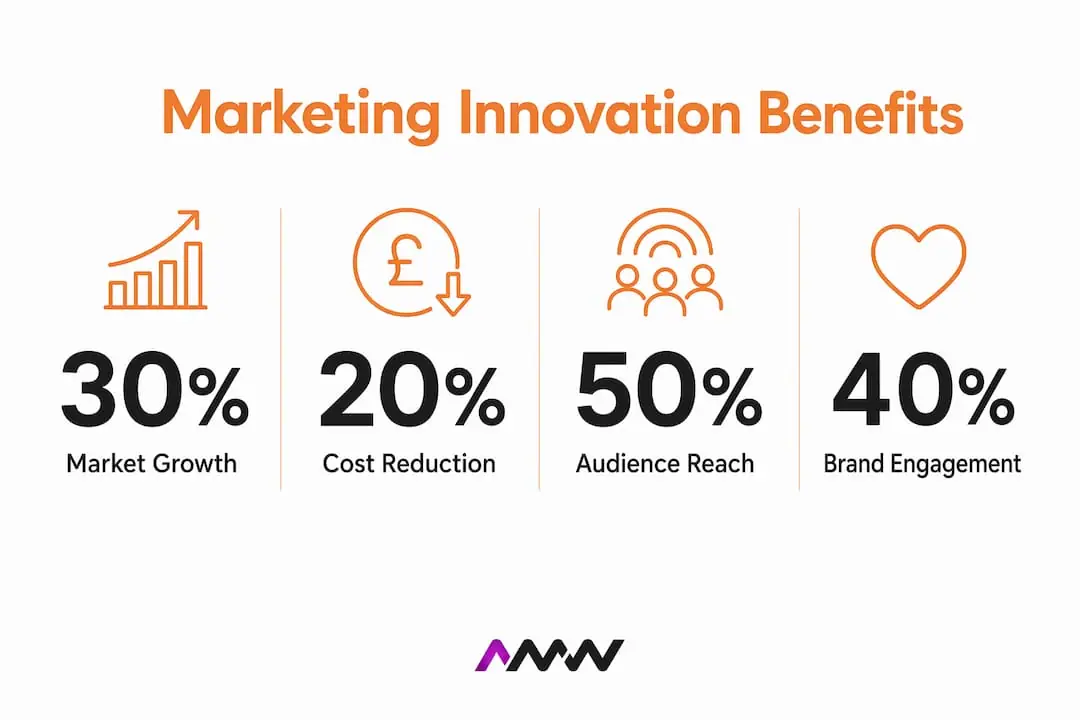
The benefits of marketing innovation extend well beyond a single campaign spike. Brands that practise it consistently see four compounding advantages.
- Market relevance. Brands that align with real cultural behaviours stay visible without relying solely on paid reach.
- Brand fame. Campaigns rooted in genuine community moments generate earned media at a scale that paid campaigns rarely match.
- Engagement lift. Authentic campaigns outperform forced marketing because they meet audiences where they already are.
- Sales acceleration. The Lidl case shows that the right campaign can compress the purchase cycle dramatically.
Wieden+Kennedy, the agency behind major Nike and McDonald’s campaigns, credits this kind of success to a pre-existing point of view within the communities a brand serves. The campaign does not create meaning. It reflects meaning that already exists.
Pro Tip: Before briefing your next campaign, map the cultural conversations your audience is already having. The best marketing innovation does not interrupt those conversations. It joins them.
The AI dimension adds another layer to the competitive advantage argument. When Lysol compressed ideation from weeks to hours using Google’s Veo and Imagen, the business did not just save money. It gained the ability to test more ideas, iterate faster, and respond to market signals in near real time. Speed is a competitive advantage in itself.
What barriers challenge marketing innovation and how do you overcome them?
The biggest obstacle to marketing innovation is rarely a shortage of ideas. Organisational resistance and inadequate ROI measurement are the two forces that kill most innovation efforts before they reach the market. Understanding both is necessary before you can address either.
Resistance to change is a structural problem. Teams optimised for efficiency are not naturally wired for experimentation. When a new campaign approach fails to hit short-term KPIs, the instinct is to revert to what worked before. This is rational at the individual level and destructive at the organisational level.
Measurement is the subtler problem. Traditional metrics capture short-term conversion well. They capture long-term brand equity poorly. A campaign like Lidl’s fashion drop would look expensive and risky on a standard ROI spreadsheet before launch. After launch, it would look like a masterclass. The measurement model shapes the decisions, so if your model only rewards short-term returns, you will systematically underinvest in the campaigns that build lasting competitive advantage.
How to build a culture that supports marketing innovation
- Adopt a learning-by-doing mindset. Run small experiments with defined learning objectives, not just revenue targets. Treat failures as data.
- Separate innovation budgets from performance budgets. When innovation spend competes directly with proven channels, it loses every time. Ring-fence it.
- Reframe measurement. Add brand equity indicators, share-of-voice tracking, and earned media value alongside conversion metrics. Explore how marketing analytics drives ROI beyond the last click.
- Align leadership expectations. Innovation campaigns need a longer evaluation window. Set that expectation before the campaign launches, not after.
- Reward calculated risk. If your team knows that a failed experiment will be held against them, they will stop proposing experiments. Recognition for well-structured attempts matters as much as recognition for wins.
Pro Tip: Establish a simple internal policy before you begin experimenting with AI tools. Decide what the brand will and will not do with generated content, and document it. Responsible use policies protect your reputation and give your team a clear framework to work within.
How does generative AI fit into marketing innovation strategies?
Generative AI is the most significant shift in marketing creative production since digital advertising replaced print as the dominant channel. The Lysol case study, conducted with Google’s Veo and Imagen tools, demonstrated that AI-powered creative reduces costs by 80% while producing assets that perform comparably to those made through traditional production methods.
The operational implications are substantial. Ideation that previously took weeks compressed into hours. Optimisation cycles that previously ran for months completed in two weeks. For a marketing team managing multiple campaigns across multiple channels, that kind of speed changes what is possible.
“Generative AI breaks the iron triangle of speed, quality, and cost. Traditionally, you could optimise for two of the three. AI makes all three achievable simultaneously.”, Lysol’s creative development case study, Think with Google
The technology also introduces new creative formats. Digital twins of actors, created with consent, allow brands to produce localised or personalised content at scale without repeated production costs. This is not a future capability. Brands are using it now.
The ethical dimension is not optional. Introducing generative AI into your creative process requires early decisions about responsible use, brand integrity, and consent. These are not legal formalities. They are reputation decisions. A brand that uses AI carelessly in its creative output risks the kind of backlash that undoes years of brand building. AMW Media’s thinking on AI in content creation covers this territory in detail for brands navigating the transition.
The role of AI in marketing strategies extends beyond creative production into personalisation, predictive analytics, and campaign optimisation. The brands that treat AI as a single-use cost-cutting tool will capture a fraction of the value available to those who integrate it across the full marketing function.
How to implement marketing innovation: a practical framework
Marketing innovation does not require a dedicated R&D department or a nine-figure budget. It requires a structured approach to identifying opportunities and executing against them with discipline. Here is a practical sequence that works for most marketing teams.
Audit your current marketing mix. Map every element of your current approach across product presentation, promotion, distribution, and pricing. Identify where you are doing what everyone else does. Those are your innovation opportunities.
Study your community before briefing your agency. The most successful campaigns, from Nike’s desert scavenger hunt with Devin Booker to Lidl’s Oasis moment, emerged from authentic community behaviours rather than manufactured brand narratives. Know what your audience cares about before you try to join the conversation.
Identify cultural moments worth owning. You do not need official sponsorship to align with a cultural event. Lidl proved that. Map the calendar of moments relevant to your audience and ask which ones you could credibly and creatively connect with.
Pilot AI tools on a contained project. Do not attempt a full creative transformation in one go. Choose one campaign or one content type and test AI-assisted production against your standard process. Measure speed, cost, and output quality. Use the results to build the internal case for broader adoption. AMW Media’s guide to creative content production outlines practical steps for integrating modern tools without disrupting existing workflows.
Set innovation-specific success metrics before launch. Define what success looks like beyond sales. Brand awareness lift, earned media value, share-of-voice, and social engagement are all valid indicators for campaigns designed to build long-term equity.
Review and iterate, not just report. After each innovation experiment, run a structured debrief. What did the audience respond to? What did the measurement model miss? What would you do differently? Build that learning into the next cycle.
Pro Tip: Marketing innovation succeeds when it is built into the product narrative from the beginning, not added as an afterthought once the product is ready to launch. Brief your marketing team at the same time you brief your product team.
Key takeaways
Marketing innovation is the deliberate adoption of new marketing methods across the full mix, and the brands that practise it consistently outperform those that treat it as an occasional experiment.
| Point | Details |
|---|---|
| Definition is broader than most think | Marketing innovation covers design, packaging, pricing, placement, and promotion, not just campaigns. |
| Cultural alignment beats paid reach | Lidl’s Oasis campaign generated 1.1 billion reach without official sponsorship by owning a cultural moment. |
| AI changes the economics of creativity | Generative AI tools cut creative production costs by 80% while maintaining comparable output quality. |
| Measurement models shape decisions | Traditional ROI metrics undervalue brand equity; add share-of-voice and earned media to your scorecard. |
| Innovation needs its own budget | When innovation spend competes with proven channels, it loses. Ring-fence it to protect experimentation. |
Why I think most brands are still getting marketing innovation wrong
After working with brands across a range of sectors, the pattern I see most often is this: marketing innovation gets treated as a campaign-level decision rather than a cultural one. A team spots a trend, pitches a bold idea, gets a budget approved, and executes. The campaign lands. Sometimes it even works. Then everyone goes back to doing what they were doing before.
That is not marketing innovation. That is a one-off experiment with a good brief.
Real marketing innovation is embedded in how a brand thinks about its audience every day. It shows up in the questions teams ask at the start of a brief, not just the executions they land on at the end. The brands I have seen do this well, whether they are using AI to compress production cycles or hijacking cultural moments without a sponsorship cheque, share one trait: they are curious about their communities. They study behaviour before they brief creative.
The technology side of this is exciting. Generative AI is not a cost-cutting tool. It is a creative capacity multiplier. When you can test ten concepts in the time it used to take to produce one, you make better decisions. You learn faster. You stop guessing and start knowing.
But the technology only works if the thinking behind it is sound. I have seen brands adopt AI tools enthusiastically and produce faster versions of the same mediocre content they were making before. The tool does not fix a weak strategy. It amplifies whatever you put into it.
The mindset shift I would encourage is this: stop asking “how do we market this?” and start asking “what does our community already believe, and how do we reflect that back to them in a way that is useful or entertaining?” That question leads to better briefs, better campaigns, and better results. Every time. Our Birmingham page is built around considered purchases, where nobody signs off eleven thousand pounds of anything from a stock photograph.
Amir
How AMW Media helps brands turn marketing innovation into results
Knowing what marketing innovation looks like in theory is one thing. Executing it consistently across your channels is another. AMW Media works with ambitious brands to close that gap. Whether you need a web presence built to support bold campaign ideas, SEO that keeps your brand visible between cultural moments, or PPC management that turns campaign traffic into measurable revenue, the team brings strategic thinking and creative production together under one roof. If you are ready to move from occasional experiments to a consistent innovation practice, AMW Media is worth a conversation.
FAQ
What is the definition of marketing innovation?
Marketing innovation is the implementation of new or significantly improved marketing methods involving changes to product design, packaging, promotion, placement, or pricing. It is classified separately from product innovation and process innovation under frameworks like the Oslo Manual.
What are some real examples of marketing innovation?
Lidl’s ‘Lidl by Lidl’ fashion campaign, which hijacked the Oasis reunion tour without official sponsorship, generated 1.1 billion reach and sold out in two minutes. Lysol’s use of Google’s generative AI tools to cut creative production costs by 80% is another widely cited example.
What are the main benefits of marketing innovation?
The primary benefits are increased market relevance, stronger brand recognition, higher engagement, and accelerated sales. Brands that align campaigns with authentic community behaviours consistently outperform those relying on paid reach alone.
Why is marketing innovation important for competitive advantage?
Marketing innovation allows brands to capture cultural moments, reduce creative costs through AI, and reach audiences in ways competitors have not yet adopted. Lidl achieved more share-of-voice than four major competitors combined through a single innovative campaign.
What is the biggest barrier to marketing innovation?
Organisational resistance and inadequate ROI measurement are the two primary barriers. Traditional metrics fail to capture long-term brand equity, which leads businesses to underinvest in the campaigns most likely to build lasting competitive advantage.
Recommended
- Open up digital growth with custom marketing strategies | AMW Media
- Essential digital marketing guide: strategies for brand growth
- Graphic design ideas for marketing: 2026 guide | AMW Media
- What is storytelling in marketing: a 2026 guide | AMW Media
Our free marketing audit looks at your site, your ads and your content, and comes back with a 30 day plan. No pitch deck.

Runs the content calendars and the community side of every social account, and keeps clients posted on what is going out and when. Meet the team.