
 Black Steel Doors
 Woodstock Campers
 Phillips Joinery

TL;DR:
- Inbound marketing attracts qualified prospects through valuable content and experiences aligned with their search intent. It builds a full-funnel system involving content creation, SEO, lead capture, nurture sequences, and customer delight, reducing costs and increasing trust. The approach requires long-term investment, consistency, and system alignment to generate sustainable growth and high-quality leads.
Inbound marketing is defined as a customer-attraction strategy that earns attention by creating valuable content and experiences aligned with what prospects are already searching for, rather than interrupting them with unsolicited messages. Where outbound marketing pushes adverts and cold calls at people who never asked for them, inbound pulls qualified prospects towards you by solving their problems first. HubSpot, which coined the term and built its entire platform around the methodology, describes the approach as earning attention through blogs, SEO, social media, and email nurture at every stage of the buyer journey. Salesforce reinforces this, noting that inbound is customer-driven, with engagement initiated by the prospect rather than the brand. The result is a marketing system that compounds over time, builds genuine trust, and consistently delivers higher-quality leads than its outbound counterpart.
What is inbound marketing and how does it work?
Inbound marketing works as an integrated system of content creation, search visibility, lead capture, and nurturing that guides a prospect from first discovery through to purchase and beyond. No single tactic makes it work. The power comes from how the components connect.

Content creation sits at the centre of the whole approach. Blog posts, videos, guides, case studies, and podcasts each serve a specific purpose: they answer the questions your ideal customers are already typing into Google. A well-written article on “how to reduce business energy costs” does not feel like marketing to the person reading it. It feels like help. That distinction is what makes inbound so effective.
Search engine optimisation is the distribution engine for that content. Without SEO, even the best article sits unread. Keyword research, on-page optimisation, internal linking, and technical site health all determine whether your content surfaces when prospects search. The content marketing and SEO relationship is symbiotic: great content earns rankings, and rankings drive the traffic that feeds the rest of the system.
Social media extends reach and builds familiarity. Platforms like LinkedIn, Instagram, and YouTube allow brands to share content with audiences who may not yet be searching actively. Social engagement also signals credibility, which reinforces trust before a prospect ever lands on your website.
Once visitors arrive, lead capture converts anonymous traffic into known contacts. This happens through gated content (downloadable guides, templates, webinars), contact forms, newsletter sign-ups, and live chat. The goal is to exchange something useful for an email address and permission to continue the conversation.
Email nurture sequences and marketing automation then take over. Tools like HubSpot, Mailchimp, and ActiveCampaign allow you to send the right message at the right time based on what a prospect has read, downloaded, or clicked. Automation removes the manual bottleneck and keeps leads warm without requiring constant human intervention. For a deeper look at how automation fits into this, the AMW Media guide on automated marketing strategies is worth your time.
- Blog posts and long-form guides attract organic search traffic
- SEO ensures content is discoverable at the moment of intent
- Social media builds brand familiarity and extends content reach
- Lead magnets and forms convert visitors into known contacts
- Email workflows and automation nurture leads towards a buying decision
- CRM integration (HubSpot, Salesforce) connects marketing activity to sales pipeline
Pro Tip: Don’t just publish content and hope for the best. Map every piece of content to a specific buyer journey stage (awareness, consideration, decision) and attach a clear next step. A blog post without a relevant call to action is a dead end.
Inbound vs outbound marketing: what’s the real difference?
The distinction between inbound and outbound marketing is not just tactical. It reflects two fundamentally different beliefs about how to earn a customer’s attention.
Outbound marketing interrupts. It places your message in front of people regardless of whether they want it. TV adverts, cold calls, display banners, and unsolicited email blasts all operate on the assumption that enough exposure will eventually produce a sale. The model works, but it is expensive, increasingly ignored, and difficult to scale without proportional budget increases.
Inbound marketing attracts. It operates on the belief that if you consistently answer the questions your ideal customers are asking, they will find you, trust you, and eventually buy from you. The pull strategy means prospects arrive already engaged with your thinking, which shortens the sales cycle and improves conversion rates.
Content marketing often gets confused with inbound marketing, but the two are not the same thing. Content marketing is a tactic nested within the broader inbound methodology. You can produce excellent content without having a lead capture system, a nurture sequence, or a sales handoff process. Inbound marketing orchestrates all of those elements together into a full-funnel system.
| Dimension | Inbound marketing | Outbound marketing |
|---|---|---|
| Direction | Pull: prospect finds you | Push: brand interrupts prospect |
| Cost per lead | 62% lower on average | Higher, scales with spend |
| Lead quality | Pre-qualified via search intent | Mixed, often cold |
| Trust building | Gradual, content-led | Dependent on repetition and reach |
| Longevity | Compounding: content works long-term | Stops when budget stops |
| Primary tools | SEO, blogs, email, social | Ads, cold calls, direct mail |
The cost-per-lead gap is significant. Inbound leads costing 62% less than outbound means a business spending £10,000 per month on outbound could theoretically achieve comparable lead volume for around £3,800 through a mature inbound system. That gap widens as content assets accumulate and rankings improve over time.
Content marketing, to be clear, is not a lesser discipline. It is the creative fuel that powers inbound. Without strong content, the attract stage collapses. The distinction matters because businesses that treat content creation as their entire strategy often wonder why leads are not converting. The answer is usually that the rest of the inbound system is missing.
The attract, engage, delight framework explained
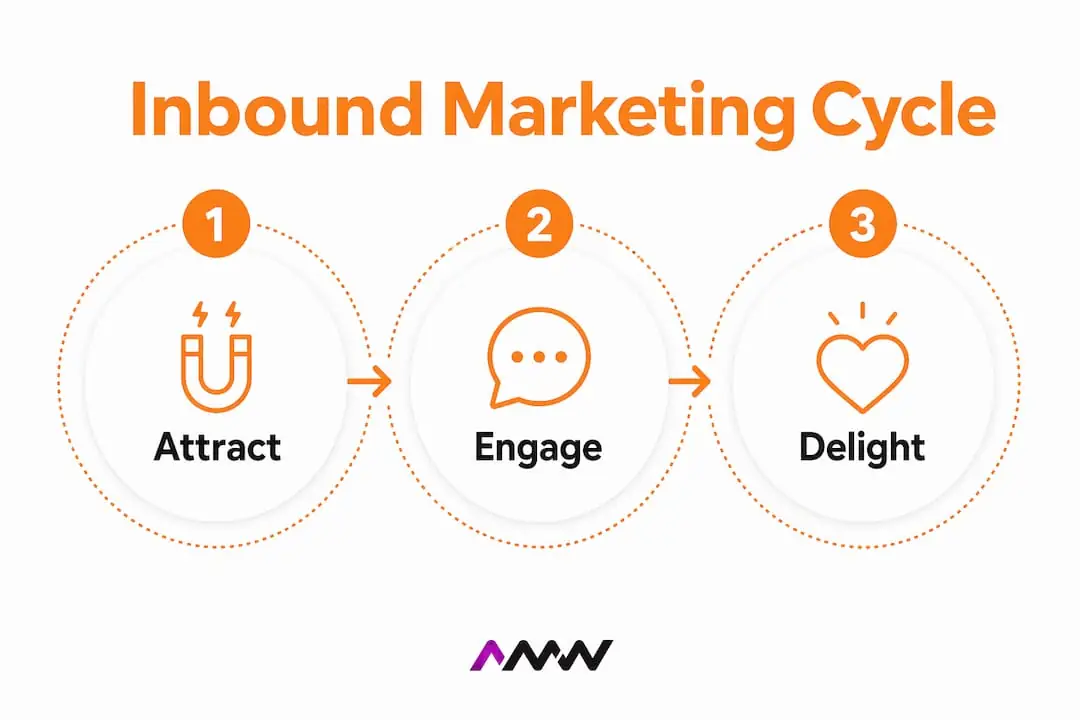
The Attract, Engage, Delight flywheel is the strategic model that organises every inbound marketing activity into a coherent, self-reinforcing loop. Understanding it changes how you allocate budget, create content, and measure success.
The attract stage
The attract stage is about drawing the right people to your website, not just any people. Qualified traffic comes from prospects who are actively searching for solutions to problems your business solves. The primary tools here are SEO-optimised blog content, YouTube videos, social media posts, and paid search campaigns that target high-intent keywords.
A B2B software company, for example, might publish a detailed guide on “how to manage remote team productivity.” Someone searching that phrase is likely a manager with a real problem. They arrive on the site already primed for a relevant solution. That is a fundamentally different starting point than someone who saw a banner advert while reading the news.
The engage stage
Engagement converts anonymous visitors into known leads and begins the relationship-building process. This stage includes:
- Offering a lead magnet (a free template, checklist, or webinar) in exchange for an email address
- Using landing pages with clear, specific value propositions rather than generic “contact us” forms
- Deploying chatbots or live chat to answer questions in real time and capture contact details
- Sending a welcome email sequence that delivers immediate value and sets expectations
- Segmenting contacts by interest or behaviour so subsequent emails feel relevant rather than generic
The quality of your engage-stage assets determines whether your attract-stage investment pays off. Traffic without conversion infrastructure is simply wasted reach.
The delight stage
The delight stage is where most businesses leave money on the table. Once a prospect becomes a customer, the inbound system should not stop. Delighted customers become promoters. They leave reviews, refer colleagues, and share content. This fuels sustainable growth through referrals and testimonials without additional acquisition spend.
Delight tactics include personalised onboarding sequences, proactive customer success check-ins, exclusive content for existing clients, and loyalty programmes. A customer who receives a helpful email six months after purchase, with no sales pitch attached, remembers it. That kind of experience generates word-of-mouth that no advert can replicate.
Pro Tip: Audit your post-purchase communications. If your only contact with customers after the sale is invoices and renewal reminders, you are missing the delight stage entirely. Add at least one value-led touchpoint per quarter that has nothing to do with selling.
How to implement inbound marketing effectively
Knowing the theory is one thing. Building a system that actually generates pipeline is another. These are the practices that separate businesses with a content blog from businesses with a functioning inbound engine.
Treat content as a compounding asset. A blog post published today can generate traffic for three to five years if it ranks well and gets updated periodically. SEO and content drive traffic over time, but the returns multiply when conversion points are also optimised. Most businesses focus entirely on publishing more content when the bigger opportunity is improving what happens after someone arrives.
Build buyer personas before writing a single word. A buyer persona is a detailed profile of your ideal customer: their job title, goals, frustrations, preferred content formats, and the questions they ask at each stage of the buying process. Aligning content to buyer personas and journey stages produces higher lead quality and a smoother buying experience. Without personas, content tends to be generic and fails to resonate with anyone in particular.
Optimise conversion paths, not just traffic. Most inbound programmes underperform because the conversion infrastructure is weak. Forms are too long. Landing pages lack specificity. CTAs are buried or vague. Email sequences stop after two messages. Fixing these elements often produces faster results than publishing more content.
- Reduce form fields to the minimum required (name and email is usually enough at the top of the funnel)
- Write CTA copy that describes the outcome, not the action (“Get the free guide” beats “Submit”)
- Test landing page headlines using A/B tools like Google Optimise or VWO
- Build nurture sequences of at least five to seven emails before assuming a lead is cold
- Use lead scoring to prioritise follow-up for the most engaged contacts
Align marketing, sales, and customer success. Inbound marketing requires aligned systems across content, lead capture, nurture, and sales handoff for measurable revenue impact. When sales teams receive leads without context about what content they have consumed, the conversation resets. When customer success teams are not briefed on what was promised during the sales process, trust erodes. A shared CRM, agreed lead definitions, and regular cross-team reviews close these gaps.
Measure lead quality, not just volume. Raw traffic and lead count are vanity metrics if the leads never convert. Track metrics like lead-to-opportunity rate, cost per qualified lead, and revenue attributed to inbound channels. These numbers tell you whether the system is working, not just whether it is busy. The AMW Media guide on optimising your digital strategy covers measurement frameworks worth adopting.
Pro Tip: Run a quarterly content audit. Identify your top ten traffic-driving pages and check whether each one has a relevant lead capture mechanism. If a page gets 500 visits per month with no CTA, you are generating awareness for free and converting none of it.
Key takeaways
Inbound marketing works because it aligns content, lead capture, nurture, and sales into a compounding system that earns trust and converts qualified prospects at a fraction of outbound cost.
| Point | Details |
|---|---|
| Core definition | Inbound marketing attracts prospects with valuable content rather than interrupting them with adverts or cold outreach. |
| Cost advantage | Inbound leads cost 62% less than outbound, making it a more efficient long-term investment for most businesses. |
| The flywheel model | Attract, Engage, and Delight stages work as a loop: satisfied customers become promoters who fuel further growth. |
| Content vs inbound | Content marketing is one tactic within inbound; the full system also requires lead capture, nurture sequences, and sales alignment. |
| Measurement focus | Track lead quality and revenue attribution, not just traffic volume, to assess whether your inbound system is performing. |
Why the delight stage is the most underrated part of inbound
Most of the businesses I speak with have some version of an attract strategy. They publish blog posts, they do some SEO, they post on LinkedIn. A smaller number have a functioning engage stage: a lead magnet, a welcome sequence, a CRM. Very few have invested seriously in delight.
This is a strategic mistake, and I say that from direct observation rather than theory. The businesses that grow most consistently through inbound are not the ones with the most content. They are the ones whose customers talk about them. Referrals, testimonials, and case studies are inbound assets that cost almost nothing to produce once the relationship is strong. A single well-placed case study from a delighted client can outperform six months of blog publishing in terms of pipeline generated.
There is also a misconception I encounter regularly: that inbound marketing is just content marketing with a fancier name. It is not. Inbound requires aligned systems across content, lead capture, nurture, and sales handoff. Businesses that post content without the conversion infrastructure in place are doing half the job and wondering why the results are half what they expected.
The other thing worth saying plainly: inbound is not fast. If you need leads next week, run a paid campaign. Inbound is a six-to-twelve-month investment before the compounding effects become obvious. The businesses that abandon it at month three are the ones who never understood what they were building. Those who stick with it tend to find, two years in, that their cost per acquisition has dropped significantly while their lead quality has improved. That is the real payoff.
Amir
Build your inbound marketing engine with AMW Media
If this article has clarified the strategy but left you wondering where to start practically, that is exactly where AMW Media comes in.
AMW Media builds inbound marketing systems for ambitious brands, combining SEO services that drive qualified organic traffic with social media management that extends your content’s reach and builds audience trust. The team also designs and develops conversion-focused websites that turn visitors into leads rather than letting traffic evaporate. Starting from scratch or fixing a system that is not converting: AMW Media brings the strategic thinking and creative execution to make inbound work as a genuine revenue channel. Get in touch to discuss what that looks like for your business.
What inbound marketing packages usually contain
Agencies sell inbound marketing packages because the work is ongoing rather than a project, but the label hides a lot of variation.
A genuine one covers four things: research into what your buyers actually search, content produced against it, the technical work that makes that content findable, and the follow up that turns a download into a conversation. If a package is mostly blog posts with no distribution and no follow up, it is a content package with an inbound label. Our Milton Keynes marketing page starts with a better question than comparing monthly fees: what would you leave out of the first proposal?
FAQ
What is the inbound marketing definition in simple terms?
Inbound marketing is a strategy that attracts customers by creating content and experiences that address their questions and problems, so they find you naturally rather than being interrupted by adverts. It contrasts with outbound marketing, which pushes messages at people who have not asked for them.
How does inbound marketing differ from content marketing?
Content marketing is one tactic within the broader inbound methodology. Inbound marketing also includes lead capture, email nurture, marketing automation, and sales alignment, whereas content marketing focuses specifically on creating and distributing educational material.
What are the main inbound marketing techniques?
The core inbound marketing techniques include SEO-optimised blog content, gated lead magnets, landing pages, email nurture sequences, social media engagement, and marketing automation workflows. These work together to attract, convert, and retain customers across the full buyer journey.
How long does inbound marketing take to produce results?
Inbound marketing typically takes six to twelve months before compounding effects become measurable, as SEO rankings and content authority build gradually. Businesses that combine inbound with paid channels during the early stages can generate leads while the organic system matures.
Is inbound marketing cost-effective for small businesses?
Inbound leads cost 62% less than outbound on average, which makes the methodology particularly well-suited to businesses with limited acquisition budgets. The upfront investment is in content creation and system setup rather than ongoing media spend, so returns improve as assets accumulate.
Recommended
- What is storytelling in marketing: a 2026 guide
- How to master your digital marketing process for 2026
- Essential digital marketing guide: strategies for brand growth
- What is marketing strategy and how to build one in 2026
Our free marketing audit looks at your site, your ads and your content, and comes back with a 30 day plan. No pitch deck.

Runs the content calendars and the community side of every social account, and keeps clients posted on what is going out and when. Meet the team.