
 Black Steel Doors
 Woodstock Campers
 Phillips Joinery
TL;DR:
- Many brands deliver excellent work yet remain invisible without a clear, consistent identity to earn customer trust. Building and activating this identity requires thorough research, strategic frameworks like Aaker’s and Keller’s models, and disciplined implementation across all touchpoints. Continual testing, adaptation, and recognition of the importance of distinctiveness over differentiation are essential for sustained market advantage.
Your brand could be delivering excellent work, yet still feel invisible. That frustration is more common than you might think. In competitive markets, a strong product alone rarely wins attention or loyalty. What separates the brands customers remember and return to is a clearly defined, consistently expressed identity that earns trust before a single sale is made. This guide walks you through the foundational models, practical frameworks, and step-by-step processes that marketing managers and brand owners at mid-sized companies can use to build, activate, and sustain a brand identity that drives market advantage.
Key Takeaways
| Point | Details |
|---|---|
| Strategy leads identity | Solidify your business strategy and positioning before investing in visual or narrative brand assets. |
| Use proven frameworks | Use Aaker and Keller models as practical guides for building and assessing your brand identity. |
| Focus on distinctiveness | Strive to stand out visibly rather than simply being different or purpose-driven. |
| Test and adapt continually | Monitor brand perceptions and adapt regularly, especially in digital environments. |
Clarifying brand identity: Foundation and strategy
Before you can build anything meaningful, you need to be precise about what brand identity actually is. Many teams conflate it with branding, and that confusion causes real problems downstream.
Brand identity is the collection of elements that define what your brand stands for, how it presents itself, and how it wants to be perceived. It includes your values, personality, positioning, and the visual and verbal language you use. Branding, by contrast, is the active process of expressing that identity through every customer interaction. Think of identity as the blueprint and branding as the construction work. Understanding visual branding explained helps clarify how these two things relate in practice.
One of the most enduring models for structuring brand identity comes from David Aaker. The Aaker Brand Identity Model views brand through four distinct perspectives: product, organisation, person, and symbol. It also distinguishes between a core identity (the timeless, central essence of the brand) and an extended identity (the additional elements that complete and texture the brand’s expression). This layered thinking stops brands from over-simplifying their identity into a tagline or logo.
Before any creative work begins, there is a preparation checklist that every brand team should work through:
- Existing assets audit: Catalogue your current visual and verbal assets, including logos, colour palettes, tone-of-voice guides, and campaign materials.
- Audience insight gathering: Collect qualitative and quantitative data on how customers currently perceive you, what language they use to describe you, and what they value most.
- Competitor mapping: Identify the visual and verbal territory your competitors occupy so you can find genuine white space.
- Leadership alignment: Ensure senior stakeholders agree on the brand’s purpose, positioning, and long-term ambitions before briefing any creative team.
- Internal culture check: Your brand identity must reflect the actual culture and capabilities of your organisation, not an aspirational fiction.
One critical principle that experienced strategists consistently emphasise is that strategy must precede identity. Many brands rush to commission a new logo or refresh their colour palette without first resolving their positioning. The result is beautiful design that communicates nothing distinctive.
| Preparation stage | Key output | Common mistake |
|---|---|---|
| Audience research | Customer perception map | Skipping qualitative interviews |
| Competitor analysis | Positioning gap report | Only reviewing direct competitors |
| Leadership alignment | Brand brief sign-off | Leaving out operations or sales leads |
| Asset audit | Inventory of current materials | Assuming existing assets are fit for purpose |
Pro Tip: Avoid what strategists call the “purpose trap.” Many brands invest heavily in articulating a grand mission or societal purpose, only to find it disconnects from actual customer decisions. Lead with clear, specific positioning. Purpose can follow once the brand has earned credibility and recognition. As explored in event brand strategy, even experience-led brands need positioning clarity before purpose narratives can land effectively.
Understanding why branding matters at a commercial level also helps teams make the internal case for investing time and resource in this foundational work.
Key frameworks: Applying Aaker and Keller to your brand
With the foundations clear, you can move to the two most widely applied frameworks in professional brand building: Aaker’s Brand Identity Model and Keller’s Customer-Based Brand Equity (CBBE) Pyramid.
Keller’s CBBE Pyramid provides a hierarchical model that builds brand equity from the ground up. The four levels are: Salience (are customers aware of you?), Meaning (what do customers associate with you, in terms of both performance and imagery?), Response (what do customers think and feel about you?), and Resonance (do customers feel loyalty and a sense of connection?). The pyramid is sequential. You cannot achieve genuine resonance without first establishing salience and meaning. Many mid-sized brands make the mistake of investing in loyalty programmes before customers even have a clear sense of what the brand stands for.
The Aaker Brand Identity Model approaches identity from four lenses that are equally practical for mid-sized companies. The product lens focuses on attributes, quality, value, and use. The organisation lens considers culture, values, and the people behind the brand. The person lens treats the brand as if it were a human character with personality traits. The symbol lens covers the visual imagery and brand heritage that create instant recognition.
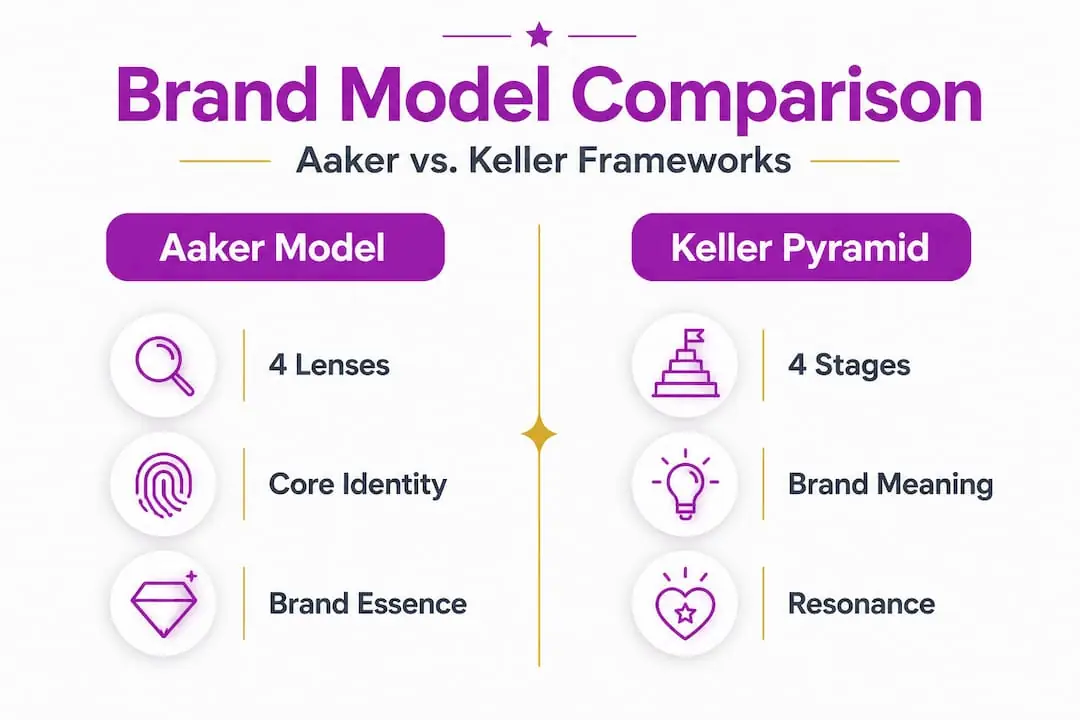
Here is how the two frameworks compare when applied to real brand decisions:
| Dimension | Keller’s CBBE pyramid | Aaker’s brand identity model |
|---|---|---|
| Primary focus | Customer perception and equity | Brand expression and identity construction |
| Structure | Hierarchical (build from base) | Multi-dimensional (four parallel lenses) |
| Starting point | Brand awareness (salience) | Core identity (essence of the brand) |
| Best used for | Diagnosing equity gaps | Constructing or rebuilding identity |
| Measurement orientation | Customer response metrics | Identity consistency and coverage |
| Practical strength | Prioritising investment by stage | Mapping all dimensions of brand expression |
To map your brand through these frameworks, follow this sequence:
- Assess salience: Survey customers and prospects to measure unaided and aided brand awareness. Identify where recognition gaps exist.
- Define meaning: Articulate the performance attributes and imagery associations you want to own. Check these against what customers actually associate with you today.
- Audit response: Gather customer judgements (quality, credibility, relevance) and feelings (warmth, excitement, security) through reviews, interviews, and social listening.
- Measure resonance: Assess loyalty metrics including repeat purchase rate, Net Promoter Score, and community engagement.
- Apply Aaker’s lenses: For each of the four perspectives (product, organisation, person, symbol), write a brief paragraph describing your brand. Identify gaps between your intended identity and your actual expression.
- Distinguish core from extended identity: Decide which elements are non-negotiable and timeless (core) and which can flex across campaigns and contexts (extended).
Effective brand storytelling is one of the most powerful tools for expressing both the person and organisation lenses in Aaker’s model, because stories make abstract values tangible and memorable.
Pro Tip: At every stage of these frameworks, test your assumptions with real customers rather than internal stakeholders. Internal teams are too close to the brand to spot the gaps that customers experience. Even a small number of structured interviews at each stage will surface insights that no amount of internal workshopping can replicate. For brands operating in experience-led sectors, brand engagement strategies offer additional methods for validating identity assumptions in live environments.
Step-by-step: Building and activating your brand identity
Understanding frameworks is one thing. Putting them into motion across your organisation and your customer touchpoints is where most brands either succeed or stumble.
Here is a repeatable process for building and activating brand identity from research through to full roll-out:
- Commission audience and competitor research. Use surveys, interviews, and social listening to build a clear picture of current perceptions and market positioning gaps.
- Run internal brand workshops. Bring together leadership, marketing, sales, and customer service teams to align on values, personality, and positioning. Disagreements at this stage are valuable. Surface them now rather than later.
- Draft your brand strategy document. This should cover positioning statement, core values, brand personality, tone of voice, and target audience profiles. It is the single source of truth for all identity decisions.
- Develop visual and verbal identity. Only once strategy is agreed should you brief designers and copywriters. The visual system (logo, colour, typography, imagery style) and verbal system (tone, vocabulary, messaging hierarchy) must express the strategy, not precede it.
- Create a brand guidelines document. This codifies how the identity is applied across every channel and format, from social media posts to packaging to email signatures.
- Pilot internally before external launch. Test the new identity with your own team and a small group of trusted customers or partners. Gather honest feedback and refine before committing to a full launch.
- Roll out across digital, print, and physical spaces. Prioritise the highest-traffic touchpoints first: website, social media profiles, and any physical environments where customers encounter your brand.
- Brief all customer-facing teams. Sales, support, and account management teams need to understand the brand identity and how to express it in their daily interactions.
Activating identity across digital channels requires particular attention to consistency. Social media branding is often where identity either comes alive or falls apart, because the pace of content production makes it easy to drift from guidelines. Establish clear templates and approval workflows to maintain coherence.

A notable example of what can go wrong during a rebrand comes from Kia’s logo update, where the new “KN” style mark caused initial public confusion because it prioritised visual distinctiveness without sufficient context for existing customers. The lesson is not that bold identity choices are wrong, but that product and communication alignment must accompany any significant visual change. Confusion tends to resolve when the identity is consistently reinforced across all touchpoints over time.
Before and during activation, verify the following:
- Does the visual identity work across all sizes and formats, from mobile screens to outdoor signage?
- Is the tone of voice guide specific enough that different writers produce consistent content?
- Have all legacy assets (old logos, outdated colour palettes) been identified and scheduled for replacement?
- Is there a named owner for brand consistency in your organisation?
- Are digital assets optimised for motion and animation, given the growing importance of kinetic identity for digital environments?
- Have you considered environmental branding strategies if your brand has physical spaces?
Brands that invest in custom marketing strategies tend to achieve faster alignment between their identity and their market positioning, because specific approaches account for the specific competitive context rather than applying generic templates.
Verifying, adapting, and evolving brand identity
Launching a brand identity is not the end of the process. The brands that sustain market advantage are those that treat identity as a living system, not a one-time project.
Setting up structured feedback loops is the first priority after launch. This means combining quantitative metrics (brand awareness scores, Net Promoter Score, social share of voice, website engagement rates) with qualitative inputs (customer interviews, focus groups, social listening themes). Neither source alone gives you the full picture.
Critical warning: As AI tools become more prevalent in content and design production, the risk of identity drift increases significantly. Automated systems optimise for engagement signals, not brand coherence. Human oversight is not optional. Every AI-assisted output must be reviewed against your brand guidelines before publication. Brands that delegate identity decisions entirely to automated tools risk becoming unrecognisable over time, regardless of how technically proficient their content appears.
The following tools and methods support ongoing brand assessment:
| Assessment tool | What it measures | Review frequency |
|---|---|---|
| Brand awareness surveys | Unaided and aided recognition among target audience | Bi-annually |
| Net Promoter Score | Customer loyalty and likelihood to recommend | Quarterly |
| Social listening analysis | Sentiment, themes, and language customers use | Monthly |
| Website behaviour analytics | Engagement, bounce rate, and conversion by page | Monthly |
| Customer interviews | Depth of perception and emotional association | Annually or post-rebrand |
| Share of voice tracking | Brand visibility relative to competitors | Monthly |
Digital environments also demand that you think beyond static assets. Motion graphics, animated logos, and video-first content have become standard expectations across social media and digital advertising. Your brand identity system needs to specify how core elements behave in motion, not just how they appear in print. This is a significant shift from traditional brand guidelines, and many mid-sized companies have not yet updated their systems to account for it.
Digital branding adaptation is an ongoing discipline, not a periodic refresh. Markets shift, competitor positioning evolves, and customer expectations change. Building a quarterly review cadence into your marketing calendar ensures that identity decisions are proactive rather than reactive.
Pro Tip: When testing your brand identity, do not limit your evaluation to designed outputs like logos and campaign materials. Test the full experience. How does your brand feel when a customer calls your support line? Does your website’s navigation and copy reflect your brand personality? Does your sales team’s language align with your tone of voice guide? Identity lives in every touchpoint, and gaps in unexpected places can undermine the investment you have made in your visual and verbal systems. Reviewing visual adaptation tips alongside experiential testing gives a more complete picture of where your identity is strong and where it needs reinforcement. For brands with physical environments, brand environment design offers a framework for extending identity into spatial and sensory dimensions.
Perspective: Why distinctiveness outshines differentiation in 2026
Here is something most brand consultants will not say plainly: the obsession with differentiation has led a generation of mid-sized brands into a trap of vague, interchangeable purpose statements that customers neither notice nor care about.
Differentiation asks, “How are we different?” Distinctiveness asks, “Will people notice us?” These are not the same question, and conflating them is one of the most expensive mistakes a brand can make. As one pointed industry perspective puts it, purpose can become meaningless if it is not directly tied to how the brand actually sells and is experienced. Strategy is the argument; identity is the proof. Without visible, consistent proof, even the most thoughtfully crafted purpose narrative disappears into the noise.
We have seen this play out repeatedly with ambitious mid-sized brands that invest heavily in brand strategy workshops and emerge with beautifully written values documents that never translate into anything a customer would actually notice. The values are genuine. The intentions are good. But the identity lacks the visual and verbal distinctiveness to register in a crowded market.
The brands that win are not always the ones with the most meaningful story. They are the ones customers can instantly recognise and consistently trust. Recognisability is earned through repetition, coherence, and a willingness to make bold choices that other brands in your category would not make. That might mean an unusual colour palette, a distinctive tone of voice that feels almost too informal for your sector, or a visual motif that appears consistently across every touchpoint until it becomes synonymous with your brand.
One hard-won lesson from working with brands through identity overhauls is this: a logo misstep is rarely fatal if the rest of the identity is consistent and the product delivers. What kills brands is inconsistency. When the website feels like one brand, the social media feels like another, and the sales team sounds like a third, customers cannot form a coherent mental picture of who you are. No amount of purpose-driven messaging recovers from that fragmentation.
If you are forced to choose between being meaningful and being recognisable, choose recognisable first. Meaning can be layered in over time once customers know who you are. The reverse is nearly impossible to achieve. Brand storytelling lessons reinforce this point: the most effective stories are built on a foundation of consistent, recognisable identity, not the other way around.
Take your brand identity further with expert support
Building a brand identity that drives market advantage requires more than a good brief and a talented designer. It demands strategic alignment, consistent execution across every channel, and the discipline to test and refine over time. Woodstock Campers, thirteen months and 2,215 leads at £12.50 each, is the case study on our Banbury marketing page.
At AMW Media, we work with ambitious mid-sized brands to translate strategy into identity systems that perform. Whether you need a full brand overhaul or targeted support to sharpen specific touchpoints, our team brings together strategic thinking and creative production to deliver results that are measurable, not just beautiful. From social media management that keeps your identity consistent at scale, to web design and development that expresses your brand in every interaction, to graphic design services that build a visual system with genuine distinctiveness, we offer the full range of support your brand needs to stand out and stay ahead.
Frequently asked questions
What is the difference between brand identity and branding?
Brand identity is what your brand stands for and how it’s recognised, encompassing values, personality, and visual language. Branding is the active process of expressing that identity, shaped by the four perspectives of product, organisation, person, and symbol.
How do I know if my brand identity needs to change?
If customers express confusion, your market shifts significantly, or engagement is declining, a structured review is overdue. Even a well-intentioned rebrand can cause initial recognition issues if not supported by consistent product and communication alignment.
Should small to mid-sized companies use both Keller and Aaker models?
Yes, both models are practical and complementary. Keller’s CBBE Pyramid helps diagnose where equity gaps exist, while the Aaker model helps construct and audit the full dimensions of your brand expression.
How do I adapt brand identity for digital or fast-moving markets?
Incorporate kinetic and motion elements into your brand guidelines to account for digital-first environments, and ensure human oversight is built into any AI-assisted content or design workflows to prevent identity drift.
Recommended
- Elevate your brand identity: What is visual branding? | AMW Media
- Harness social media in branding for growth in 2026
- brand storytelling engage customers and drive growth | AMW Media
- How to create brand content that drives real results | AMW Media
- Event brand identity: strategies for revenue-driving experiences
- Branding in the digital age: the SME growth driver
Our free marketing audit looks at your site, your ads and your content, and comes back with a 30 day plan. No pitch deck.

Owns how everything looks and feels, from a brand identity to the grade on a reel, and makes the animated films such as Blue Light Services' Journey to Net Zero. Meet the team.