
 Black Steel Doors
 Woodstock Campers
 Phillips Joinery

A good video brief fits on one or two pages and answers six things: why the video exists, who it is for, what it should say, where it will run, what it must include, and how much time and money you have. Below you will find three worked video brief examples (a brand film, a social campaign and a product explainer), a template you can lift, and the mistakes that quietly wreck otherwise decent projects.
We read a lot of briefs. The best ones are rarely the longest. They are the ones where someone has made decisions before picking up the phone.
TL;DR
- A video brief is a short roadmap that sets out the who, what, why and how of a project, so a production team can quote accurately and make creative choices without guessing.
- Cover objective, audience, one core message, call to action, deliverables, platforms, budget, timeline and approvals. Skip any of them and you will pay for it later.
- List deliverables precisely (quantities, lengths, formats), not just “a video”, and say what you do not want as well as what you do.
- Send two or three reference videos. One link beats a paragraph of adjectives.
- The examples below are written to be adapted: swap in your own details and send.
Table of Contents
- What a video brief actually is
- What every good video brief includes
- Video brief example 1: brand film
- Video brief example 2: social media campaign
- Video brief example 3: product or service explainer
- A template you can paste and fill in
- Questions to settle before you hit send
- Common mistakes in video briefs
- How to brief a team you have not worked with before
- Where AMW Media fits in
- Our perspective
- FAQ
- Sources
What a video brief actually is
Think of it as a roadmap. Storyblocks describes a video brief as a concise document that sets out the purpose, audience and execution requirements of a project, and that forms the foundation of the relationship between you and the people making the video.
That last bit matters. A brief is not paperwork for the sake of it. It is the first thing a production partner sees, and it sets the tone for the whole job. A clear one says you know what you want and you respect everyone’s time. A vague one says “surprise me”, which sounds fun until the invoice arrives.
You will also hear it called a creative brief for video, a production brief or a briefing document. The names differ, the job is the same. If you want the wider, non-video version, our creative brief examples and one-page template cover it.
Brief, treatment and script: not the same thing
People mix these up, so quickly:
- Brief: written by you. It says what the video must achieve and the practical limits.
- Treatment: written by the production team in response. It says how they would make it, with ideas, tone and look.
- Script or storyboard: written later, once the treatment is agreed. It says what is said and shown, scene by scene.
Your job is the first one only. Resist the urge to write the script into the brief. You are hiring creative people; let them be creative inside a clear fence.
What every good video brief includes
Research from several sources lines up on the same core ingredients. HolaBrief says a brief should, at the very least, cover the project introduction, the objective, the target audience, what needs to be communicated and the technical requirements. Here is how we would put that into practice, in the order we would write it.
1. Background and objective
Two or three sentences on who you are and why this video exists now. Then one objective. Not five. “Raise awareness, drive sales, boost engagement and educate” is a wish list, not an objective.
A good objective is measurable where possible: “Get more enquiries from the pricing page”, “Cut the number of repeat questions our sales team answers”, “Give our recruiters something to send to candidates”. If you track a number already, name it.
2. Audience
Describe real people, not demographics. “Facilities managers at mid-sized UK schools who are tired of chasing three suppliers” gives a director something to work with. “Adults 25 to 54” gives them nothing.
FileFeedback makes a useful point here: your audience description improves when you state what viewers currently believe or struggle with, because that lets the team craft a message that meets those obstacles head on.
3. One core message, one call to action
If the viewer remembers one thing, what is it? Write it as a sentence. Then say what they should do next: book a call, visit a page, follow an account, ask their boss for budget. Wedio’s guidance, published for a UK audience, structures this around a single core message, the feeling you want viewers to leave with and a clear call to action, which is a tidy way to think about it, though we would not link to a rival’s tool, so use it as a mental checklist only.
4. Tone and references
Adjectives like “modern, friendly, premium” mean different things to different people. Links do not. Storyblocks recommends sharing specific references, such as existing videos that match the tone you want, because it reduces mismatched expectations.
Send two or three, and add a line on what you like about each: “the pacing”, “the warmth of the interviews”, “the music, not the graphics”. Without that line, the team has to guess which bit you liked.
5. Deliverables
This is where quotes go wrong. Polimake advises listing deliverables explicitly rather than asking for “a video”, including quantities, durations, resolutions and file types, so the quotation is accurate.
A 90-second hero film and six vertical cut-downs are two completely different jobs to a 90-second hero film. Say which one you want.
6. Platforms and formats
Where will it live? Website hero, LinkedIn, Instagram Reels, a trade show screen, a sales deck? Each has different shapes and lengths. One example from the research: a social campaign brief can ask for 9:16 and 4:5 cuts. If you are not sure which ratio goes where, we have a plain-English guide to exporting 9:16, 4:5 and 1:1 for social video.
7. Must-haves and no-gos
Sume suggests including must-haves such as required logos, legal text and assets that have to appear in the final video. Add the flip side too. FileFeedback notes that stating exclusions, such as certain buzzwords, drone footage or stock music, is a quick way to line up the creative vision and save time.
If your CEO hates a particular phrase, now is the time to say so. It is cheaper than finding out in round three.
8. Budget, timeline and approvals
Give a budget range. We know, we know: it feels like showing your cards. But a range lets the team propose something realistic instead of a menu of options that wastes everyone’s week. Sume’s guidance also covers deadlines and who approves the work, across how many rounds.
On approvals, Polimake suggests naming the reviewers, the person who owns feedback, the final approver, the rounds included and the response time. That one sentence can save weeks. Nothing slows a edit like six people giving six conflicting opinions on a Friday afternoon.
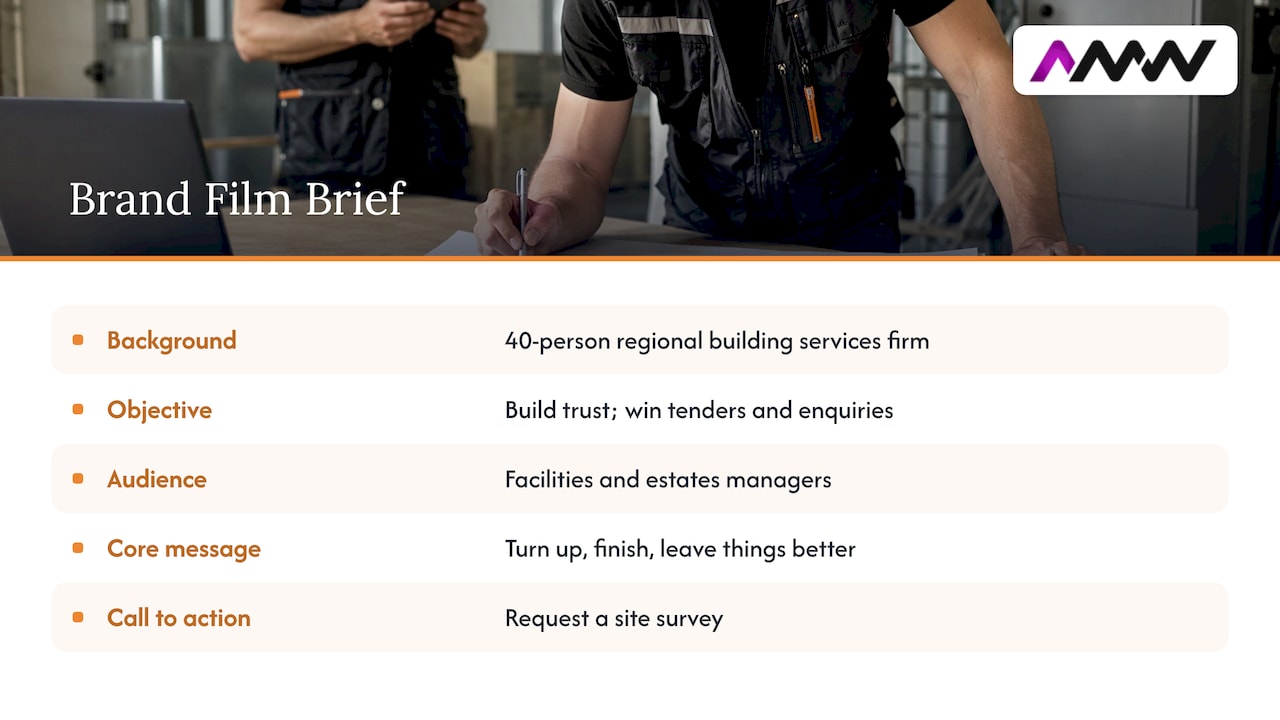
Video brief example 1: brand film
This is a fictional example, written to show the level of detail that works. Change the details to suit you.
Project: Company story film for a regional building services firm
Background: We are a 40-person firm that installs and maintains heating and ventilation for schools and offices across the Midlands. Most of our work comes through referrals, and prospects often say they had no idea how big or established we were until they visited.
Objective: Make a first-time visitor to our website trust us as a serious, established supplier. Success means more tender invitations and a higher number of enquiries from the contact page.
Audience: Facilities and estates managers at schools, academies and mid-sized offices. They are cautious, they have been let down by contractors before, and they care more about reliability than price.
Core message: We turn up, we finish, and we leave things better than we found them.
Call to action: Request a site survey.
Tone: Warm, honest, unpolished in a good way. Real engineers, not actors. References: [link 1] for the interview style, [link 2] for the pacing. We do not want dramatic music or slow-motion hard hats.
Deliverables: One 90-second film (16:9, 4K master, MP4 and ProRes), one 30-second cut for LinkedIn (1:1 with burnt-in subtitles), three 15-second vertical clips for social.
Must-haves: Our logo and accreditation badges in the end frame. Two customer quotes (we will clear permission). Footage of at least one live site.
Locations and talent: Our depot, one school site (access outside term-time lessons only), up to four staff on camera. We will arrange signed release forms.
Budget: Between [£X] and [£Y] including music licensing and subtitles.
Timeline: Treatment within two weeks of kickoff, filming over two days, first cut ten working days later.
Approvals: Marketing manager gives all feedback in one document. Managing director signs off. Two rounds of changes. We reply within two working days.
Notice what is not there: no script, no shot list, no mention of drones. The team gets the problem, the people and the limits. The ideas are theirs to bring.
If you are still working out which style suits you, our rundown of nine brand video types and when to use each will help you pick before you brief.
Video brief example 2: social media campaign
Social briefs live or die on format and speed. Here is a compact one.
Project: Four-week launch campaign for a new skincare range, social-first
Background: We are an independent UK skincare brand launching a new vitamin C serum in spring. We have 18,000 followers and a small but loyal email list.
Objective: Drive pre-orders from Instagram and TikTok. Our target is [number] orders in the launch window, tracked through unique discount codes.
Audience: Women and men in their late twenties to forties who already use a basic routine and are curious about active ingredients but put off by jargon. They scroll with the sound off.
Core message: Brighter skin does not need a ten-step routine.
Call to action: Tap the link to pre-order.
Tone: Funny, quick, a bit self-aware. References: [link 1] for the humour, [link 2] for the editing rhythm. Please avoid “glow” and “transform” and avoid before-and-after claims.
Deliverables: Six short videos, each in 9:16 and 4:5. Lengths between 10 and 25 seconds. Captions burnt in. Two hook variants for each of the three best performers, so we can test.
Must-haves: Product shot in the first three seconds. Pack with legal wording visible. Any paid influencer content marked clearly as an ad.
Budget: Between [£X] and [£Y], including one shoot day and editing.
Timeline: Shoot three weeks before launch, edits delivered a week later, then weekly drops.
Approvals: Brand manager approves, founder gives final sign-off, one round of changes per video, 24-hour turnaround on feedback.
Two things make this brief work. First, the testing request (two hooks) is built in from the start, so nobody has to renegotiate it later. Second, the ad labelling note is in the must-haves, not an afterthought. If you are planning the wider push around it, our guide to running successful social media campaigns shows where video fits.
Video brief example 3: product or service explainer
FileFeedback’s advice for explainers is to detail the exact workflow or pain point you want to demonstrate, not just list product features. Here is how that looks.
Project: 75-second explainer for a scheduling app aimed at small clinics
Background: Our software replaces the paper diary and the phone reminders. We have around [number] clinics using it and a free trial on our site.
Objective: Increase free trial sign-ups from the homepage. A visitor should understand what we do within the first ten seconds.
Audience: Practice managers at clinics with three to ten staff. They are busy, wary of switching systems, and have probably lost a day to a double booking.
The problem to show: A receptionist spends the first hour of Monday phoning patients to confirm appointments, while the phone keeps ringing. Show that hour, then show it disappear.
Core message: Fewer no-shows, a calmer front desk.
Call to action: Start your free trial.
Tone: Friendly and clear. Screen recordings are fine but not for more than a third of the runtime. No cartoon characters, please. Reference: [link] for the way it explains one idea at a time.
Deliverables: One 75-second master (16:9), one 30-second cut, one 15-second cut, and a square version of each. Subtitles and a separate clean version without text. MP4, 1080p minimum.
Must-haves: Our logo, the trial URL, a line saying data is stored in the UK (our compliance lead will confirm wording).
Budget: Between [£X] and [£Y].
Timeline: Script draft in two weeks, animation and edit in four, delivery by the end of the quarter.
Approvals: Head of product reviews accuracy, marketing director signs off, two rounds.
The pain point is a specific scene (the Monday hour), not a feature list. That gives the writer something to build a story on.
A template you can paste and fill in
Copy this into a document and answer in plain sentences. Bullet fragments are fine.
- Project name and type: (brand film, social series, explainer, testimonial, event, recruitment)
- About us and why now: two or three sentences
- Objective and how we will measure it: one main aim
- Audience: who they are, what they believe, what is annoying them
- Core message: one sentence
- Call to action: one action, one destination
- Tone and references: two or three links, plus what you like about each
- Deliverables: quantities, lengths, aspect ratios, file types, subtitles
- Where it will run: channels and any paid media plans
- Must-haves: logos, legal wording, product shots, quotes
- No-gos: words, styles, music, things competitors have done
- Locations, talent and permissions: access times, release forms, who is on camera
- Budget range: include whether music, licences and subtitles are inside it
- Timeline: key dates, launch date, any fixed event
- Approvals: reviewers, feedback owner, final approver, rounds, response time
- Brand assets: style guide, fonts, logo files, previous footage
On that last point, if you do not have a style guide yet, it is worth sorting before the shoot. Our guide to what to include in a brand style guide is a good place to start, and it saves a production team from having to reverse-engineer your colours from your website.
Questions to settle before you hit send
A brief is only as strong as the thinking behind it. Ask yourself these:
- Could a stranger explain the video’s purpose after reading only the first paragraph? If not, rewrite it.
- Is there one objective? If you have three, rank them.
- Are the deliverables countable? “A few social clips” is not countable.
- Do I know who signs this off? If it is “whoever has time”, sort it out now.
- Have I told them what not to do?
- Is the budget realistic for what I have asked? If you want a multi-location shoot with actors, original music and animation, say what you can spend and let the team tell you what fits.
The timeline question trips people up most. Filming is often the quick part. Planning before and editing and feedback after take longer than most first-timers expect, so build in time at both ends. Our guide to video production for creators and small businesses walks through the stages.
Common mistakes in video briefs
Asking for “a video”
Without lengths, formats and quantities, no two quotes are comparable. You will get a spread of prices and no idea why.
Stuffing in five objectives
A video that tries to sell, educate, entertain and recruit will do none of them well. Pick the main job. If you really need four jobs done, you need four videos, or one hero film with cut-downs, and the brief should say so.
Describing the look with adjectives only
“Clean, modern, bold” is how every brief starts. Show, do not tell. Share references, and say what you like about them.
Forgetting the people on camera
Filming staff, customers or members of the public means thinking about permissions. The research gives a good example: a brief for a children’s museum shoot has to deal with filming during particular hours and securing talent releases. Even a simple office shoot needs to know who has agreed to appear, and what happens if someone says no on the day. If you use personal data, your own compliance lead should check the wording of releases.
Leaving out approvals
The usual horror story is not the shoot. It is the edit that goes round eleven people and returns with contradictory notes. Name one person who collects feedback.
Hiding the budget
It does not help you. A range lets the team be honest about what is realistic.
Writing the script
If you already have a script, say so and attach it. If you do not, leave the ideas to the team. A brief that prescribes every shot leaves nothing for a director to improve.
Forgetting what happens after launch
Will you promote the video with paid ads? Put it on landing pages? Cut it up for email? Mention it. It changes the shoot: more vertical footage, extra B-roll, cleaner frames for text.
How to brief a team you have not worked with before
If this is your first project together, a few habits make life easier.
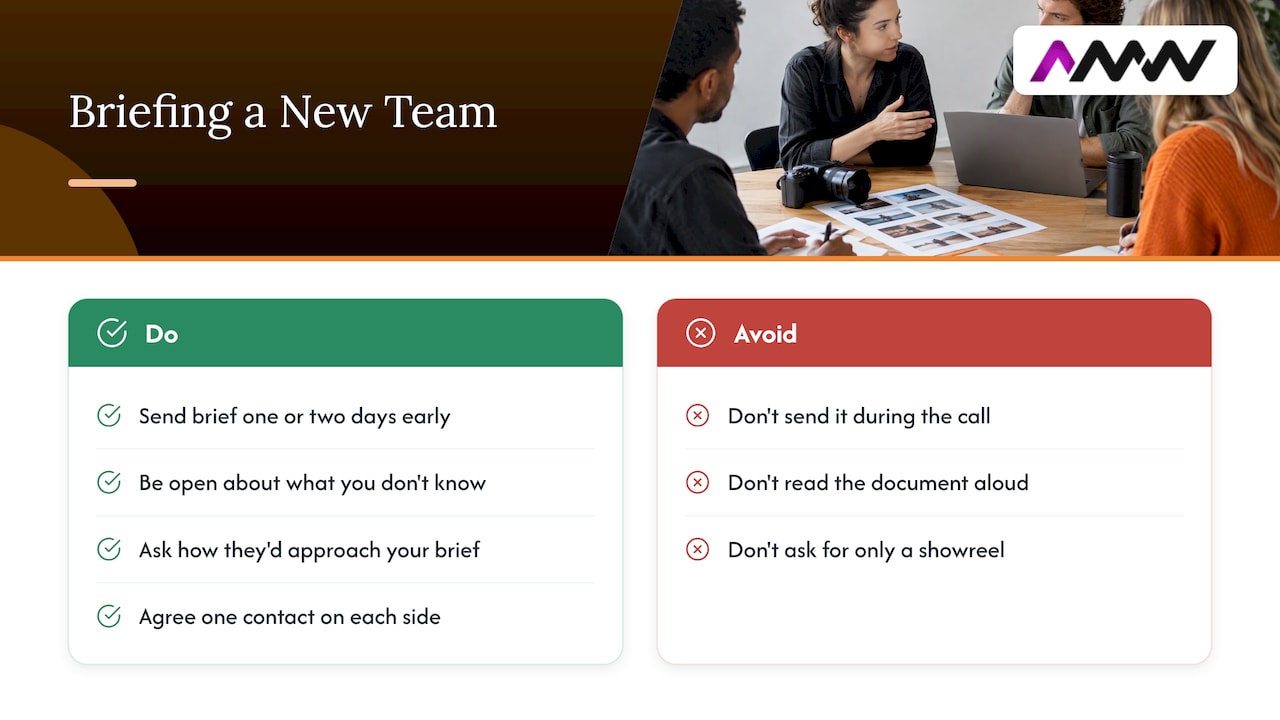
Send the brief a day or two before a call, not during it. Give people time to read and form questions. Then use the call to answer those questions, not to read the document aloud.
Be open about what you do not know. “We think we need a hero film but we are not sure whether to do one long video or lots of short ones” is an excellent thing to write. A good team will lay out options with rough costs.
Ask to see how they would approach your brief, not just a showreel. A showreel shows what they have done for others. A treatment shows how they think about you.
Finally, agree one point of contact on each side. Fewer channels, fewer misunderstandings.
Where AMW Media fits in
If you would rather talk it through than fill in a form, that is fine. We make video and photography for brands, and we also handle the planning, the social cut-downs and the wider campaign around them. You can see how we approach content production, browse recent projects, or look at the full list of services. Our stated approach is transparent reporting and no long-term contracts, so a first conversation does not tie you into anything.
Even a rough brief is a fine starting point. Send what you have, including the half-finished bits, and we will help shape it into something a team can quote against.
Our perspective
Here is what we have learned from reading briefs and making the videos that follow them: the single most useful thing a client can give us is a decision.
Not a perfect document. Not a forty-slide deck. A decision about who the video is for, what it should achieve and what it should not do. Everything else (style, format, music, pace) is easier once those are clear, and a lot of it we can suggest.
We would also gently argue that a brief should be a conversation starter, not a contract. The best projects we see are the ones where the brief gets sharpened in a call, a few assumptions get challenged and the final plan is better than what anyone wrote on day one. That is what a team with strategy and production under one roof is for. We would rather help you refine an imperfect brief than receive a polished one that asks for the wrong thing.
So if yours is half-written, send it anyway.
Amir
FAQ
How long should a video brief be?
One to two pages is plenty for most projects. Longer briefs are fine for complex shoots with several locations or deliverables, but only if the extra length adds decisions, not background waffle. If the first paragraph does not explain the purpose, shorten and rewrite it.
What is the difference between a video brief and a creative brief?
In practice they overlap heavily. A creative brief sets the overall idea, audience and message, and can apply to any medium. A video brief takes that and adds production details such as deliverables, formats, locations, talent and approvals. Many people use the terms interchangeably.
Should I include my budget in the brief?
Yes, a range at least. It lets a production team propose something realistic rather than a vague menu of options. Say what is included, such as music licensing, subtitles and revisions, so quotes can be compared fairly.
Who should write the video brief?
Whoever understands the business goal best, usually a marketing manager or the owner, with input from sales or customer-facing colleagues. Get the final approver to read it before it is sent, so they cannot change the objective halfway through the edit.
Do I need reference videos?
They are not compulsory, but they are one of the quickest ways to align expectations. Pick two or three, and add a sentence about what you like in each. It saves several rounds of back and forth.
Sources
- Your guide to writing great video briefs, Storyblocks
- What Is a Video Brief and How to Write One, HolaBrief
- Video Production Brief Examples That Get Results, FileFeedback
- Creative brief examples: 10 complete briefs to copy, The One Page Brief
- How to write a useful video brief, Polimake
- How to do a creative brief you can really use, Wedio
Recommended
- Brand Video Types: 9 Formats and When to Use Each
- Guide to video production for creators and small businesses
- 8 Video Storyboard Examples and a 10 Step Plan for UK Video Teams
Our free marketing audit looks at your site, your ads and your content, and comes back with a 30 day plan. No pitch deck.

Founded AMW Media in 2024 and runs strategy, paid media and the CRM builds. The reason everything here is in house and measured in revenue. Meet the team.