
 Black Steel Doors
 Woodstock Campers
 Phillips Joinery

The main brand video types are the brand story film, the product demo, the explainer, the customer testimonial, the behind-the-scenes piece, the founder or team interview, the culture video, the social cut-down and the documentary-style series. Each does a different job. Some make people feel something, some make people understand something, and a few make people pick up the phone. This guide walks through all nine, shows what good looks like, and helps you pick the one that fits your goal and budget without wasting a shoot day.
TL;DR
- Pick the video type by the job it needs to do (be remembered, be understood, be trusted or be bought), not by what looks flashy.
- Product demos and explainers handle understanding. Testimonials and interviews handle trust. Story films and series handle memory.
- Your first seconds matter most: Kantar’s work on product demos points to stopping the scroll within about five seconds.
- One shoot can feed several formats, so plan the cut-downs before you pick up a camera.
- If it is your own brand’s advert and it is not obvious, label it as an ad. The ASA is firm on this.
Table of Contents
- What counts as a brand video?
- The nine brand video types
- Which type should you choose?
- Plan one shoot, get many videos
- Where your brand videos should live
- Labelling your brand videos in the UK
- Our take on brand video
- Want help making one?
- Brand video examples to learn from
- FAQ
- Sources
What counts as a brand video?
A brand video is any film that exists to build how people see your business, rather than to shout about a single discount. That covers a lot of ground, which is why the search results for this topic read like a buffet.
A useful way to cut through it: ask what the viewer should do or feel afterwards. Kantar’s Lynne Deason makes a similar point, suggesting marketers think less about ad formats and more about attention experiences. A demo and a story film both fail if they feel generic. Both can work if they feel distinct.
So treat the nine types below as tools, not boxes to tick. You rarely need all of them. Most small and mid-sized brands do well with three or four, chosen on purpose.
The nine brand video types
1. The brand story film
This is the “who we are and why we exist” piece. It usually runs from 60 seconds to three minutes, leans on emotion and sits at the top of your website or on your YouTube channel.
Best for: new brands, rebrands, and businesses whose product looks similar to everyone else’s but whose reason for existing is not.
What good looks like: one clear idea, real people, real places and a point of view. Skip the drone shot of a sunrise unless your business genuinely involves sunrises.
Watch out for: vague mission-statement narration. If your film could be swapped with a competitor’s by changing the logo, it is not a story yet. Our own piece on brand storytelling that engages customers and drives growth goes deeper on finding the angle.
One more thing on brand assets. Research from Dr Karen Nelson-Field suggests distinctive brand assets can drive memory in as little as 1.5 seconds of active attention. So put your colours, logo, sound or characters in early, not in a grand reveal at second 40.
2. The product demo
A demo shows what something does and why it matters. It is the workhorse of video marketing: Kantar found that 76% of the ads it tested featured some form of product demonstration.
Best for: products with features that are hard to explain in a sentence, software, tools, food and drink, anything where seeing is believing.
What good looks like: it opens with the interesting bit, not the logo animation. The same Marketing Week piece notes that demos have a dry reputation but work well when they are entertaining, and that the winners are distinctive rather than merely informative. Magnum’s ASMR-style ads are the example it uses.
Watch out for: feature dumps. Show one or two things properly rather than twelve things badly.
3. The explainer
An explainer answers “what is this and how does it work?” for something conceptual: a service, a process, a piece of tech. It is often animated or built from screen recordings and graphics, which makes it cheaper than a full location shoot.
Best for: B2B services, software, financial products, anything with a “wait, what exactly do you do?” problem.
What good looks like: one problem, one solution, one next step. Keep it under 90 seconds if you can, and write the script before anything else. If the script is wobbly, no animation will rescue it.
Watch out for: jargon. If your mum could not follow it, rewrite it.
4. The customer testimonial
A real customer saying, in their own words, what changed after working with you. It is the most straightforward trust builder on this list.
Best for: high-consideration purchases, B2B sales cycles, and anywhere buyers worry about picking the wrong supplier.
What good looks like: specific outcomes, a real name and company, and natural speech. A customer saying “it saved us two days a week” beats a customer saying “they were great to work with”.
Watch out for: scripted answers read off a card. Ask open questions, let the person ramble a little, then edit hard. Also, if you have incentivised someone to say nice things, the advertising rules around disclosure can apply, so check before publishing (more on that below).
5. Behind-the-scenes footage
This is the how-it’s-made, how-it’s-done, how-the-sausage-gets-made category. It is cheap to produce, because you are filming things that already happen.
Best for: makers, restaurants, studios, trades, events, and any business whose process is more interesting than it sounds.
What good looks like: honest, a bit rough around the edges and short. It works particularly well in vertical format on social.
Watch out for: over-polishing. The charm of behind-the-scenes is that it feels behind the scenes.
6. The founder or team interview
A sit-down conversation with the person who knows the most. Founders explaining why they started, a head of product explaining a decision, a customer service lead explaining how they handle problems.
Best for: professional services, consultancies, and any business where people buy from people.
What good looks like: two cameras, decent audio (audio matters more than people think), a few good questions and a natural pace. One interview can be sliced into a dozen short clips.
Watch out for: the talking head who reads from a teleprompter and looks like a hostage. Conversation beats monologue.
7. The culture video
A culture video shows what it is like to work at your company. Its main audience is future hires and, to a lesser extent, clients who like knowing who they are dealing with.
Best for: growing teams, businesses competing for talent, and companies with a distinctive way of working.
What good looks like: actual employees, actual offices (or actual remote setups), unscripted moments. Let people be funny.
Watch out for: stock-photo positivity. If every person in the video is laughing at a salad, viewers will know.
8. The social cut-down
Short, vertical, hook-first clips made for Instagram Reels, TikTok, LinkedIn and YouTube Shorts. They might be standalone ideas or edits from a longer film.
Best for: staying visible, testing messages cheaply, and getting more value from every shoot.
What good looks like: a hook in the first couple of seconds, captions (plenty of people watch on mute), and your brand recognisable fast. Kantar’s research on Reels-style product demonstrations found they work when they convey something new and show how a product meets people’s needs in an enjoyable way.
Watch out for: treating short-form as a replacement for everything else. The IPA notes that long-term profit ROI is more strongly associated with long-form video, while short-form is good for maintaining presence and short-term tactics. You probably want both.
9. The documentary-style series
This is the ambitious end of the scale: a multi-episode series that tells a story the audience actually wants to watch, with your brand woven in.
The best UK example is Specsavers. Its eight-episode YouTube documentary following ‘Britain’s Best Worst Team’ reached over 32 million people and drove 105,000 appointments. That is a big brand with a big budget, so do not expect the same numbers. But the principle scales down: find a story your audience cares about, and let the brand be part of it rather than the whole of it.
Best for: brands with a strong community, a niche passion or a genuinely interesting story to tell.
Watch out for: commitment. A series needs a plan, a consistent release rhythm and patience.
Which type should you choose?
Start with the goal, then work backwards. Here is a quick cheat sheet.
| Your goal | Start with | Add later |
|---|---|---|
| Be remembered by people who have never heard of you | Brand story film | Social cut-downs, series |
| Help people understand what you sell | Explainer or product demo | Short demo clips for social |
| Win trust before a sales call | Customer testimonial | Founder interview |
| Hire better people | Culture video | Behind-the-scenes clips |
| Stay visible week to week | Social cut-downs | Behind-the-scenes |
| Build a loyal audience | Documentary-style series | Interview clips |
A few honest rules of thumb:
- If you only make one video, make a testimonial or a demo. They do the most work for the least creative risk.
- If you have a tiny budget, film behind-the-scenes and interviews. They need little more than a good camera, decent audio and some thought.
- If your sales cycle is long, lean on trust formats. People rarely sign a five-figure contract after one reel.
- If you are new, start with the story film. It gives every other video a home to link back to.
The Marketing Week Language of Effectiveness 2025 report describes the central tension for marketers as delivering immediate sales while also building the brand. Your video mix should do both: a couple of long-term brand pieces, and a few shorter ones that push towards a specific action.
Plan one shoot, get many videos
The most common money-waster is shooting a single film and stopping there. A smarter approach is to plan the whole family of assets up front.
Say you film a half-day with your founder and two customers. From that you could get:
- One 90-second brand story film for your homepage
- Two testimonials, each around 60 seconds
- Six to ten vertical clips for social, pulled from the interviews
- A set of stills for your website and newsletters
- A few behind-the-scenes snippets filmed on a phone while the crew set up
That is a month of content from one day. It is also why video and photography often work best when planned together. Our own look at the role of video content in digital brand engagement covers how the pieces fit together.
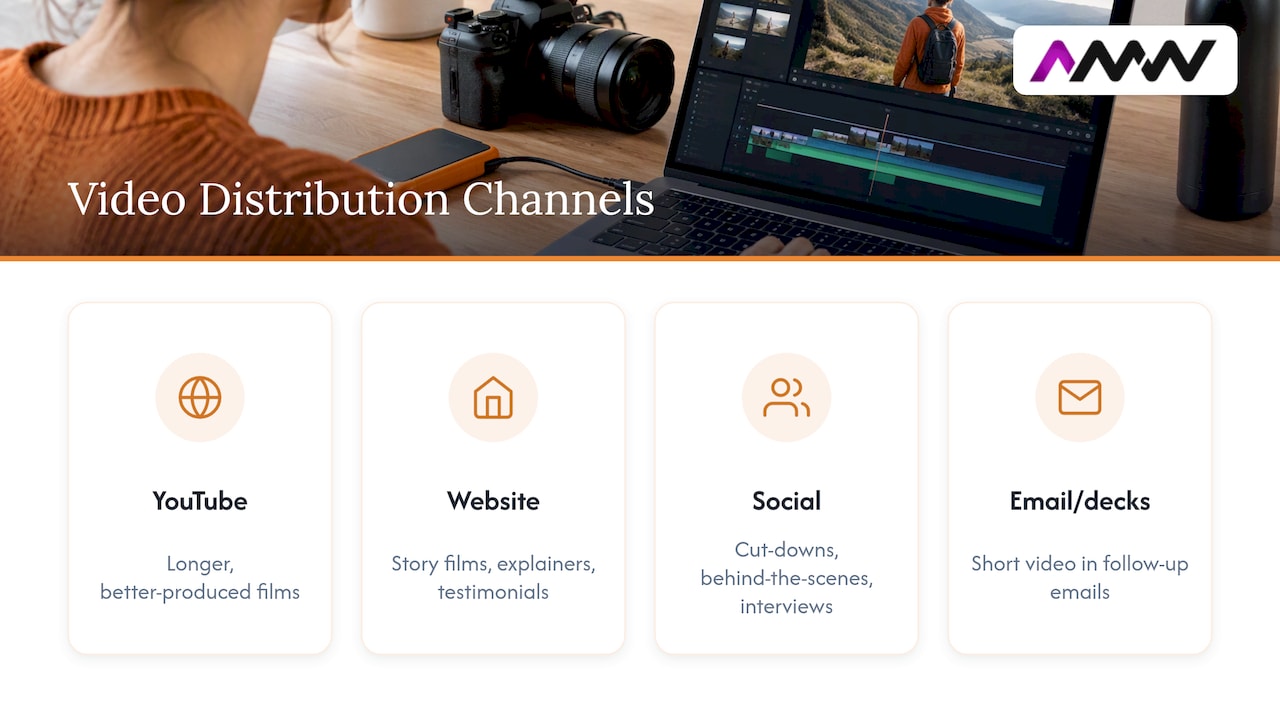
Where your brand videos should live
Different formats suit different places.
YouTube is the big one. According to Ofcom, YouTube reaches 94% of UK adult internet users, who spend an average of 51 minutes a day on it. Ofcom’s Media Nations report also finds that 41% of in-home YouTube viewing now happens on a TV set. In practice that means longer, better-produced films have a real home there, and they will sometimes be watched on a big screen. If you plan to advertise on the platform, our 90-day YouTube ads strategy shows how creative and first-party data fit together.
Your website suits the story film, the explainer and testimonials. Put the right video on the right page: a testimonial on a service page, a demo on a product page.
Social platforms suit cut-downs, behind-the-scenes and interviews. Think vertical, captioned and quick.
Email and sales decks are underrated. A short video in a follow-up email often does more than another paragraph of copy.
Labelling your brand videos in the UK
A quick compliance point, because it trips up more brands than you would expect. The ASA’s guidance says that if a video promoting your own brand is not obviously an ad from its context, it needs a clear ‘Ad’ label upfront. Burying the label in a hashtag list or behind a “See more” link is likely to cause problems. For YouTube, the title or thumbnail should carry the identifier.
If you work with creators or influencers, the rules about disclosing payment apply to them too. The ASA has published a guide for influencers on making clear that ads are ads. If you are not sure whether a particular video needs a label, ask the ASA’s advice service or a lawyer who knows advertising rules before it goes live.
Our take on brand video
We make a lot of video, so here is the view from the edit suite.
Most brands do not have a video problem. They have a clarity problem. They arrive wanting “a brand video” and, after ten minutes of conversation, it turns out they want more enquiries from a specific kind of customer. That is a different brief, and it usually needs a different video.
So we start with the question: who needs to watch this, and what should they do next? Only then do we talk about formats. Often the answer is less glamorous than the client expected, such as three customer testimonials and a set of social clips rather than a cinematic anthem. And that is fine. A film that gets the right person to book a call beats a film that wins applause at the team meeting.
We are also big believers in planning the cut-downs before the shoot. It costs almost nothing to think about vertical framing and clip lengths up front, and it costs a fortune to fix afterwards.
Finally, we care about measuring what happens next. We do not tie clients into long-term contracts, so the work has to earn its keep, and we report openly on what is and is not working. If a video format is not pulling its weight, we would rather tell you and change it.
If you want to see how other brands have done it, our round-up of branded content campaigns that actually work is a good place to browse.
— Amir
Want help making one?
If you are weighing up which brand video type makes sense for your business, we can help you shape the idea, film it and cut it into everything you need. Have a look at our video and content production services, browse recent projects to see what we have made, or get in touch and tell us what you are trying to achieve. We do not publish prices, because they depend on what you need, so the quickest route is a short conversation.
Brand video examples to learn from
You asked for examples, so here are three patterns worth studying, all from the research above.
- Specsavers’ football documentary series. A long-form play that built brand equity and still produced measurable business results. Lesson: entertainment first, brand second, and the business results follow. Read the Marketing Week case study.
- Magnum’s ASMR-style product demos. A reminder that demos can be sensory and fun rather than a feature list. Lesson: be distinctive, not just informative. See Kantar’s analysis.
- Brand assets in the first seconds. Nelson-Field’s research shows how quickly distinctive assets can work. Lesson: do not hide your brand until the end. Read the interview.
For more, our own post on what makes a successful branded content example breaks down what to look for in any campaign.
FAQ
What are the main types of brand video?
The core ones are brand story films, product demos, explainers, customer testimonials, behind-the-scenes footage, founder or team interviews, culture videos, social cut-downs and documentary-style series. Most businesses only need three or four. Pick them based on whether you need to be remembered, understood, trusted or bought from.
How long should a brand video be?
It depends on the format and where it will live. Social clips often work best when they are short and hook-first, while story films, interviews and series can run longer on your website or YouTube. The IPA notes that long-form video is more strongly associated with long-term profit ROI, so do not assume shorter is always better.
Do I need to label my brand video as an ad?
If it is not clear from context that you are advertising your own brand, the ASA expects an upfront ‘Ad’ label, not one hidden in hashtags or behind a “See more” link. The ASA’s guidance also says YouTube titles or thumbnails should carry the identifier. If you are unsure, check with the ASA’s advice service before publishing.
Which brand video type is best for a small business?
Start with customer testimonials and a short product demo or explainer, because they build trust and understanding quickly. Then add behind-the-scenes clips and interview cut-downs, which are cheap to make. Save the story film or series for when you have a clear angle and the budget to do it properly.
Sources
- Ofcom, Online Nation report 2025
- Ofcom, Media Nations 2025: UK report
- Marketing Week, How Magnum and Perfect Draft made effective product demos
- Marketing Week, How Specsavers reached 32 million people via football
- Marketing Week, Dr Karen Nelson-Field interview
- Marketing Week, The Language of Effectiveness 2025
- IPA, We are in a new paradigm for advertising choices
- ASA, Recognising ads: social media and influencer marketing
- ASA, Influencers’ guide to making clear that ads are ads
Recommended
- What is video marketing: effective strategies for 2026
- The role of video content in digital brand engagement
- 8 Part Marketing Case Study Format, UK Compliant With AMW Media Proof
- Examples of branded content: 10 campaigns that actually work
Our free marketing audit looks at your site, your ads and your content, and comes back with a 30 day plan. No pitch deck.

Founded AMW Media in 2024 and runs strategy, paid media and the CRM builds. The reason everything here is in house and measured in revenue. Meet the team.