
 Black Steel Doors
 Woodstock Campers
 Phillips Joinery
Use this paste-ready marketing case study format: headline, context, challenge, insight, approach, results, takeaway. Keep the whole thing tight: aim for 600 to 1,200 words for a written version, and gather at least one primary KPI, one supporting metric, and written permission before you draft a single line.
TL;DR:
- Case studies should focus on measurable outcomes, with primary KPIs clearly linked to the activity and supported by relevant data.
- Permission and accurate data attribution are essential before publishing any client-related information or results.
- Use concise, targeted formats for different audiences, such as one-page sheets for sales or detailed long-form reports for awards and internal reviews.
- Visuals must be labeled clearly, with highlights on key data points to ensure the story is easily understood and credible.
- Reporting methods should match the campaign goals, combining techniques like attribution data, controlled experiments, and market modeling for stronger impact evidence.
Table of Contents
- What a marketing case study is and when to use one
- Why case studies matter: benefits and outcomes to show
- Recommended format: a copy-ready template you can paste and use
- Writing and presentation tips: narrative, headline, visuals and accessibility
- Measuring and proving impact: which KPIs, how to attribute and how to be credible
- GDPR, PECR and customer consent when using case study data
- Examples and mini-templates: three short, copy-ready variants
- Agency proof: how AMW Media applied this format and the results it produced
- When to write short versus long case studies: a practitioner’s view
- How AMW Media can help produce publishable marketing case studies
- Sources
- FAQ
What a marketing case study is and when to use one
A marketing case study is a structured account of a real project: what the goal was, what you did, and what changed as a result. It exists to make a claim about effectiveness credible, using specific evidence rather than general praise.
The format you choose depends entirely on who is reading it. A salesperson sharing proof with a prospect needs something skimmable in ninety seconds. An awards judge or a technical stakeholder wants the working shown, including caveats and appendices. A team doing an internal retrospective needs honesty more than polish.
Before committing to a full write-up, check whether the project actually earns one:
- Did a specific, measurable outcome move (leads, revenue, cost per acquisition, retention)?
- Can you attribute at least part of that change to the activity you’re describing?
- Do you have permission, or a realistic path to permission, to use the client’s name, logo or data?
- Is there a genuine before-and-after, or just steady performance with no real story?
If the answer to most of these is no, write a shorter internal note instead and save the full format for a project that can carry it.
Why case studies matter: benefits and outcomes to show
Case studies do two jobs at once: they help someone else make a decision, and they help your own team learn what worked. For sales and procurement, a well-evidenced case study often shortens the conversation because it answers the “has this worked before” question before it’s asked. For internal teams, the same document becomes a reference for what to repeat and what to drop.
External stakeholders, including award judges, tend to look for the same things: a clear objective, a plausible causal link between activity and result, and enough detail to rule out other explanations. Templates save time and keep production on schedule, but the strongest case studies still leave room for the specific detail that made that particular project unusual.
- Sales teams use case studies to reduce perceived risk for a buyer comparing options.
- Marketing leaders use them to justify budget for the next similar campaign.
- Award panels and technical readers use them to check whether a result is genuinely attributable to the work described.
One thing worth remembering: case studies are widely used as conversion tools in B2B marketing, precisely because a specific, evidenced story does more persuading than a general claim ever will.
Recommended format: a copy-ready template you can paste and use
Here’s the structure, section by section, with guidance on what actually belongs in each field.
- Headline (one sentence). State the outcome, not the activity. “New email flow cut cost per lead by a third” beats “Email marketing case study” every time. Avoid vague adjectives; let the number or outcome do the work.
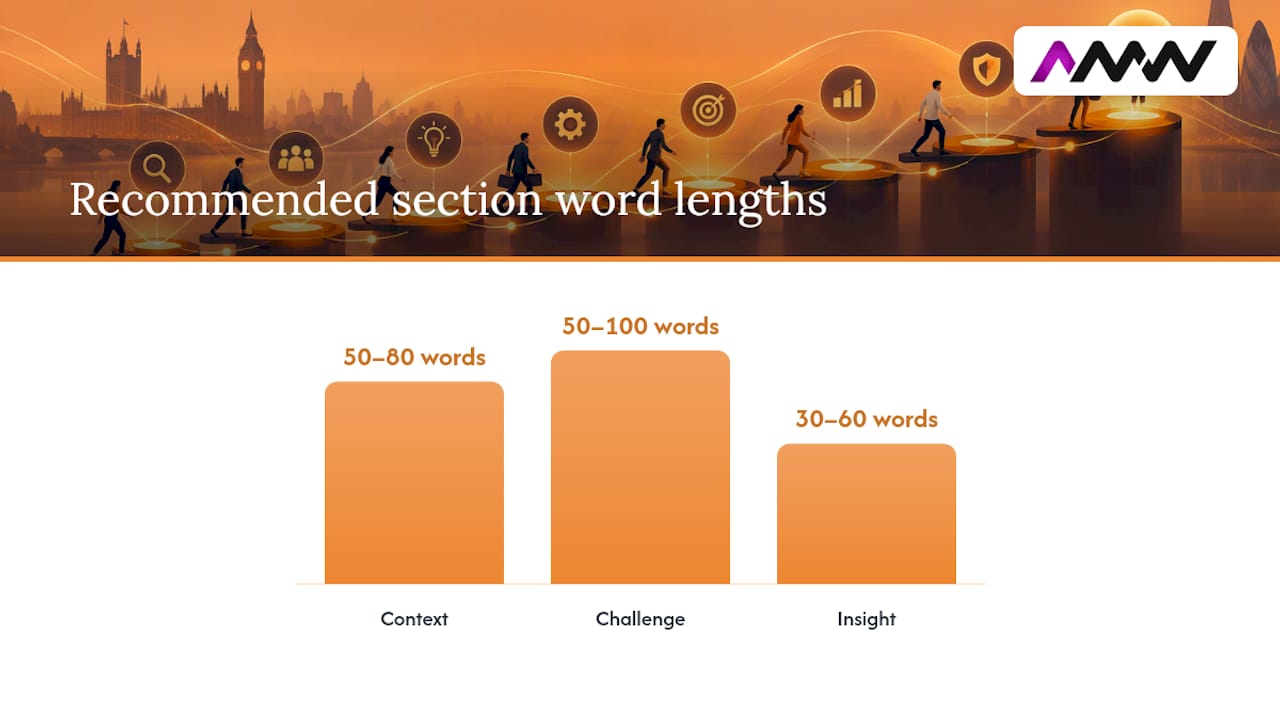
- Context (50 to 80 words). Name the market, the timeframe, and the objective the client actually set. Include a baseline: what was happening before you got involved, in plain terms rather than jargon.
- Challenge (50 to 100 words). Describe the specific obstacle, not a generic pain point. If the client’s ad spend was rising while leads flat lined, say that, with the timeframe attached.
- Insight (30 to 60 words). This is the single idea that changed the approach. It should be specific enough that a competitor couldn’t claim the same insight about their own market.
- Approach (bullet form, 4 to 6 lines). List the channels, creative choices and timing decisions that followed from the insight. Keep each bullet to one idea.
- Results (the primary KPI first, then supporting metrics). Lead with the metric the client actually cared about. Add one or two supporting metrics and a short note on how you attributed the change.
- Takeaway (one sentence). What should the reader do differently because they read this? Avoid restating the results; state the lesson.
- Appendix (for long-form versions only). Raw data tables, methodology notes, and any model assumptions that a technical reader might want to check.
For the approach section, a document like AMW Media’s guide to the creative campaign process is a useful reference for how to document channel and creative decisions without turning the section into a diary.
Pro Tip: Write the headline last. You’ll know what the real story is only once you’ve drafted the results section.
Writing and presentation tips: narrative, headline, visuals and accessibility
A case study lives or dies on its first sentence. That line should carry the outcome and a hint of how it happened, giving the reader a “red thread” to follow through context, challenge and result without getting lost in detail that doesn’t serve the story.
Charts need the same discipline as prose. Judges and technical readers expect legible, annotated visuals, which in practice means every chart carries a title, a legend, a labelled base, and a note on confidence where relevant. A chart without a base number is just a shape.
- Label every axis and state the base (“n=340 respondents”, “12 months of spend data”).
- Highlight the one data point that matters most; don’t make the reader hunt for it.
- Use customer quotes and images to support the numbers, never to replace them.
- Choose the format to match the channel: a one-page PDF for sales, a short web page for SEO reach, a two-minute video for social proof.
Pro Tip: If a chart needs a paragraph of explanation to make sense, redesign the chart rather than writing the paragraph.
Video and image assets should show the work, not just the client smiling. A short before-and-after clip or a screen recording of a dashboard often does more persuading than a stock photo of a handshake.
Measuring and proving impact: which KPIs, how to attribute and how to be credible
Match the KPI to the objective before you touch the results section. A brand campaign gets judged on reach or market share; a lead-generation push gets judged on cost per lead or conversion rate; a retention project gets judged on churn or repeat purchase rate. Put the primary KPI first and don’t bury it under three supporting metrics.
No single measurement technique is a silver bullet. Combining marketing mix modelling, controlled experiments and attribution data builds a stronger, more defensible causal argument than any one method alone.
| Method | Best suited for | Main limitation |
|---|---|---|
| Marketing mix modelling | Long-term, multi-channel campaigns | Needs a good run of historical data |
| Controlled experiments (A/B, geo-holdout) | Isolating one channel or creative variable | Can be slow and needs a large enough sample |
| Attribution data (platform or CRM) | Short-term, digital-heavy campaigns | Tends to overstate the channel it’s measured in |
- State the exact time frame the results cover, including start and end dates.
- Give the baseline figure the comparison is measured against, not just the percentage change.
- Report a confidence interval or margin of error where the sample size allows for one.
- Note explicitly what you couldn’t test or rule out, rather than implying certainty you don’t have.
A technical appendix, for readers who want to check the work, should include raw data tables, the model or attribution method used, and any assumptions baked into the calculation. AMW Media’s analysis of digital growth results and its piece on how analytics drives return on investment are useful references for structuring that kind of appendix without overwhelming the main narrative.
GDPR, PECR and customer consent when using case study data
Before you publish anything with a client’s name, logo, quote or data attached, you need their explicit, recorded permission, not an assumption that silence means yes.
- Active opt-in, not implied consent, is required for using customer data and marketing cookies under UK GDPR and PECR.
- Non-essential cookies must not be set before consent is given, and pre-ticked boxes or sliders defaulted to “on” don’t count as valid consent.
- Get sign-off in writing for the specific quote, logo, and any figures you plan to publish, not a blanket “you can use our name” email from months ago.
- Where the client wants to share a number but not the underlying detail, anonymise the company name or move the sensitive figures to a confidential appendix shared only with vetted readers.
- Run a final checklist before publishing: confirmed quote wording, confirmed logo usage rights, confirmed numbers, and a named contact who signed off on all three.
Examples and mini-templates: three short, copy-ready variants
Different audiences need different lengths. Here are three templates you can lift directly.
One-page sales sheet (150 to 250 words total):
- Headline (one line).
- Client and sector (one line).
- Challenge (two sentences).
- Approach (three bullets, one line each).
- Result (primary KPI plus one supporting metric, bold).
- One customer quote (one sentence, with permission on file).
Long-form award or internal review (800 to 1,500 words):
- Full seven-part structure from the template above, written out in full.
- A methods appendix covering attribution, sample size, and time frame.
- A “what we’d do differently” note, which internal reviewers value more than a polished sales pitch ever will.
Video case study brief (90 second to 3 minute runtime):
- Three interview questions: what was the problem, what changed, what would you tell someone in the same position now.
- Shot list: talking head, product or service in use, one supporting graphic with the primary KPI on screen.
- Runtime guidance: keep the finished cut under two minutes for social use, up to three minutes for a website case study page.
AMW Media’s own email marketing examples show how a short, metric-led format can work just as well for a single-channel case study as for a full campaign write-up.
Agency proof: how AMW Media applied this format and the results it produced
AMW Media has used this exact structure on live client work. For Cotswold Gloss, a paid campaign generated 157 leads with the primary KPI reported first and the campaign timeframe stated alongside it. For Osmo UK, product films were used as the “approach” evidence within a case study rather than treated as a separate marketing asset. Reporting for both projects, along with ongoing client work, runs through MyContentLab, the agency’s own reporting tool, which doubles as a source for appendix-level detail when a client wants to see the underlying numbers.
- Every project case study led with the metric the client actually asked to improve.
Creative assets (video, photography) were treated as part of the approach section, not bolted on afterwards.
Reporting cadence was agreed with the client before the project started, so the numbers in the final case study matched what had already been shared along the way.
When to write short versus long case studies: a practitioner’s view
The honest rule is that audience decides length, not how proud you are of the project. A sales team needs a one-pager within a week; an awards submission needs sign-off from the client, the analyst, and whoever owns the budget, and that can take a month. Export a PDF for sales, a web page for search visibility, and a slide deck for internal reviews. Anything longer than three pages for a sales audience gets skimmed, not read.
— Amir
How AMW Media can help produce publishable marketing case studies
Most teams have the results but not the time to turn them into something client-facing. AMW Media handles the parts that usually stall a case study: filming the interview, building the chart that actually makes sense, and pulling the reporting into a format a client or judge can check.
- Content production covers the interview footage, photography and edited video for a case study.
- Reporting and analytics work draws on the same data used for ongoing client campaigns, so the numbers in the case study match what’s already been reported.
- Social media and web teams can turn a finished case study into a web page, a social carousel, or both.
A typical engagement starts with a short call to confirm what’s already been measured and what permissions are in place, then moves straight into drafting. Have your KPI data and client sign-off ready and the first draft can usually turn around within a couple of weeks. See the full range of services or get in touch through the contact page to talk through a specific project.
Sources
FAQ
What is the 3-3-3 rule in marketing?
Definitions vary depending on who’s using the term, and it isn’t a standard fixture of case study writing. Some marketers use it to mean three key messages delivered across three channels in three formats, but it’s worth checking the specific context before applying it to your own work.
What are the five components of a case study?
Most practical formats boil down to context, challenge, approach, results and takeaway, with a headline sitting above all five as the entry point. The structure recommended above adds an insight step between challenge and approach, which sharpens the story without changing the core five parts.
What is a marketing case study?
A marketing case study is a structured, evidence-based account of a real campaign or project, built to show what was done and what changed as a result. It’s used to persuade prospects, satisfy award judges, or help a team learn from its own work, and its credibility depends on specific data rather than general claims.
Can ChatGPT write a case study?
A tool like ChatGPT can draft a first pass of the structure and tighten the language, but it can’t generate real client data, permissions, or measurement evidence on its own. Treat any AI-assisted draft as a starting point that still needs verified numbers, a client sign-off, and a human check for accuracy before publishing.
Recommended
- The role of case studies in B2B: a proof-to-revenue guide
- Content marketing packages: a practical UK guide
- Best marketing methods for UK businesses in 2026
- Types of content formats: the complete 2026 guide
Our free marketing audit looks at your site, your ads and your content, and comes back with a 30 day plan. No pitch deck.

Founded AMW Media in 2024 and runs strategy, paid media and the CRM builds. The reason everything here is in house and measured in revenue. Meet the team.