
 Black Steel Doors
 Woodstock Campers
 Phillips Joinery
Service area SEO is the work of proving to Google that you genuinely serve named local areas, even though you have no shop window or storefront for customers to walk past. If you run a plumbing, electrical or mobile trade business, your first move is fixing your Google Business Profile setup and building service-area pages that actually help people, not thin pages stuffed with a city name and little else. Get those two things right and reviews, citations and local content do the rest.
TL;DR:
- Prioritize building fewer, highly detailed service-area pages with genuine local content over numerous generic pages to avoid risking algorithmic demotion.
- Set your Google Business Profile with accurate service areas within a realistic radius, avoiding virtual addresses or excessive coverage that can cause suspension.
- Use structured data with areaServed properly matching your website content, and ensure all city pages are fast, mobile-friendly, and correctly indexed to improve local visibility.
- Focus on gathering specific reviews mentioning job types and locations, and develop local citations and links from community sources to boost prominence signals.
- Regularly audit and update your GBP, citations, and city pages to reflect actual capacity, and build targeted content answering local questions to strengthen your relevance.
Table of Contents
- Why service area SEO matters and how Google treats service-area businesses
- Set up and audit your Google Business Profile for a service-area business
- Build high-quality service-area pages that avoid doorway penalties
- Technical SEO and structured data for service-area businesses
- Reviews, citations and local linking: proving local presence across your service area
- Measure and report: how to track visibility across multiple service areas
- How to optimise for competitive service areas including keyword research
- Content beyond location pages: answering local intent properly
- Mobile speed and usability for service area SEO
- Using Q&A and customer engagement to build local relevance
- Managing service area changes without losing your SEO progress
- Using social media to support your local search visibility
- Editorial take: what most SAB SEO advice gets backwards
- How Amwmedia can help you rank across your service area
- Sources
- FAQ
Why service area SEO matters and how Google treats service-area businesses
Google ranks local results using three factors: relevance, distance and prominence. For a shop on the high street, distance is simple. Someone searches nearby, the shop is nearby, job done. For a service-area business (SAB) with a hidden address, that calculation gets murkier, and it changes how you should spend your time.
Google’s own guidance on service-area businesses confirms that if you don’t serve customers at your business address, you should hide it. This is good news for privacy, but it strips out the one signal Google leans on most heavily for local pack rankings: a fixed, verifiable location close to the searcher. Without a visible address, Google has to work harder to figure out where you actually operate, which means it leans more on your listed service areas, your website content, and your reviews.
Here’s what that means in practice:
- Relevance now depends more on your website explicitly naming the towns and services you cover, not just your GBP categories.
- Distance is estimated from your service areas and any signals scattered across the web (citations, mentions, review locations), not a pin on a map.
- Prominence carries extra weight because it’s one of the few strong signals Google can lean on when your address is hidden.
The practical consequence: a SAB competing for “boiler repair Reading” is fighting an uphill battle against a Reading-based plumber with a shopfront, purely on proximity grounds. You can close that gap, but only by stacking relevance and prominence signals hard enough to compensate. That’s the entire game of service area SEO in one sentence, and it’s why the next two sections (GBP setup and city pages) matter more for SABs than for almost any other business type.
Set up and audit your Google Business Profile for a service-area business
Get your Google Business Profile wrong and you risk suspension. Get it right and you’ve built the foundation everything else sits on. Start here before touching a single page of website copy.
1. Choose service-area or hybrid correctly. If customers never visit your premises, hide your address and mark the listing as service-area only. If you also welcome walk-ins or have a showroom, you can run a hybrid profile with a visible address plus service areas layered on top. Getting this wrong, showing an address you don’t actually receive customers at, is one of the fastest routes to a suspension.
2. Set your service areas with intent, not guesswork. You can list multiple areas, defined by city, postcode or county, based on your actual service capacity. Google’s guidance on setting your service area recommends keeping these within roughly two hours’ driving time of where you’re actually based. Prioritise the towns where you have real capacity to respond quickly. Don’t list 20 areas just because you can. A gas engineer covering Bristol who bolts on Cardiff, Bath and Gloucester “just in case” dilutes the relevance signal Google is trying to read.
3. Nail the primary category. Choose the single most accurate category (“Plumber”, not “Home Improvement”), then add secondary categories only where they’re genuinely accurate.
4. Write a business description that names what you do and where. Vague marketing fluff here wastes valuable space. Say what you fix, for whom, and roughly where.
5. Build out your service menu properly. List each service with a name and, where you’re comfortable, a price range. This feeds both your GBP visibility and the semantic relevance Google reads from your listing.
6. Add real photos. Vans, uniforms, jobs in progress, the actual team. Stock photos are a giveaway that erodes trust with both customers and Google’s quality systems.
7. Keep opening hours and phone number accurate and consistent. Mismatches between your GBP and your website are a citation problem waiting to happen (more on that later).
8. Complete verification properly. Video verification is now common for SABs precisely because virtual or fake addresses have been a persistent abuse pattern.
Pro Tip: Set a quarterly calendar reminder to audit your GBP against your actual capacity. Businesses that expand service areas as they grow, but forget to shrink them when a technician leaves, end up promising coverage they can’t deliver, which tanks response-time reviews.
The most common suspension triggers are a visible address at a residential property or virtual office, service areas that clearly exceed realistic operating capacity, and inconsistent business names across citations. Run through those three before you do anything else.
Build high-quality service-area pages that avoid doorway penalties
A doorway page is any page built purely to rank for a location, with little unique value once someone actually lands on it. Google flagged this practice explicitly in its doorway pages update, and the warning has only become more relevant as more SABs mass-produce “[Service] in [Town]” pages by swapping a single placeholder variable.
The test is simple: if you could delete the town name from the page and nothing else would need to change, it’s a doorway page. Google’s systems are increasingly good at spotting exactly that pattern, and the risk isn’t just a poor ranking. It’s a filtered listing or an algorithmic demotion across your whole domain.
So what does a genuinely useful city page look like? Industry guidance on service area pages points to a consistent anatomy that works:
- Localised service detail. Not “we fix boilers in Oxford” but which boiler brands you service most often in that area, what typical call-out times look like for that postcode, and any local quirks (older housing stock with specific plumbing issues, for instance).
- Response times specific to that area. If you can hit Oxford within 45 minutes but Banbury takes 90, say so. Specificity reads as honesty, and honesty reads as trust.
- Social proof tied to the location. A short testimonial or review snippet from a customer in that town, not a generic quote reused across every page.
- Real photos from jobs in that area, where you have them. Even a handful beats none.
- A short, locally relevant FAQ. Parking restrictions in a city centre, common boiler models in a particular housing estate, whatever genuinely comes up in that patch.
Pro Tip: Ask your team what questions actually come up on jobs in each town. That five-minute conversation usually produces better local FAQ content than an hour of keyword research.
On uniqueness: the swap-and-publish trap is real, and it’s the single most common mistake SABs make. Twenty pages that differ only by town name and postcode aren’t twenty pages of content, they’re one thin page copied twenty times. Aim for genuinely distinct detail on each page rather than hitting an arbitrary word count. A page with 400 honest, specific words beats one with 1,200 padded words every time. As a rough guide, most well-built service-area pages land somewhere between 500 and 900 words once you include local detail, FAQs and proof points, but let the actual content dictate the length rather than forcing it.
One more decision to make: when do you build individual city pages versus a single index page listing all your areas? If you cover fewer than five or six towns, or if several are small and low-volume, a single “areas we cover” page with a paragraph per town often outperforms diluted individual pages. Once you’re covering meaningfully different markets, with different search volume and different local competition, dedicated pages earn their place. Don’t build twenty city pages because a template makes it easy. Build the ones where you have enough genuine local substance to say something real.

Technical SEO and structured data for service-area businesses
Your city pages can be brilliantly written and still underperform if the technical layer underneath them is broken. Three things matter most here, and none of them are optional extras.
Implement LocalBusiness schema with the areaServed property. Schema specification includes areaServed precisely so you can declare, in machine-readable form, which cities, postcodes or regions you cover. List them as an array rather than a single string, and keep the list matched to what’s actually on the page, not your full 20-area GBP list. Mismatched schema (claiming coverage in the markup that the visible page never mentions) is the kind of inconsistency that erodes trust with search systems.
Make sure every service-area page is actually indexable. That sounds obvious, but it’s the most common silent failure. Check that pages sit in your sitemap, aren’t accidentally blocked by robots.txt, and don’t carry a canonical tag pointing back to a generic services page (a mistake that effectively tells Google “ignore this page, it’s a duplicate”). Run a crawl monthly if you’re adding pages regularly.
Keep it fast on mobile. Most service-area searches (“emergency electrician near me”) happen on a phone, often in a genuine hurry. A slow-loading page loses that customer to the next result before it even finishes rendering.
Google’s own guidance on succeeding in AI search reinforces that accurate structured data paired with genuinely unique content increases your odds of surfacing in AI-driven search features, not just traditional blue links. That’s a growing slice of how people find local services now, and it rewards exactly the same discipline: real content, accurate markup, no shortcuts.
- Add LocalBusiness schema with a correctly scoped areaServed array
- Confirm indexability: sitemap inclusion, no rogue noindex tags, correct self-referencing canonicals
- Test page speed on mobile specifically, not just desktop
- Validate your schema with a structured data testing tool before publishing
- Cross-check that schema claims match what’s visible on the page
Pro Tip: Validate your schema every time you update your service areas. It’s an easy step to forget, and stale schema claiming coverage you no longer offer is worse than having none at all.
Reviews, citations and local linking: proving local presence across your service area
Reviews are where SABs win or lose the prominence battle. BrightLocal’s research on GBP for service-area businesses makes clear that review distribution across your actual coverage area matters as much as review volume overall. Fifty five-star reviews all from one town don’t help you rank in the other nine towns you claim to serve.
1. Ask for reviews that name the job and the location. Instead of a generic request, prompt customers with something like “mention the boiler repair we did in Aylesbury” when you follow up. Most people are happy to be specific if you give them the nudge.
2. Build citations methodically, not randomly. Get listed on the general directories (Yell, Thomson Local, Checkatrade for trades), plus any trade-specific bodies relevant to your industry. Keep your name, address (or service-area status) and phone number identical everywhere. Inconsistent NAP data is one of the quieter reasons SABs plateau in rankings.
3. Chase local links that have nothing to do with SEO trickery and everything to do with being a real local business. Sponsor a local sports team, get listed on a trade association’s member directory, contribute a quote to local press covering a relevant story, or partner with a complementary local business (an electrician and a heating engineer cross-referring, say) and ask for a website mention.
4. Set a monthly review target per service area, not just an overall number. Search Engine Journal’s reporting on local SEO for SABs backs up what most agencies see in practice: businesses that spread review requests deliberately across their coverage area close the proximity gap faster than those chasing volume alone. Five reviews a month, spread across your top three towns, beats fifteen reviews all from your home patch.
Prominence, in the end, is really just reputation made visible to an algorithm. The trades that win it are the ones treating every job, not just the ones near head office, as a chance to earn a mention.
Measure and report: how to track visibility across multiple service areas
A single rank tracker checking “plumber near me” from one location tells you almost nothing useful for a SAB. You need a geo-grid, a tool that checks your rankings from multiple points across your service area, because your position in Newbury and your position in Swindon can differ wildly even on the same keyword.
Pair that with:
- GBP Insights data: search queries, profile views, and call clicks, broken down where possible by area
- Review velocity per town, tracked monthly against your targets from the previous section
- Page-level conversion metrics on each city page (calls, form fills, click-to-message) rather than just traffic
- Correlation checks between city-page traffic spikes and recent review or citation activity in that same town
If you see a city page climbing in traffic but converting poorly, that’s usually a signal the page reads as generic rather than locally credible, worth revisiting against the anatomy covered earlier.
And here’s the honest bit most SEO advice skips: sometimes SEO can’t close the gap. If a town sits at the outer edge of your service area and you’re consistently getting outranked by businesses with a physical presence there, no amount of schema or reviews will fully compensate for real distance. At that point, the actual answer might be a small satellite location or a partnership with a local operator, not more content. Recognising that boundary early saves months of chasing a ranking that proximity alone will keep just out of reach.
How to optimise for competitive service areas including keyword research
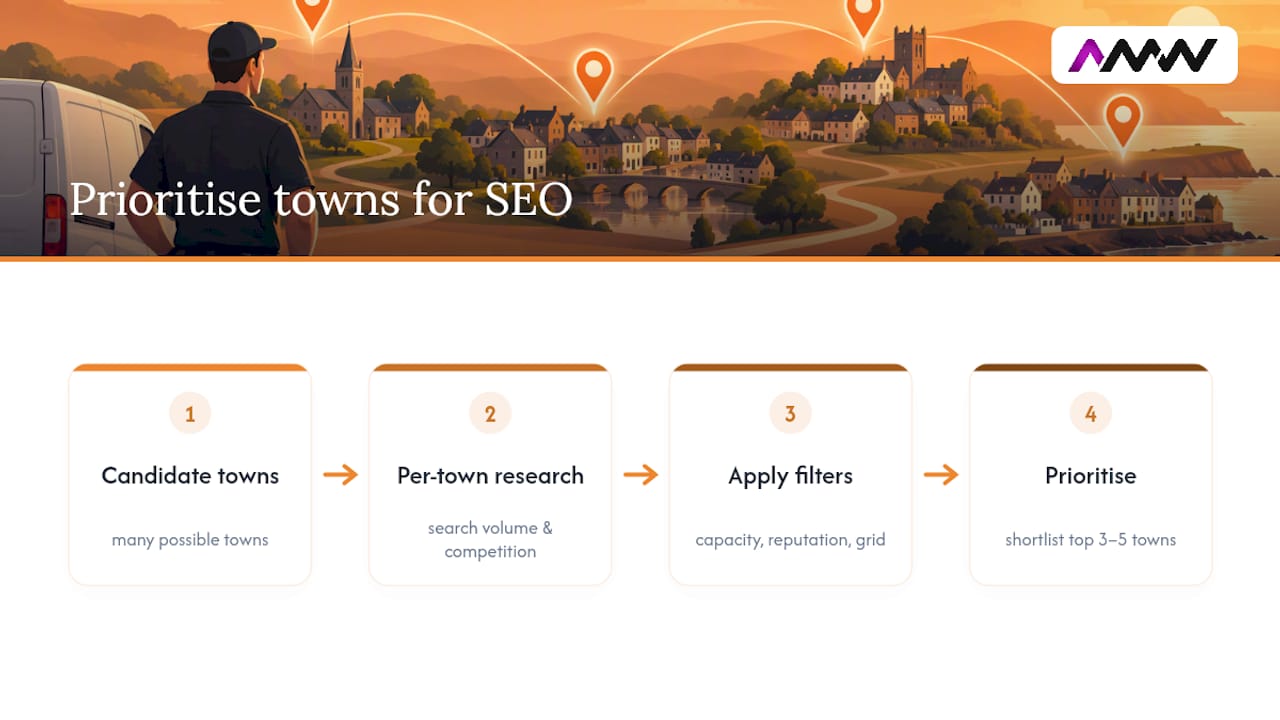
Competitive service areas need sharper keyword work than a single-location business ever does, because you’re effectively running multiple local campaigns under one roof. Start by researching search volume and competition per town individually, not as one blended national number. “Emergency electrician Manchester” and “emergency electrician Salford” can have very different competition levels even a few miles apart.
Layer in service-plus-modifier combinations that locals actually search: “same day”, “emergency”, “no call out fee”, alongside the service and town. These modifiers often carry lower competition and higher buying intent than the bare “[service] [town]” pattern everyone targets first.
Use Google’s own Keyword Planner or a rank-tracking tool with local grid data to see where you’re already getting partial visibility, those are usually the fastest towns to push over the edge with a stronger page and a review push, rather than starting from zero somewhere you have no presence at all.
Prioritise ruthlessly. Trying to rank strongly in fifteen towns simultaneously usually means mediocre results everywhere. Picking your top four or five, based on where you actually have capacity and existing reputation, and genuinely dominating those first, tends to outperform spreading effort thin.
Content beyond location pages: answering local intent properly
Location pages cover “who can fix my boiler in Reading”, but they don’t cover the questions people ask before they even know they need you. That’s where supporting content earns its keep.
Think seasonal guides (“why does my boiler break down every winter”), cost transparency posts (“what does a new consumer unit actually cost in 2026”), and troubleshooting content that positions you as the obvious call when the DIY fix fails. None of these need a town name in the title to support local SEO. They build topical relevance and internal linking opportunities that feed your city pages, and they’re the kind of content people actually share and link to, which location pages rarely attract on their own.
Local intent also shows up in format, not just topic. A short video walking through a common repair, filmed on an actual job in one of your service areas, does double duty: it’s genuinely useful content and it’s proof of local activity for the town it’s filmed in.
Don’t neglect comparison and decision content either (“boiler repair vs replacement: how to decide”), which captures people earlier in their search, before they’ve settled on the exact service they need. Getting found at that stage, then earning trust through genuinely useful writing, often converts better than a page that only shows up once someone’s already decided and is comparison-shopping on price.
Mobile speed and usability for service area SEO
Most emergency service searches happen on a phone, frequently in a hurry, sometimes standing next to a leaking pipe. That context changes what “good enough” mobile performance actually means for a SAB.
Compress images before upload rather than relying on a plugin to do it after the fact. A hero photo of your van at full resolution can add a full second or more to load time on a average 4G connection, and that second matters when a stressed customer is deciding whether to call you or the next result down.
Make your phone number tappable and visible without scrolling on every service-area page. It sounds basic, but plenty of trade sites still bury the call-to-action below a paragraph of copy on mobile.
Test your actual pages, not your homepage, with a tool like Google’s PageSpeed Insights. City pages loaded with photos and testimonials are often the slowest pages on the whole site, precisely because they’re doing the most work to prove local credibility.
Using Q&A and customer engagement to build local relevance
The Q&A section on your Google Business Profile is underused by most SABs, and that’s a missed opportunity. Customers, and sometimes competitors, can post questions there whether you engage or not. Seed it yourself with the genuinely common questions (“do you cover Aylesbury on weekends?”, “what’s your call-out fee for Bicester?”) and answer them promptly and specifically.
Respond to every review, not just the positive ones, and mention the town and job type in your reply where it’s natural to do so (“Glad we could sort that boiler issue in Thame so quickly”). That reinforces the exact location and service signals covered earlier, in a format that reads as completely natural because it is.
On your website, a genuine FAQ section per service area, built from real questions your team actually gets asked on the phone, does more for local relevance than another paragraph of generic service description. It also tends to pick up featured snippets, since FAQ-style content matches how people phrase voice and AI-assisted searches increasingly closely.
Managing service area changes without losing your SEO progress
Growing into a new town, or pulling out of one that never worked, both carry SEO consequences if you handle them carelessly. Adding a new service area to your GBP listing without also building a proper page for it undercuts the very consistency Google is checking for between your listing and your website.
When you expand, build the page before you update the GBP area, not after. When you contract, because a technician left or a route stopped making financial sense, don’t just delete the page outright. Redirect it to your nearest still-active service-area page or an index page, so you don’t strand any links or citations pointing at a dead URL.
Update citations and directory listings in step with any change, and audit your GBP against your team’s real capacity every quarter, exactly as covered in the setup section earlier. A profile that promises coverage you’ve quietly stopped delivering is a slow-motion trust problem with both customers and Google.
Using social media to support your local search visibility
Social media doesn’t directly move your rankings, but it feeds almost every signal that does. Posting job photos tagged with the town you were working in builds the same kind of location-specific proof that strengthens your GBP and city pages. A quick video of a finished job in Reading, shared to a local Facebook community group, often generates the exact kind of local engagement and word-of-mouth that eventually turns into a review or a citation.
Engage with local community groups and pages relevant to each town you serve, not just your own followers. Answering a question in a local Facebook group about a trusted plumber, genuinely and without a hard sell, builds the kind of reputation that shows up later as a direct search for your business name, itself a strong prominence signal.
Consistency between your social profiles and your GBP and website details (name, phone number, service areas) matters here too. It’s one more citation source, and one more place inconsistency can quietly undermine the trust you’re trying to build.
Editorial take: what most SAB SEO advice gets backwards
Most advice on this topic treats service-area pages as a volume game: build more pages, target more towns, publish faster than the competitor down the road. The research doesn’t support that. Google’s own doorway pages guidance and the mechanics of how proximity actually works both point the other way: fewer, genuinely useful pages beat a template stamped across twenty towns.
Where conventional advice really falls short is expectation-setting. Plenty of guides imply that a well-optimised GBP and a stack of city pages will close the proximity gap entirely. They won’t, not fully. Google says as much itself: service areas help Google understand your coverage, but they don’t guarantee rankings. Reviews, real content and consistent citations carry more weight than the areas list ever will.
If you take one thing from this, prioritise your top three or four towns properly before spreading effort across twenty. Depth beats breadth here, every time.
— Amir
How Amwmedia can help you rank across your service area
A specialist agency is an alternative to hiring a generalist freelancer for service area SEO. Where a one-person contractor juggles your GBP, your city pages and your reviews alongside a dozen other clients, a dedicated team runs SEO and local search as part of a joined-up effort that also handles the content, design and outreach feeding those rankings.
A typical engagement starts with a proper GBP audit against the risks covered above, followed by a review of which service-area pages are working and which need rebuilding from thin templates into genuinely useful content. From there it’s a mix of SEO and local search work, supported by content production and local outreach where a business needs citations or link-building help. The team holds certifications across major platforms, and the project portfolio shows the practical, measurable work that goes into campaigns like this, including social growth results for trade-sector clients such as Phillips Joinery.
If your service-area pages need an honest audit rather than another generic template, get in touch through the full services overview and Amwmedia will tell you straight what’s actually worth fixing first.
Sources
The guidance in this article draws directly on Google’s own documentation for service-area businesses and setting service areas, plus its doorway pages policy and guidance on AI search. Industry perspective comes from Search Engine Land’s service area pages guide and BrightLocal’s GBP research, with additional background from Search Engine Journal and schema.org for structured data specifics. For wider context on why local SEO matters at all, see this explainer on local SEO benefits.
- An update on doorway pages
- Google Business Profile help: Service-area businesses
- Service area pages: Boost local SEO across locations
FAQ
What is an example of a service area business?
A mobile plumber, electrician, cleaner, or locksmith who travels to customers rather than serving them at a fixed shop counts as a service-area business. Google’s own SAB guidance covers exactly this category, and the defining feature is simple: no walk-in trade at a physical address.
Is SEO dead now with AI search?
No. Google’s guidance on succeeding in AI search explicitly says unique, people-first content and accurate structured data are what get surfaced in AI features, which is the same foundation service area SEO has always rested on. AI search has changed the format results appear in, not the underlying rules for earning visibility.
What does “SEO service” mean for a service-area business?
An SEO service for a SAB typically covers GBP setup and auditing, building genuine city pages, structured data implementation, and ongoing review and citation work. Amwmedia offers this as part of its wider SEO and local search service, built around exactly the GBP and content foundations covered in this article.
What is a service area on Google Business Profile?
A service area is the list of towns, postcodes or counties you tell Google you serve, up to 20 entries, set from your GBP dashboard. It signals coverage rather than guaranteeing rankings; Google’s own service area setup guidance is clear that proximity, reviews and website content matter more than the list itself.
How many service areas should I list on my Google Business Profile?
List only the towns where you can realistically respond within a reasonable timeframe, rather than filling all 20 slots. Overreaching your listed coverage is a common trigger for poor conversion and, in some cases, profile suspension.
Recommended
- SEO Services & Packages London
- Home Services Marketing Agency
- Google Business Profile SEO: local ranking guide for UK small businesses
- Construction & Trades Marketing Agency
Our free marketing audit looks at your site, your ads and your content, and comes back with a 30 day plan. No pitch deck.

Founded AMW Media in 2024 and runs strategy, paid media and the CRM builds. The reason everything here is in house and measured in revenue. Meet the team.