
 Black Steel Doors
 Woodstock Campers
 Phillips Joinery
A lead scoring model ranks prospects by fit and intent so sales focuses on the best opportunities first. Start with a transparent rule based 0 to 100 model, since it needs little historical data and is easy for sales to trust. Then move to predictive scoring once your data clears sensible thresholds. Done properly, this improves MQL to SQL conversion and cuts wasted follow up time.
TL;DR:
- Rule-based scoring is quick to set up and fully explainable, making it suitable for teams with limited historical data and when building trust with sales.
- Behavioral scoring should decay over time to accurately reflect current intent, with half points at 30 and 60 days, while firmographic and demographic points remain stable.
- The ideal MQL threshold usually falls between 60 and 75 points, with scores above 70 often validated by sales as genuinely sales-ready leads.
- Using a combination of four scoring types—demographic, behavioral, predictive, and negative—ensures a comprehensive assessment of lead quality and intent.
- Regular review of rejection reasons, acceptance rates, and time-to-contact metrics is critical for maintaining and calibrating the model’s accuracy over time.
Table of Contents
- Lead scoring model types and examples
- How to build a lead scoring model step by step
- Assigning points and setting your thresholds
- Rule based scoring versus predictive scoring
- Keeping the model accurate over time
- Privacy and fairness in automated scoring
- How AMW Media supports lead scoring in practice
- A straightforward view on getting started
- Sources
- FAQ
Lead scoring model types and examples
Most B2B teams blend four types of scoring rather than picking just one.
Demographic and firmographic scoring looks at who the lead is: company size, industry, job title, and location. A marketing director at a 200-person software company might score higher than an intern at a five person shop, simply because they match your ideal customer profile more closely.
Behavioural scoring tracks what the lead does: website visits, content downloads, webinar attendance, pricing page views. A prospect who views the pricing page twice in a week is showing stronger intent than one who read a blog post once and vanished.
Predictive scoring uses machine learning to spot patterns in your closed won and closed lost history that humans would miss. It can surface non obvious combinations, such as a specific job title visiting a particular page sequence, but it needs a decent volume of labelled outcomes to work reliably, and a segmentation first approach that groups leads into similar clusters before modelling tends to produce steadier results.
Negative scoring subtracts points rather than adding them.
- Competitor domains visiting your site or downloading content.
- Personal email addresses on a B2B form (gmail.com instead of a company domain).
- Unsubscribes, bounced emails, or roles clearly outside your buying committee.
Each type answers a different question. Demographic scoring asks “could they buy?”, behavioural asks “are they ready?”, predictive asks “what does the data say they’ll do?”, and negative scoring asks “should we filter them out?”
How to build a lead scoring model step by step
Building a model that sales actually trusts takes more than a spreadsheet of point values. It takes agreement before you ever touch the numbers.
- Run a joint workshop with marketing and sales to agree your ideal customer profile and, just as importantly, what a rejected lead looks like and why.
- List the specific fields and events you can reliably capture: job title, company size, page visits, form fills, email opens, demo requests.
- Design a 0 to 100 point schema and map each criterion to a point value, keeping the logic simple enough to explain in one sentence per category.
- Set thresholds for marketing qualified leads, sales qualified leads, and hot leads, plus a routing service level agreement for how quickly sales should make contact.
- Implement the scoring logic in your CRM or marketing automation platform, and hold back a pilot sample so you can validate the model before rolling it out fully.
Getting the CRM and automation setup right matters as much as the scoring logic itself. Poorly mapped fields or broken integrations will quietly wreck a model that looks perfect on paper, so it is worth reviewing how your automation and CRM integration actually passes data between systems before you go live.
Pro Tip: Keep your first version deliberately simple, five or six criteria at most, because a model nobody understands is a model nobody trusts.
Once leads start crossing your thresholds, the handoff to sales needs its own structure, particularly around automated lead routing and how quickly a rep actually picks up the phone.
Assigning points and setting your thresholds
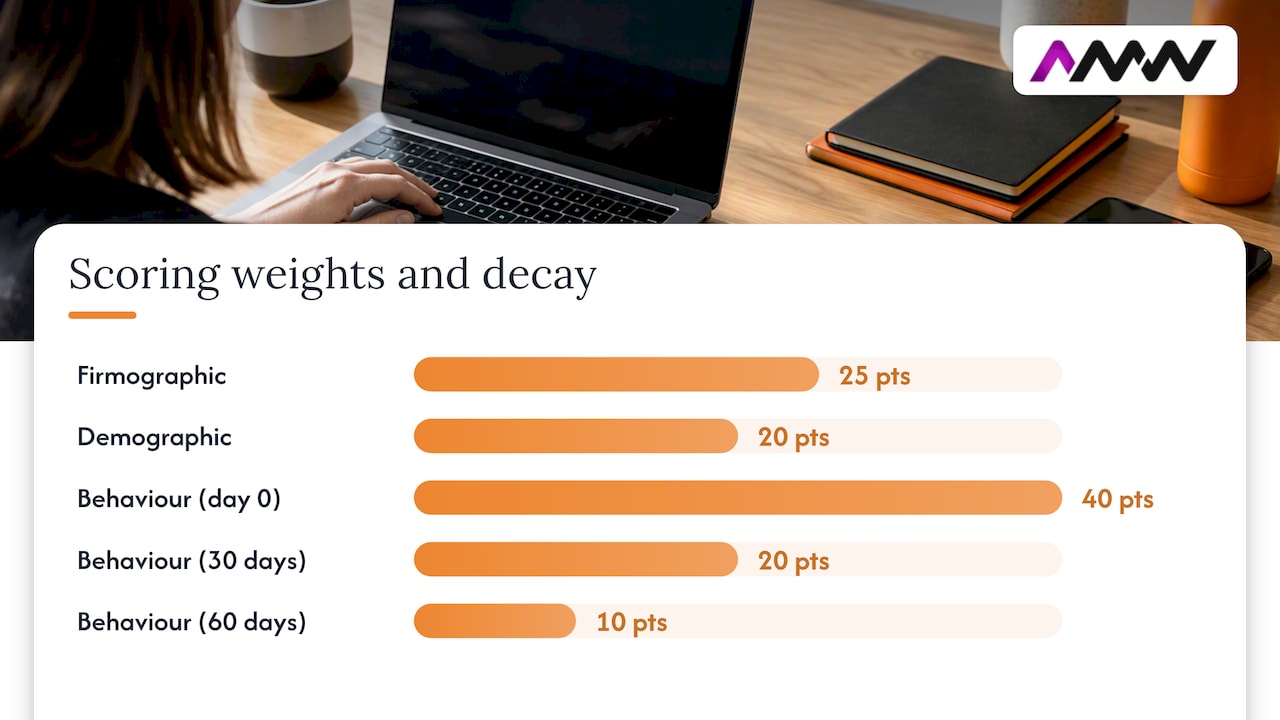
A common starting allocation spreads 100 points roughly as follows: 25 for firmographic fit (company size, industry), 20 for demographic fit (job title, seniority), 40 for behavioural signals (page visits, downloads, demo requests), and 15 for timing signals (recent activity, urgency indicators).
To find your MQL threshold, look for the inflection point in your conversion data, the score above which conversion to a real opportunity jumps noticeably, and aim to capture roughly the top 15 to 20% of leads by score.
- MQL threshold typically sits around 60 to 75 points out of 100.
- SQL threshold typically sits at 70 or above, once sales has validated fit.
- Scores below your MQL cut off usually go to nurture, not sales.
A practical 100 point scoring architecture with decay schedules and calibration routines can lift pipeline quality when paired with clear MQL and SQL thresholds, because it gives both teams a shared, numeric language for “ready” versus “not yet.”
Behavioural points should decay over time, since a demo request from six months ago says little about today’s intent. A standard approach halves behavioural weight at 30 days and halves it again at 60 days, while leaving firmographic and demographic points untouched.
Rule based scoring versus predictive scoring
Rule based models are transparent, quick to set up, and need very little historical data, which makes them the sensible starting point for most teams. Sales can see exactly why a lead scored 72 and argue with the logic if they disagree, and that visibility builds trust fast.
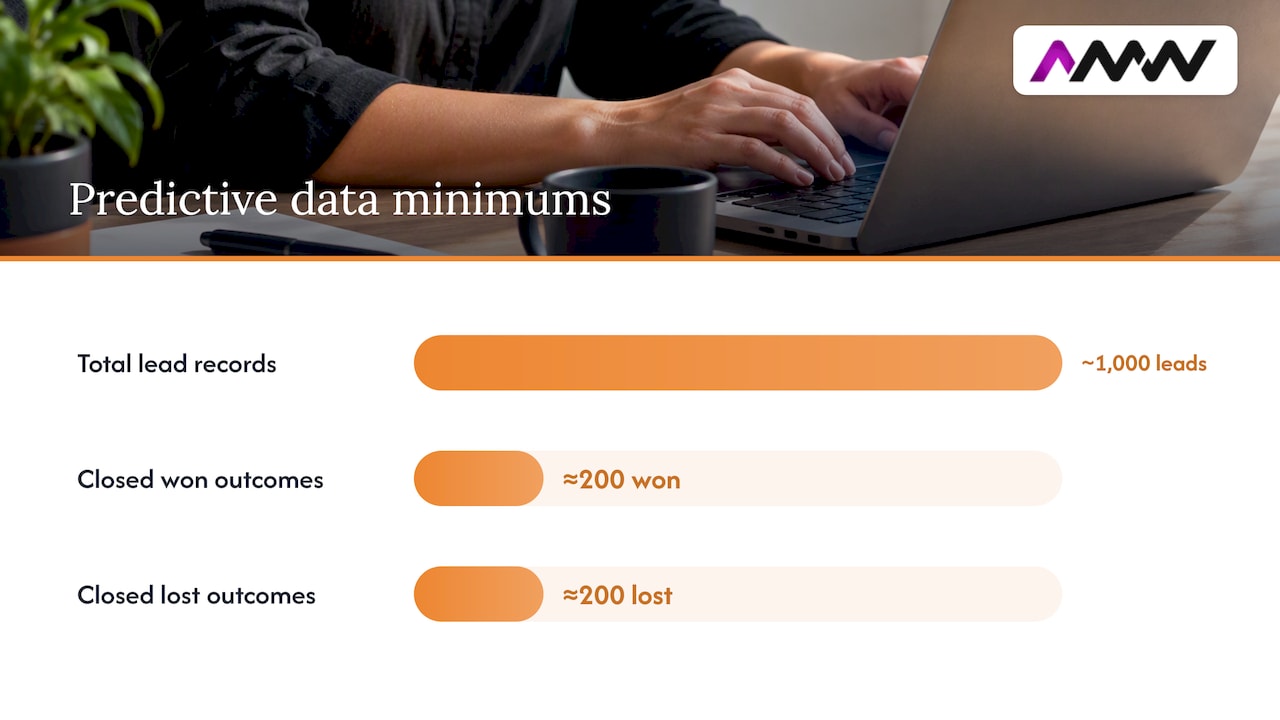
Predictive models, built with machine learning, can surface patterns that rules would never catch, but they need real volume behind them. Industry guidance commonly points to roughly 1,000 lead records with around 200 closed won and 200 closed lost outcomes as a practical minimum before predictive signals become reliable. Without that, models tend to overfit and quietly erode sales confidence.
- Rule based: fast to launch, fully explainable, ideal for teams under the data threshold.
- Predictive: stronger pattern detection, but needs volume and clear interpretability for sales adoption.
- Hybrid: stabilise the rule based model first, then pilot predictive scoring on one well documented segment.
Whichever route you pick, run the new model against a holdout sample and compare conversion side by side with the old one before asking sales to switch, an approach that consistently helps prove uplift rather than just asserting it.
Keeping the model accurate over time
A scoring model is never really finished. Treat the MQL threshold as a living service level agreement between marketing and sales, anchored to the rate at which sales actually accepts or rejects the leads you send.
Three metrics matter more than the rest:
| Metric | Healthy target | What it tells you |
|---|---|---|
| MQL to SQL acceptance rate | 60% to 75% | Whether sales trusts the scoring threshold |
| SQL to opportunity conversion | Above 30% | Whether qualified leads are genuinely sales ready |
| Time to first contact | Under 4 hours | Whether hot leads are being worked fast enough |
Require sales to log a structured rejection reason code on every lead they reject, rather than a free text note nobody reads, and review those codes quarterly. Patterns in rejection codes tell you which criteria to re-weight, which is far more useful than tweaking thresholds in isolation. Run a full rebuild when you launch a new product line, enter a new market, or your ideal customer profile shifts meaningfully, rather than waiting for the model to quietly stop working.
Privacy and fairness in automated scoring
Where lead scoring feeds into a solely automated decision that significantly affects someone, UK GDPR’s Article 22 restrictions apply, and the ICO’s guidance on automated decision-making and profiling sets out what that means in practice: a documented Data Protection Impact Assessment, a route to human review, and a meaningful explanation for anyone affected.
In practice, that means keeping a human in the loop for final qualification decisions, documenting where each scoring input comes from, and reviewing whether any criterion could disadvantage a particular group unfairly.
How AMW Media supports lead scoring in practice
AMW Media builds CRM and marketing automation systems alongside the content, web design, and SEO work that feeds a scoring model with cleaner data in the first place. The team typically gets involved at the data capture stage, wiring up forms and tracking, then connects that data into the CRM so scoring rules and routing actually fire correctly. Training the marketing and sales team to read and trust the model is part of the same project, not a separate add-on.
A straightforward view on getting started
Skip the ambition of a perfect predictive model on day one. Pilot a simple rule based version with rejection reason codes built in from the start, validate changes with holdout samples, and calibrate quarterly. That discipline builds more trust than any algorithm. If you want help setting it up, AMW Media’s services page is a reasonable place to start.
— Amir
Sources
For deeper reading, the ICO’s automated decision-making guidance covers legal obligations, while the Fairview lead scoring template offers a ready-made 100 point framework and calibration schedule. For interpretability techniques as you consider predictive scoring, see this primer on interpretable machine learning.
- MQL to SQL score thresholds (marketing-sales alignment)
- Machine learning-driven sales and marketing (Salesforce Engineering)
- Segmentation-first approach improves predictive lead scoring (academic article)
- Automated decision making and profiling (ICO guidance)
- Lead scoring model template: weights and MQL thresholds (Fairview)
FAQ
Can you give me an example of lead scoring?
A marketing director at a mid-sized software company who downloads a pricing guide and visits your demo page twice might score 25 points for firmographic fit, 20 for job title, and 30 for behaviour, landing well above a typical MQL threshold. A student downloading the same guide from a personal email address would score far lower, or even into negative territory.
How is lead score calculated?
Points are assigned across categories such as firmographic fit, demographic fit, and behavioural activity, then summed into a single number, commonly out of 100. Behavioural points typically decay over time, halving at 30 and 60 days, so recent activity counts for more than something from months ago.
What are the best lead scoring tools?
Most CRM platforms and marketing automation tools, such as those integrated through CRM and marketing automation setups, include built-in scoring features that support both rule based and predictive approaches. The right choice depends on which system already holds your lead data and how well it connects to your sales pipeline.
What are scoring models?
A scoring model is a structured system for ranking leads, customers, or prospects by assigning numeric values to specific attributes or behaviours. In B2B lead generation specifically, it typically combines firmographic fit, demographic fit, and behavioural intent into a single comparable score used to prioritise sales follow up.
How do you know when a lead scoring model needs rebuilding?
A full rebuild makes sense after a major shift, such as a new product line, a new target market, or a changed ideal customer profile, rather than on a fixed schedule. Watch the MQL to SQL acceptance rate and rejection reason codes: a sustained drop usually signals the model no longer reflects how your business actually sells.
Recommended
- Lead generation methods: proven strategies for sales growth
- Automated lead routing: what it is and how to get it right
- Turn LinkedIn into B2B pipeline with lead gen forms
- What is lead generation? A practical guide for 2026
Our free marketing audit looks at your site, your ads and your content, and comes back with a 30 day plan. No pitch deck.

Founded AMW Media in 2024 and runs strategy, paid media and the CRM builds. The reason everything here is in house and measured in revenue. Meet the team.